
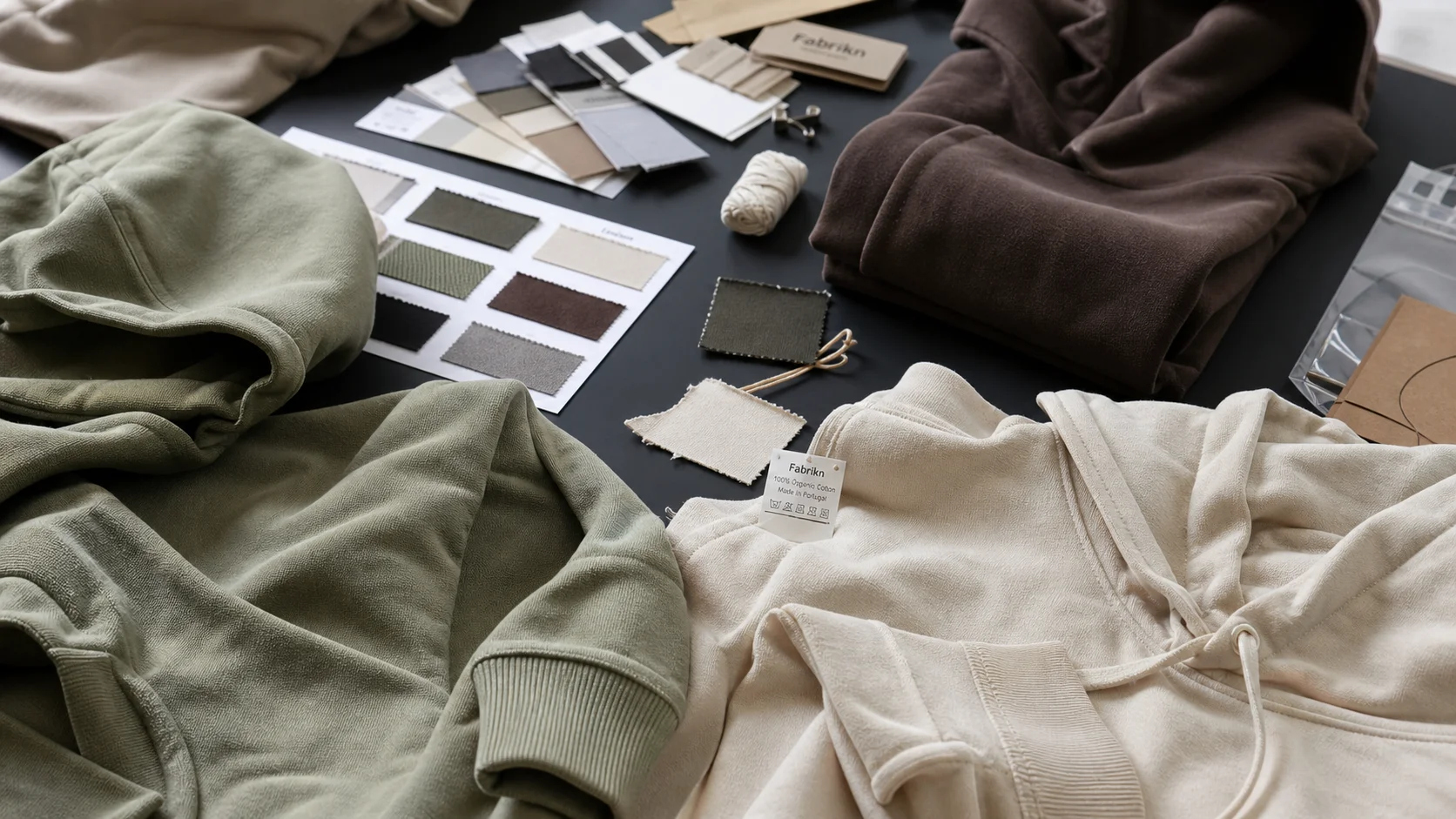
Fashion Ecommerce Branded Tape with checks for samples, fit, MOQ, QC evidence, pricing terms, and delivery risk.
Fast answer: Fashion Ecommerce Branded Tape: Adhesive, Width, Print, and Carton Flow should be judged by production evidence, not by a generic sourcing promise. The buyer needs sample proof, cost breakdowns, QC checkpoints, and delivery buffers in writing.
Ask for recent sample photos, measurement tolerances, fabric or print test assumptions, decoration test notes, packing examples, and a named inspection checkpoint. These details show whether the team can repeat an approved sample at bulk volume.
Separate garment cost, decoration, labels, packaging, sampling, testing, freight, and rush charges. When every cost line is visible, it becomes easier to reduce colorways, adjust size depth, or reserve more time for sampling.
The box can be plain, the filler forgettable, and the tissue tucked in like an afterthought — custom branded tape for fashion ecommerce packaging is often the first thing a customer actually notices. In plenty of fulfillment lines, it is the only branded surface that survives the trip looking exactly as intended. I have watched parcels arrive with a logo buried under the flap and a generic mailer doing all the heavy lifting. The tape was the handshake.
Across 200-plus factories in eight countries, one pattern kept repeating: brands would spend $0.40 to $1.20 on a heavier mailer, then seal it with unprinted tape that cost almost nothing and said nothing. A roll of branded tape at $0.08 to $0.22 per parcel can do more for memory than a $0.60 box upgrade because it sits right across the seam, where eyes land first.
Perceived value shifts with price point. Luxury DTC parcels tend to use rigid boxes, tissue, and $1.50-plus finishing systems, so tape becomes less about opulence and more about discipline. Mid-market fashion, especially at $35 to $120 AOV, gets the biggest return because a cleaner seal can make a $48 knit set feel deliberate rather than disposable. Discount fashion usually wins on speed, not ceremony, so branded tape becomes a low-cost way to avoid looking stripped down.
UK and EU DTC brands often run lighter packaging systems than US brands. I have seen London teams ship a 320 GSM French terry hoodie in a 45 g mailer with printed tape and save 18 to 25 grams per order versus an American brand using a larger box, extra void fill, and a second adhesive strip. That sounds small until you run 50,000 units and freight starts nibbling at margin. For brands already investing in clothing packaging solutions, tape is the cheapest place to make the pack feel branded without adding much mass.
It does three jobs at once: branding, sealing, and keeping the line consistent. That is why custom branded tape for fashion ecommerce packaging shows up again and again in the brands that care about detail without pretending every parcel needs theater.
Material choice changes almost everything. Polypropylene, or PP, is the workhorse: light, inexpensive, and available in clear, white, or kraft-look finishes. PVC is stronger and quieter in unwind, but many markets avoid it because of recycling concerns and higher cost. Paper tape is the darling of sustainability decks, while reinforced tape with fiberglass or polyester strands is the heavy-duty option for larger cartons and higher abuse risk.
I have tested tape in humid warehouses in Vietnam, dry distribution centers in Germany, and long-haul routes through the US Midwest. PP handled moisture better than paper in most hot, damp settings, especially on corrugated cartons sealed after long shifts when the adhesive had to grab fast. Paper tape looked better on camera, but in one fulfillment operation it tore earlier than a lower-cost film tape when workers dragged cartons over metal tables and forklift edges. Counterintuitive, yes. A greener-looking tape can fail faster if the pack line is rough.
The thing nobody tells you: in some warehouses, paper tape becomes the expensive choice because labor keeps redoing failed seals. I saw a 7% re-tape rate on one “eco” program, versus 2% on plain PP, and the labor cost dwarfed the tape savings.
Print method matters just as much as substrate. Flexographic printing usually fits larger runs, often 5,000 rolls or more, with better unit economics and decent color consistency once plates are set. Digital runs can support smaller orders, faster artwork changes, and MOQ 500 to 1,000 pieces, but the per-roll cost rises quickly and deep reds or metallic tones may shift. Lead time can be 7 to 10 days for repeat flexo jobs and 14 to 21 days for first-time digital or plate-based work, depending on supplier load.
Choose by parcel weight, transit distance, and brand positioning. A 250 g shirt shipment going 40 miles does not need the same tape as a 1.4 kg denim order crossing two hubs. For premium basics, I often see PP with clean one-color flexo print work best. For heavy cartons or export shipments, reinforced options hold up better, even if they look less delicate on the roll.
The price story is more interesting than the sticker price. Plain carton tape can cost $0.02 to $0.04 per order in bulk. Single-color custom branded tape for fashion ecommerce packaging often lands around $0.05 to $0.11 per order at 10,000 to 25,000 roll-equivalent volumes, while multi-color printed tape may sit at $0.10 to $0.25 per order once setup, plates, and freight are spread out. Small brands feel the gap hardest because plate fees can add $150 to $500 per design, and proofing may add another $40 to $120 before the first usable roll arrives.
At 1,000 to 3,000 orders a month, those fixed costs can distort the math. A brand selling entry-level tops at $18 to $30 may spend 3% to 5% of packaging budget on tape if the order volume is low, which sounds high until you compare it with box spoilage, damage, and time spent re-taping. Premium basics at $60 to $120 AOV can usually absorb $0.08 to $0.15 per parcel without upsetting margin. Luxury DTC can go higher, but only if the rest of the pack story justifies it.
I worked with one brand shipping silk shirts and knit sets that assumed custom tape would add too much cost. Their plain tape cost was $0.03 per order, but damaged seams and crushed cartons were generating $0.19 in labor and replacement packaging on about 8% of orders. When they switched to wider 48 mm printed tape with stronger adhesive, the spend moved to $0.09 per order and total packaging losses dropped by 14%. Not a miracle. Process math.
Procurement details matter because they alter freight and storage. Roll length may run 66 meters, 132 meters, or 990 meters; width is usually 48 mm or 72 mm; cores are typically 76 mm; cartons per pallet can range from 80 to 200 depending on roll size and packing density. A heavier carton with 36 rolls may raise freight by $60 to $180 per pallet, especially on air shipments. If you are scaling private label clothing, those variables should sit in the same spreadsheet as SKU counts and monthly forecast.
There is also a returns angle. Cleaner seals reduce transit damage, and better-identifying parcels can cut warehouse mis-picks when outbound and returns sit in the same staging area. In one 12-week test, a brand saw return-related re-ships fall from 4.6% to 3.9% after switching to branded tape and updating carton labels. That small shift paid for the artwork and part of the freight.
Good tape design reads from arm’s length, not from a laptop mockup. Repeat length keeps deciding whether the logo lands on the seam, the flap, or the edge. A repeat of 250 to 350 mm works well for small mailers; larger boxes often need 400 to 600 mm so the mark appears at least once on every face. If the logo is too crowded, it disappears when the carton folds or the tape stretches under tension.
High-contrast designs usually beat busy artwork in fast packing lines. Black on kraft, white on navy, or a single accent color on clear PP reads fast and survives imperfect application. Thin lines below 0.3 mm can break up on flexo plates, and overpacked typography becomes mush after adhesive squeeze. I have seen brands print five words, a website, a tagline, and a recycled icon on one strip. None of it landed.
Matte finishes can feel softer and more premium for quiet luxury labels. Gloss works better for bold fashion or beauty-driven brands because it catches light on camera. Kraft-compatible aesthetics suit earthy basics and smaller batches with low-MOQ positioning. For categories like intimates, where packaging needs to feel precise without becoming expensive, a restrained mark often performs better than a decorative one; that is also where custom bra manufacturing clients tend to care about subtlety over spectacle.
Design should build memory, not just decoration. A customer may toss the box in 20 seconds, but the tape can still anchor recall if the pattern is distinctive and repeated consistently across outer cartons, inserts, and shipper labels. I have seen brands increase social mentions simply because the tape was recognizable in a hallway or apartment lobby photo. Not vanity. Repetition.
Factory vetting starts with four questions: What is the MOQ, how do proofs get approved, what color tolerance do you guarantee, and how consistent is the repeat across a 10-roll sample? If a supplier cannot answer those in numbers, keep moving. I prefer vendors who specify delta-E targets, sample turnaround of 3 to 5 days, and production lead times that stay under 15 working days for repeat orders.
Adhesive testing should match real storage conditions. Cold rooms around 5 to 8 degrees Celsius can punish low-tack adhesive, while humid transit at 70% to 85% relative humidity can weaken paper-backed products. Ask for peel tests, carton drop tests from 60 to 90 centimeters, rub resistance checks, and unwind noise measurements. In one Chinese plant, the quietest tape failed faster under cold storage. In one Polish facility, the strongest tape was so loud on the line that operators cut application speed by 12%.
Domestic sourcing often wins on sample iteration speed and lower communication friction. Offshore sourcing usually wins on unit cost and broader substrate options. If your launch window is four weeks, buy domestic or nearshore. If your forecast is 50,000 units and your artwork is fixed, offshore can reduce tape cost by 15% to 30% even after freight. Brands doing private label clothing should be especially careful here, because packaging delays can stall the whole drop.
Artwork revisions are where budgets quietly leak. Many teams price tape at $0.08 a unit and ignore the two rounds of proofing, the plate remake, and the third color correction. I have seen a supposedly simple project burn $620 in revisions before a single pallet shipped. Supplier selection should include not just the roll price, but the full sample path and who pays for errors when the PMS match is off.
Start with measurement. Pull 30 days of current tape usage, carton sizes, damaged parcel rates, and average pack time per order. Split parcels by type: poly mailer, small carton, large carton, and export carton. Then choose the tape width and adhesive by use case, not by one-size-fits-all habit. A 48 mm roll may cover 70% of orders; the remaining 30% might need 72 mm or reinforced tape.
Next comes artwork approval. Create one master file with bleed, repeat length, and color codes in CMYK and Pantone. Order 2 to 3 sample variants and test them on actual cartons, not just proofs. If you are running cut-and-sew programs with many fabric weights, tape choice should be reviewed alongside carton strength; the packing mix for cut and sew manufacturing orders is rarely identical to basic tees or knitwear.
Build a timeline that your warehouse can live with. I would use 1 week for audit and spec selection, 1 week for artwork and proof sign-off, 1 to 2 weeks for samples, 2 to 4 weeks for production depending on MOQ, and 1 week for inbound freight and receiving. If the supplier is offshore, add 7 to 14 days for transit and customs. Train the warehouse before rollout, not after. A 20-minute SOP briefing, visual sample board, and a quick audit of first 100 cartons can prevent weeks of sloppy application.
Here is the checklist I give teams:
During the pilot, watch for skewed application, tape lift at the seam, and operator speed drops. If pack time rises by more than 8 seconds per order, the design or dispenser is working against the team. The goal is visible brand value with no warehouse penalty.
Sustainability claims live or die on substrate, adhesive, and local recovery rules. Paper tape may be recyclable in some systems, but not if the adhesive or reinforcement contaminates the stream. Plastic tape can be lighter per meter, yet its recovery potential depends on the municipality and how much of the parcel is covered. Data from WRAP, ISO, Textile Exchange, and OEKO-TEX show that material labels mean little without actual collection and sorting conditions.
I have seen brands switch to greener tape, then apply two full wraps and a cross seal on every carton. That wipes out the benefit quickly. A thinner, better-applied film tape can sometimes use less total material than an overbuilt “eco” option. The systems view matters more than the label on one roll.
For most fashion teams, the real win is not choosing the prettiest sustainable option. It is choosing the one that seals properly, uses the least material needed, and does not force the warehouse to compensate with extra strips. That is where custom branded tape for fashion ecommerce packaging earns its keep: fewer mistakes, less waste, and a parcel that still looks like it came from a brand that pays attention.
PP is the most versatile choice for high-volume fashion parcels because it balances cost, print quality, and moisture resistance. Paper tape works well for lower-abuse shipments, but it can fail faster in humid warehouses or rough handling. Match the substrate to parcel weight, transit time, and storage conditions.
At bulk scale, plain tape can run $0.02 to $0.04 per order, single-color custom tape about $0.05 to $0.11, and multi-color tape about $0.10 to $0.25. Small orders pay more because setup, plates, and freight are spread across fewer rolls. MOQ, roll length, and width all shift the final price.
Repeat flexo orders can ship in 7 to 10 days after approval, while first-time jobs often take 14 to 21 days. Add 7 to 14 days if you are sourcing offshore and need customs clearance. Sample rounds can add another 3 to 5 days per revision.
Yes, if the tape is matched to the carton and adhesive conditions. Better seal consistency can reduce seam failure, re-taping, and mis-picks, especially on parcels moving through humid or cold environments. In some pilots, damage-related reships dropped by 0.5 to 0.8 percentage points.
Source domestically or nearshore if you need fast sample iteration, short lead times, and a launch window under four weeks. Offshore sourcing usually makes sense for larger runs, often 10,000 units and up, where unit cost matters more than speed. Compare freight, sample fees, and revision costs before placing the order.