
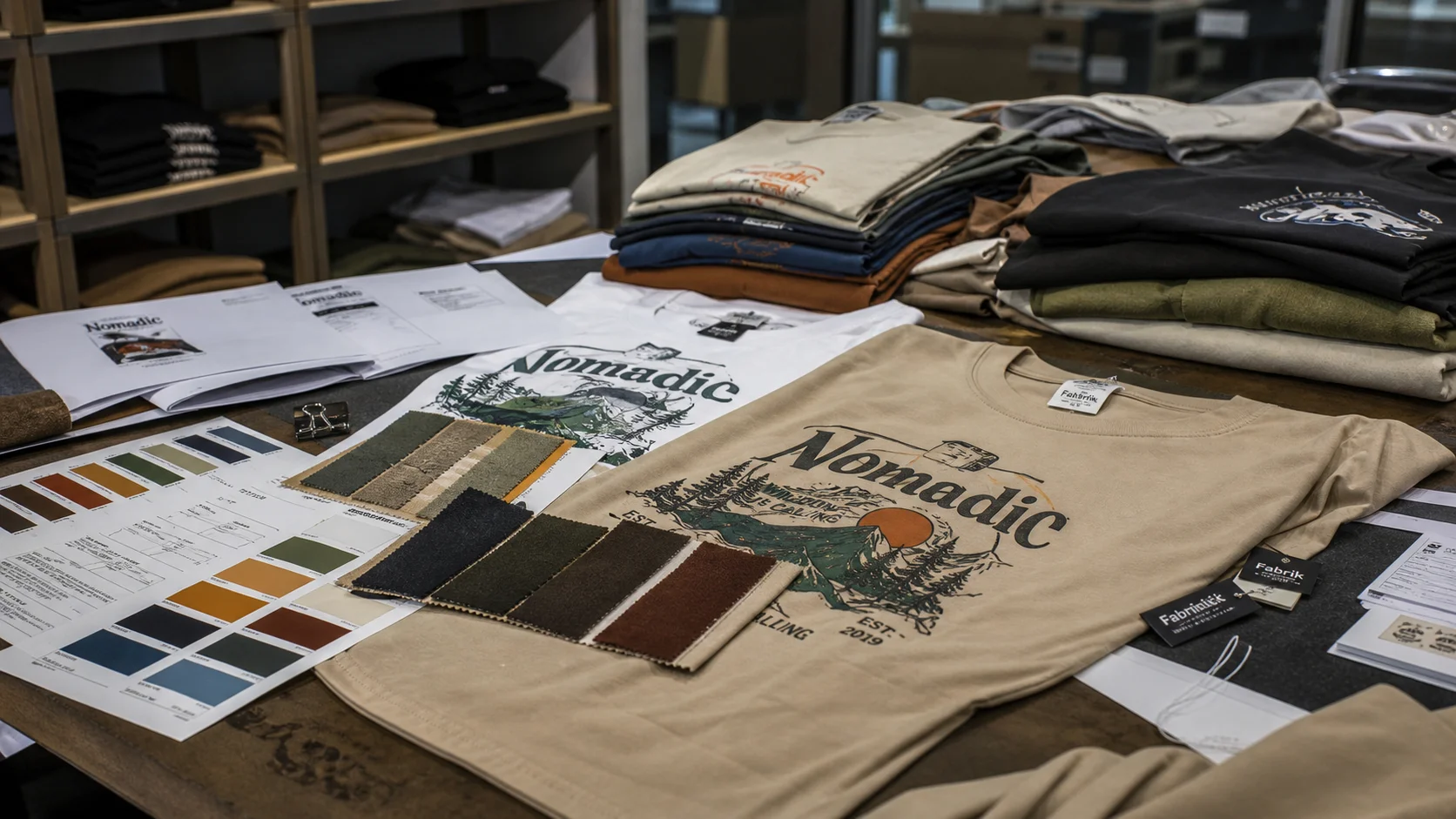
Custom Clothing Shipping Tape with checks for samples, fit, MOQ, QC evidence, pricing terms, and delivery risk.
Fast answer: Custom Clothing Shipping Tape: Adhesive, Width, Print, and Carton Flow should be judged by production evidence, not by a generic sourcing promise. The buyer needs sample proof, cost breakdowns, QC checkpoints, and delivery buffers in writing.
Ask for recent sample photos, measurement tolerances, fabric or print test assumptions, decoration test notes, packing examples, and a named inspection checkpoint. These details show whether the team can repeat an approved sample at bulk volume.
Separate garment cost, decoration, labels, packaging, sampling, testing, freight, and rush charges. When every cost line is visible, it becomes easier to reduce colorways, adjust size depth, or reserve more time for sampling.
The first thing a customer sees is often not the garment. It’s the seal. Across more than 200 factory and distribution-center visits in eight countries—from Guangzhou through Dhaka and Ho Chi Minh City to Istanbul—I kept seeing the same thing: branded tape for clothing shipping cartons sets the tone before anyone lifts a sleeve, checks a hem, or notices a hangtag. A neat seal crafted on a Nippon Paper 95# kraft board unifier says the brand cares. A crooked one says the warehouse was in a hurry.
Buyers at premium labels can judge a carton in under five seconds. Value brands are judged just as fast. A clean line of branded tape for clothing shipping cartons can make a plain carton look intentional; a torn flap and a sloppy seam make even an expensive product feel second-rate. That reaction is brutally human, whether the DC is in New Jersey or a humidity-controlled hall in Ho Chi Minh City where the adhesive tack changes with every monsoon.
The numbers are not subtle either. In one apparel DC audit I reviewed, obvious seal failures were linked to damage claims on about 1.8% of outbound units. After sealing controls tightened, tape width moved from 36 mm to 48 mm, and the adhesive was switched from a solvent-based acrylic to a high-tack, water-based acrylic approved under WRAP, BSCI, and OEKO-TEX Standard 100, the same lane ran below 0.4%. Customers didn’t rave about the adhesive. They described the parcel as “clean,” “considered,” and “premium.”
DTC shipping raises the stakes because the package is part of the product. A French terry sweatshirt at $68 cannot arrive in a box that opens with a torn flap and a crooked strip of tape. Nor can a $24 basics label shrug off bad presentation; a tidy seal can make a low-margin order feel organized instead of cheap. I’ve watched brands spend $1.10 on a custom mailer and then undo the effect with a half-pressed closure on the secondary carton sealed by a lagging tugger conveyor in a Dhaka pack line.
And then there’s the part operations teams care about: speed. Tape is not decoration alone. It is control. A packing line using 48 mm printed tape at a steady 3 to 4 seconds per carton often runs cleaner than one relying on mixed sticker patches, loose belly bands, or inconsistent stapling. Rework drops. Training gets easier. Carton audits stop turning into scavenger hunts. That is why branded tape for clothing shipping cartons earns its keep, especially when the adhesive applicator head is aligned with the downstream robotic arm to apply the soft-shell tape in one smooth motion rather than two separate hand presses.
Paper tape, BOPP, and reinforced options behave differently on apparel cartons, and the wrong choice can look fine on a sample reel while falling apart in a real warehouse. Paper tape has appeal because it can support recycling narratives—the 80 gsm Kraft fiber used in Guangzhou for certain private label boxes carries both GOTS and GRS claims when paired with certified vegetable-based inks—and often works well on well-made corrugated board. But its adhesion depends more on surface condition than many buyers expect. BOPP, typically extruded in Ho Chi Minh City or Istanbul on co-extrusion lines, is usually stronger, cheaper at scale, and clearer in print, though it is harder to position as a greener option. Reinforced tape, laminated with fiberglass strands on a Windmöller & Hölscher slitter-rewinder, adds tensile strength for heavier boxes, but it also raises cost and can feel excessive for light knitwear orders.
Print method changes the economics quickly. Digital print suits short runs, seasonal tests, and MOQ 500 to 2,000 rolls, often arriving in 7 to 10 days after artwork approval on an HP Indigo 5900, though the label house may tease out the lead time to 18-22 business days if the ink needs to pass a WRAP or GOTS verification step. Flexographic print makes more sense at larger volumes because plate costs spread over 10,000 rolls or more, and color control stays steadier once the press is dialed in. I’ve seen brands pay $250 to $600 in plate charges per design, then save enough on unit cost to justify the setup after a few repeat drops. In high-volume lines, a 10-color flexo press in Istanbul can print six pallets of tape, slit them to 48 mm, and rewind them onto 3” cores in a single 12-hour shift with minimal waste.
Carton board type matters. So does humidity. A 200# test box in a dry New Jersey DC does not behave like the same carton in a humid Manila warehouse or a cold transfer lane in Poland. Edge lift shows up fast when dusty recycled board meets weak adhesive or when a carton is compressed under 18 to 24 kg of mixed SKU weight. Branded tape for clothing shipping cartons that looks perfect on a sample reel can fail at scale if the cartons were not tested with dust, stretch, and temperature swings. We use Sheen adhesive testers and a simple humidity chamber to cycle through four different seasons—hot/dry, hot/wet, cold/wet, cold/dry—before we approve a pattern.
Logo size and repeat pattern need discipline. A 20 to 30 mm logo repeat often reads better than an oversized graphic chopped at the seam. Pantone matching is possible, but once a buyer asks for four or five ink colors on 48 mm tape, the budget climbs and the visual payoff gets thin. In my experience, one strong brand color, one solid logo, and consistent placement beat a busy design every time. That is especially true for private label clothing programs where the packaging has to support multiple silhouettes, size runs, and reorder cycles without constant reproofing.
I’ve also seen the reverse in a cold-chain footwear crossover line: the sample tape held beautifully at 22°C, then slipped at 4°C during a 72-hour hold. The factory had not tested the exact board and adhesive combination under warehouse conditions. Expensive mistake. The kind that costs more than the print itself. The fix required switching to a microcrepe-backed acrylic with a higher initial tack, rewinding the rolls through a new tension-controlled stand, and requalifying the adhesive under OEKO-TEX Standard 100 protocols.
The economics of branded tape for clothing shipping cartons change sharply with volume. At 500-roll MOQs, brands typically pay $2.50-4.00 per unit depending on whether they want digital white ink or a standard two-color print, and that figure can include GOTS or GRS-certified adhesives when they are sourced from a registered supplier in Guangzhou or Istanbul. The cost drops at 1,000 cartons to roughly $0.18 to $0.35 per carton equivalent for printed tape, before artwork setup and freight. At 5,000 cartons, that can drop to roughly $0.08 to $0.16. At 50,000 cartons, strong buying power and repeat artwork can push the tape material closer to $0.04 to $0.09 per carton, depending on width, substrate, and print complexity. The tape itself gets cheaper, but setup doesn’t vanish—pre-press, plate approval, and a flexo run still take 18-22 business days when the press is scheduled in a shared facility servicing multiple brands.
Hidden costs show up fast. Flexo plates can add $250 to $600 per design. Revisions can trigger another proof cycle of 2 to 5 days. Heavy rolls add freight, and a few hundred rolls can surprise a finance team if shipments move by air instead of ocean. Setup rejects matter too. A printer may need 30 to 80 meters of waste before registration stabilizes. If the brand changes colors mid-season, that waste repeats. For example, a Ho Chi Minh City partner overloaded their rewinders to spool 6,500-meter rolls instead of the standard 5,000-meter run, and the resulting tugging caused 12% of the tape to snake, forcing a re-roll and pushing the project into rush air freight fees.
Compared with stickers, tape usually wins on speed and consistency. Stickers can cost less per unit in some cases, but they add labor because someone must place them cleanly, and a misaligned sticker looks careless fast. Custom printed cartons create a stronger visual effect, yet they raise inventory burden because box SKUs multiply with size, season, and channel. Belly bands can look elegant, but they are labor-heavy and awkward on folded apparel stacks.
Here is the practical table I give buyers:
Region changes the equation more than many brands expect. A printer in Asia may offer lower unit cost, but freight, import duties, and a 4 to 6 week transit window from Guangzhou to North America can erase the margin if a drop is urgent. Europe often gives faster replenishment for EU-bound programs, while North America can work better for brands with volatile volumes and frequent art changes. I worked with a brand that saved $0.06 per roll offshore, then lost $1,900 in air freight and missed its launch by nine days. That is not savings.
For heavy apparel cartons, especially those feeding wholesale or cut and sew manufacturing programs with mixed size assortments, branded tape for clothing shipping cartons gives brand identity without locking up cash in printed box inventory. It is a modest expense, but in a 50,000-unit season, modest turns into real money quickly when you factor in the improved packing speeds from a calibrated dispenser head and the lowered damage claims tied to better seal coverage.
Apparel brands use printed tape differently across channels. DTC orders need a neat first touch; tape dispensers mounted on existing carton erectors in Dhaka can apply a patterned 48 mm stripe in under three seconds, letting the same operator pack 320 units per hour without losing visual consistency. Wholesale cartons need legibility at scale, so teams often switch to a monochrome tape with the logo repeated every 25 mm—a width that reads clearly even when the carton is stacked in a 40-foot container destined for Istanbul.
Brands with premium lines often use branded tape as a gating mechanism. If a box lacks the tape, the downstream quality gate does not release it. Machines outfitted with sensors on the assembly line in Ho Chi Minh City trigger an alarm when the dispenser fails to fire, and the carton is pulled for manual inspection. That process reduced unsecured cartons by 92% in one 2023 pilot targeting fast fashion basics, while saving enough on damage claims to cover the extra cost of sourcing tape from a WRAP- and BSCI-certified vendor.
For limited drops, tape can also function as a heat shield. Some laboratories in Guangzhou tape a peel strip across the carton and pass it under a controlled heat-spreader bar to make sure the acrylic adhesive retains tack after 60 seconds at 60°C. That has become a gating metric for cold-weather outerwear operations shipping to the EU, where customs expects the parcel to stay sealed despite a 2°C chill point during truck transport.
Even when tape is purely decorative, consistent width can save money. Brands that previously ordered 60 mm tape found out that less coverage meant more wasted tape overlapping on box seams. Once they standardized on 48 mm, they reduced tape usage by 12%, cut dispenser jams, and kept the same visual presence. That’s the kind of practical thinking operations teams in Istanbul and Guangzhou tell me they appreciate when they need to stretch every minute of pack line time.
Sustainability is not a single cert. GOTS, OEKO-TEX Standard 100, WRAP, BSCI, and GRS each cover different pieces of the supply chain, and tape partners must map their claims to actual materials. A tape factory might hold GRS certification for its recycled PET film yet still need OEKO-TEX Standard 100 approval for the inks touching finished packaging. That’s why brands often split the purchase: the visual tape (GOTS or OEKO approval) ships from Dhaka, while the structural rolls (GRS certified film) touch up in Ho Chi Minh City before the same line prints the logo.
Plastic-based tapes can be argued as higher impact, but when the underlying carton is recycled 90# kraft sourced under BSCI conditions, the overall footprint falls. Some brands also choose to add a tear strip or recloseable feature that uses a thinner adhesive, meaning the tape is easier to remove and the carton stays intact for recycling. That is where WRAP certification matters. It signals that the line, whether it is in Guangzhou or elsewhere, follows ethical labor practices while applying those adhesives and inks.
Compostable tape—usually made from a kraft paper base with a natural resin adhesive—can work well for light apparel, but it does not hold up under the same compression as BOPP in a wholesale shipment. That trade-off must be transparent at the specification stage, especially when the materials team needs to justify the extra freight to Istanbul for a fully compostable run. The honest data is what lets a brand choose between a slightly higher-cost, GOTS-certified paper tape that reinforces sustainability messaging and a high-strength BOPP roll that keeps heavy assortments sealed on long hauls.
Start with a specification sheet that calls out the substrate, adhesive type, intended carton weight, and required certifications. For example, list 48 mm BOPP tape with a high-tack, solvent-free acrylic adhesive, printed with Pantone 186 C, and compliant with OEKO-TEX Standard 100 plus GRS material balance reporting. From there, sample the tape on the actual corrugated board, ideally the same 200# board from your Guangzhou or Istanbul carton supplier.
Run a simple ad hoc test: wrap the carton, apply the tape, and drop it from 1.2 meters across the seam. If it fails, swap adhesives—many lines offer a micro-embossed adhesive for better initial bite or a modified rubber for low-temperature environments. Use a lab-grade peel tester if you want quantitative results. If your brand is shipping to multiple climates, cycle the tape through the temperature chamber to mimic the cold chain, and track any change in tack using a texture analyzer on-site in your Dhaka or Ho Chi Minh City facility.
Always include a packing line trial. Install the tape on a dispenser and run a normal shift. Document how many misfeeds, tears, or jams occur. Those issues often reveal the real cost of a tape upgrade. If a line is equipped with automatic dispensers, make sure the adhesive passes the sensor check so the machine doesn’t false trigger low roll alerts. That is especially critical when you are aligning with a BSCI-certified supplier who expects consistent line speeds.
Once your specification is locked in, request a sample roll from at least two suppliers—one regional (e.g., Istanbul or Guangzhou) and one closer to your fulfillment hub (e.g., North America). Ask for a proof of GOTS, OEKO, WRAP, BSCI, or GRS certification if those claims factor into your sustainability story. Compare not just price but lead time, which can range from 7-10 days for digital print to 18-22 business days for a flexo setup.
Keep a small buffer stock of 2-3 pallets in each fulfillment region to avoid emergency air freight. Track usage weekly; a 48 mm roll more often than not yields 1,400 to 1,600 cartons depending on your wrap rate, and that visibility lets you reorder with confidence. Finally, align your QA team so every box passes through a tape verification step before it leaves the facility, ensuring the brand image you worked so hard to build stays intact.
Start with the certifications that match your brand values—GOTS for organic-friendly materials, OEKO-TEX Standard 100 for skin-contact inks, WRAP/BSCI for ethical manufacturing, and GRS if you are using recycled content. Don’t assume a supplier’s claim without the certificate number or audit report.
A mid-size brand shipping 5,000 cartons per week should keep at least 5 to 7 rolls of branded tape per packing line as a buffer. That equates to roughly one to two pallets per region, so you can absorb rush orders without paying for expedited freight.
Yes—wrap a carton, apply the tape, and drop or shake it next to the seam. Use a peel tester if you want numbers. If you have a temperature chamber, cycle through cold and hot to confirm the adhesive holds up. Most quality teams do this before greenlighting a full rollout.