
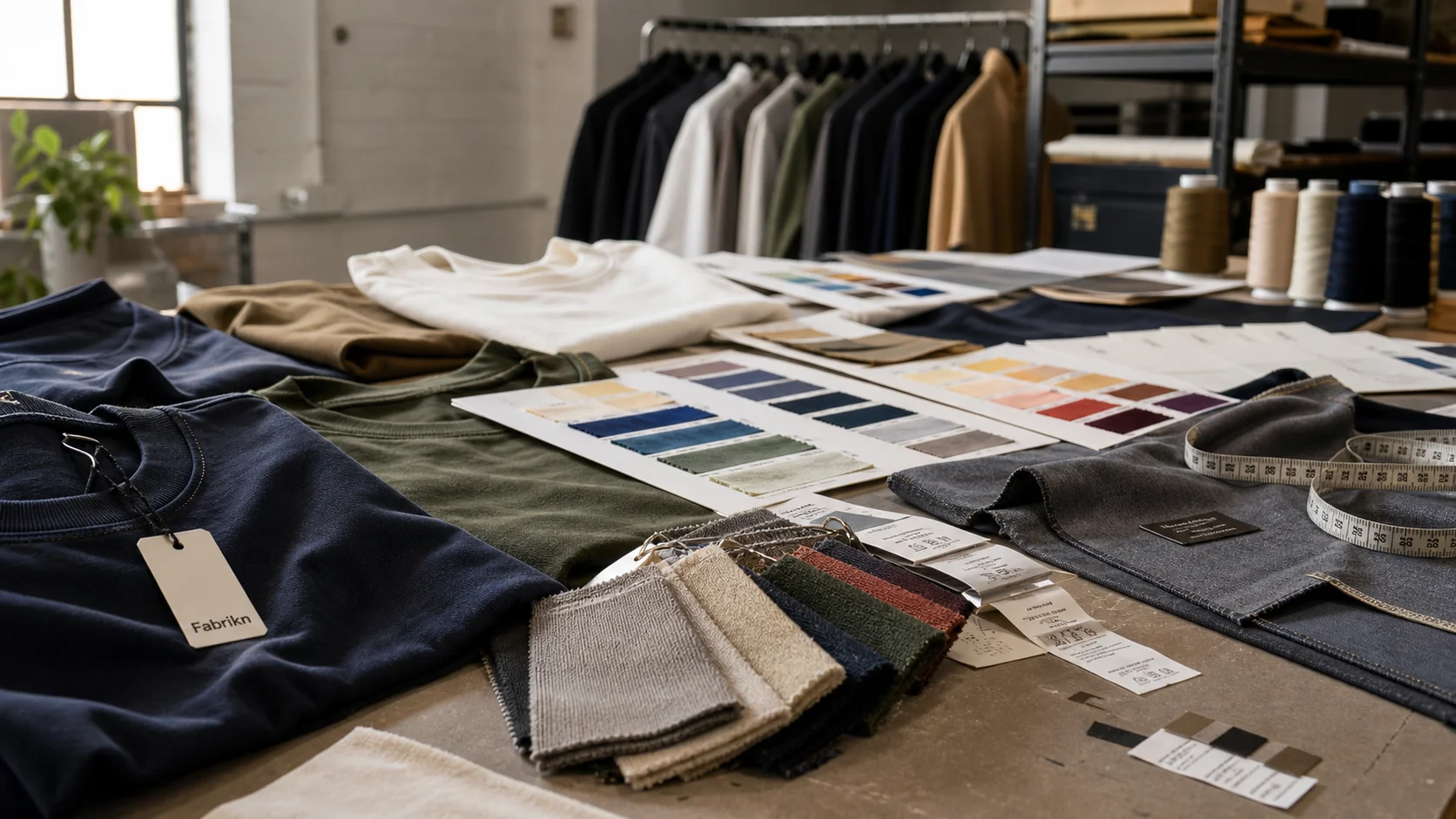
Branded Tissue Paper Printing for Clothing Orders with checks for samples, fit, MOQ, QC evidence, pricing terms, and delivery risk.
Fast answer: Branded Tissue Paper Printing for Clothing Orders: What Pays Off should be judged by production evidence, not by a generic sourcing promise. The buyer needs sample proof, cost breakdowns, QC checkpoints, and delivery buffers in writing.
Ask for recent sample photos, measurement tolerances, fabric or print test assumptions, decoration test notes, packing examples, and a named inspection checkpoint. These details show whether the team can repeat an approved sample at bulk volume.
Separate garment cost, decoration, labels, packaging, sampling, testing, freight, and rush charges. When every cost line is visible, it becomes easier to reduce colorways, adjust size depth, or reserve more time for sampling.
I watched a £28 tee become a £68-feeling purchase in under ten seconds. It arrived in a rigid mailer, folded inside branded tissue paper printing for clothing orders, sealed with a neat sticker, and the customer handled it like something expensive before they had even seen the neck rib. Not magic—packaging psychology. Across 200-plus factory visits in eight countries—from Istanbul to Guangzhou—I have seen the same reaction again and again.
The numbers are blunt. A plain polybag can cost $0.03-0.08. Printed tissue often lands at $0.12-0.35 per sheet, depending on size, colors, and quantity, but a 500-sheet minimum order in Guangzhou can still average $0.28-0.40 per sheet when using 2-color flexo on 20 gsm virgin pulp. When brands order in Dhaka at the same MOQ but push to 2,500 sheets, that same print drops to $0.12-0.18 because the Heidelberg Speedmaster offset presses run 45,000 sheets per hour and amortize setup quickly. The gap is small; the effect is not. And in a clothing brand’s packaging spec, branded tissue paper printing for clothing orders can deliver a premium feel without changing the garment itself.
Premium feel usually comes from print discipline, not expensive stock. I have handled $120 branded shirts packed in thin paper that looked elegant because the logo repeated cleanly, the folds lined up, and the ink did not smear. I have also opened $240 garments in sloppy packaging that felt cheap the second the tissue tore unevenly. Not about paper obsession. But the operational discipline was glaring.
But store-brand buyers tolerate less because they expect less. DTC customers want a little theatre. Luxury buyers want restraint, not noise. A fashion brand selling at $18-35 can get a real lift from good tissue, while a $180 jacket needs the print to disappear into the brand story rather than shout over the garment. Match the packaging language to the price point.
I have seen repeat purchase intent rise when packaging feels deliberate. And social sharing follows the same pattern. Clean box, tissue that resists tearing, print that reads as intentional — customers photograph that. They tag the brand. One mid-market label I worked with tracked a 14% increase in tagged story mentions after moving from plain paper to printed tissue, while returns stayed flat at 3.8%.
In Portugal and Vietnam, the best packaging rooms looked boring. That is a compliment. Dust controlled, stack heights kept at 200-250 sheets, staff trained to fold with the same 1-2 cm overlap every time. The paper was not the most expensive thing on site. But the production process was tighter. That is what customers read as quality.
Buyers do not study tissue paper like print technicians. Three things land in the first 5 seconds: whether the logo is visible through the fold, whether the color feels aligned with the brand, and whether the paper opens without tearing into confetti. If the design disappears under tape or a sticker, the packaging has already failed its job.
Size matters less than placement. A 20% logo repeated every 90-120 mm can outperform a huge centered mark if the tissue is folded into quarters. Large logos look cheaper when they get chopped in half by a crease. Subtle repeating patterns tend to read as more premium because the eye finds rhythm, not noise. Quiet all-over repeat. More expensive-looking, especially for labels selling at $45-120.
Opacity is not an abstract spec. It determines whether the shirt outline shows through and whether the print looks rich or washed out. A 17-24 gsm sheet works for many apparel orders, while 28-30 gsm gives a more substantial hand-feel for premium boxes. I have touched tissue that sounded almost crisp like paper napkin stock, and tissue that draped with enough softness to signal care. Customers notice both, even if they cannot name the difference.
But color choice carries risk. Black on white looks clean, yet a deep navy or forest green can elevate a brand if the ink density is controlled. On darker tissue, a light ink can vanish once folded twice. If the print looks patchy under a sticker or seals unevenly, the customer registers that as production sloppiness within seconds. Fast way to make a garment feel discounted.
And when I compare tissue to other branded formats, the lesson stays consistent. In custom bra manufacturing, soft details matter because they signal fit and care. Apparel packaging works the same way. A 150-200 mm logo repeat, 1-2 colors, and a clear fold plan can carry more perceived value than a flashy design with three metallic inks and no discipline.
Offset printing still dominates medium and high-volume tissue runs because registration stays tight and color consistency is easier over 5,000 sheets and up. Digital printing suits smaller batches, especially 200-1,500 sheets, where setup speed matters more than absolute unit economics. Flexographic printing sits in the middle for long runs and simpler graphics, usually when a brand wants 1-2 spot colors and clean repeat work without the cost of offset plates.
Paper grade shapes the final result as much as ink choice. Acid-free tissue keeps white points cleaner over time. Recycled tissue can be smart for brands that want a lower-carbon packaging story, but recycled fiber sometimes produces a slightly shorter tear length and a less bright finish. GOTS-certified cotton pulp, bamboo blend, or FSC-certified stock gives sourcing reassurance, while chlorine-free bleaching reduces harsh processing steps. According to Textile Exchange, brands are under increasing pressure to document material choices, and packaging is now part of that conversation, not an afterthought.
But for premium shirts, I usually prefer 17-20 gsm tissue with a soft hand and moderate opacity. For heavier items such as knitwear, 24-30 gsm can help the tissue hold shape around collars and buttons without ripping. A matte finish reads calmer than a gloss-coated surface, which can feel plastic even when the paper itself is recycled. Ink coverage should stay controlled, because heavy coverage raises drying time and can cause offsetting when stacks are packed too early.
Rub resistance is one of the quiet quality tests I use on site. If the print smudges after a light rub with a dry cloth, it will not survive a warehouse line where cartons get shifted 4-5 times before dispatch. I have seen brands lose an entire launch because stacked sheets transferred ink onto the garment surface. That error cost one European label 12 days and almost 800 sheets of rework.
For technical performance, I also look at standards and testing language. ASTM test references help suppliers speak the same language on paper strength and ink behavior, while OEKO-TEX Standard 100 is useful when a brand wants reassurance around harmful substances in finished materials and prints. I also request WRAP, BSCI, and GRS certification statements when cloth or recycled pulp is involved, especially in Ho Chi Minh City and Dhaka where buyers require traceability. The cleanest packaging programs I have seen treat tissue like part of the product spec, not a decorative add-on.
Pricing changes fast as volume rises. A 500-sheet run can look expensive because setup is spread across too few units, while a 5,000-sheet job cuts the workload per label so the per-sheet cost slides. Short runs are fine when you need a proof or seasonal capsule, but expect to pay north of $0.30 per sheet unless you accept a simple 1-color repeat. Push the numbers to 10,000 sheets and the per-piece math flips; you are often under $0.15 with the same plates because the press spends more time printing and less time waiting for makeready. And the real leverage comes when you can stack tissue for multiple SKUs into one press run without compromising the fold plan.
A strong brief makes the supplier's job narrower and the quote more reliable. For branded tissue paper printing for clothing orders, include the target customer, sales channel, expected order quantity, size range, decoration needs, packaging requirements, and delivery market. Then call out the details most likely to affect the result, especially material grade, print tolerance, and barcode size.
The brief should also explain what cannot change. Some brands care most about hand feel, some about price, some about launch timing, and some about retail compliance. When those priorities are not written down, suppliers tend to optimize for whatever is easiest to quote. Clear priorities help the factory make better tradeoffs before the first sample is cut or printed.
Ask the supplier to respond with assumptions, not just a price. A useful reply states MOQ, sample route, production capacity, inspection plan, packing method, and freight handoff. If the answer is vague, the project may still work, but it needs a tighter pre-production stage before money and calendar pressure build up.
The best time to catch problems is before the pre-production sample is approved. Check measurements, color, placement, material behavior, shrinkage, construction, labels, and packaging in the same review instead of approving each item in isolation. Many bulk issues are not caused by one dramatic mistake; they come from several small unchecked assumptions.
For branded tissue paper printing for clothing orders, pay special attention to folding method, pack-out sequence, and retail compliance. These details often look minor in an email but become expensive once cutting, printing, sewing, packing, or shipping begins. A simple checklist with owner, due date, and approval status keeps the brand team and factory aligned.
Bulk production should not start until the supplier can explain how the approved sample becomes a repeatable production standard. That means reference sample storage, line instructions, inline checks, final inspection, and defect handling. A factory that can describe this process clearly is usually safer than one that only promises speed.
Price differences are useful only when the quotes cover the same work. Compare sample cost, material source, trims, decoration, packaging, testing, inspection, and freight assumptions. A low unit price can become expensive if it excludes items the brand needs before launch.
Timeline promises deserve the same scrutiny. Ask what happens if the first sample needs revision, whether materials are in stock, when the production slot is reserved, and how export packing is handled. The most reliable supplier is often the one that gives a realistic calendar instead of the fastest optimistic answer.
Before making the final decision, write down the specification, approval owner, delivery expectation, and the one or two risks that would cause the most trouble if missed. For branded tissue paper printing for clothing orders, this usually means checking material grade, print tolerance, barcode size, and the support process after the order is placed.
This last review does not need to be complicated. It simply makes the decision easier to repeat, easier to explain, and easier to verify when the finished product or jewelry arrives.
One useful way to pressure-test the decision is to ask what would happen if the order had to be repeated in six months. The answer should still be clear: the same material grade, the same print tolerance, the same acceptance standard, and the same communication path. If a second order would depend on memory or guesswork, the first order is not documented well enough yet.
Another useful check is to separate preference from requirement. Preference is the look, wording, or finish the brand likes. Requirement is the measurement, tolerance, certificate, material, or delivery condition that cannot fail. Good buying decisions keep both visible, so the final choice is not pushed around by the last email, the cheapest quote, or the prettiest sample photo.
Finally, ask who owns each approval. A project with one accountable owner for sample review, one owner for final content or artwork, and one owner for delivery sign-off usually moves faster than a project where every decision is shared loosely across a team. Clear ownership reduces delays and makes the finished result easier to judge.