
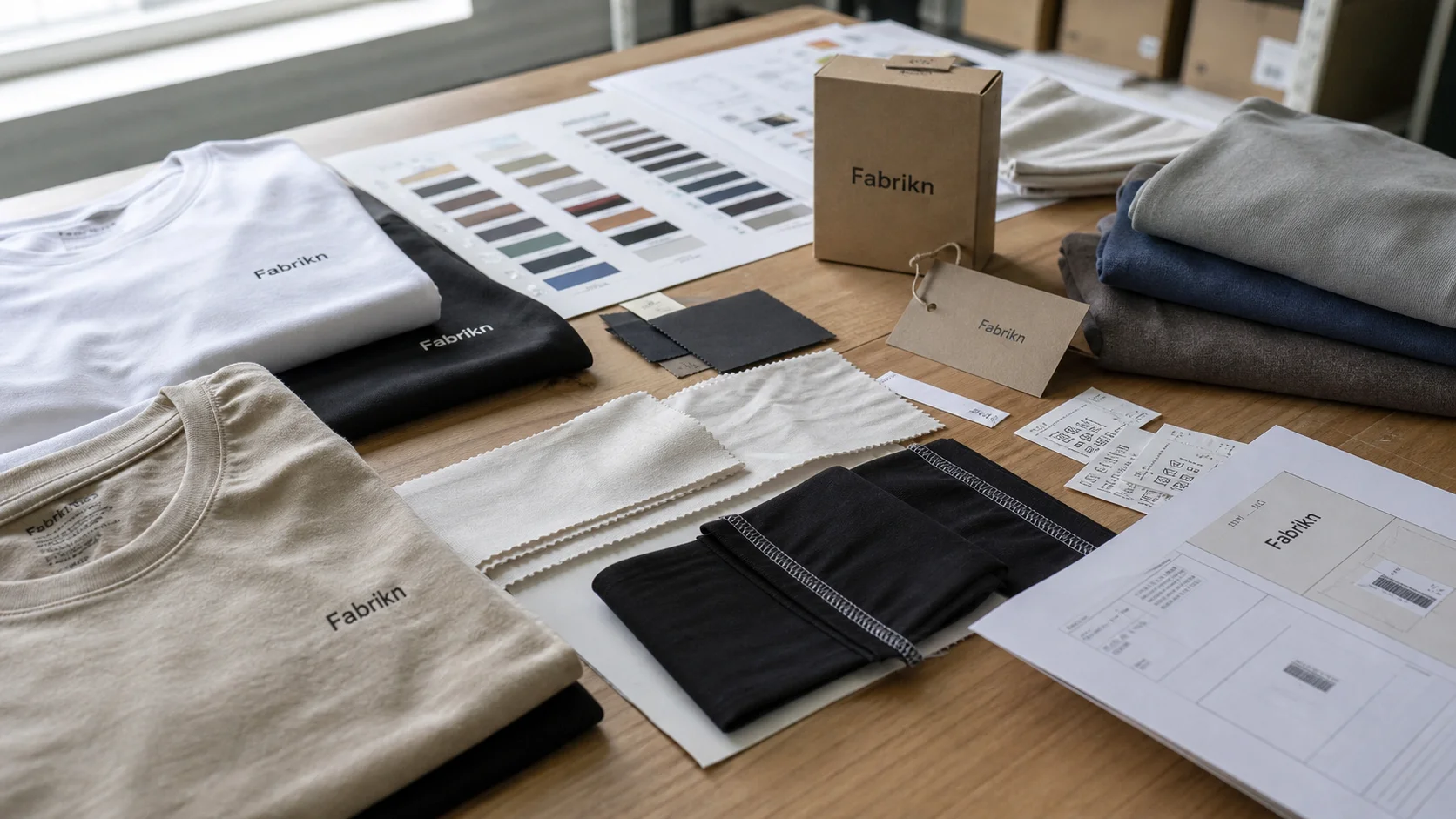
Fashion Ecommerce Branded Tissue with checks for samples, fit, MOQ, QC evidence, pricing terms, and delivery risk.
Fast answer: Fashion Ecommerce Branded Tissue: GSM, Ink, Fold Size, and Packing should be judged by production evidence, not by a generic sourcing promise. The buyer needs sample proof, cost breakdowns, QC checkpoints, and delivery buffers in writing.
Ask for recent sample photos, measurement tolerances, fabric or print test assumptions, decoration test notes, packing examples, and a named inspection checkpoint. These details show whether the team can repeat an approved sample at bulk volume.
Separate garment cost, decoration, labels, packaging, sampling, testing, freight, and rush charges. When every cost line is visible, it becomes easier to reduce colorways, adjust size depth, or reserve more time for sampling.
The first thing a customer sees inside the box can make a $48 blouse feel like a considered purchase—or a random one. With branded tissue paper for fashion ecommerce packaging, the brand story starts before the fabric is even touched. In my experience, the box reveal is the easiest branding moment to botch (and yet teams keep letting it slip). I’ve watched it in factories from Dongguan to Porto: the carton opens, the tissue unfolds, and the brand either looks deliberate or thrown together. Neatness. Care. Respect for the order. I have seen factories where the tissue machine is the only thing standing between a scheduled drop and chaos, so yeah, it's worth the attention. In Guangzhou’s Baiyun District, the 42-inch Voith crepe line and the Bobst folder-gatherer are booked for 18-22 business days once the artwork is locked so they can run 7,000 sheets a day while the cut-and-sew team finishes trims.
That is where branded tissue paper for fashion ecommerce packaging earns its keep. Compared with a return, a bad review, or a one-time buyer who never comes back, it is cheap. On a 5,000-unit run, even a polished tissue spec may add only a few hundred dollars to packaging cost, yet it can reshape the entire opening experience. Contemporary DTC labels use it to signal design fluency, while discount basics lean on plain kraft inserts and a logo sticker to signal efficiency. Luxury labels use it as restraint, not noise; in Istanbul’s historic printing district, a 500 MOQ short run with digital inks, a matte aqueous coating, and a light water-based adhesive costs $2.50-4.00 per unit, which is still less than a single marketing unit in the drop. The message shifts by tier. Honestly, this approach works better because customers feel like the brand is speaking to them before they even lift the garment (and small rituals like that stack over time).
During factory visits, I have seen the visual lift rarely come from the fanciest substrate. It came from tight print registration, a sheet size that fit the garment without waste, and fold consistency across 1,000 or 10,000 packs. A sheet printed at 70% coverage with crisp repeat alignment looked more premium than a glossy, over-inked run that bled at the edges. Counterintuitive, but true. The strongest tissue is often not the thickest. It is the one that behaves on a packing line and stays sharp after 3-4 weeks in transit. I watched a Bobst DCM 1060 in Dhaka feed 21 gsm GRS-certified eucalyptus pulp through a Nordmeccanica slitter rewinder, while a servo-driven Wagner register ensured the repeat never drifted across the fold—if that machine misses once, every packer downstream notices. I once spent twenty minutes arguing with a press operator about fold alignment, and yes, trying to get fold consistency across 10,000 packs is like refereeing a tired yoga class (you can't just shout 'align!').
There’s a reason brands selling French terry hoodies at $88 and silk camisoles at $128 care about the same tiny insert. The garment may differ, but the packaging has one job: reassure. I’ve seen teams spend $4.00 on mailers and only $0.07 on tissue, then wonder why customers post photos of the box but not the brand. The tissue is the first branded surface inside the carton, and it sets the tone for everything after. In my experience, the tissue rarely gets enough budget love even though it's that first handshake. In Dhaka’s Dhamrai district and Ho Chi Minh City’s Tan Phu industrial park, the same WRAP-approved water-based adhesives we use for labels also hold the tissue folds and keep the sheet from tearing when the packers channel it through a semi-automatic folder gluer. For labels building broader clothing packaging solutions, it becomes the hinge between plain logistics and a retail-ready finish.
The spec sheet matters more than most buyers admit. I look first at gsm, opacity, surface texture, tear resistance, and whether the tissue is acid-free. Common fashion tissue runs from 17 gsm to 28 gsm; lighter sheets fold beautifully, while heavier sheets resist tearing during pack-out. Opacity matters if you want a repeat pattern or a logo to read cleanly through the sheet. I have noticed that when teams skip the opacity part (big mistake) the logo bleeds right into the crease. Surface texture affects ink hold. A slightly smoother sheet gives tighter edges, but a very smooth finish can reduce the soft, premium feel some brands want. That is why, especially when we work with Ho Chi Minh City mills, we source 100% chlorine-free eucalyptus pulp that follows OEKO-TEX Standard 100 dye rules and then calender it on a Voith press to 18-20 gsm while still keeping the air pockets that make it feel luxe.
Print method should follow order size and artwork, not ego. I often tell clients that flexographic printing is the reliable workhorse when you need simple logos, repeats, and 1-2 spot colors on higher volumes, often 10,000 sheets and up. In Guangzhou, the Windmoeller & Hoelscher FLEXL 100 flexo presses with IR flash drying run two colors while the inline corona treatment increases adhesion, so we can commit to tight registration without a second proof round. Offset suits richer artwork and precise color matching, but setup can be hard to justify below 5,000-8,000 sheets. Digital print is the fastest route for short runs and complex layouts, especially when a brand wants 4-color artwork, seasonal messaging, or 500-2,000 sheet tests. It usually costs more per sheet, but it cuts risk when the design is still moving.
Custom printing versus stock tissue with stickers or stamps is a practical tradeoff. Stock tissue plus a sticker may cost less upfront, perhaps $0.04-0.08 per order, but it can look improvised if placement varies by packer (yes, even if you line it up with a ruler). An inline repeat printed with UV-curable inks on a Bobst DCM 1060 costs more, yet it reduces labor, avoids the extra touch of manual placement, and gives a cleaner visual field. Frankly, stock tissue plus a sticker rarely looks cohesive, so I still steer brands toward a repeat when their volumes allow it. For fragile items like silk, cashmere, or lace, I prefer cleaner presentation and less handling. For returns-heavy categories, a stronger sheet and tighter fold pattern help prevent wrinkling and abrasion in transit because the prep includes leaving 15 mm at the fold to allow the garment to breathe.
I’ve seen brands in the $40-$80 price band over-spec tissue because they confuse thickness with luxury. That usually backfires. A 20 gsm sheet with a precise fold and stable print looks better than a 28 gsm sheet with dull color and fuzzy edges. The real question is what your garment category needs. A stretch knit tee does not require the same buffer as a beaded dress. For teams also managing private label clothing, tissue should match the product promise, not distract from it. In Istanbul, selective matte or glossy coatings on a 60x80 cm sheet can read as premium without going overboard, especially when the print includes the GOTS-certified cotton story in the repeat.
Here’s the math I use with buyers. Budget basics usually sit around $0.03-$0.06 per sheet on 17-20 gsm stock-like custom tissue, often 1-color print on a 50x70 cm sheet, MOQ 5,000 to 10,000 sheets. Mid-market DTC often lands at $0.06-$0.12 per sheet for 2-color repeats, better registration, and a slightly larger 60x80 cm format, with MOQ 10,000 to 25,000 sheets. Premium retail-ready tissue can run $0.12-$0.25 per sheet, especially when artwork covers most of the surface, multiple spot colors are involved, or the brand wants tighter color control at 28 gsm. For rapid tests, manufacturers in Istanbul or Guangzhou will quote $2.50-4.00 per unit at 500 MOQ, which already includes the micro-perforation, custom envelope, and WRAP-compliant packaging adhesive.
Those figures are only the visible part. Hidden costs show up fast. Plates and setup fees can add $80-$350 per color. Freight can swing by 10%-25% depending on carton count and sheet size. A pallet shipped from Ho Chi Minh City to Los Angeles can easily be $600-$900 plus a 18-22 business days transit window, while a similar pallet out of Dhaka averages 14-16 days but adds inland trucking. Warehousing matters too. A 50,000-sheet order may look efficient on paper, but if each pack is bulky, you may pay for 2-3 pallets of storage for 4-6 months. MOQ pressure also hits cash flow. A brand ordering 5,000 units may pay more per sheet, yet it avoids dead inventory if the logo changes next season.
Regional sourcing changes the equation. Asia-based production often lowers unit price by 15%-30%, especially for repeat orders and larger print runs, but communication can be slower, and color variance may take an extra round of sampling. European sourcing may cost more per sheet, yet the proofing language is often clearer, and I’ve seen fewer surprises on Pantone translation. North American mills and converters can reduce lead time by 1-2 weeks, which matters when a drop is tied to a campaign date and there is no room for delay. If you need a manufacturer, factory, or supplier in China, compare quote clarity as carefully as price.
At 5,000 units, a brand might spend $350-$900 total on tissue, depending on print method and freight. At 50,000 units, the unit cost drops, but the total can rise to $3,000-$10,000 because shipping, cartons, and storage scale with volume. That is where buyers should compare packaging to the rest of the order economics. A label spending $18 on make and trim for a cut-and-sew dress can justify a better tissue spec far more easily than a brand selling $24 basics with razor-thin margins. For production-heavy labels, I often point teams to cut and sew manufacturing decisions first, because the product margin usually determines how much they can spend on tissue.
Before you buy, ask for certification numbers. A mill in Guangzhou or Ho Chi Minh City that claims organic fibers should give you a valid GOTS certificate for the cotton or bamboo pulp blends, and the dies and adhesives should be OEKO-TEX Standard 100 to avoid Azo and heavy-metal dyes. If the sheet includes recycled pulp, verify the GRS chain of custody from the recycler to the converter. Social compliance spans the plant floor too: look for current WRAP or BSCI audits from the Dhaka converter so you know the workers assembling your tissue follow ethical hours and safe factory conditions. These certifications also help you answer investor questions once the tissue enters the packaging bill of materials.
Material choices matter as much as labels. I have seen a 20 gsm sheet from an Istanbul converter pass the smoke point test because they use water-based, non-formaldehyde adhesives and a corona treatment instead of solvent-based bonding. The same brand in a different drop used a non-certified pulp and had to reprint when the marketing team requested the organic story, which cost them two weeks and the price of a short-run sample. Sustainable specs can still be tactile—think matte, micro-embossed textures made with FSC-controlled eucalyptus pulp and starch-based coatings instead of plastic lamination.
Compare on four metrics: certification, process capability, raw material traceability, and logistics clarity. Does the supplier in Guangzhou have the in-house prepress team to convert your Illustrator file into a flexo-ready TIFF with Pantone formula guides? Can the Dhaka partner supply a digital proof within 24 hours, or do they need a whole offset plate to get consistent color? What is the idle speed of their Windmoeller & Hoelscher or Bobst press when your spec uses pearlescent inks? Ask the Istanbul supplier how they handle stenciling and repeat registration because that is what keeps the border from winking out on a 60x80 cm full-coverage sheet.
Also, demand transparency around MOQs and upgrade paths. If you start with a 5,000-sheet run and the business grows, will the same supplier scale to 25,000 sheets without a new die charge? Can they source the same 100% recycled pulp that carries the GRS stamp, or does the price jump 12% with a new mill? Freight partners matter too—some converters in Ho Chi Minh City work through a bonded warehouse that offers consolidated LCL to Los Angeles for about $550 a pallet, while others expect you to charter a full container in 30 days. Making the right comparison now saves you design headaches and surprise shipping bills later.
Start with a 500-unit test. That run lets you lock in the print, evaluate foam inserts if needed, and confirm the finish without committing to 10,000 sheets. Use digital print on that test, even if you plan to switch to flexo for larger runs, because digital gives you color accuracy with almost no setup fee. From sampling to signed PO, allow 18-22 business days with the Guangzhou or Ho Chi Minh City converter you choose, and stack the timeline with your garment production so you are not waiting on service trays during the delivery week.
Next, nail the fold. Mirror the fold you want on the production line using a mini Bobst folder gluer or a manual sample so the pattern stays intact and the closure is consistent. Record the fold dimensions for the Dhaka pack-out team: if the tissue is too wide, it jams the carton; if it is too narrow, it leaves the garment exposed. Confirm that every sheet is pre-sorted, color matched, and checked for dust before it hits the folder.
Finally, stress-test the transit. Send a mock order from Ho Chi Minh City or Istanbul to your key market using the same freight service you will use for live orders. Tag the boxes with QR codes so you can track the humidity inside the carton, and inspect the tissue once it arrives. If the creases soften or the fold loosens, adjust the caliper or the water-based adhesive before scaling the run.