
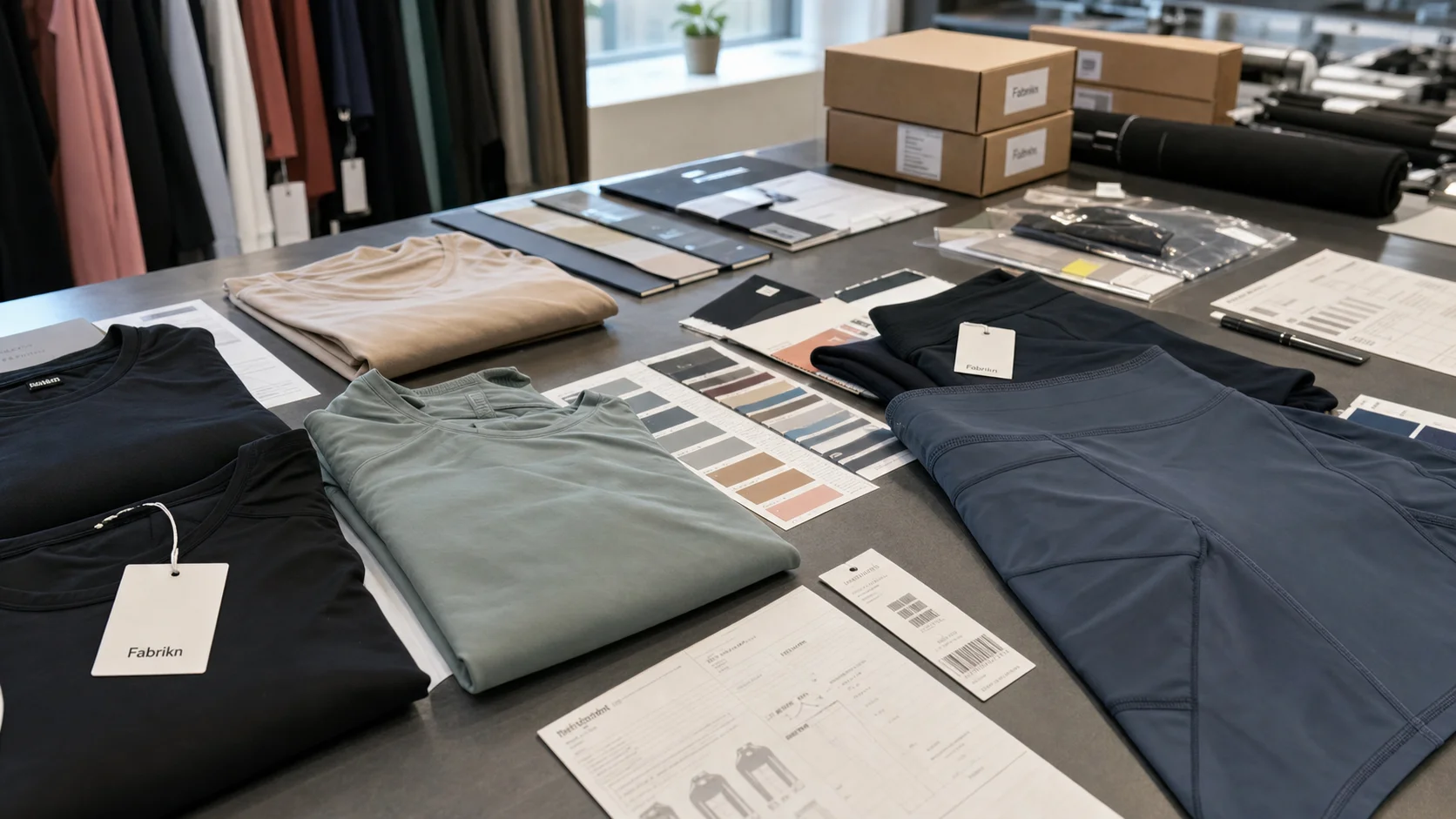
A practical outline for writing about fabric testing bulk activewear sets for corporate fitness challenge orders, covering performance standards, test...
Bulk Activewear Sets Fabric Testing for Corporate Orders - Fabrikn production reference
Corporate fitness challenge orders look simple on a purchase order, then the fabric starts telling the truth. A set that feels fine in a showroom can shrink, pill, sag, or go sheer after repeat wear and washing. For bulk activewear sets, fabric testing is not a technical extra. It is the part that protects the order from avoidable returns, complaints, and inconsistent team presentation.
When a company orders matching leggings, tops, shorts, or layered sets for employees, the standard is higher than for a one-off retail run. The garments need to hold shape across varied body types, manage sweat, survive frequent laundering, and remain visually consistent under fluorescent office lighting and gym conditions. That is why sourcing teams should treat fabric testing as part of the buying decision, not a post-production check.
Corporate fitness challenge orders sit in an awkward middle ground. They are not custom sportswear for professional athletes, yet they are also not low-expectation promotional tees. Employees notice comfort, fit, and finish quickly, and the company’s brand gets attached to every visible flaw.
Fabric testing gives procurement teams evidence on whether a chosen material can support the use case. For activewear, that usually means a blend of mechanical performance and wear comfort. The fabric must stretch and recover, move moisture, resist pilling, avoid transparency in light colors, and stay within tolerance after washing.
Testing also reduces disputes later. When a buyer approves a fiber content, GSM, and test result set in advance, it is much easier to challenge a supplier that switches yarn quality, changes finishing, or quietly alters shrinkage behavior during production. That kind of control matters when the order is large enough to carry seasonal deadlines, event dates, or internal launch milestones.
Not every fabric needs every test. The right test plan depends on garment type, color, expected wear frequency, and whether the order includes compression, athleisure, or more general training apparel. For corporate activewear sets, a practical testing list usually starts with the following:
Start with the basics. If a supplier quotes 77 percent nylon and 23 percent spandex, the production fabric should match that target closely. Fiber drift can change stretch, hand feel, dye uptake, and recovery. In bulk orders, even a small shift can create visible differences between sizes or replenishment runs.
For corporate sets, a verified blend is more useful than a vague “performance stretch” description. Buyers should ask for the mill composition sheet and, where appropriate, third-party verification for the final fabric. This is especially important when the order includes mixed items such as leggings, sports bras, and zip jackets, because each component may need a slightly different composition to perform well.
GSM affects structure, drape, opacity, and cost. Many corporate activewear programs land in the approximate range of 180 to 320 GSM depending on garment type. Lightweight tops usually sit lower. Leggings, shorts with structure, and support layers often require higher density.
Lower GSM can improve comfort in warm environments and reduce cost, but the tradeoff is often transparency and weaker shape retention. Higher GSM can feel more premium and stable, yet it may run hotter and raise freight cost. Buyers should select GSM according to the team activity, climate, and intended use frequency rather than defaulting to the heaviest fabric available.
Stretch alone is not enough. A fabric can elongate well and still fail if it does not snap back cleanly after wear. Recovery is what preserves fit across the knees, seat, waist, and elbows. In activewear sets, poor recovery shows up quickly as bagging, knee growth, and loose hems.
For corporate orders, ask for stretch direction details, recovery percentage after extension, and any limits from the fabric mill. Four-way stretch is common in activewear, but not every item needs it. Some jackets and tops perform better with controlled two-way stretch, especially when shape retention matters more than ultra-soft drape.
Pilling is one of the fastest ways to make a uniform-looking program feel cheap. Small pills on thighs, underarms, or sleeve edges can appear after only a few washes if the yarn quality or surface finish is weak. This risk rises with brushed finishes, lower twist yarns, and aggressive friction zones.
Corporate fitness challenge apparel is likely to be worn repeatedly, packed into bags, and washed often. A pill-prone surface may pass a quick pre-shipment inspection and still disappoint after a month of use. That is why buyers should request pilling results, not just a visual promise.
Colorfastness is critical when the order includes branded colors, dark shades, or white trim. Sweat, laundering, and rubbing can all expose weak dye fixation. For matching sets, shade inconsistency becomes visible fast, especially across different size runs or reorders.
Testing should cover at least wash fastness and dry/wet rub fastness. If the garments will be used outdoors or in high-sweat sessions, sweat resistance deserves attention too. Bright colors and black fabrics often need extra scrutiny because dye migration and rubbing issues are easier to hide at the sampling stage than in finished bulk.
Opacity deserves special attention for leggings, fitted shorts, and lighter colors. A fabric can technically meet stretch and weight targets and still become see-through when pulled across the hips or knees. That is a production problem, not a style preference.
The right test is garment-specific. Fabric swatches alone are useful, but the real check happens in a made-up sample worn in motion. Squats, bends, and seated posture reveal problems that a flat textile test will miss. For corporate orders, this matters because employees will use the garments in mixed settings, not just controlled gym demos.
Most bulk activewear sets are built from synthetic blends, though the exact ratio depends on the target market and branding position. Nylon-spandex is common for softer hand feel and a smoother premium look. Polyester-spandex can offer better cost efficiency, faster drying, and stronger color stability in some constructions. Recycled polyester is often requested for sustainability messaging, but its performance should still be tested rather than assumed.
Fabric Type Common Strengths Typical Watchouts Best Use Case Nylon-spandex Softer hand feel, strong stretch, good premium appearance Can cost more, dye and shade matching need control Leggings, fitted tops, premium challenge sets Polyester-spandex Cost-effective, quick drying, stable for printing Can feel less soft, may pill if yarn quality is weak Training tops, shorts, multi-piece teamwear Recycled polyester blends Supports sustainability claims, widely available Quality varies by supply chain, testing still required Brand-led corporate wellness programs Brushed performance knits Warm, soft, comfortable for cooler conditions Pilling risk, surface wear may show faster Cool-weather sets, layering piecesThe cheapest fabric is not always the cheapest order. A low-cost knit that fails stretch recovery or opacity testing can force redesign, rework, or disposal. On the other side, over-specifying a fabric for casual office fitness use can raise cost without a corresponding gain in utility. Buying judgment sits in the middle: specify enough to protect the product, but not so much that the garment becomes overbuilt for the program.
Fabric testing is only useful if the approval path is disciplined. Corporate buyers should expect a sequence that starts with lab dips or strike-offs, moves to fabric swatches, then on to proto samples and size-set confirmation before bulk cutting begins.
Do not collapse these steps into one approval if the order is important. A fabric can pass swatch review and still fail as a finished garment because of seam behavior, trim interaction, or print distortion. The sample stage should answer two questions: does the fabric perform, and does the garment still look correct after construction?
When branding includes logos, heat transfer, embroidery, or sublimation, the sample should also check how decoration interacts with the fabric. Some activewear fabrics react poorly to heat applied during branding. Others distort under embroidery density or show sheen changes around printed areas. Those are not cosmetic edge cases. They affect acceptability at scale.
MOQ for bulk activewear sets varies widely by supplier capability, fabric availability, and decoration method. A practical range for custom corporate orders often starts around 100 to 300 sets per style and color, while more specialized programs can require 500 units or more per colorway. Mills may also impose fabric minimums that exceed garment MOQ, especially for custom-dyed materials.
Lead time depends on more than sewing capacity. Fabric reservation, lab testing, dyeing, print approvals, trim sourcing, and inspection scheduling all affect the calendar. A simple stock-fabric order may move faster, while a custom knit with branded elastic, special zipper pulls, or color-matched panels can take materially longer.
For planning purposes, allow room for sample iteration. Many corporate orders underestimate the time needed for one or two correction rounds. If the event date is fixed, place the order early enough to absorb a failed test, a shade issue, or a fit adjustment without compressing production too hard.
Even when the fabric test results look acceptable, production can still drift. That is why in-line and final inspections matter. Common risks in bulk activewear sets include shade variation across rolls, fabric roll defects, misaligned stretch direction, stitching skip, seam puckering, and label placement errors.
Activewear adds a few specific traps. Heat transfer logos can lift if the fabric finish is wrong. Flatlock seams can break visual consistency if thread tension is not controlled. Elastic waistbands may twist if the elastic quality differs from the approved sample. Zippers and trims can also introduce failure points when supplier substitutions happen without approval.
A clean fabric test report does not guarantee a clean bulk run. Buyers still need roll inspection, pre-production verification, and size-run confirmation before shipment.
Final inspection should pay attention to functional wear points, not only overall appearance. Waist stretch, crotch stress, underarm movement, and collar recovery are the spots most likely to expose a weak fabric choice or an inconsistent sewing line. That is where production and performance meet.
A good spec sheet reduces confusion. It tells the supplier what counts as acceptable and what does not. For bulk activewear sets, a usable spec sheet should include fiber composition, GSM, width, color standard, stretch direction, recovery target, shrinkage limit, approved hand feel, and decoration method.
Include trim requirements too. If the set uses drawcords, elastic, zipper tape, or branded labels, those items need their own specifications. A weak trim can damage an otherwise strong garment. Buyers sometimes focus so much on the fabric that they forget the waistband, stitching thread, or size label can become the quality complaint.
It is also worth stating acceptable test methods where possible. Some suppliers default to local internal methods that may not line up with buyer expectations. A clear test standard makes comparison easier across vendors and helps avoid arguments once the bulk sample arrives.
Before committing to a bulk activewear program, ask direct questions and expect direct answers. The supplier should be able to explain the fabric source, the test scope, the sample route, and the likely failure points.
Suppliers that answer these clearly are usually easier to manage during production. Suppliers that speak only in generalities often become harder to control once the order is underway. For corporate buyers, that difference matters more than a small unit-cost discount.
For service-level support and manufacturing coordination, see fabrikn.com/services/. Buyers who need to discuss a corporate order path can also use fabrikn.com/contact-us/. Company background and capability context are available at fabrikn.com/about-us/.
The best sourcing decision is not always the fabric with the longest test sheet. It is the one that fits the actual use case, the deadline, and the budget. For a corporate fitness challenge, that usually means selecting a durable, comfortable knit with stable color and predictable sizing, then controlling production tightly enough to keep the whole order consistent.
Buyers should be wary of overpromised technical language. A fabric can be labeled moisture-wicking, anti-odor, or high-performance without those claims being equally meaningful in day-to-day use. Ask for the underlying proof. If the garment will be worn casually and washed normally, performance claims should be judged against the real use pattern, not the marketing copy.
Price should be evaluated alongside risk. A slightly more expensive fabric that passes recovery and opacity testing is often better value than a cheaper one that creates fit complaints. The reverse can also be true if the corporate use is low intensity and the order needs basic visual consistency rather than elite athletic behavior. Good procurement is about matching the material to the job, not buying the thickest spec on the chart.
Bulk activewear sets for corporate fitness challenge orders need disciplined fabric testing because the garments are expected to look coordinated, feel comfortable, and hold up under repeated wear. The buying team should define composition, GSM, stretch, recovery, pilling, colorfastness, and opacity before production begins. Sample approval must follow a clear sequence, and final inspection should look closely at the areas where activewear usually fails first.
That approach lowers the chance of last-minute surprises and keeps the order aligned with the brand presentation the company is trying to create. In this category, testing is not bureaucracy. It is the practical cost of getting the order right.
Get a free quote from Fabrikn — your trusted B2B clothing manufacturer with 10+ years of experience. MOQ as low as 200 pieces.
Get a Free Quote →Nylon-spandex is often preferred for a softer premium hand feel and good stretch recovery. Polyester-spandex is usually a stronger value choice for cost, drying speed, and general teamwear use. The best option depends on the garment type, climate, and wear frequency.
Many suppliers start around 100 to 300 sets per style and color for custom corporate orders. Some programs need 500 units or more if the fabric is custom dyed or the trims are specially sourced.
At minimum, test fiber content, GSM, shrinkage, stretch recovery, pilling, colorfastness, and opacity. Garment samples should also be checked for seam behavior, logo application, and fit in motion.
Lead time depends on fabric readiness, sample approvals, dyeing, trims, and inspection scheduling. Stock fabric orders can move faster, while custom fabrics and branded trims add time. Sample revisions can also extend the timeline.
Common reasons include shade variation, poor recovery, pilling, weak seams, incorrect trim substitution, and transparency issues. Many failures are not obvious in swatches and only appear once the garment is fully sewn and worn under movement.
For larger orders or tighter brand requirements, third-party testing is a sensible step. It is especially useful when the fabric claim affects performance, durability, or color stability. Buyers should still review finished garment samples, since fabric-only testing does not catch every production issue.