
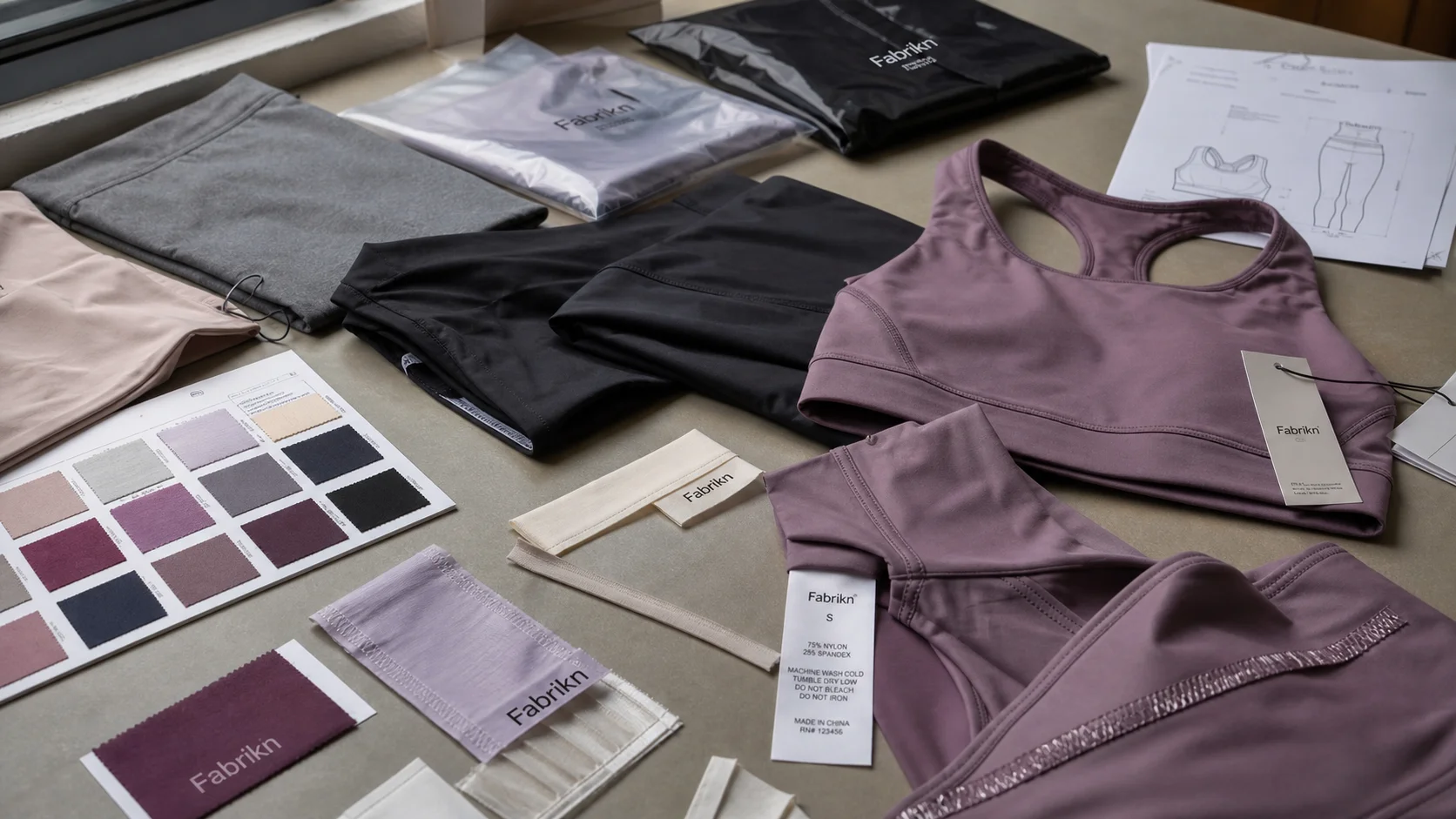
A practical SEO outline for planning minimum order quantities on bulk activewear sets for fitness distributor programs, with section ideas focused on set...
Bulk Activewear Sets MOQ Planning for Fitness Buyers - Fabrikn production reference
Bulk activewear sets are not bought like blank basics. A distributor program has to keep tops and bottoms aligned across fabric shade, stretch, decoration, size ratio, packing, and delivery timing. MOQ planning is the point where those details become commercial decisions, not just production notes. The minimum order quantity reflects fabric booking, print setup, trim purchasing, sewing efficiency, and packaging cost.
For fitness buyers, the working target is clear: protect margin without locking too much cash into one colorway, print, or size curve. The sourcing risk sits in the details. A set may look straightforward on a line sheet, then price differently once the factory separates dye lots, screen counts, heat-transfer setup, stitch programs, custom labels, or packing requirements. MOQ planning should expose those cost points before the PO is issued.
For a broader manufacturing overview, see fabrication and decoration services. For sourcing discussions or RFQ follow-up, use the contact page. Buyers who need supplier background can also review the about page.
Activewear sets carry more coordination risk than a single garment order. A tee can be approved on its own. A set has to read as one program: the top and bottom need compatible shade, stretch recovery, decoration placement, and packing that keeps the pieces paired through warehouse handling and transit.
Size mix is usually where the order starts to tighten. Fitness programs may sell faster in certain sizes, while MOQ rules often favor a cleaner ratio. If the buy includes women’s, men’s, and unisex styles, the quantity can split across too many buckets. The PO may look healthy in total units, but the effective MOQ per color, size curve, or decoration method can still be thin.
Decoration adds another layer. A set may need screen print on the top, a heat-transfer logo on the bottom, and a woven label across both pieces. Each method brings its own setup, approval, and inspection points. Decoration & Printing can decide whether a 300-piece colorway can carry its setup cost or needs to be simplified.
MOQ is usually built from several smaller minimums. The issue is rarely one line item. It is the way fabric, color, decoration, and trim requirements stack inside the same program.
Typical MOQ ranges vary by factory and specification, but many fitness buyers see 300 to 500 sets per colorway as a workable starting point for standard programs. More complex decorated or custom-dyed sets can move toward 800 to 1,500 sets, depending on fabric, trim, and approval workload. Stock-supported programs can sometimes go lower. Fully custom programs should not be costed as if they were stock programs with a logo added.
Buyers should treat MOQ as a cost signal, not a number to push down in isolation. A lower minimum only helps if the order still covers fabric yield, decoration setup, and a realistic defect allowance.
Fitness distributor programs usually need a repeatable assortment, not a one-time fashion drop. That changes the MOQ question. The useful question is not only “What is the minimum?” It is “What minimum supports stable cost, consistent quality, and a reorder path?”
In practice, distributor orders often fall into three structures:
Buyers should separate trial quantity from repeat quantity. A first order may test sell-through at a lower level. The follow-up PO is where pricing usually improves. That only works when the supplier can repeat the same fabric, decoration standard, trim package, and size grading without rebuilding the style.
Sample flow needs to be built into the calendar. A set can pass as a sales sample and still fail in bulk because of shrinkage, shade mismatch, decoration adhesion, or size drift after washing. The approval path should be agreed before bulk materials are ordered.
A practical sample path usually includes these steps:
For decorated sets, buyers should request decoration strike-offs or digital approvals before bulk printing starts. A logo that works on screen may shift in production if the fabric stretches, the print sits over a curved area, or the underbase is too heavy. Dye-sublimation, silicone, and heat-transfer logos should be checked on the actual production fabric when possible, not only on artwork proofs.
Bulk approval should not move forward without confirming:
Lead time is not just sewing time. Activewear set programs depend on fabric booking, lab dips or color approvals, trim sourcing, decoration setup, sample sign-off, and final inspection. A buyer who asks only for cutting and sewing time is not looking at the full schedule.
Typical lead time ranges often look like this:
Seasonal demand can stretch these timelines quickly. If the order is tied to a fitness launch, holiday promotion, or distributor conference, the main risk may be missed approval dates rather than sewing capacity. A late artwork sign-off can hold screens or transfers. A delayed shade approval can push fabric booking. Those slips can move the delivery date even when the factory still has sewing capacity available.
The easiest MOQ wins often come from specification discipline. Buyers do not always need to reduce quality. They may need to reduce the number of variables the factory has to control at low volume.
Specification control also makes supplier quotes easier to compare. If one factory prices stock fabric with a transfer logo and another prices custom-dyed fabric with embroidery, the cheaper quote may not be a cheaper version of the same product. It may be a different product.
Inspection for activewear sets should check the set as a unit, not just as separate garments. A top that passes measurement and a bottom that passes measurement can still fail the program if the shade, fit balance, or decoration position does not match.
Inspection planning should be part of the MOQ conversation because low-volume programs have less room to absorb rejects. If the buyer orders close to the exact selling need, a small defect rate can create broken size runs or short shipments.
A workable MOQ strategy starts with deciding what must be custom and what can stay standard. Buyers should protect the features that matter to the program, then simplify the details that do not affect sell-through.
The strongest buyer position is not always the lowest opening quantity. It is a program the factory can produce cleanly, repeat reliably, and quote without hidden assumptions.
A good manufacturing partner should be able to explain what is driving the MOQ. The answer should be specific: fabric booking, color dyeing, print setup, trim purchase, size grading, packing labor, or inspection requirements. If the explanation stays vague, the buyer has no clear way to adjust the order.
Buyers should bring the supplier a complete working brief: target quantity by color and size, fabric direction, decoration method, label needs, packing format, delivery date, and whether the program is a test or a repeatable assortment. That gives the factory enough information to suggest where MOQ can be reduced without weakening the product.
The best MOQ discussion is practical. Change one color. Move from custom trim to standard trim. Use a stock fabric. Consolidate logo methods. Increase depth in the sizes that sell. Small specification decisions often do more for margin than pushing for a lower minimum with the same complexity.
Get a free quote from Fabrikn — your trusted B2B clothing manufacturer with 10+ years of experience. MOQ as low as 200 pieces.
Get a Free Quote →What is a typical MOQ for bulk activewear sets? Many standard programs start around 300 to 500 sets per colorway, while more custom fabric, color, decoration, or trim requirements can push the MOQ toward 800 to 1,500 sets. The exact number depends on the supplier and specification.
Can buyers order below the stated MOQ? Sometimes, especially with stock fabric and simple decoration. The buyer should expect a higher unit cost or fewer customization options if the order sits below the normal production floor.
What usually raises MOQ the fastest? Custom-dyed fabric, too many low-volume colorways, multi-method decoration, and custom trims usually raise the MOQ faster than basic sewing changes.
Should tops and bottoms be counted as one set or separate units? Both views matter. Buyers sell the program as a set, but factories may manage the top and bottom as separate production items. That difference should be clarified during quotation.
How can a buyer reduce MOQ without weakening the product? Use a proven fabric, limit launch colors, standardize decoration placement, avoid unnecessary custom trims, and confirm packaging early. These changes reduce production complexity while keeping the core activewear set intact.
When should sampling begin? Sampling should begin before the buyer commits to bulk materials or final delivery promises. Pre-production approval is especially important for decorated, custom-colored, or high-stretch activewear sets.