
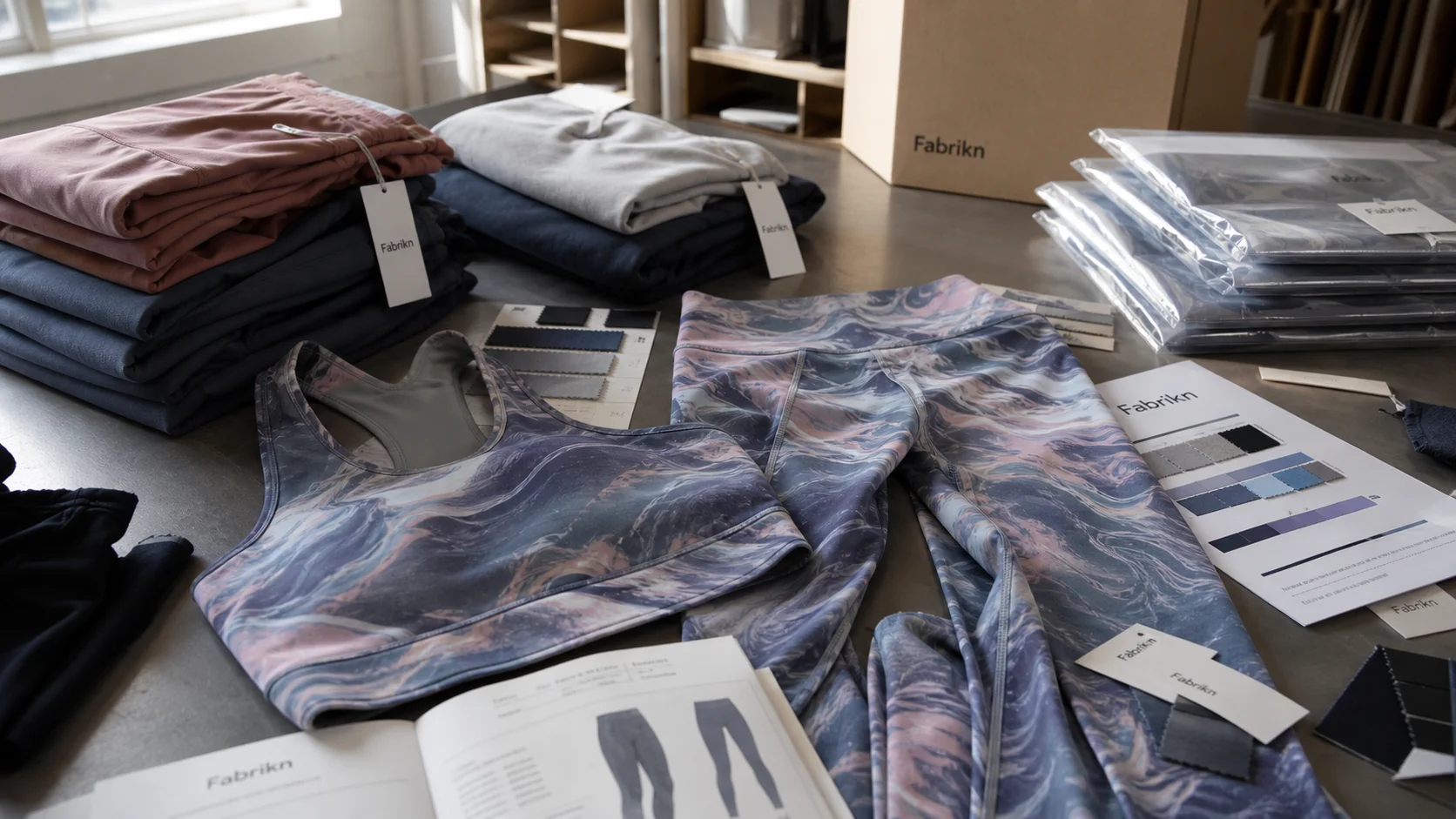
Plan corporate wellness activewear set orders around minimums, size runs, decoration, and replenishment so bulk buys stay on budget and on schedule.
Bulk Activewear Sets MOQ Planning for Orders - Fabrikn production reference
Bulk activewear sets for corporate wellness orders sit at the intersection of brand presentation, employee comfort, and procurement discipline. The product is simple at a glance: a coordinated top and bottom, sometimes with a layer piece, delivered in consistent colors and sizes. The planning behind it is not simple. MOQ assumptions, fabric development, decoration method, size curves, and sustainability document requests can move cost from a typical $12.50-$28.00 per set at 500-1,000 sets to well above $35.00 per set when the order is split across several colors, extended sizes, and custom trims.
For sourcing teams, the main mistake is treating activewear sets like a generic apparel purchase. Sets usually require tighter matching across fabric lots, trims, sizing, and color continuity than basic tees or hoodies. In corporate wellness programs, that matters because the order often needs to cover multiple branches, mixed genders, and a wide size spread. A supplier that can make a 300-set starting MOQ on paper may still struggle once the order becomes 4 colors, 9 sizes, recycled polyester-spandex fabric, and logo decoration on both pieces.
MOQ, or minimum order quantity, is the smallest production volume a factory is willing to run at a workable cost. In activewear, MOQ is not just about the garment body. It is influenced by fabric dye lots, cutting efficiency, sewing line setup, decoration setup, and whether the factory needs to source custom trims, silicone logos, woven labels, heat-transfer neck labels, or branded polybags.
For a basic corporate wellness set, MOQ can be relatively modest if the style uses stock fabric and standard trim packages. A common starting point is 300-500 sets for one color using available 160-220 GSM cotton-poly jersey or 240-300 GSM fleece. Once the program asks for custom Pantone matching, recycled polyester with elastane, private labeling, or men’s and women’s separate fit blocks, MOQ often moves to 800-1,500 sets because the fabric mill and dye house minimums become the real constraint.
Procurement teams should separate three numbers:
A supplier may quote 300 sets as an MOQ, then quietly expect 100 pieces per color and a full XS-3XL size curve. That is not a contradiction. It is a signal that the stated MOQ is only workable if the order is concentrated. A practical sourcing check is to ask for the MOQ by fabric color, by decoration artwork, and by size range before comparing unit prices.
Corporate wellness orders rarely behave like a retail launch. They tend to be cross-functional, deadline-driven, and distributed across regions. The audience is internal, but the expectations are still high. Employees notice poor fit, inconsistent color, scratchy care labels, twisting side seams, and cheap-looking decoration. Procurement notices budget creep, late delivery, and overstock in dead sizes such as XS, 4XL, or unpopular inseams.
That combination changes how MOQ should be planned. A wellness order usually needs a broader size curve than a fashion drop because the wearer population is wider. A common corporate size allocation is 8%-10% XS, 18%-22% S, 25%-30% M, 22%-26% L, 12%-16% XL, and 5%-10% 2XL and above, but HR headcount data should override generic curves. Gender-neutral styling can simplify SKUs, but it increases fit sensitivity around shoulder width, front rise, inseam, and waistband pressure.
There is also a sustainability angle. Corporate buyers increasingly want recycled polyester, organic cotton, lower-impact dyeing, or packaging reduction. Those choices are sensible, but they do affect MOQ. Sustainable fabric programs often depend on mill stock, dye-house capacity, and document availability. Buyers commonly request GRS or RCS transaction certificates for recycled inputs, GOTS scope and transaction documents for organic cotton, OEKO-TEX Standard 100 test reports for restricted substances, or fabric composition test reports from labs such as SGS, Intertek, or Bureau Veritas. Those should be requested as buyer documents, not assumed.
For sourcing teams, the tradeoff is straightforward: a cleaner sustainability story usually requires earlier commitment on color, fabric weight, and label content. Late changes are where programs get expensive. Changing from virgin polyester-spandex to recycled polyester-spandex after lab dip approval can add 10-20 business days for mill confirmation and may reset the MOQ if the recycled yarn is not already in stock.
MOQ varies by factory, country of origin, fabric source, and decoration method. The ranges below are practical starting points, not guarantees. They are useful for budget planning and supplier comparison, especially when paired with a target FOB cost and a clear size curve.
Activewear Set Type Typical MOQ Range Notes Basic tee + jogger set 300 to 800 sets Usually easier if using stock 180-220 GSM jersey and 260-320 GSM fleece with one screen print or embroidery position; typical FOB can land around $11.50-$18.00 per set at 500-1,000 sets. Performance top + legging set 500 to 1,500 sets Higher MOQ is common because 220-280 GSM polyester-spandex or nylon-spandex needs stretch recovery, opacity, and colorfastness testing; typical FOB is often $16.00-$28.00 per set. Sports bra + short set 500 to 2,000 sets Fit sensitivity is high. Buyers should confirm removable cup quality, underband elastic width, bar tack points, and support level before bulk approval. Layered wellness kit with outer piece 800 to 3,000 sets More trims, zipper sourcing, drawcord tipping, pocket construction, and sewing operations can add 5-8 production days versus a two-piece set. Custom recycled-fabric program 1,000 to 5,000 sets Can be efficient at scale, but recycled yarn availability, dye-lot control, and buyer-requested documents such as GRS transaction certificates raise the entry point.These ranges move up or down based on color complexity. One solid corporate color is easier than three mixed shades. A heathered or melange effect often requires higher minimums than a standard dyed fabric because the yarn blend and knit structure are more specialized. Printed sets can also shift MOQ depending on whether the factory uses rotary screen printing, flat-bed screen printing, sublimation transfer printing on a calender press, heat transfer with a pneumatic heat press, or direct-to-garment decoration.
Buying judgment matters here. A low MOQ is not useful if the unit price is so high that the program loses relevance. In corporate wellness procurement, it is often better to order 800 sets in two colors than 500 sets spread across five colors, because cutting markers, trim allocation, decoration setup, and shade control are all cleaner.
Activewear sets should not go straight from quotation to bulk production. The sample path needs to be controlled, especially when the order includes recycled materials or fit-critical items like leggings and bras. A typical development sample takes 7-12 business days after the tech pack is confirmed, lab dips usually take 5-7 business days per round, and a pre-production sample commonly takes 10-15 business days once bulk fabric and trims are available.
A practical approval sequence is usually:
For corporate wellness programs, this stage is where buyer discipline saves money. If the logo placement is untested, the waistband elastic is only 25 mm when the garment needs 35-40 mm support, or the inseam is not aligned with employee feedback, bulk production will simply scale the problem.
Sample approval is not paperwork. It is the last cheap chance to catch a fit or construction issue before the order locks in fabric consumption, trim allocation, decoration screens, cutting markers, and sewing capacity.
One practical point: do not approve a set based only on a hanger sample if the product is meant to be worn for movement. Stretch recovery, squat opacity, seam comfort, and waistband rolling need movement testing. That is especially true for leggings and compression-style tops, where buyers should check 4-way stretch, 30-minute recovery, and opacity under bend and squat positions.
For teams working through vendor selection, a clear services page helps set expectations around development and production support. See Fabrikn services for the kind of project structure buyers usually need, and use the contact page when the order needs a direct quote with size, fabric, and decoration details.
Sustainable fashion sourcing works best when the specification is precise. Broad language such as “eco-friendly activewear” is not enough for production. Buyers need to define fiber content, fabric weight, performance expectations, packaging, and certification or test-report requests before suppliers quote.
Common fabric directions for bulk activewear sets include:
Typical spec points to confirm early:
Lead time is usually driven less by sewing and more by decisions made before sewing starts. For a stock-fabric activewear set with one logo position, a realistic timeline is often 18-22 business days for bulk production after pre-production approval. For custom-dyed fabric, recycled yarn booking, sublimation print artwork, or multiple lab dip rounds, the working timeline commonly becomes 35-55 business days before export handoff.
The main dependencies are fabric availability, lab dip approval, trim procurement, decoration setup, and inspection timing. Stock fabric can be cut quickly once shade continuity is confirmed. Custom-dyed polyester-spandex or nylon-spandex may need 10-18 business days for knitting and dyeing, plus 3-5 business days for finishing processes such as moisture-wicking treatment, brushing, or anti-pilling finishing.
Decoration also changes the schedule. Screen printing usually needs film, screens, strike-off approval, and curing checks. Embroidery needs digitizing and stitch-density approval, especially on stretch fabrics where puckering is common. Heat transfers require temperature, pressure, and peel testing; a typical production setting might be 145-160 degrees Celsius for 10-15 seconds, but the final setting should come from the transfer supplier and be tested on the actual fabric.
A practical sourcing calendar should reserve 5-7 business days for quote and material confirmation, 10-20 business days for sampling, 5-10 business days for approvals and revisions, 18-45 business days for bulk production depending on fabric, and 2-5 business days for final inspection, carton marking, and export documentation.
Inspection for activewear sets should be more detailed than a basic visual check. The common failure points are shade variation between top and bottom, leg twisting, waistband rolling, seam cracking, needle holes on spandex fabric, print cracking, embroidery puckering, uneven inseams, and inconsistent logo placement across sizes.
Common checkpoints include:
For final inspection, many buyers use AQL 2.5 for major defects and AQL 4.0 for minor defects, though the buyer should set the actual standard in the purchase order. Functional checks should include stretch recovery, squat opacity for leggings, drawcord pull strength, zipper operation, colorfastness to rubbing, and wash shrinkage after 1-3 home-laundry cycles. Typical acceptable shrinkage for activewear is often within 3%-5%, but the tolerance should be agreed before production.
The best MOQ plan starts with the wearer count, not the supplier’s lowest headline number. If 600 employees are expected to participate, the buyer should usually plan 660-720 sets to cover size exchanges, late joiners, damaged pieces, and regional allocation errors. A 5%-10% overage is common for corporate programs, while retail-style buys may need a different reserve logic.
Procurement teams should give suppliers a structured request instead of asking for a generic quote. The RFQ should include set type, target fabric, GSM, fiber content, size curve, color count, decoration method, packaging requirement, document requests, delivery deadline, and target price. A useful quote comparison also separates sample charges, mold or screen charges, label setup, bulk unit price, carton packing, and inspection availability.
Cost control usually comes from SKU discipline. For example, 1,000 sets in one navy color with XS-3XL sizing may be much easier to source than 1,000 sets split into navy, black, grey, and green with separate men’s and women’s blocks. The first order may hit a practical $14.00-$22.00 FOB range for a tee and jogger set, while the fragmented version can add $2.00-$6.00 per set because fabric, trims, cutting, and decoration are split into smaller runs.
A strong sourcing brief should also define approval ownership. HR may approve fit feedback, marketing may approve logo color and placement, procurement may approve price, and legal or compliance may approve claims language. Without that sequence, the supplier can lose 7-14 business days waiting for decisions that should have been made before bulk fabric booking.
Get a free quote from Fabrikn — your trusted B2B clothing manufacturer with 10+ years of experience. MOQ as low as 200 pieces.
Get a Free Quote →What is a realistic MOQ for bulk activewear sets?
A realistic MOQ is commonly 300-800 sets for basic stock-fabric tee and jogger sets, 500-1,500 sets for performance top and legging sets, and 1,000-5,000 sets for custom recycled-fabric programs. The practical MOQ depends on color count, size spread, fabric source, and decoration method.
How long does production usually take?
For stock fabric and simple decoration, bulk production typically takes 18-22 business days after pre-production sample approval. Custom dyeing, recycled yarn sourcing, complex trims, or multiple approval rounds can extend the timeline to 35-55 business days before export handoff.
What documents should buyers request for sustainable activewear?
Buyers commonly request fabric composition reports, colorfastness or shrinkage test reports, OEKO-TEX Standard 100 reports, GRS or RCS transaction certificates for recycled materials, and GOTS documents for organic cotton where relevant. These should be requested as supplier or material documents and verified against the actual order.
Which construction details matter most for activewear sets?
Important details include flatlock or coverstitch seams, waistband elastic width, bar tacks at stress points, stitch stretch, logo placement tolerance, fabric GSM, stretch recovery, and opacity. For leggings, crotch gusset construction and squat opacity are especially important.
How should a corporate buyer reduce MOQ risk?
The simplest way is to reduce SKU fragmentation. Use fewer colors, confirm the size curve early, choose stock or already-developed fabrics where possible, approve lab dips quickly, and avoid changing sustainability or decoration requirements after sampling. A clear RFQ can save 1-2 weeks of back-and-forth before quotation.