
A practical SEO outline for construction safety teams sourcing bulk base layer sets, with compliance checkpoints for fabric, fit, labeling, documentation,...
Bulk Base Layer Sets Compliance Checklist for Buyers - Fabrikn production reference
Buying bulk base layer sets for construction safety teams is not the same as buying retail thermal underwear. The garments may look simple, but the sourcing risk sits in the details: fiber content, thermal performance, flame resistance claims, labeling, size grading, color consistency, packaging, country-of-origin marking, and whether the supplier can repeat the approved sample at production scale.
For construction buyers, base layers sit close to the skin and often work under high-visibility vests, FR outerwear, rainwear, or insulated jackets. A weak fabric choice can cause overheating, odor complaints, shrinkage, seam failure, or non-compliance with site PPE rules. A poorly controlled bulk order can also create avoidable cost: rejected cartons, delayed onboarding kits, unplanned rework, and field teams refusing to wear the product.
This checklist is built for procurement managers, safety teams, distributors, and project buyers sourcing base layer sets in volume. It focuses on practical buying controls: what to ask for, what to approve, what to test, and where costs usually move.
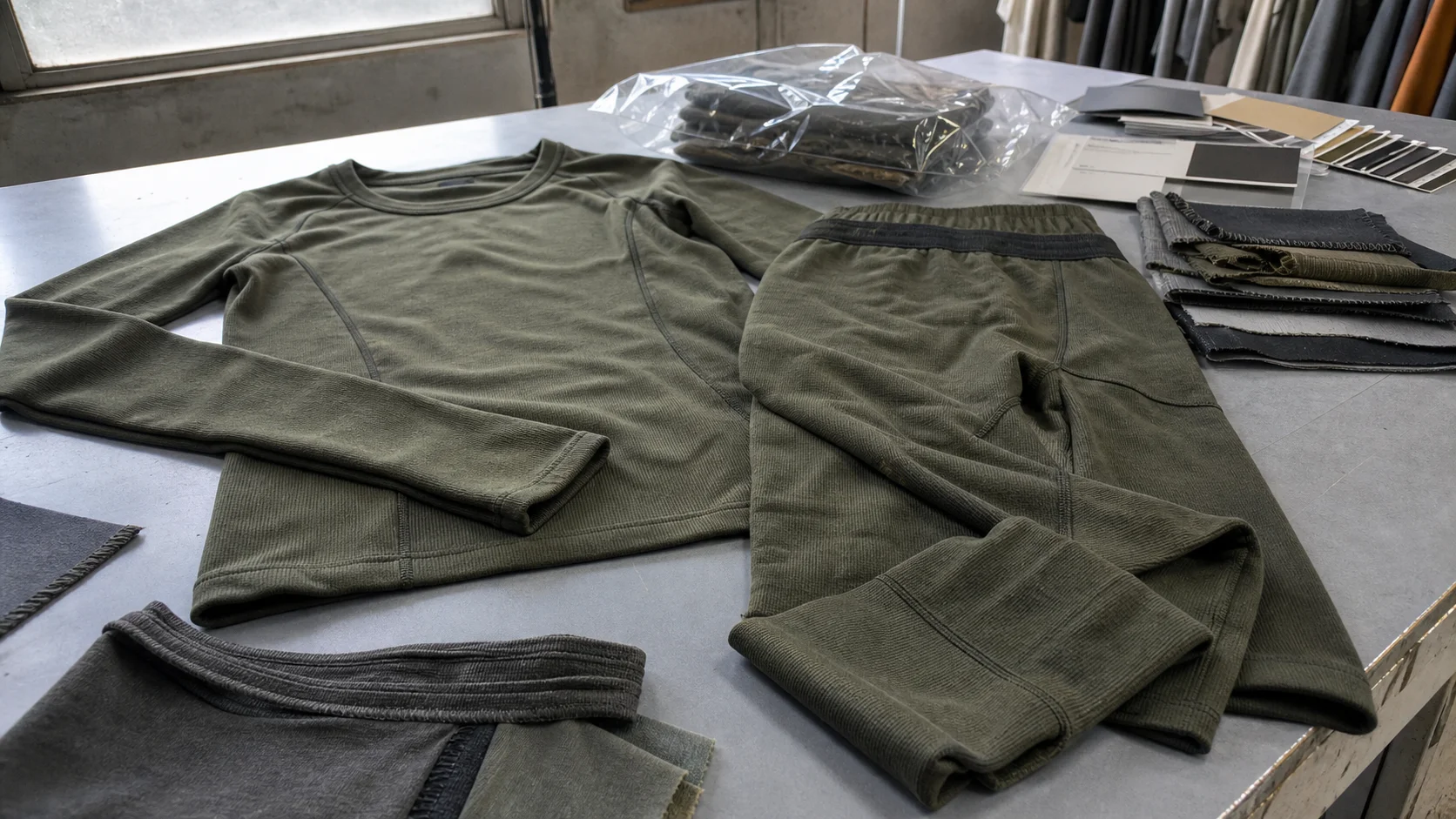
A base layer set usually includes a long-sleeve top and matching bottom designed to be worn under work clothing or PPE. For construction safety teams, common versions include lightweight moisture-wicking sets, midweight thermal sets, heavyweight cold-weather sets, and flame-resistant base layer sets for higher-risk environments.
The buyer should define the set clearly before approaching factories or sourcing partners. “Base layer set” is too broad for accurate pricing. A factory needs to know whether the product is polyester-spandex, merino blend, cotton-rich thermal knit, modacrylic FR blend, or another fabric. It also needs garment weight, seam type, waistband construction, cuff design, labeling rules, color, packaging, and size ratio.
In bulk sourcing, ambiguity creates price differences that look like savings but are often specification gaps. One supplier may quote a 160 gsm polyester jersey with basic overlock seams. Another may quote a 220 gsm brushed thermal knit with flatlock seams and branded waistband elastic. Both are “base layers,” but they are not equivalent garments.
Construction buyers should treat the top and bottom as separate technical garments even when they are sold as one set. Sleeve length, rise, inseam, waistband recovery, and seat stretch all affect whether workers keep wearing the product after the first wash.
The main goal is not simply to buy warm clothing. The buyer needs a compliant, repeatable, and wearable base layer set that supports site safety rules without creating comfort problems. Construction teams work across changing temperatures, physical exertion levels, and PPE layers. A base layer that is too warm can be as problematic as one that is too light.
Before issuing a request for quotation, define the buying objective in plain language. A cold-storage crew, a road crew in winter, a utility contractor, and a general construction team may all need different fabric weights and compliance standards.
A low unit price is only useful if the approved specification survives bulk production, laundering, and field use. For construction safety teams, comfort complaints often become compliance problems because workers stop wearing garments that restrict movement or trap sweat.
Compliance starts before a price is requested. The buyer should identify which safety standards, customer rules, and regulatory requirements apply to the work environment. Base layers may not always be certified PPE, but they can affect PPE performance. This is especially true when worn under flame-resistant outerwear or in environments where synthetic fibers could melt.
For general cold-weather construction use, compliance may focus on labeling accuracy, fiber content, care instructions, chemical restrictions, and product safety. For electrical, utility, oil and gas, welding-adjacent, or high-heat tasks, the buyer may need FR or arc-rated base layers. Those claims should never be accepted based only on a catalog description.
Buyers should request the supplier’s compliance file early. That file may include fabric composition reports, shrinkage tests, colorfastness results, pilling results, FR test reports if applicable, and a declaration of conformity where relevant. If the order is private label, the buyer should also confirm who is responsible for label accuracy and documentation retention.
For buyers building a complete sourcing program, it can help to compare garment development and manufacturing support options through a partner such as Fabrikn services. The practical value is not just finding a supplier; it is turning a vague product request into a controlled specification package.
Fabric is the largest driver of comfort, compliance, and cost. For base layer sets, the buyer should define fabric by fiber content, knit structure, weight, stretch, finish, color, and test requirements. Terms like “thermal,” “moisture-wicking,” and “heavyweight” are not enough for bulk buying.
A cautious buyer should avoid over-specifying features that workers do not need. Antimicrobial finishes, premium wool blends, and branded performance yarns can raise cost and MOQ quickly. They may be worthwhile for long-term uniform programs, but they are often unnecessary for short-duration project kits.
These ranges are general buying references, not universal rules. Knit structure and fiber content can make two fabrics with the same gsm feel very different. A brushed 220 gsm thermal knit may feel warmer than a smooth 240 gsm jersey. Sample testing and wearer trials matter.
FR base layer sourcing deserves separate treatment. A synthetic non-FR base layer worn under FR outerwear can create a serious risk if exposed to flame or arc flash. Some safety programs restrict meltable fibers against the skin. Others require arc-rated base layers for specific job functions.
Buyers should not rely on loose claims such as “fireproof,” “heat resistant,” or “safe for electrical work.” Those phrases are too broad and can be misleading. The purchase specification should name the required standard, test method, rating, and documentation format. If the buyer is unsure which standard applies, the safety officer or qualified compliance consultant should define it before sourcing begins.
The biggest purchasing mistake is treating FR as a fabric-only issue. Thread, waistband elastic, heat transfers, reflective details, care labels, and packaging claims all need review. A compliant fabric can be undermined by non-compliant trims or inaccurate labeling.
If flame resistance or arc protection is part of the buying requirement, the buyer should budget for documentation review and testing. Skipping that step is not a sourcing shortcut; it is a liability risk.
Base layers fail in the field when they restrict movement, ride down, shrink after washing, or feel uncomfortable under work pants and jackets. Construction teams need mobility for bending, lifting, climbing, kneeling, and overhead work. Fit should be close enough to layer properly but not so tight that it limits movement or excludes larger body types.
A bulk order should include a measured size chart and a tolerance table. The supplier should provide garment measurements for chest, waist, hip, sleeve length, body length, inseam, rise, thigh, cuff opening, and waistband relaxed and extended dimensions. For stretch garments, the buyer should also consider recovery after wear.
Size ratio planning affects both cost and worker satisfaction. Standard ratios may not reflect a construction workforce. A buyer that orders too many medium sets and too few XL or 2XL sets may face shortages even when total units look correct. Extended sizes can increase fabric consumption and sometimes unit cost, especially for 3XL and above.
MOQ depends on fabric availability, dyeing requirements, trim customization, label requirements, and factory capacity. For base layer sets, buyers often see lower MOQs when using stock fabric and standard colors. Custom yarn, custom dye, FR fabric, branded waistband elastic, and special packaging usually raise MOQ.
These are typical commercial ranges, not fixed rules. A sourcing partner may be able to combine fabric orders, use existing fabric programs, or negotiate staged deliveries. The buyer should still expect higher pricing at low volume because cutting, sampling, setup, testing, and admin costs are spread across fewer units.
Flatlock seams usually cost more than basic overlock seams, but they reduce bulk and improve comfort against the skin. Brushed thermal fabrics may improve warmth, yet they can increase pilling risk if the yarn and finishing are weak. A premium waistband improves perceived quality, but custom elastic can create MOQ and lead-time issues. These are the tradeoffs buyers should price intentionally rather than discover during production.
If the order is time-sensitive or the specification is still being built, buyers can use a sourcing inquiry through Fabrikn contact to clarify feasibility, MOQ, and production route before locking the purchase order.
Sampling is where buyers prevent expensive mistakes. The goal is to approve a sample that can be reproduced in bulk, not to collect attractive prototypes. Every sample should be tied to a written specification and a decision: approved, approved with comments, or rejected.
Buyers often skip wearer trials to save time. That can be reasonable for repeat orders or standard stock programs, but it is risky for new fabric, new sizing, or a workforce with demanding movement requirements. A short wearer trial can reveal waistband rollover, overheating, ankle cuff discomfort, sleeve twist, or shrinkage complaints before the full order is cut.
The pre-production sample should match the final fabric, final trims, final labels, and final packaging. If a supplier submits a sample with substitute fabric or temporary labels, buyers should treat it as a development sample rather than final approval.
Lead time is not only the sewing time. It includes specification alignment, fabric sourcing, lab dips, sample rounds, trim production, testing, bulk cutting, sewing, finishing, inspection, packing, and freight. A simple stock-fabric order may move quickly. A custom FR set with testing and special trims can take much longer.
A practical planning range for many custom bulk base layer sets is 60–120 days from confirmed specification to dispatch. Stock programs can be shorter. FR programs, extended testing, or late artwork approvals can push longer. Buyers should build the purchase calendar backward from the date workers need the sets on site, not from the preferred purchase order date.
Inspection should be built into the order, especially when buying for safety teams. Base layers are stretch garments, which means measurement and workmanship need careful checking. AQL inspection can be used, but the buyer should define critical defects clearly.
For base layer sets, inspectors should open enough units to confirm that tops and bottoms are correctly paired. Carton-level checks are important because packing errors can be hard to fix after distribution. If sets are issued directly to workers, a mixed-size set creates immediate dissatisfaction and extra handling.
Testing does add cost, but targeted testing is usually cheaper than a failed field rollout. For lower-risk general thermal sets, buyers may choose a focused test package around shrinkage, colorfastness, pilling, and fiber content. For FR or arc-rated sets, compliance testing and documentation should be non-negotiable.
Private label branding is common in uniform and safety programs, but every added trim creates a sourcing dependency. A heat transfer logo may be simple, while a jacquard waistband, custom woven label, or printed retail carton can add MOQ, sampling time, and approval steps.
Packaging should match the distribution method. A retail-style printed box may be unnecessary for internal safety issue. Individual polybags with size stickers may be enough. For project kits, set packing by size and clear carton marks can reduce warehouse labor and prevent wrong-size issuing.
The supplier’s answers before the purchase order reveal how controlled the production will be. Buyers should avoid vague answers and request written confirmation for key points. If the supplier cannot clearly explain fabric source, MOQ, testing, lead time, and sample approval, the order carries more risk.
Supplier selection should consider responsiveness and documentation quality, not only price. A factory that quotes quickly but cannot support compliance paperwork may be a poor fit for construction safety programs. A slightly higher unit cost can be justified when the supplier controls fabric, measurements, testing, and packing more reliably.
Buyers who want to evaluate sourcing partners and manufacturing support can review Fabrikn’s background as part of supplier discovery. The right partner should help pressure-test the product specification before money is committed to bulk production.
The purchase order should do more than state quantity and price. It should attach or reference the approved specification, sample status, packaging instructions, inspection criteria, and compliance documents. If a dispute arises, the purchase order and sealed sample become the buyer’s main protection.
A practical buyer also locks the approval chain. If safety, procurement, branding, and operations all need to review the product, name the decision makers early. Late comments from a branding team or safety manager can delay production and increase costs after materials are already purchased.
For construction safety teams, the best bulk base layer set is not always the warmest or cheapest option. It is the garment that fits the work environment, meets the required compliance level, can be produced consistently, and will actually be worn by the team.
Use stock fabrics and standard trims when speed and lower MOQ matter most. Move to custom fabric, premium trims, or FR programs when the site risk, brand requirement, or long-term uniform strategy justifies the cost. Do not pay for performance claims that are not documented. Do not accept a bulk shipment that has not been compared against the approved sample.
The strongest sourcing process is simple but disciplined: define the use case, write the specification, approve real materials, verify compliance documents, test where risk demands it, inspect before shipment, and keep records. That approach reduces avoidable surprises and gives construction safety teams a base layer program they can issue with confidence.
Get a free quote from Fabrikn — your trusted B2B clothing manufacturer with 10+ years of experience. MOQ as low as 200 pieces.
Get a Free Quote →A typical MOQ can range from 300 to 800 sets for stock fabric and standard colors. Custom colors, branded trims, or special fabrics often move the MOQ into the 800 to 3,000 set range. FR or arc-rated base layer sets can require 1,000 to 5,000 sets depending on fabric availability, testing, and supplier capacity.
Polyester base layers can work well for general moisture-wicking and cold-weather layering. They may not be suitable for work involving flame, arc flash, welding-adjacent tasks, or other heat exposure unless the safety program confirms acceptability. For high-risk environments, buyers should review FR or arc-rated options with proper documentation.
Common tests include shrinkage, colorfastness to washing, colorfastness to perspiration, crocking, pilling, fabric weight, seam strength, and fiber composition. If FR or arc protection is claimed, buyers should request relevant certified test reports for the exact fabric and garment specification.
Many custom base layer set orders require about 60 to 120 days from confirmed specification to dispatch. Stock fabric orders may be faster. Custom dyeing, FR testing, branded trims, late sample approvals, or factory capacity constraints can extend the timeline.
A wearer trial is strongly recommended for new programs, new fabrics, extended size ranges, or demanding work environments. Even a small trial can identify overheating, seam irritation, waistband issues, shrinkage, and mobility problems before the full bulk order is produced.
Size and set-matching errors are common risks. Buyers should check that each top and bottom are correctly paired, measurements match the approved tolerance, fabric weight is consistent, seams stretch properly, and labels match the required compliance and care information.
Yes, private labeling is common. Buyers can add woven labels, heat transfer logos, branded waistbands, size stickers, barcodes, and custom packaging. Each branding element should be approved before production, and FR garments need extra caution because decoration may affect compliance.
The specification should include fabric content, gsm, knit structure, color standard, size chart, seam type, trims, labels, packaging, testing requirements, inspection criteria, and approved sample references. A complete specification gives the supplier less room to substitute materials or interpret requirements differently.