
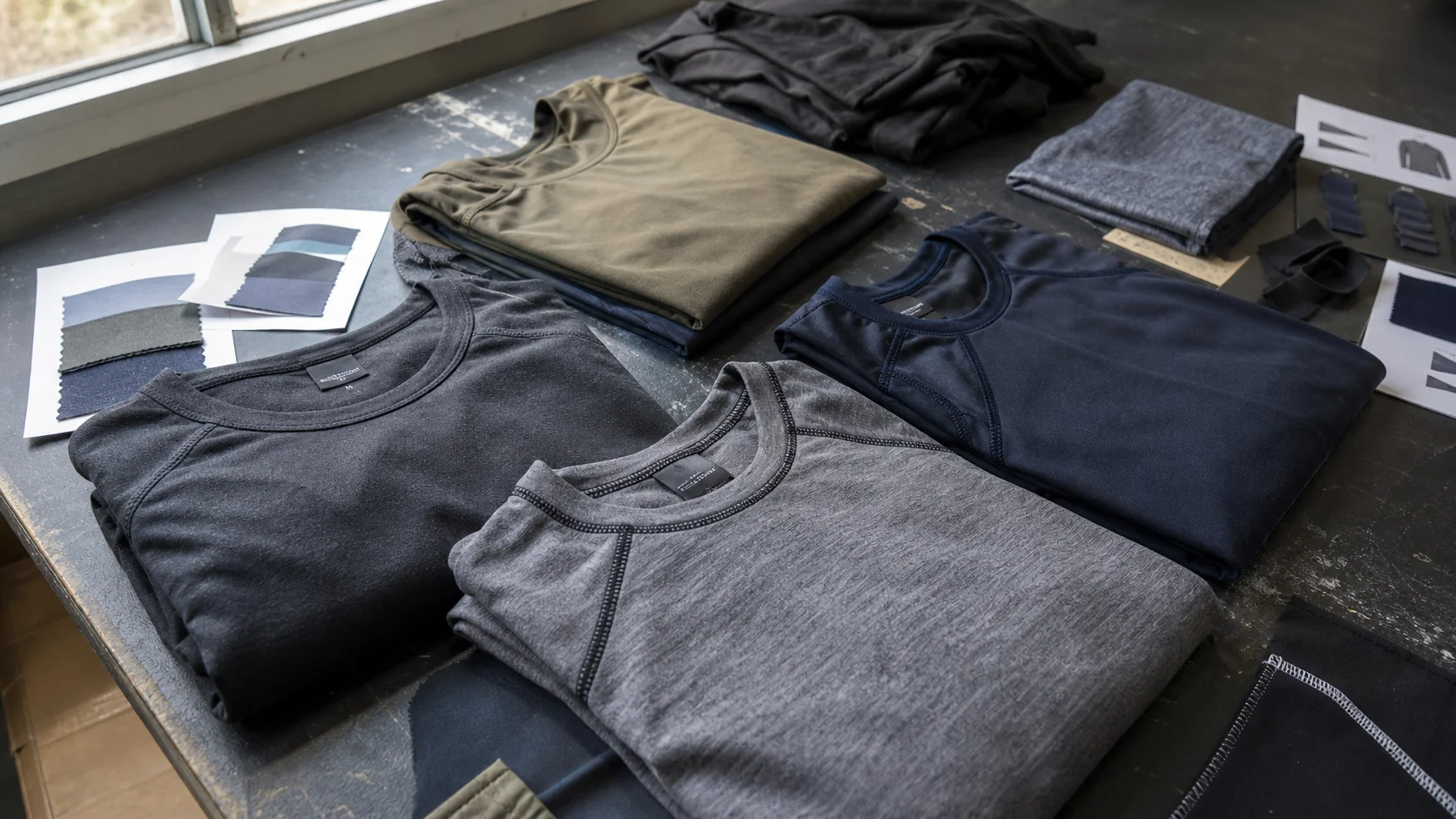
A buyer-focused supplier scorecard for sourcing bulk base layer sets designed for cleaning crews, with the right performance, durability, and decoration...
Cleaning crews need uniforms that work as hard as the people wearing them. A base layer set may look simple at first glance, but for commercial cleaning teams it affects comfort, hygiene, mobility, and consistency across shifts. When sourced in bulk, the difference between a dependable program and a recurring complaint often comes down to fabric choice, sizing stability, wash performance, and supplier control. For that reason, a bulk base layer set supplier scorecard for cleaning crews is one of the most practical tools a purchasing team can use.
This guide breaks down what to look for when buying base layer sets for cleaning crews at scale, how to score suppliers, what fabric and trim details matter most, and where sourcing risk tends to show up. It is written for buyers comparing multiple vendors in the activewear and teamwear space, especially when the end use is demanding and repetitive rather than fashion-led.
Bulk Base Layer Sets for Cleaning Crews - Fabrikn production reference
Base layer sets for cleaning crews are not just cold-weather add-ons. In many facilities, they serve as the first functional layer under a work shirt, tunic, scrub top, or outer uniform. The role is simple: regulate temperature, reduce irritation, wick sweat, and stay presentable through a long shift. A good set should not interfere with movement during bending, lifting, mopping, cart pushing, or repeated reaching.
For cleaning crews, the wrong base layer can create avoidable problems. Excessive warmth may lead to overheating in active indoor work. Weak seams can fail during frequent stretch and recovery. Fabrics that hold odor or pill quickly will shorten perceived garment life, even if the product is technically intact. A supplier should understand that this is a repeat-use work item, not a one-off promotional garment.
In bulk programs, consistency matters just as much as comfort. Crews need predictable fit across sizes, dependable color matching between replenishment orders, and wash stability after repeated laundering. If the supplier cannot control these points, the program becomes harder to manage and more expensive over time.
A scorecard turns a broad sourcing discussion into a measurable comparison. Without it, buyers often rely on sample feel, price per unit, or a polished sales pitch. Those factors matter, but they do not predict performance under cleaning-crew conditions. A scorecard helps separate a supplier that can sell a sample from one that can support ongoing bulk delivery with acceptable quality variation.
For base layer sets, the supplier scorecard should reward operational discipline. That includes accurate tech pack interpretation, yarn and fabric consistency, trim control, packaging accuracy, and willingness to support pre-production approvals. Price should never be ignored, yet the lowest quote can become the most expensive option if it creates rejects, late deliveries, or replacement costs.
A practical scorecard also reduces internal friction. Operations teams, procurement staff, and end-user managers may each prioritize different things. A common scoring framework gives everyone a basis for discussion. It makes it easier to justify a decision when the chosen supplier is not the cheapest but is stronger on repeat quality and on-time delivery.
The best supplier scorecards stay simple enough to use, but detailed enough to reflect real risk. For bulk base layer sets intended for cleaning crews, the following categories are usually the most useful.
Scorecard Category What to Review Why It Matters Fabric Performance Fiber blend, weight, stretch, shrinkage, moisture management, pilling resistance Drives comfort, durability, and wash life Construction Quality Seam type, stitch density, thread quality, neckline finish, hem recovery Affects failure risk and appearance after wear Fit and Size Range Pattern consistency, grading spread, plus-size availability, shrink allowance Impacts comfort and crew adoption Sample Process Prototype accuracy, revision speed, approval workflow Shows how well the supplier handles development Lead Time Reliability Production capacity, material readiness, shipping plan Critical for replenishment and rollout timing Quality Control Inline checks, final inspection method, defect thresholds Reduces surprises at shipment Commercial Terms MOQ, payment terms, pricing stability, re-order support Affects budget and long-term supply continuity Communication Responsiveness, clarity, documentation, issue resolution Predicts ease of managing the programMany buyers weight these categories differently. A common approach is to give fabric and construction a combined 35% to 40%, sample and quality control 20% to 25%, lead time and commercial terms 20% to 25%, and communication 10% to 15%. The exact percentages should reflect the program’s urgency and how expensive failure would be.
A strong supplier for bulk base layer sets should be able to explain fiber content clearly, confirm fabric testing or prior production benchmarks, and show a workable sample approval path. It should also be able to discuss reorder consistency without promising unrealistic exactness. In textile sourcing, there is always some variation; the goal is controlled variation, not perfection.
Buyers should watch out for suppliers who answer only in generalities. If a vendor cannot state expected shrinkage range, seam specification, or packaging method before order placement, that is a warning sign. Cleaners wear these garments hard. The product needs engineering, not just decoration.
For cleaning crews, base layers are usually chosen for comfort under movement and ease of care. The most common fabric options are polyester/spandex blends, polyester/viscose blends, merino blends for premium applications, or brushed synthetics for colder environments. Each option has tradeoffs.
Polyester/spandex is often the most practical for bulk teamwear because it balances stretch, recovery, wash stability, and price. A common range is 85/15 or 90/10 polyester/spandex, though the best ratio depends on whether the wearer needs more compression, more softness, or more breathability. Heavier knit weights may feel more durable, but they can also trap heat. Buyers should test actual wear conditions, not just hand feel.
For construction, look closely at seams and recovery. Flatlock seams are often preferred for low-chafe wear because they reduce bulk and irritation. Coverstitch can be acceptable for hems and necklines if the stitch density is stable. Thread quality should match the fabric and wash program. A weak thread can cause seam pop even when the fabric itself is sound.
Neckline shape also deserves attention. A base layer set for cleaning crews should sit comfortably under the outer uniform without creating visible bulk or collar distortion. Cuffs and hems should recover after repeated stretching. If sleeves ride up or waistbands twist, the wearer will stop using the product as intended.
For cleaning crews, odor resistance may be requested, but buyers should be careful with marketing claims. Antimicrobial or anti-odor finishes can improve user acceptance, yet they also add cost and may have regulatory or durability limits. Ask for clear test references rather than broad performance claims.
MOQ is one of the first commercial filters in bulk sourcing. For base layer sets, MOQs often range from 300 to 1,000 sets per color or style, depending on fabric availability, customization, and supplier size. Larger factories may prefer higher MOQs if dyeing or knitting is involved. Stock-fabric programs can sometimes start lower, but that usually limits color options and trim customization.
Sampling is where many programs lose time. A realistic process often includes a proto sample, a revised fit sample, and a pre-production sample or size set. If the garment is technically simple, some steps may be combined. Still, skipping approvals is a poor tradeoff. A sample that looks close enough on a desk can fail under laundering, movement, or size grading.
Lead time depends on more than sewing capacity. Fabric knitting or sourcing, lab dips, trims, labeling, approval delays, and freight planning all affect the final date. Buyers should ask suppliers to separate material lead time from production lead time. That distinction matters when reorders are needed quickly.
A lower unit price is rarely worth much if the supplier cannot lock in fabric, confirm size grading, and keep a stable replenishment window. For workwear programs, predictability often beats a small cost saving.
As a working rule, many bulk programs need 30 to 45 days for development and approval before production begins, then another 30 to 60 days for manufacturing depending on order size and material readiness. Shipping time is additional. Rush orders are possible, but they increase the risk of missed approvals and rushed inspections.
Inspection risk is easy to underestimate in a basic-looking product. Base layers may appear simple, but they involve multiple failure points: fabric shade inconsistency, size variance, seam twisting, weak stitch density, improper label placement, and mixed carton packing. If these issues are not caught early, they can create expensive rework or partial rejections.
For cleaning crews, garment comfort can also become a compliance issue internally. If staff reject the uniform because it is too hot, too tight, or too scratchy, the purchasing team may end up with stock that sits unused. That is not a factory defect in the narrow sense, but it is a sourcing failure all the same.
Third-party inspection is often worth using once the order size becomes material. Pre-shipment inspection should confirm measurements, workmanship, packing count, label accuracy, and visible fabric defects. If there is any print or logo application, that area needs separate attention for position, sharpness, and wash resistance. For base layer sets, even a small logo can affect wearer comfort if placed poorly.
If a supplier cannot control these points, the issue is usually process maturity, not just one bad batch. That is why a scorecard should reward documented quality systems, not verbal assurance alone. Buyers can review more about sourcing support and production services through Fabrikn services or learn more about the company through About us.
Pricing should be evaluated as landed cost, not factory price only. Freight, duties, packaging, labelling, inspection, and rejection risk can change the real unit economics. For cleaning crews, a slightly higher unit cost may still be better if the garment lasts longer, fits more reliably, and generates fewer complaints.
There are a few practical tradeoffs buyers should weigh. A lighter fabric may lower cost and improve breathability, but it may also reduce coverage and durability. A brushed interior can improve comfort, but it may hold heat. A premium antimicrobial finish may sound attractive, but if the crew washes frequently at high temperatures, the finish may not hold its value.
Buyers should also decide how much customization is truly needed. Private label wash labels, size stickers, and pack-instructions are often useful. Special dyeing, unique prints, and elaborate trim changes add cost and risk. For many cleaning crews, standardization across multiple sites is more valuable than a highly customized garment.
In procurement terms, the right question is not “What is the cheapest base layer set?” It is “Which supplier can deliver an acceptable product repeatedly, with a manageable defect rate and a stable replenishment cycle?” That framing tends to produce better long-term outcomes.
A clean supplier selection process usually begins with a basic brief: intended use, climate conditions, wearer profile, required sizes, fabric preference, logo needs, order volume, target delivery date, and wash expectations. Suppliers should be asked to quote against that brief rather than against a vague concept. Vague requests produce vague offers.
After quotation, request a sample in the actual intended fabric or the closest available equivalent. Compare multiple suppliers using the same test method: hand feel, stretch recovery, seam comfort, visual quality, size consistency, and wash behavior. If possible, wash samples before deciding. A base layer that looks good out of the box can disappoint after repeated laundering.
Once a shortlist is formed, ask for a production plan that shows material sourcing, sampling milestones, inspection timing, and shipment forecast. This is often where the strongest suppliers separate themselves from the rest. They do not just quote a price; they explain how they will protect the schedule.
For buyers looking to start a conversation, the simplest path is often to request a sourcing review and ask direct questions about fabric options, MOQ, and production support. A structured contact process is available through Contact us.
Get a free quote from Fabrikn — your trusted B2B clothing manufacturer with 10+ years of experience. MOQ as low as 200 pieces.
Get a Free Quote →It is a coordinated top-and-bottom base layer, or similar innerwear set, purchased in volume for cleaning staff to wear under their uniforms. The focus is comfort, moisture management, and durability across repeated use.
Typical MOQs often fall between 300 and 1,000 sets per style or color, though the number depends on fabric type, customization, and supplier scale. Stock fabric programs may allow lower MOQs.
Polyester/spandex blends are often the most practical because they balance stretch, recovery, and wash stability. The best choice still depends on climate, wearer activity level, and budget.
Fabric performance, construction quality, fit consistency, sample responsiveness, lead time reliability, inspection control, commercial terms, and communication quality are the core categories.
Most programs need at least one proto sample and one revised or pre-production sample. Fit-sensitive programs may require a size set as well. Skipping approvals increases risk.
Use a clear spec sheet, approve samples carefully, request inline and final inspections, and confirm packing details before shipment. Wash testing is also useful for this product category.
They often focus on unit price first and only later discover problems with shrinkage, fit, or wash durability. For cleaning crews, repeat performance matters more than a small initial saving.
For sourcing support, product development, or early-stage supplier comparison, buyers can review the available manufacturing support at Fabrikn services or reach out directly through Contact us.