
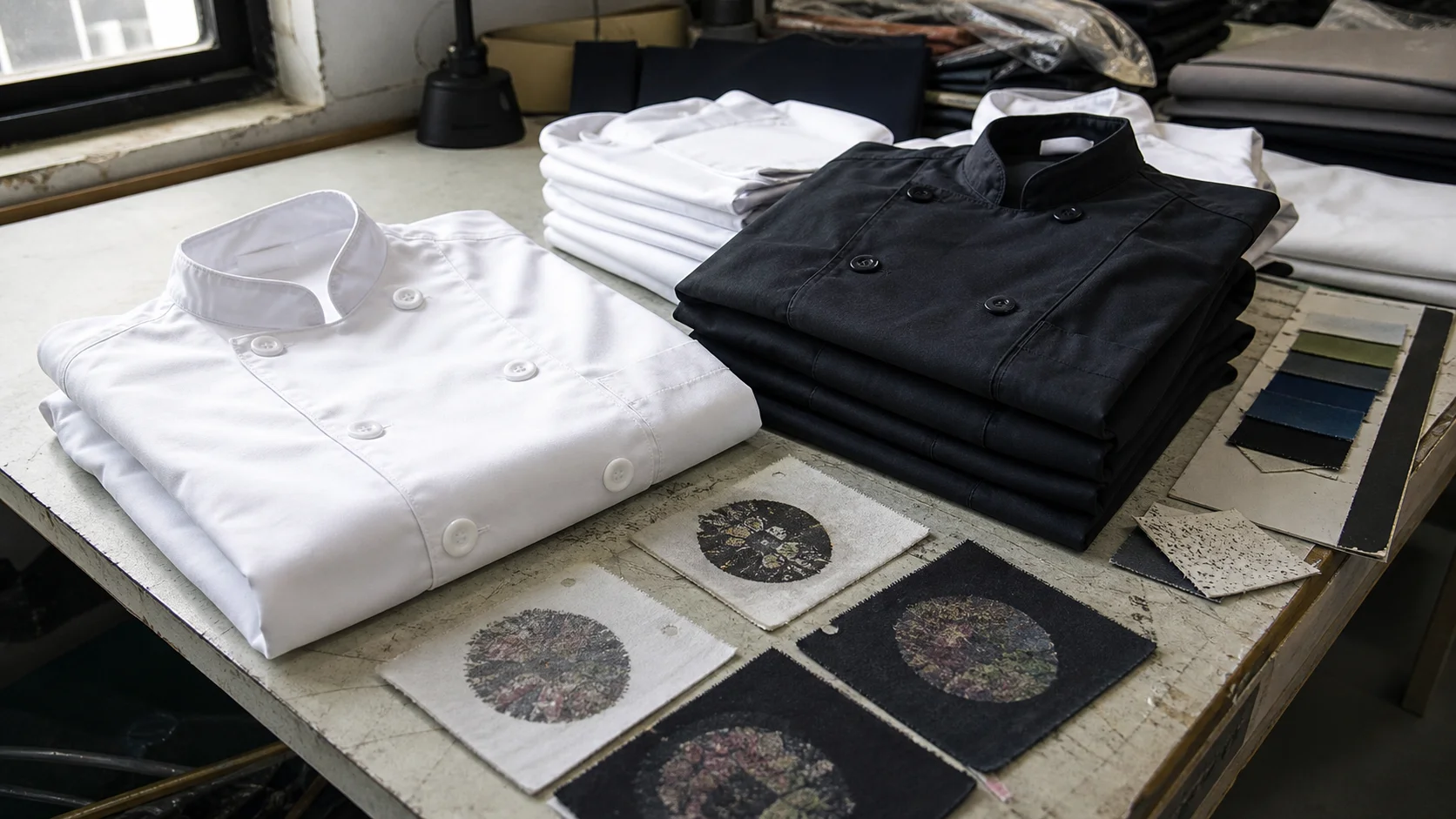
A quality and inspection focused outline for evaluating printed bulk chef coats used by security contractors, with attention to logo wear, laundering,...
Bulk Chef Coat Print Durability Review for Buyers - Quality & Inspection manufacturing guide
Buying printed chef coats in bulk is not the same as ordering a small promotional apparel run. For security contractors, the risk is higher because uniforms are often used across multiple job sites, shift patterns, subcontracted teams, and client-facing environments where brand control matters. A chef coat may be issued to food-service security support staff, event catering control teams, hospitality security supervisors, or hybrid back-of-house personnel working in venues where a clean, professional appearance is required.
The key issue is durability. A printed logo that looks sharp on delivery can crack, fade, bleed, peel, or distort after repeated industrial washing. Once that happens, the coat still has fabric life left, but the uniform no longer represents the contractor properly. That creates avoidable replacement cost and inconsistent presentation across teams.
This review explains how buyers should assess bulk chef coat print durability before placing production orders. It covers print methods, fabric behavior, wash testing, trim risks, inspection checkpoints, MOQ expectations, sample approval steps, and practical purchasing tradeoffs. The goal is not to pick one universal printing method. The goal is to help procurement teams choose the right decoration route for the fabric, usage conditions, washing process, and budget.
Security contractors usually manage uniforms under operational pressure. Staff turnover, multi-site deployment, seasonal event schedules, and client-specific branding can all affect how many garments are needed and how quickly replacements must be issued. If chef coats are part of the uniform program, printed identification has to survive real use rather than just pass a visual check at delivery.
The durability problem is practical. A print can fail even when the base garment is acceptable. White chef coats may still be wearable after months of use, but a cracked chest logo or faded back print makes the contractor look careless. In client environments such as stadiums, hotels, healthcare facilities, corporate kitchens, and large event venues, uniform consistency is part of perceived control.
For security contractors, chef coat prints may include a company logo, department label, role identification, event branding, or site-specific wording. A print failure can create confusion if the garment is used to distinguish approved staff from casual visitors or third-party workers. This is especially relevant where uniforms support access control, food handling supervision, or high-visibility staff coordination.
Durability should be reviewed before bulk production because failures are expensive to correct later. Reprinting finished garments is rarely ideal. It can leave hand-feel differences, registration issues, shadow marks, or heat damage. Replacing the full batch is even worse. A buyer should treat print durability as a quality requirement, not a cosmetic add-on.
Purchasing judgment: if the printed mark is part of staff identification or client compliance, do not approve bulk chef coats based only on a fresh sample photo. Request wash-tested samples or define an agreed wash-test standard before production.
Chef coats are not only bought by restaurants. Contractors may source them for controlled catering operations, event service teams, hospitality support staff, facility service divisions, food safety monitors, or security personnel assigned to kitchen-adjacent areas. Some buyers use chef coats because they provide a clean, authoritative appearance in food-service environments while still allowing embroidered or printed contractor branding.
Security contractors should first define why the garment is being used. A chef coat worn once for a VIP event has different durability needs than a coat issued for daily kitchen access control. A garment used by supervisors may need sharper branding and longer life. A garment used by temporary staff may need a lower unit cost and acceptable short-term performance.
The use case should guide the print method. A temporary event order may tolerate a lower-cost transfer if the wash requirement is limited. A reusable uniform program should lean toward embroidery, high-quality screen printing, or tested heat transfer depending on the logo design and laundering conditions.
Print durability starts with fabric. Many print failures blamed on the decorator are actually caused by poor fabric compatibility, unstable dyeing, excessive shrinkage, or incorrect finishing chemicals. Chef coats are commonly made in cotton, polyester-cotton blends, or performance fabrics. Each behaves differently under heat, washing, pressing, and abrasion.
Cotton chef coats are breathable and familiar, especially in traditional kitchen uniforms. They can accept screen printing and embroidery well if the fabric weight and surface are stable. The risk is shrinkage and wrinkling. If the coat shrinks after printing, the logo may pucker or distort. Cotton can also hold stains more easily, which may lead laundries to use stronger wash cycles that accelerate print wear.
For bulk procurement, buyers should ask for fabric composition, GSM, shrinkage tolerance, and colorfastness data. A common chef coat fabric may range from around 180 GSM to 240 GSM, depending on whether the buyer wants a lighter service coat or a heavier professional kitchen coat. Heavier fabric may feel more premium but can increase heat discomfort in active sites.
Poly-cotton blends are common for uniform programs because they balance comfort, cost, crease recovery, and wash performance. A 65/35 polyester-cotton or 80/20 blend may dry faster and shrink less than 100% cotton. Print adhesion depends on the surface finish and heat tolerance. Some blends accept screen print and transfer well, but the supplier must control curing temperature to avoid scorching or dye migration.
For security contractors managing repeated laundering, poly-cotton is often a practical middle ground. The tradeoff is hand-feel. Some lower-cost blends can feel stiff or less breathable. A buyer should test actual samples, not rely only on composition labels.
Performance chef coats may include moisture-wicking finishes, mechanical stretch, elastane, or lightweight synthetic yarns. These can improve comfort for long shifts, but they complicate printing. Stretch fabrics can crack rigid prints if the decoration does not move with the garment. Heat-sensitive synthetics can also be damaged by transfer application or curing.
If stretch is required, buyers should avoid heavy, inflexible print areas. Smaller chest logos, silicone transfers, flexible heat transfers, or embroidery patches may be safer depending on the fabric. Large back prints on stretch chef coats need careful testing because repeated movement across the shoulders can expose cracking early.
Wrinkle-resistant, stain-release, water-repellent, and antimicrobial finishes can reduce print adhesion. The surface may look normal, but ink or adhesive may not bond properly. This is one reason printed samples should be produced on the actual bulk fabric, not a similar substitute.
Buyers should ask whether the fabric has any special finish. If it does, the factory or decorator should confirm compatibility with the selected print method. The safest specification is clear: actual shell fabric, actual color, actual logo size, actual print method, actual wash test.
No print method is best for every bulk chef coat order. The correct option depends on logo detail, order quantity, fabric type, expected wash cycles, budget, and whether the garment will be industrially laundered. For security contractors, the best choice is usually the one that stays legible after repeated washing with minimal replacement risk.
Screen printing is a strong option for medium to large orders with simple logos and limited colors. It can be durable when properly cured, especially on stable cotton or poly-cotton fabrics. For bulk orders, screen printing is often cost-effective because setup costs are spread across the quantity.
The risks are curing errors, ink cracking, poor opacity on dark fabrics, and registration problems for multi-color designs. Thick ink deposits can feel heavy on chef coats, particularly if placed on the chest or back. In kitchen-adjacent environments, heavy prints may also trap heat and reduce comfort.
Screen printing is a good choice when the logo is simple, the fabric is compatible, and the buyer can approve a wash-tested sample. It is less suitable for highly detailed designs, small personalized names, or very low quantities where setup costs become inefficient.
Heat transfers are common for uniforms because they support sharp logos, multiple colors, and relatively flexible production. They can work well for contractor branding, especially when different client names or site labels are required. MOQ can be lower than screen printing in some cases, and reorders may be easier if transfer stock is prepared.
The main durability risks are peeling, edge lifting, cracking, dye migration, and adhesive failure after washing. These risks increase when application pressure, temperature, time, or fabric compatibility is not controlled. Chef coats exposed to hot wash cycles and tumble drying need stronger transfers than garments used for light promotional wear.
Buyers should specify whether the garment will be domestic washed, commercially laundered, or industrially laundered. A transfer that survives gentle washing may fail quickly in harsher laundry conditions. If a supplier cannot state the recommended wash limit, the buyer should treat that as a risk.
Embroidery is not a print method, but it is often compared with print for chef coat branding. It is durable, professional, and suitable for small chest logos, names, and role identifiers. For security contractors, embroidery can provide a more permanent look and can handle repeated washing better than many print methods.
The tradeoff is cost and comfort. Large embroidered areas can feel heavy and stiff. Dense embroidery on lightweight chef coats may pucker. Fine text can lose clarity if the stitch count is too low or the lettering is too small. Embroidery is usually strong for left-chest logos, sleeve marks, and name lines, but poor for large graphic back designs.
For long-term uniform programs, embroidery is often the safest choice for small branding. For temporary event chef coats or large back identification, print may still be more practical.
Sublimation can produce durable, vibrant prints on polyester fabrics because the dye becomes part of the fiber rather than sitting on top of the fabric. It is useful for full-color designs and all-over graphics. The limitation is fabric type. Sublimation works best on white or light polyester. It is not suitable for cotton chef coats and does not perform the same on dark garments.
Most classic chef coats are not designed as sublimation garments. If a buyer wants sublimated chef coats, the fabric and construction should be selected for that process from the start. Sublimation is not usually the first choice for conservative security contractor uniforms unless the design requires high-color customization.
Printed woven or heat-applied patches can be useful when the buyer wants consistent branding across multiple garment types. A contractor might use the same badge patch on chef coats, work shirts, aprons, and outerwear. This can simplify stock control.
The durability depends on patch construction and attachment method. Sewn patches are generally more secure than heat-applied patches, but they add labor cost. Heat-applied patches can lift at the edges if the adhesive does not suit the fabric or wash process.
Method Best Use Main Durability Risk Buyer Judgment Screen Printing Simple logos, medium to large bulk orders Cracking, poor curing, opacity issues Good value if wash-tested and properly cured Heat Transfer Sharp logos, variable branding, smaller batches Peeling, edge lift, dye migration Useful, but must match wash conditions Embroidery Chest logos, names, role identification Puckering, stiff hand-feel, small text loss Strong long-term option for small branding Sublimation Polyester garments, full-color graphics Limited fabric compatibility Best when designed into the garment from the start Printed Patch Badge-style branding across garment types Edge lifting or stitching inconsistency Good for uniform systems if attachment is controlledA visual sample is not enough. Buyers should request durability testing that reflects actual use. Testing does not need to be overcomplicated for every order, but it must be specific. “Good quality print” is not a measurable standard. “No cracking, peeling, or significant color loss after 20 wash cycles at agreed conditions” is much clearer.
Wash testing is the most important checkpoint for printed chef coats. The buyer should define the washing temperature, detergent type if known, drying method, and number of cycles. A basic domestic wash test may involve 5 to 10 cycles. A more serious uniform program may require 20 to 30 cycles before approval. Industrial laundering may require separate testing because chemical exposure, mechanical action, and drying heat can be much harsher.
For security contractors, the wash test should reflect who controls laundry. If garments are taken home by staff, domestic wash conditions may be realistic but inconsistent. If garments are laundered centrally, the contractor can specify a clearer standard. If the client’s facility handles laundering, buyers should ask for the expected process before choosing the decoration method.
Chef coats can rub against radios, lanyards, ID badges, aprons, counters, and outer layers. A chest logo may experience abrasion from equipment straps. A sleeve logo may rub against work surfaces. Abrasion testing does not always need a lab report, but the supplier should at least evaluate whether the print surface scuffs or flakes easily.
For high-value contracts, buyers can request more formal abrasion or rub testing. This is especially useful for heat transfers and large printed patches. A print that passes washing but scuffs badly during daily use may still fail operationally.
Stretch and flex testing matters for performance fabrics and large prints across movement zones. The print should be bent, stretched lightly where appropriate, and checked for cracking. Rigid prints on flexible garments are a common mismatch.
Buyers should pay attention to logo placement. A small left-chest print may survive well, while the same print compound may crack across the upper back if the wearer is constantly reaching, bending, or carrying equipment.
Dye migration happens when garment dye moves into the print, often causing discoloration. It is more common with polyester fabrics and dark colors, especially red, navy, black, or bright synthetic shades. White or light-colored prints can become tinted after heat application or washing.
Security contractors often use dark branding colors. If the chef coat is black, charcoal, navy, or burgundy, migration testing becomes more important. The buyer should ask for low-migration inks or transfers where needed.
Shrinkage affects print appearance. If the garment shrinks more than the print, puckering can occur. If the print is applied before the fabric has stabilized, the logo may twist or distort after washing. Buyers should ask for shrinkage tolerances for both length and width. For many uniform garments, a practical target may be within 3% to 5%, depending on fabric and price level. Tighter tolerances may cost more.
Test Area What to Check Why It Matters Wash durability Cracking, peeling, fading, edge lift Shows whether the logo survives repeated laundering Abrasion Scuffing, surface wear, flaking Important for equipment contact and daily movement Stretch and flex Cracks under bending or movement Needed for stretch fabrics and large prints Color migration Print discoloration from fabric dye Critical for dark polyester or poly-rich fabrics Shrinkage Logo distortion and garment size change Affects fit, presentation, and repeat ordersA disciplined approval process prevents most bulk print problems. Buyers should avoid jumping from artwork approval directly to production. Chef coats have too many variables: fabric composition, construction, print location, curing, washing, packaging, and size grading.
The garment specification should include fabric composition, GSM, color, size range, button type, sleeve length, pocket details, collar style, care label requirements, and packaging. For chef coats, buyers should also define whether the garment is double-breasted or single-breasted, long sleeve or short sleeve, with plastic buttons, snap buttons, cloth-covered buttons, or removable studs.
Trim details matter because they affect laundry and inspection. Plastic buttons can crack under high heat. Metal snaps can corrode if low-grade materials are used. Poor button attachment can fail before the fabric or print does. A buyer focused only on logo durability may miss these related quality risks.
Artwork should be supplied in a clean vector file where possible. The buyer should define exact print dimensions, Pantone or approved color references, placement from seam lines, and tolerance. A practical placement tolerance may be around plus or minus 0.5 cm to 1 cm for many bulk uniform orders, though complex garments may need careful review.
Placement should be practical. A chest logo placed too close to a pocket, placket, or seam may distort. A back print placed across shoulder seams can wear faster. Sleeve prints may look sharp but can face more abrasion.
The pre-production sample should use actual bulk fabric, actual trims, actual print method, actual artwork, and actual size if possible. A substitute sample is useful only for early design review. It should not be treated as final quality approval.
Buyers should inspect the sample before and after washing. Check print clarity, hand-feel, adhesion, stitch quality, garment symmetry, button strength, label accuracy, and packaging. If the sample fails after washing, do not assume bulk will improve. Bulk usually exposes more variation, not less.
Uniform buyers often order broad size ranges. A print that fits well on medium may look too large on small or too small on 4XL. Security contractors should confirm whether the same logo size will be used across all sizes or adjusted for extended sizes. Consistency is important, but visual proportion also matters.
For large orders, approve a size set before full production. This is especially useful when chef coats are worn over base layers or protective garments. Fit complaints can drive replacement requests even if the print is durable.
During production, print application conditions should be controlled. For heat transfer, this means time, temperature, pressure, peel method, and cooling time. For screen printing, curing temperature and dwell time are critical. For embroidery, thread tension, backing, stitch density, and trimming must be monitored.
Buyers working through a sourcing partner can define production checkpoints early. Companies reviewing apparel development and production support can explore Fabrikn services to understand how structured sourcing support may help align product specs, sampling, and quality expectations.
Final inspection should include both garment quality and decoration quality. Printed chef coats can pass general sewing inspection and still fail branding requirements. The inspector should be given the approved sample, measurement chart, artwork file, placement guide, packing list, and acceptable quality limits.
Inspection should include a reasonable sample size across sizes, colors, and cartons. If the order includes multiple site names or client logos, each version should be checked. Mixed branding errors are a real risk in contractor orders because similar garments may carry different markings.
Purchasing judgment: if the order includes several logos or site names, require carton-level labeling and version control. The cost of sorting mixed uniforms after delivery can exceed the savings from a low-cost supplier.
MOQ depends on whether the buyer is ordering stock chef coats with decoration or fully custom chef coats. Stock decoration can start at lower quantities. Fully custom production requires fabric sourcing, cutting, sewing, trims, labels, and decoration, so the MOQ is usually higher.
These ranges are typical planning references, not fixed rules. A supplier may accept lower quantities at a higher price, especially for simple stock decoration. A factory may also require a higher MOQ if the fabric is uncommon, the size range is wide, or trims must be custom made.
Lead time depends on approvals. A simple stock decoration order may take around 2 to 4 weeks after artwork and sample approval, assuming blank inventory is available. A fully custom chef coat program may take around 6 to 12 weeks after approvals, depending on fabric sourcing, lab dips, trim development, production capacity, and inspection scheduling.
Delays often come from unclear specifications, artwork revisions, failed wash tests, missing size breakdowns, late deposit payments, or changes in packaging requirements. For security contractors working against event dates or client onboarding deadlines, sample approval should be started early. Rush production can reduce quality control time and increase decoration failures.
Buyers should also consider reorder timing. If the chef coat program will continue, ask whether the supplier can hold fabric, maintain transfer films, keep embroidery files, or repeat the same shade. Shade continuity matters for white coats too, because different batches can vary in brightness or undertone.
A good specification reduces arguments. It tells the supplier what to make, how to test it, and what will be rejected. For printed chef coats, the spec should cover the garment, decoration, washing expectation, packaging, and inspection standard.
Care labels must match the decoration method. A heat transfer that cannot be tumble dried should not be used for a program where tumble drying is unavoidable. A printed coat that cannot handle chlorine bleach may not suit environments where white garments are aggressively laundered. The buyer should not approve care instructions that staff or laundry providers will ignore in practice.
Contractors that need help clarifying garment requirements, production expectations, or quality checkpoints can review Fabrikn’s background and assess whether the sourcing approach fits their procurement needs.
The cheapest print is not always the lowest-cost option. If a low-cost transfer fails after five washes, the replacement cost, shipping cost, staff dissatisfaction, and client impression can erase the savings. At the same time, the most durable option may be excessive for a one-week event. Buyers should match durability to the real operating life of the garment.
Choose embroidery for long-term use, small logos, names, and premium presentation. It is a strong option for supervisor chef coats or security contractor uniforms that must remain consistent over many wash cycles. Avoid dense embroidery on very lightweight fabric unless the sample proves stable.
Choose screen printing for repeat bulk orders with simple designs and stable fabric. It can be cost-effective and durable if curing is controlled. Avoid it for very low quantities, complex color gradients, or fabric surfaces that resist ink bonding.
Choose heat transfers when artwork is detailed, quantities are split across multiple logos, or faster customization is needed. Demand wash testing. The transfer must be suitable for the fabric and laundry process. Avoid bargain transfers for industrial laundering unless testing proves performance.
Use patches when the contractor wants a badge-style identity across multiple apparel categories. Sewn patches are safer for durability than heat-only patches in demanding wash environments. The tradeoff is a more structured look and extra labor cost.
There are cases where decoration should be minimized. If chef coats will face bleach-heavy laundering, high heat, heavy abrasion, or frequent replacement, a small embroidered badge or sewn label may outperform a large print. If the staff role must be visible from a distance, consider a separate apron, vest, or outer layer rather than overloading the chef coat with a large back print.
Direct buying view: for a recurring security contractor uniform program, a small embroidered chest logo on a stable poly-cotton chef coat is usually safer than a large decorative print. For short-term event branding, a tested heat transfer may give better flexibility and lower upfront cost.
Before issuing a purchase order, buyers should run through a simple checklist. This keeps the discussion practical and prevents quality assumptions from replacing written requirements.
This checklist is not only for large enterprises. Smaller security contractors can use the same logic at a lighter level. The buyer may not need formal lab testing for every order, but they should still request a washed sample and inspect it carefully before committing to bulk production.
Artwork approval only confirms the design. It does not confirm durability. A digital mockup cannot show shrinkage, adhesion, dye migration, or hand-feel. Buyers should separate artwork approval from physical sample approval.
A decoration method that works for retail apparel may not survive uniform laundering. Chef coats often need hotter washing than casual garments. If staff or laundry providers use bleach, strong detergents, or high drying heat, the print must be selected accordingly.
Placement affects durability. Prints near seams, pockets, plackets, and high-movement areas face more stress. Large back prints may look good in a mockup but crack or feel uncomfortable in use.
Uniform orders often include extended sizes. Logo proportion and placement can shift across sizes. A size set review helps prevent awkward branding on small and plus-size coats.
Unit price matters, but replacement rate matters more. A slightly higher decoration cost may be justified if it reduces complaints and reorder pressure. The buyer should compare cost per expected wear, not only cost per garment.
A bulk chef coat print durability review should be handled before production, not after complaints arrive from the field. Security contractors need uniforms that look controlled, consistent, and professional across sites. That requires a practical match between fabric, decoration method, wash process, and inspection standard.
The best buying decision is rarely the most complicated one. For durable everyday use, stable poly-cotton fabric with embroidery or well-tested print decoration is often a sensible route. For temporary or variable branding, heat transfers can work if the buyer verifies wash resistance. For large, simple repeat orders, screen printing can be economical if curing and fabric compatibility are controlled.
Procurement teams should insist on real samples, clear specifications, wash testing, and final inspection. If the order involves multiple contractor sites, client names, or event roles, version control should be treated as part of quality assurance. Buyers preparing a new uniform project can contact Fabrikn to discuss sourcing requirements, quality expectations, and production planning for bulk apparel programs.
Get a free quote from Fabrikn — your trusted B2B clothing manufacturer with 10+ years of experience. MOQ as low as 200 pieces.
Get a Free Quote →For small chest logos and long-term uniform use, embroidery is usually one of the most durable options. Screen printing and heat transfers can also perform well when matched correctly to the fabric and laundering process. The safest choice depends on logo size, fabric composition, wash temperature, and expected garment life.
For basic approval, buyers often start with 5 to 10 wash cycles. For recurring uniform programs, 20 to 30 cycles gives a better view of durability. Industrial laundering may require more specific testing because heat, chemicals, and mechanical action are harsher than domestic washing.
Heat transfers can be suitable if the transfer quality, application settings, and fabric compatibility are controlled. They are useful for detailed logos and variable site branding. Buyers should be cautious with low-cost transfers if the coats will be washed frequently or exposed to high drying heat.
Polyester-cotton blends are often practical for bulk uniform programs because they can offer better shrinkage control and easier care than 100% cotton. Cotton can still work well, especially for comfort and traditional appearance, but shrinkage and laundering conditions must be reviewed. Performance fabrics need extra print compatibility testing.
Stock chef coats with decoration may start around 50 to 150 pieces, depending on the method. Screen printing is often more economical from around 100 to 300 pieces. Fully custom chef coat production commonly starts around 300 to 1,000 pieces, with higher MOQs for custom fabric, special colors, or unique trims.
Common causes include poor curing, incorrect heat press settings, incompatible fabric finishes, excessive stretch, harsh washing, high drying heat, and low-quality transfer materials. Shrinkage can also distort or stress the print after laundering.
Large back prints can improve visibility, but they may reduce comfort and increase cracking risk in high-movement areas. For daily uniforms, buyers should test the print after washing and flexing. For short events, large back prints may be acceptable if the expected wear life is limited.
Inspectors should check print clarity, adhesion, placement, color, cracking, peeling, heat marks, garment measurements, stitching, trims, labels, stains, and carton labeling. If multiple logos or site names are included, every version should be verified before shipment.
Some printed chef coats can handle industrial laundering, but only if the fabric, print method, and care instructions are designed for it. Buyers should not assume a standard print will survive industrial wash conditions. Testing should be agreed before bulk production.
Use a clear specification, approve a physical pre-production sample, run realistic wash testing, confirm fabric finishes, define placement tolerances, and inspect bulk goods before shipment. These steps reduce the chance of receiving chef coats that look good on arrival but fail after a few washes.