
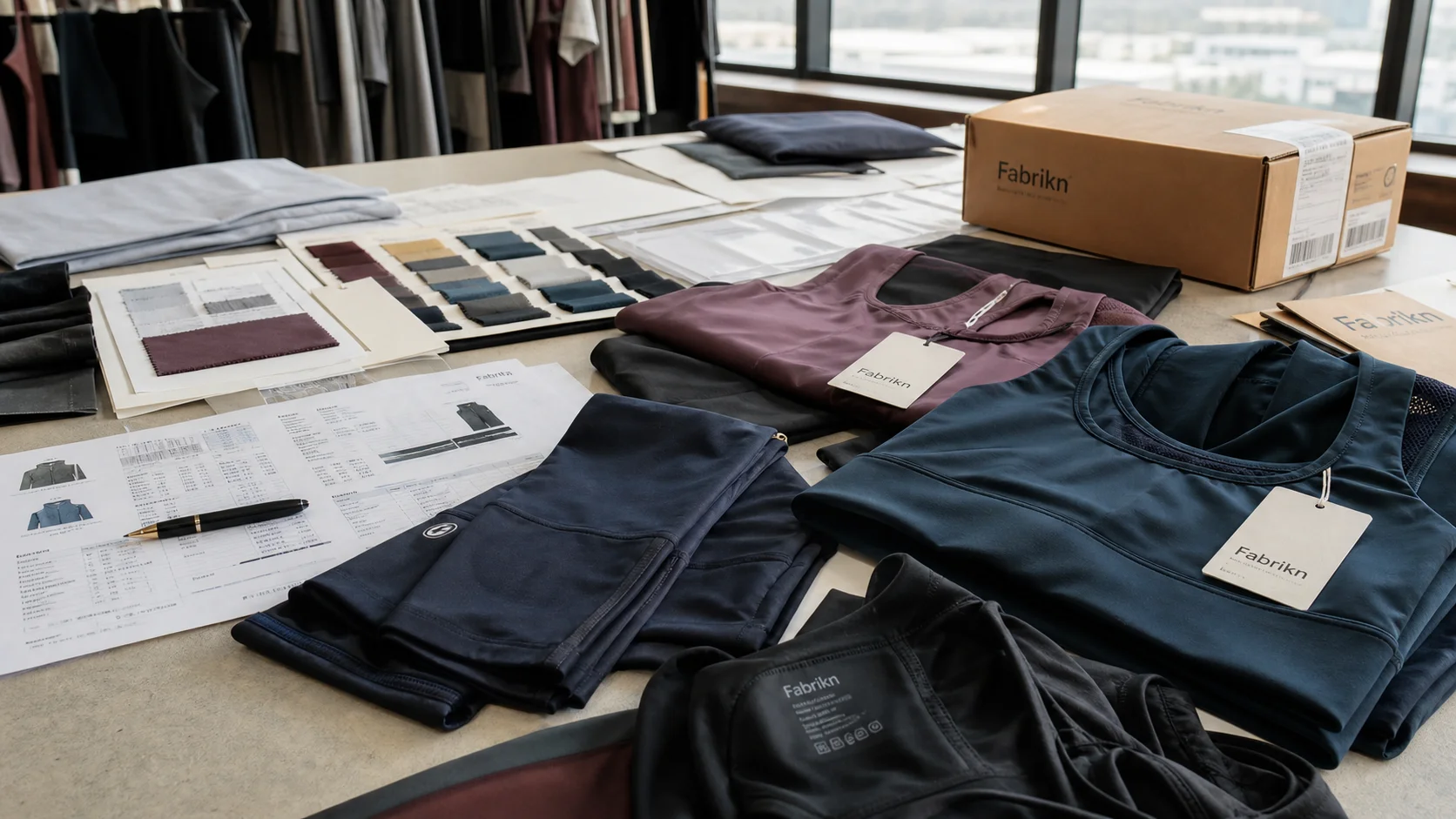
A practical outline for an SEO article on what drives bulk cut and sew tracksuit pricing for regional sportswear brands, with cost components, order...
Bulk Cut and Sew Tracksuit Pricing for Brands - Fabrikn production reference
Bulk cut and sew tracksuit pricing is one of the first commercial questions regional sportswear brands ask when they move beyond blank garments or import-ready stock styles. In practice, a basic teamwear set in 220-240 GSM polyester tricot commonly lands around $12.00-18.00 per set at 500 sets, while a more developed 280-320 GSM interlock, double-knit, or brushed-back program with multiple panels, embroidery, and custom trims often reaches $22.00-34.00 per set at the same volume. Price depends on fabric weight, pattern complexity, trim quality, decoration method, order quantity, and how much development work sits between the first concept and a production-ready set. For brands selling into local clubs, school programs, training academies, or regional retail channels, the right approach is to understand the cost structure before negotiating the factory quote.
Cut and sew tracksuits are usually built from custom patterns, custom colorways, and a specification sheet that defines the fabric, zippers, elastic, lining, rib, stitching, and logo application. Typical specs include body fabric composition such as 100% polyester tricot or 92/8 polyester-spandex interlock, GSM tolerance of plus or minus 5%, SBS or YKK nylon coil zippers, 2x2 rib at cuffs, and 3 cm waistband elastic with internal drawcord. That level of control is useful for branding, fit consistency, and margin management. It also means the supplier is not pricing a commodity blank. Every decision affects labor time, material yield, and approval risk.
For brands evaluating suppliers, it helps to review the manufacturer’s process and service scope first. A straightforward starting point is fabric and garment production services, followed by direct conversations through contact when the program has a target price, quantity, and seasonal window. Buyers usually get more accurate first quotes when they provide a tech pack, size breakdown, color count, decoration file type, and target ex-factory budget from the start. Background on the company, its production model, and its role in apparel manufacturing is usually easier to assess from about information than from a quote alone.
A bulk quote for a tracksuit normally reflects two pieces: the jacket and the pant. Some suppliers price them as a set, while others break them out line by line. Brands should ask for both, because it reveals where the cost sits and makes later negotiation easier. At 500 sets, a straightforward jacket in 230 GSM tricot with a front zipper and two zip pockets might price around $6.50-9.50, while matching pants often come in around $5.50-8.00 depending on ankle zips, pocket construction, and lining. A jacket with a full front zipper, lined hood, contrast panels, rib cuffs, and chest embroidery will rarely land at the same price as a simple unlined warm-up top. Pants with zip pockets, ankle zips, mesh lining, or shaped panels add their own labor and material burden.
The broad pricing range is usually driven by the spec level rather than the category name. A basic polyester tricot tracksuit for teamwear can be significantly cheaper than a brushed fleece or bonded knit version with multiple panels and heat-transfer branding. For example, moving from 230 GSM tricot to 300 GSM brushed-back double knit can add roughly $1.20-2.40 per set in fabric cost alone before sewing impact. Small detail changes can move the cost more than some buyers expect. A covered zipper garage, a branded woven tape, or a lined hood may look minor on the line sheet, yet each item adds handling, trimming, and inspection time.
Regional sportswear brands should also separate garment cost from landed cost. Freight, duties, packaging, carton labeling, and inspection services can shift the final number enough to matter. Polybag, size sticker, barcode label, and export carton costs commonly add $0.25-0.60 per set, while third-party inline or final inspection is often budgeted separately. A clean factory price is useful, but it is not the number that decides margin. The real question is whether the full landed cost still supports the intended wholesale or retail price point.
Fabric choice is usually the biggest driver after quantity. Polyester tricot, double-knit polyester, interlock, brushed fleece, and recycled blends all behave differently in cutting and sewing. Common tracksuit fabrics include 100% polyester tricot at 220-240 GSM for teamwear, 95/5 poly-spandex interlock at 250-280 GSM for a cleaner athletic hand feel, and 60/40 cotton-poly brushed fleece at 280-320 GSM for lifestyle sets. Knit stability, shrinkage control, and color consistency affect reject rates and handling. A heavier GSM does not automatically mean a better garment, but it often means higher fabric cost and more sewing resistance. Stretch content also changes the pattern approach and can increase waste if the marker made in CAD is not efficient.
Trim package matters just as much. Zippers, drawcords, cord tips, elastic, snaps, labels, hanger loops, and heat transfer prints all create cost. Suppliers often quote standard components first, then adjust when the buyer specifies branded hardware or custom-dyed trim. A standard #5 nylon coil zipper is commonly much cheaper than a reverse coil branded zipper with custom puller, and custom silicone badge, molded cord end, or woven patch programs can add $0.30-1.20 per unit depending on volume. If the product is for teamwear, buyers should decide early whether the brand wants visual distinction or a price-led offer.
Construction complexity is a third major factor. Raglan sleeves, curved side panels, color blocking, piped seams, topstitch detailing, and lining all increase labor. A basic jacket body may use 10-14 pattern pieces, while a fashion-heavy color-blocked set can easily run above 20 pieces once pocket bags, facings, waistbands, and collar or hood components are counted. Each added seam line affects sewing time and quality risk. Pockets are not equal either. Welt pockets, zip pockets, and seam pockets carry different allowances and machine operations, often involving single-needle lockstitch, overlock, bartack, and edge-cover finishing. Buyers often underestimate how much a pocket bag or zipper guard changes the quote.
Decoration can shift pricing materially. Embroidery is durable and premium, yet it can slow production and may require extra handling for stabilizing fabrics. Heat transfer is efficient for smaller logos and variable names, but some transfer systems are less durable under repeated wash cycles. Screen print can be economical at volume, though it is less suited to performance fabrics that need breathability or a soft hand. Typical sourcing detail: left-chest embroidery of 6,000-8,000 stitches may add around $0.35-0.80 per piece at volume, while a single-color heat transfer logo can be closer to $0.15-0.40 depending on size and supplier setup charge. The right choice depends on the product position and the wash standards expected by the end customer.
MOQ is not only a factory policy. It reflects fabric minimums, cutting efficiency, color matching economics, and the supplier’s willingness to reserve production time for a custom program. In activewear and teamwear, a small order often carries a disproportionately high cost because setup time is spread across fewer units. Buyers should expect this and compare quotes on a like-for-like basis. For dyed-to-order knits, common fabric mill minimums can start around 250-300 kg per color, which can become the real commercial floor even if the sewing factory accepts a smaller cut quantity.
Order Tier Typical Program Shape Commercial Implication 100-300 sets Development or small regional drop Higher unit price, often 15-30% above a 1,000-set run, limited trim customization, more sampling pressure 300-1,000 sets Regional club, school, or retail test run More workable pricing, wider fabric options, better marker efficiency, and more realistic access to custom labels and packaging 1,000-5,000 sets Established seasonal program Factory setup becomes more efficient, stronger leverage on materials, and better ability to book repeated dye lots and trims 5,000+ sets Scaled regional or multi-channel rollout Lowest practical unit cost, but longer planning, tighter forecast discipline, and firmer booking of fabric and line capacity are usually neededMOQ should be discussed in terms of color, size breakdown, and style mix. A supplier may accept 500 sets overall, yet require 200 units per color or 100 units per size range if the fabric is stocked or dyed in batches. Brands that plan regional sportswear drops around club colors should confirm whether each colorway is treated as a separate MOQ. That detail often changes the economics more than the headline quantity. It is also common for mills to require surcharge recovery when one color consumes less than the standard dye lot minimum.
Sampling is where many projects lose time and margin. A tracksuit usually needs a technical pack, fabric swatches, trim approvals, size set samples, and a pre-production sample before bulk release. Typical sample charges for a cut and sew tracksuit are often in the $80-180 range per set for initial development, with higher charges when custom-dyed fabric or special embroidery files are required. Buyers who rush sampling often pay later through delays, rework, or spec drift. A good sample process reduces those risks, but it also extends the calendar.
There are several sample stages worth planning for. A proto sample is usually for silhouette and construction review. A fit sample confirms measurements on the intended size range. A salesman sample may be needed for marketing or buyer presentation. A pre-production sample, made from bulk-confirmed materials, is the one that matters most before cutting starts. Typical timing is 7-10 business days for a proto in substitute fabric, 7-14 business days for fit revision rounds, and 5-7 business days for a PP sample once bulk fabric and trims are in-house. For regional brands, this sequence is practical because it catches issues before larger fabric commitments are placed.
Lead-time expectations should include sample feedback cycles. If the brand takes a week to review each round, the calendar shifts immediately. If fit comments are vague, the factory may revise the wrong area and burn another round. Clear measurement tolerances such as chest width plus or minus 1 cm, inseam plus or minus 1 cm, stitch requirements, logo placement, and wash standards reduce this risk. Missing detail at the sample stage almost always gets expensive later. A useful checkpoint is to approve print strike-off, embroidery swatch, zipper color, and bulk fabric lab dip before PP sample sewing begins.
Fabric specification should be written in practical terms, not just fabric names. A supplier needs composition, GSM, knit structure, finish, and color target. For example, polyester tricot, double-knit polyester, or recycled polyester each implies a different hand feel and performance profile. Common spec language would be 100% polyester tricot 230 GSM with brushed back, anti-pilling finish, and color matched to Pantone reference within mill tolerance. If the tracksuit is intended for training, moisture management and durability matter. If it is aimed at lifestyle wear, hand feel and drape may matter more.
Trim and construction details should be equally specific. Buyers typically need to call out zipper type, pocket opening method, rib composition, thread count, seam type, and label application. For example, a standard build might use #5 reverse nylon zipper, 1x1 or 2x2 polyester rib, 120D/2 polyester sewing thread, four-thread overlock for joining, lockstitch topstitching at major seams, and bartack reinforcement at pocket openings. Without this level of definition, suppliers will quote to different assumptions and the cheapest quote may simply reflect a lighter trim package.
Inspection-sensitive construction points should also be stated early because they affect both cost and risk. Common checkpoints include zipper wave, panel alignment at side seams, embroidery position tolerance, pocket symmetry, waistband elastic twist, color shading between jacket and pant, and finished measurement tolerance after wash. Buyers that sell into schools, clubs, or retail chains often also request test reports or compliance documents for the fabric or trims, such as colorfastness, azo-free dye confirmation, or buyer-required chemical compliance paperwork, before approving bulk.
Lead time for bulk cut and sew tracksuits is usually determined by material readiness more than sewing speed. Once approvals are closed, a common production window is 18-22 business days for 500-1,000 sets using available fabric programs, and 30-45 business days when the order depends on custom knitting, dyeing, special trims, or repeated sample revisions. The sewing line itself may only need several days, but fabric knitting, dyeing, heat setting, and trim arrival often control the real schedule.
Production scheduling usually follows a predictable path: lab dip or color approval, fabric booking, knitting or greige allocation, dyeing and finishing, trim arrival, marker making, cutting, sewing, finishing, inspection, and packing. In knit activewear, the cutting room commonly uses CAD marker planning and straight-knife or band-knife cutting, while heat transfer logos may be applied with a pneumatic heat press either before or after sewing depending on placement. Any delay in lab dip approval, artwork release, or trim confirmation can push the line booking.
Buyers should also ask what dependencies change the date. Custom-dyed fabric, sublimated panels, branded zipper pullers, and woven labels often arrive on different calendars. A practical sourcing question is whether the supplier will reserve sewing capacity before all trims are complete or only after materials are fully in-house. That answer affects delivery certainty. It is also common for pre-holiday peaks or school-season programs to require booking 4-6 weeks earlier than normal.
Regional sportswear brands should prioritize consistency before chasing maximum customization. A repeatable fit block, dependable fabric quality, and stable trim sourcing usually create better commercial results than adding every possible design feature in the first season. For a club or academy program, the difference between a reliable $14.50 set and a highly developed $19.50 set can matter less than on-time delivery and consistent color across reorders.
They should also build the line with reorder logic in mind. If a style will be replenished, it helps to use fabrics and trims that can realistically be matched again, whether from stock-supported programs or from mills willing to maintain the same yarn and finish specification. Common practice is to standardize core black, navy, and charcoal programs, then limit seasonal colors to planned MOQ windows so reorders do not become uneconomical.
Another practical priority is documentation. Brands should keep approved measurement charts, graded specs, artwork files, trim cards, and packing standards together so the next purchase order does not restart development from scratch. This is especially useful when a buyer later requests compliance paperwork, carton marking format, or retail barcode labeling for a larger account.
Tracksuits carry several recurring quality risks that buyers should inspect deliberately. The most common are color shading between jacket and pant, zipper waviness on lightweight knits, puckering at curved panels, pocket asymmetry, loose thread tails, and measurement drift after pressing or wash. These are ordinary manufacturing risks in knit activewear, which is why final random inspection alone is not always enough.
A practical control plan usually includes inline sewing checks, measurement audits during the first bulk output, and a final AQL inspection before shipment. Common checkpoints include chest, body length, sleeve, waist, inseam, and cuff opening measurements; logo position; zipper function; seam slippage; needle damage; and carton assortment accuracy. Many buyers use AQL 2.5 for major defects and ask for defect photos and measurement reports before balance payment or shipment release.
For decorated garments, inspection should also cover wash durability and appearance retention. Heat transfer peel, embroidery puckering, print cracking, and color bleeding from contrast panels are worth checking on approved bulk fabric. When the end customer has a compliance program, buyers often request third-party lab tests or document review as part of pre-shipment approval rather than treating that paperwork as an afterthought.
Most suppliers build a quote from the same core blocks: fabric consumption, trim consumption, cut-make-pack labor, decoration, overhead, and commercial margin. Fabric consumption is commonly calculated from CAD marker yield and garment weight, with an added waste factor that often falls around 3-8% depending on fabric width, panel shape, and shade control requirements. This is why style complexity changes price even before sewing starts.
Trim costing usually includes visible components and hidden components. Buyers tend to notice the zipper and labels, but the supplier also costs drawcord, elastic, sewing thread, fusing if used, polybag, carton, silica gel if required, and carton stickers. Labor is then estimated by operation count, often influenced by whether the garment needs extra pressing, logo application, lining attachment, or hand trimming. A quote that looks low may simply assume cheaper trims, lighter fabric, or fewer QC steps.
Brands should ask suppliers to separate one-time and recurring costs where possible. Pattern development, digitizing for embroidery, custom mold charges for pullers, and sample courier charges are often not the same as repeat-order unit economics. This makes the commercial picture clearer, especially when comparing the first order against planned replenishment orders.
It usually makes sense to save on non-critical trim upgrades before cutting core fabric or construction quality. A standard zipper puller, stock drawcord end, or simpler packaging spec can reduce cost without changing the garment’s performance much. By contrast, trying to save by dropping fabric GSM too far, using weak waistband elastic, or reducing seam reinforcement often creates visible quality issues and higher claim risk.
Brands should also be careful about approving substitutes late in the process. Changing from one knit structure to another, or from embroidery to a low-grade transfer, can alter drape, shrinkage, and perceived value. If cost needs to come down, the cleaner route is usually to remove one or two operations, such as ankle zips, contrast piping, or hood lining, and then re-cost the style against the target.
The best buying judgment is usually to align the specification with the selling channel. School and club programs often need durable, repeatable, easy-to-reorder tracksuits with controlled color consistency. Retail capsules may justify more expensive trims or a heavier fabric hand feel. In both cases, the useful question is not just “What is the cheapest price?” but “What specification will still perform at the target margin after freight, defects, and reorder reality are included?”
Get a free quote from Fabrikn — your trusted B2B clothing manufacturer with 10+ years of experience. MOQ as low as 200 pieces.
Get a Free Quote →What is a typical MOQ for custom cut and sew tracksuits?Common starting points are around 200-300 sets per style for simpler programs, but 500 sets is often a more workable level for better pricing and trim flexibility. The real MOQ may be set by fabric dye lot minimums or per-color requirements rather than the sewing factory alone.
How long does bulk production usually take?For approved styles using available materials, 18-22 business days is common for mid-sized orders. Programs that require custom knitting, dyeing, branded trims, or multiple sample revisions often move into a 30-45 business day window after all approvals are closed.
What fabric is most common for teamwear tracksuits?100% polyester tricot around 220-240 GSM is common because it is durable, price-efficient, and familiar for club and school use. Some brands upgrade to interlock or double-knit polyester around 250-300 GSM for a cleaner hand feel and slightly more premium appearance.
What should buyers inspect before approving bulk?At minimum, buyers should confirm measurement spec, fabric hand feel, GSM, color approval, zipper quality, logo placement, and decoration durability on the PP sample. It is also common to review lab dips, print strike-offs, embroidery swatches, and packing details before cutting starts.
Should buyers ask for certificates?They should ask for any buyer-required compliance documents or test reports that apply to their market, customer, or product claim, such as colorfastness reports or chemical compliance paperwork for fabric and trims. Those requests should be defined early so the supplier can quote and schedule them correctly.