
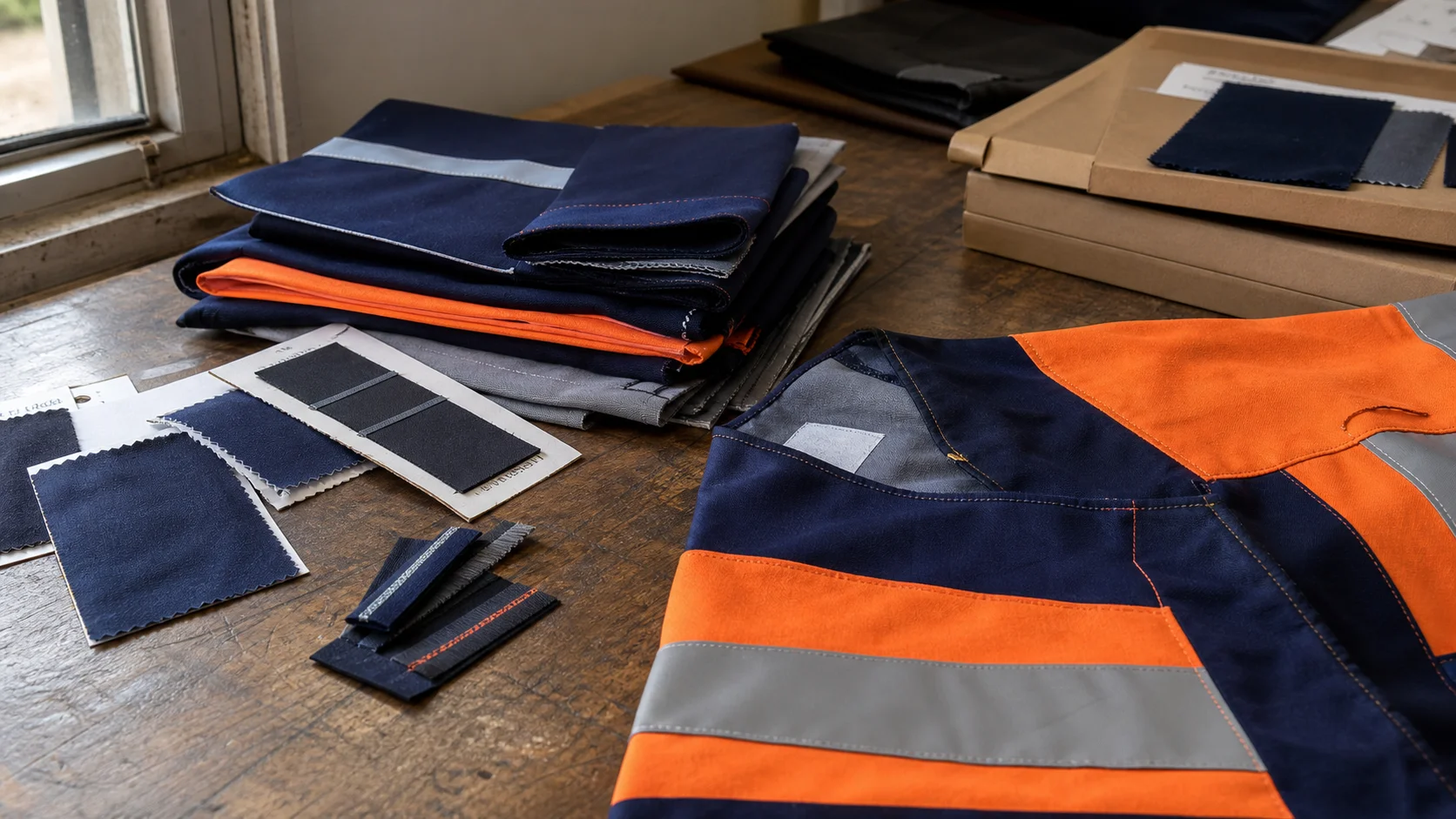
A focused outline for workwear distributors evaluating bulk jackets through seam strength testing, construction details, compliance needs, and...
Bulk Jackets With Seam Strength Testing for Buyers - Fabrikn production reference
Bulk jackets with seam strength testing are a practical sourcing priority for workwear distributors that sell into demanding industrial, construction, logistics, utilities, transport, and field-service channels. In this category, buyers are not only purchasing outerwear by style, color, and target price. They are buying durability, reduced claims exposure, and more predictable in-market performance.
Seam failure is one of the fastest ways a workwear jacket program becomes expensive. A fabric may look acceptable on the hanger and still fail under repeated stress at the armhole, shoulder, side seam, sleeve placket, pocket corners, or zipper attachment points. That matters for distributors because end users rarely separate fabric failure from manufacturing failure. If a jacket opens at the seam during regular wear, the product is judged as unreliable regardless of whether the shell fabric itself tested well.
For workwear distributors, seam strength testing adds value in three areas. First, it helps verify that the garment construction matches the intended job use. Second, it creates an objective checkpoint before large-scale shipment. Third, it supports cleaner discussions with suppliers when performance issues appear during pre-production or inspection.
Purchasing teams should treat seam strength as part of total garment engineering, not as an isolated lab number. A strong result usually reflects the right combination of fabric structure, stitch density, seam type, thread ticket, needle selection, reinforcement planning, and operator consistency. A weak result can come from any break in that chain.
For workwear outerwear, a low FOB price is rarely a win if seam performance creates returns, replacement costs, or distributor reputation damage six months later.
Buyers developing private label or OEM workwear jackets should define seam performance requirements early, then align sampling, testing, and production control around those requirements. Teams that wait until final inspection often discover problems too late, when rework options are narrow and delivery windows are already under pressure.
Seam strength testing for jackets generally evaluates how much force a sewn seam can withstand before it ruptures, slips, or distorts beyond acceptable limits. In practical sourcing terms, the test is used to assess whether garment seams are robust enough for intended wear conditions.
Buyers should distinguish between seam strength and related measures such as seam slippage, tear strength, tensile strength, and burst strength. These properties interact, but they are not interchangeable.
For workwear jackets, the most relevant seam zones usually include armholes, shoulder seams, side seams, sleeve inseams, pocket joins, waistband joins, and zipper seam attachments. If the garment has reflective tape, articulated panels, contrast reinforcements, or quilted sections, those joining points may require separate review because construction becomes more complex.
Testing protocols vary by market, product category, and buyer requirement. A supplier may reference recognized test methods used by third-party laboratories, but buyers should confirm the exact method, seam location sampled, conditioning requirements, and pass criteria before approving production. A report without that detail can look complete while leaving too much room for interpretation.
Good sourcing practice is to ask not only for a pass result, but also for the tested seam construction details. That should include stitch type, stitches per inch or per centimeter, seam allowance, thread specification, reinforcement method, and fabric composition. If any of these elements change after testing, the original result may no longer represent the final bulk garment.
Distributors buying bulk jackets with seam strength testing should issue a technical package that goes beyond size chart and artwork. Too many workwear programs rely on general comments like “durable stitching” or “heavy-duty construction.” Those phrases are commercially familiar, but they are not quality controls.
A stronger specification set usually includes the following points:
In heavy-use outerwear, the choice of seam type can affect durability as much as the shell fabric. A lighter woven polyester-cotton shell may still perform well if the seam construction is stable and reinforcement is placed properly. A heavier shell can still fail if seam allowance is too narrow or thread tension is inconsistent.
Buyers also need to specify the intended end-use environment. Jackets for warehouse teams, delivery drivers, roadside crews, and oilfield support staff do not face the same movement patterns or abrasion levels. That distinction influences whether standard seam reinforcement is enough or whether bar tacks, double-needle joins, elbow overlays, or heavy thread are warranted.
If you are building a private-label workwear range and need broader product-development support, a service overview such as /services/ is the type of internal resource buyers often review when comparing supplier capabilities.
For bulk workwear jackets, seam strength should be controlled across development, pre-production, and bulk sewing. A single approved salesman sample is not enough. Many seam-related failures emerge because the sample room and bulk line do not use exactly the same settings, operators, thread lots, or machine attachments.
At the development stage, the supplier should translate the tech pack into a workable construction method. This is where many sourcing problems begin. If the requested seam build is too costly, too slow, or unsuitable for the chosen fabric, some factories simplify the construction unless the buyer catches it.
Buyers should review:
Proto samples should be checked for seam appearance, puckering, slippage, skipped stitches, and seam grin under hand tension. This is not a replacement for laboratory testing, but it quickly reveals whether the factory is close to a viable construction standard.
Fit samples for workwear also need movement review. Ask the supplier to confirm that the jacket allows reaching, bending, driving, and overhead arm motion without excessive strain at the back yoke or armhole. A pattern that is too tight will stress seams even if the sewing quality is acceptable.
The pre-production sample is the critical approval point. It should represent bulk fabric, bulk trims, approved pattern, approved grading, and intended line construction. If seam strength testing is done on an early development sample instead of a true pre-production sample, the result may have limited value.
At this stage, buyers often request:
Approved testing does not guarantee stable bulk output. Production managers should hold line settings and operator methods consistent with the approved sample. Needle changes, machine maintenance, thread substitution, and operator handling all affect seam performance.
Inline inspection is useful for checking seam margin, SPI consistency, broken stitches, open seams, seam twisting, and reinforcement placement. Final random inspection catches packed-goods issues, but by then the best chance to correct seam construction problems has already passed.
MOQ for bulk workwear jackets varies widely by fabric complexity, insulation type, and trim count. A practical range for basic woven work jackets often starts around 300 to 600 pieces per colorway or style with some suppliers, while more technical insulated or multi-trim jackets may start closer to 800 to 1,500 pieces per style. Buyers asking for custom shell colors, reflective applications, specialty coatings, or branded hardware should expect MOQs to rise.
Distributors should be careful with very low MOQ offers on complex jackets. A supplier may accept a small order, but then use stock-adjacent trims, simplify seam construction, or push the order behind larger customers. Low MOQ flexibility can be useful during a launch phase, but it often comes with tighter limitations.
Lead time for bulk production commonly lands in the 45 to 90 day range after full sample approval and deposit, though actual timing depends on material sourcing, seasonality, order size, printing or embroidery requirements, and inspection scheduling. Waterproof seam-sealed jackets, flame-resistant constructions, and jackets with special compliance claims can take longer because approvals are less forgiving.
One practical point often missed by buyers: lab testing can add time not only because of the test itself, but because a failed result may trigger construction revision, resampling, and retesting. That means critical path planning should include at least some buffer if seam performance is central to the program.
Workwear outerwear programs rarely fail because of one obvious error. Most problems come from small construction compromises that accumulate. Seam strength issues are often a symptom of broader process control gaps.
This can result from low stitch density, unbalanced thread tension, poor operator handling on thick areas, or an unsuitable seam type for the fabric weight. Buyers should watch for suppliers that approve one construction during sampling and quietly downgrade it in bulk.
A strong seam on paper may still perform poorly if the base fabric is prone to slippage or coating crack. Shell fabrics with water-resistant coatings, laminated backings, or mechanical stretch need careful needle and thread matching.
Pockets, sleeve openings, and zipper bottoms are routine failure points in work jackets. Missing bar tacks or short backstitching at these locations can create claims even when primary seams test adequately.
Heavy insulation, facings, zipper tapes, and multiple folded seam allowances can create thick crossovers that lead to skipped stitches, needle damage, or seam distortion. This is especially common in winter jackets and high-collar constructions.
Some inspections focus heavily on appearance, measurement, and packaging while giving too little time to seam-stress review. For workwear, inspectors should include targeted pull checks at high-risk seam zones and compare construction details against the approved pre-production sample.
If the inspection checklist treats a workwear jacket like a fashion shell, the buyer may miss the exact issues that drive distributor complaints later.
Every workwear distributor wants competitive pricing, clean appearance, and strong durability. In reality, jacket sourcing involves tradeoffs, and seam strength is often where those tradeoffs become visible.
Reducing price pressure too aggressively may lead to lighter thread, fewer reinforcement points, narrower seam allowance, or lower operator time per garment. These changes are not always obvious in photos or top-level quotations. They show up later in wear performance.
Some distributor programs prioritize lighter jackets for comfort and freight savings. That can be a valid strategy, especially for driver or warehouse use. It does mean seam engineering becomes more important, because lighter fabrics have less room for construction error.
Compressed timelines often tempt teams to overlap approvals or waive retesting after a material or construction adjustment. That saves days in the short term and can cost months in claims management if the finished jacket underperforms.
Extended sizing is commercially important in workwear. Larger sizes can place added strain on armholes, side seams, and back panels if grading is not handled carefully. Buyers should confirm that performance expectations apply across the size range, not only in the base sample size.
The strongest purchasing position is not “always buy the highest spec.” It is “buy the right spec for the end use and protect it through production.” Many distributors overspend on features users do not notice while under-specifying the seams that actually determine service life.
Choosing the right supplier for bulk jackets with seam strength testing requires more than asking whether they can make workwear. Most suppliers will say yes. Buyers need to verify whether the supplier can control consistency at commercial scale.
Useful questions include:
Buyers should listen carefully to how specific the answers are. A reliable supplier usually discusses seam type, line control, stress areas, and testing dependencies in practical terms. Vague replies like “quality is guaranteed” are not enough for a workwear program.
It is also sensible to review the supplier’s broader operating profile, communication clarity, and development support. Pages such as /about-us/ can help buyers understand positioning and capability scope before moving into technical discussions.
When the program is urgent or technically demanding, involve the supplier early and push for written confirmation of every approved construction detail. That protects both sides. If you are moving toward quotation or sample development, a direct inquiry route like /contact-us/ is usually the most efficient next step.
Bulk jackets with seam strength testing are not a niche requirement for workwear distributors. They are a practical safeguard in a category where construction failure creates visible, costly downstream problems. The value of testing is not only in obtaining a pass certificate. The real value is in using seam strength requirements to shape garment engineering, sample approval, bulk production control, and final inspection discipline.
Distributors that buy workwear jackets on appearance and price alone often learn the hard way that outerwear durability depends on details hidden inside the seams. Buyers that define seam construction properly, test the actual pre-production build, and monitor bulk consistency are usually in a stronger position to reduce claims and support repeat business.
The commercial goal is straightforward: source jackets that match the job, survive routine wear, and hold up under distributor scrutiny. Seam strength testing is one of the clearest tools available to support that goal.
Get a free quote from Fabrikn — your trusted B2B clothing manufacturer with 10+ years of experience. MOQ as low as 200 pieces.
Get a Free Quote →It refers to testing the sewn seam’s ability to withstand force without breaking, opening, or slipping excessively. For workwear distributors, it helps verify that jacket construction is suitable for regular occupational wear rather than just showroom appearance.
Armholes, shoulders, side seams, sleeve inseams, pocket attachments, waistband joins, and zipper attachment seams are usually the highest-risk areas. Stress points vary by jacket design and end use, so buyers should review them style by style.
Many basic jacket programs start around 300 to 600 pieces per style or color, while more technical jackets may require 800 to 1,500 pieces or more. Exact MOQ depends on fabric sourcing, trim customization, insulation, and color development.
The best checkpoint is usually the pre-production sample stage using bulk-intended materials and approved construction. Testing too early on a non-final sample can produce results that do not fully represent bulk production.
Yes. Fabric strength alone does not guarantee seam durability. A garment can use acceptable fabric and still fail if seam allowance, stitch density, thread choice, reinforcement, or operator consistency is weak.
They can extend development if testing, revisions, or retesting are needed. Buyers should build in extra time for lab scheduling and potential construction adjustments rather than assuming testing can be added at the last minute.
Not necessarily. A lower-cost jacket can still be commercially sound if its construction matches the actual use case. The problem starts when cost reductions undermine seam durability in ways that lead to returns or customer dissatisfaction.