
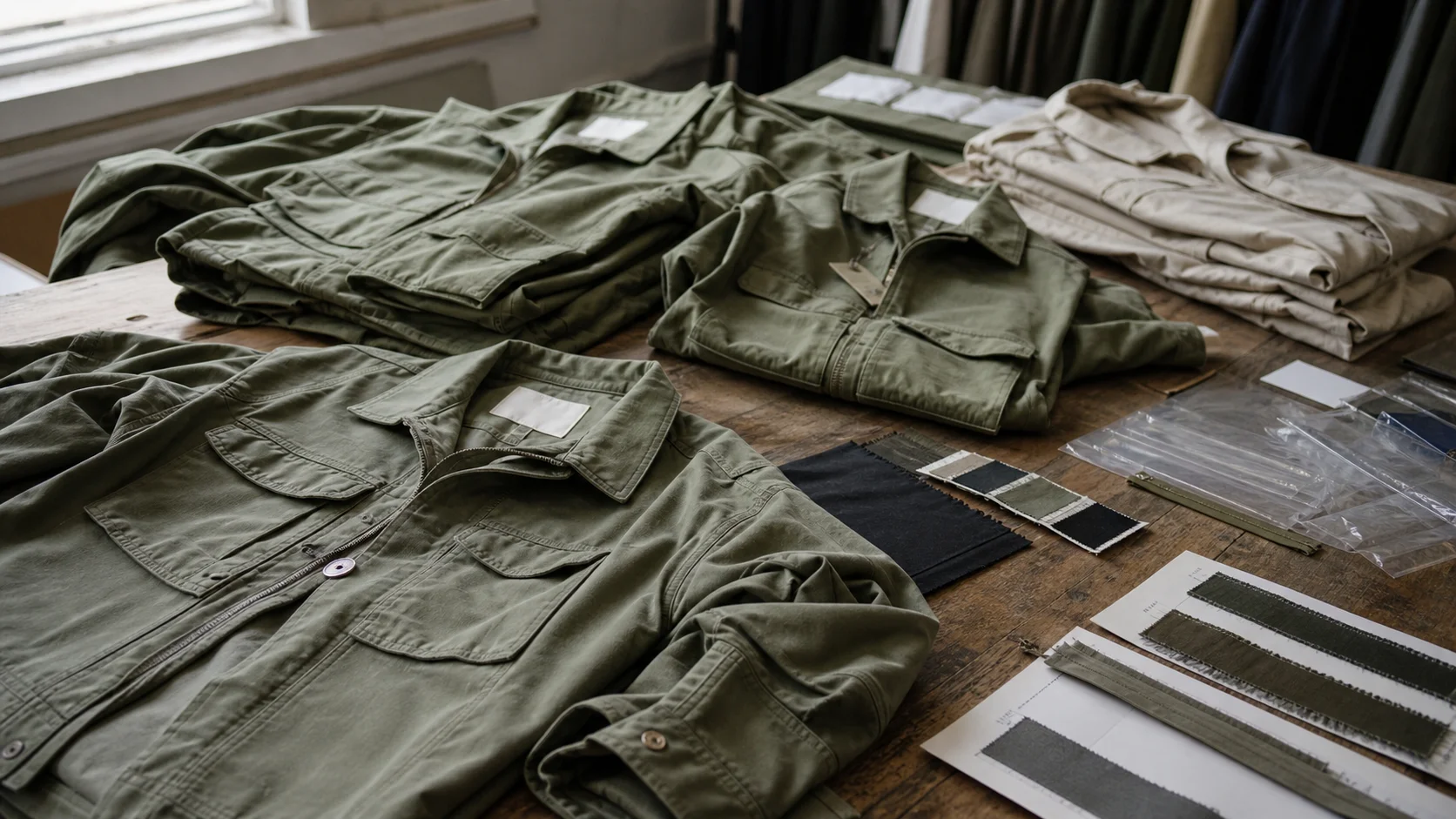
A product-specific SEO outline for security contractors reviewing bulk lyocell utility jacket size grading, fit consistency, measurement tolerances, and...
Lyocell Utility Jacket Grading Review for Buyers - Sustainable Fashion manufacturing guide
A bulk lyocell utility jacket size grading review for security contractors is not a simple apparel sizing exercise. It is a uniform performance decision. The jacket must fit across a working team, look consistent on site, allow arm movement during shifts, carry equipment without pulling out of shape, and stay within an approved budget. When buyers skip the grading review, the problems usually appear after delivery: tight shoulders, uneven sleeve lengths, pocket positions that move too far on larger sizes, and returns that are expensive to correct.
Lyocell adds another layer to the sourcing decision. It is valued in sustainable fashion because it is made from regenerated cellulosic fiber, often promoted for its soft hand feel, drape, moisture management, and lower-impact positioning compared with some conventional fibers. Yet a utility jacket for security contractors cannot behave like a soft lifestyle overshirt. It needs structure, seam stability, color consistency, and predictable shrinkage control. The best result usually comes from treating lyocell as one component in a technical uniform program, not just as a sustainability claim.
For buyers, the grading review should happen before bulk purchase order confirmation. It should include the base pattern, size chart, fabric shrinkage report, wash process, trim behavior, pocket placement, tolerance rules, and inspection method. A supplier can grade a jacket from XS to 5XL, but that does not mean the final fit will be suitable for guards, supervisors, mobile patrol teams, or event security personnel. The grading rules must reflect how the garment is worn during work.
This article reviews the practical issues that matter when sourcing bulk lyocell utility jackets for security contractors: size grading, measurement tolerances, sample approval, MOQ expectations, lead-time dependencies, inspection risks, and purchasing tradeoffs. It is written for buyers comparing suppliers, preparing a tech pack, or reviewing a manufacturer’s production sample before committing to a large uniform order.
Security contractor uniforms sit between corporate apparel and workwear. They must look clean enough for client-facing posts but function well enough for active duty. A lyocell utility jacket may be used in malls, residential compounds, hospitality sites, logistics yards, campuses, event venues, and private facilities. The wearer may stand for long periods, drive, lift barriers, check vehicles, use radios, write reports, or respond quickly to incidents.
Standard fashion grading often prioritizes visual proportion. Security uniforms require movement and consistency. A jacket that looks sharp on a medium model may fail when a larger wearer carries a radio, wears a belt, or layers a polo underneath. A smaller wearer may find that large pockets, oversized flaps, or long sleeves interfere with work. Bulk grading must protect the function of the garment across the size range, not only the look of the sample size.
Buyers should pay particular attention to three realities. First, security teams often include a wide body-size distribution. Orders may need sizes from XS to 5XL or even extended custom sizing. Second, uniform wearers do not usually choose a relaxed fashion fit for style; they need the correct size issued quickly. Third, replacement orders must match earlier deliveries. If grading is not documented, repeat production can drift.
Purchasing judgment: do not approve bulk production from a good-looking medium sample alone. For security contractor programs, approve at least one middle size and one upper size before committing to a broad size run.
Security contractors also care about brand presentation. A utility jacket that fits poorly can make a team look unprepared even when the fabric and sewing are acceptable. Uneven hem lengths, tight biceps, gaping front plackets, and pocket distortion are visible defects in a uniform environment. Fit is part of operational credibility.
Lyocell is commonly selected for sustainable fashion programs because it offers softness, breathability, and a smooth surface. In a utility jacket, those properties can be useful, especially for indoor security teams or mild-weather layering. Yet pure lyocell can drape more fluidly than buyers expect. A utility jacket usually needs enough body to hold pocket shape, support hardware, and keep a neat silhouette after hours of wear.
Many buyers should consider lyocell blends rather than pure lyocell. A lyocell-cotton blend can improve natural hand feel and structure. A lyocell-polyester blend can add durability, quicker drying, and shape retention, though it may reduce the sustainability story depending on the fiber mix. A small amount of elastane may help comfort, but it can complicate shrinkage, recovery, and seam stability if not controlled. For a security contractor uniform, performance should guide the blend decision.
Fabric weight matters. A lightweight lyocell fabric around 160–200 gsm may be comfortable but may not support patch pockets, epaulettes, zipper guards, or utility trims well. A midweight fabric around 220–280 gsm is often more suitable for an overshirt-style utility jacket. Heavier constructions can improve durability, but they may reduce breathability and raise cost. The ideal weight depends on climate, intended layering, and whether the jacket is used indoors, outdoors, or across both conditions.
Shrinkage control is essential. Lyocell can be sensitive to washing, finishing, and garment processing. Buyers should request fabric shrinkage data before pattern approval and garment shrinkage data after sample washing. If the jacket is garment washed for softness, the shrinkage profile must be built into the pattern. If the jacket is piece-dyed or enzyme washed, color variation and measurement stability need closer review.
Fabric Factor Buyer Review Point Risk if Ignored Fabric weight Confirm gsm and construction before sample cutting Jacket may look too soft or feel too heavy Shrinkage Check fabric and garment wash shrinkage reports Bulk sizing may run small after laundering Drape Review pocket support, front fall, and hem balance Utility details may collapse or twist Colorfastness Test washing, rubbing, perspiration, and light exposure Uniform sets may fade unevenlyFor buyers building a broader uniform program, the fabric decision should also align with shirts, trousers, caps, and outerwear. A sustainable jacket loses value if it cannot be repeated or matched. If sourcing support is needed, manufacturers with structured development processes can help convert design intent into a production-ready specification. Buyers can review apparel development options through Fabrikn services when planning a bulk program.
The base size is the foundation of the full size range. For men’s or unisex security jackets, the base size is often M or L, depending on the target market. For women’s fits, the base may be S or M. For a unisex contractor jacket, buyers should be careful. Unisex sizing may simplify inventory, but it can create fit compromises around chest, shoulder, hip, and sleeve length. A security contractor with a mixed workforce may need separate men’s and women’s patterns if appearance and comfort are important.
A base size should be approved on a fit model or verified against a measured wearer profile. It should not be based only on a flat garment that matches a generic size chart. The base sample should be tried over the intended inner layer, such as a polo shirt, shirt, light fleece, or body armor if relevant. The amount of ease must be intentional. A utility jacket that is too close-fitting will restrict the wearer. A jacket that is too loose may look sloppy and catch on equipment.
Security contractors should also confirm radio and ID placement before grading. A pocket that works on a medium jacket may sit too low on a 4XL if placement is graded without control. Some placements should grade proportionally; others should remain fixed from a reference point. For example, a chest badge loop may need consistent visibility across sizes, while a body panel can widen more naturally.
The base sample should be washed or finished in the same way as bulk production before final approval. Reviewing an unwashed sample when the bulk garment will be washed is a common sourcing mistake. It creates false confidence in measurements, hand feel, and seam appearance.
Size grading is the process of increasing or decreasing a base pattern to create other sizes. In bulk lyocell utility jacket production, grading rules must cover both measurements and construction balance. A size chart may show chest increments, but it does not automatically preserve armhole comfort, pocket usability, or front placket alignment.
Typical alpha size grading for utility jackets may use 4–6 cm chest circumference increments between core sizes. Larger sizes may require slightly different increments depending on the market and fit standard. Sleeve length may increase 1–1.5 cm per size across regular sizes, then slow down for extended sizes to avoid excessive sleeve length. Body length may increase 1–2 cm per size, but buyers should avoid over-lengthening large sizes if the jacket must look uniform across a team.
For extended sizes, straight proportional grading can fail. A 5XL wearer does not simply need every dimension enlarged at the same rate. Shoulder width, chest, belly, bicep, and hem sweep may need adjusted distribution. The jacket must close comfortably without pulling at the front. The sleeve must allow bending. The armhole must not become so deep that movement becomes awkward.
Measurement Typical Core Size Grade Buyer Caution Chest circumference 4–6 cm per size Confirm ease over required inner layer Body length 1–2 cm per size Avoid excessive length on larger sizes Sleeve length 1–1.5 cm per size Check driving and radio-use positions Bicep circumference 2–3 cm per size Review comfort for muscular or larger wearers Hem sweep 4–6 cm per size Must clear belts and trouser waist bulkMeasurement tolerances should be realistic. For woven jackets, common bulk tolerances may be around plus or minus 1 cm for small points such as cuff opening, plus or minus 1.5 cm for sleeve and body length, and plus or minus 2 cm for chest circumference. Tighter tolerances may be possible, but they can increase inspection failures and production cost. Looser tolerances may reduce claims but can undermine uniform consistency. The correct tolerance depends on fabric behavior, factory capability, and order size.
Grading must also include pocket and trim placement rules. Patch pockets, flap widths, zipper lengths, snaps, badge tabs, epaulettes, and drawcord channels need size-by-size review. A pocket can be graded wider for larger sizes, but over-grading it may make the jacket look bulky. A fixed pocket size may control cost and trim purchasing, but it can look too small on extended sizes. Buyers should decide which trim components are shared across sizes and which need size breaks.
Purchasing judgment: use shared trims where possible to control cost, but do not force one pocket scale across the full size range if the order includes many 3XL to 5XL units. The savings can be lost in poor appearance and wearer complaints.
A lyocell utility jacket for security contractors should be reviewed while the wearer performs practical movements. Static fit is not enough. Ask the model or wearer to raise arms, cross arms, reach forward, sit, drive, zip or button the front, access pockets, and bend slightly. These checks reveal whether the grading and pattern are suitable for work.
The shoulder line affects both appearance and mobility. A narrow shoulder creates pulling across the back. An overly dropped shoulder can look casual and may interfere with epaulettes or sleeve pitch. The armhole should provide movement without excessive depth. Very deep armholes can make reaching difficult, especially in woven jackets without stretch.
The jacket should close without strain across the chest and stomach. Security contractors often issue jackets over shirts, polos, or light knit layers. If a duty belt or radio harness is used, the hem sweep and lower front opening need extra review. Front plackets should remain straight. Snaps or buttons should not gape.
Bicep width is a frequent complaint in uniform jackets. The sleeve should not bind when the wearer bends the elbow or crosses arms. Lyocell blends with a soft drape may feel comfortable at first, but tight sleeves can still stress seams over time. Sleeve length should cover the wrist in standing position without interfering with hand use, watch access, or gloves if worn.
Security jackets often include chest pockets, lower pockets, inner pockets, pen slots, radio loops, ID tabs, or badge points. Every added detail increases the need for accurate placement. Pocket bags must be deep enough and reinforced where necessary. Flaps should close securely. If snaps are used, the reinforcement behind the snap must be adequate, especially on softer lyocell fabrics.
Back width is more important than many buyers expect. Guards and patrol personnel reach forward often, including when opening doors, checking vehicles, using radios, or handling barriers. A back yoke, action pleat, or small amount of stretch can improve movement. These features add cost but may reduce wearer complaints.
For a security contractor order, buyers should consider a movement test as part of sample approval. It does not need to be complicated. A short checklist with five or six movements is enough to catch most grading and pattern issues before bulk cutting.
A clear specification table is the buyer’s best defense against size drift. The table should define the base size and all graded sizes, with tolerances and measurement method diagrams. If measurement points are not defined, the supplier and inspector may measure differently. This is a common source of disputes.
Spec Area What to Define Why It Matters Size range XS–5XL, men’s, women’s, or unisex Determines grading logic and stock planning Base size Approved sample size and measurements Controls all graded sizes Fabric Fiber content, gsm, weave, finish, shrinkage Controls fit, drape, and durability Trims Zippers, snaps, buttons, labels, elastic, drawcords Affects function and inspection consistency Pockets Size, placement, reinforcement, closure type Critical for utility and appearance Tolerances Allowed variance by measurement point Reduces dispute during inspection Packing Size ratio, polybagging, carton marking Supports uniform distributionBuyers should insist on a measurement diagram for each point of measure. “Chest” can mean different things depending on whether it is measured at the armhole, below the armhole, or across the widest part of the body. Sleeve length may be measured from the shoulder seam, center back neck, or collar point. A small misunderstanding can create a large issue across thousands of units.
For contractors that reorder regularly, the final approved spec should become the reference standard for repeat production. Keep the approved sample, size chart, fabric swatch, trim card, label artwork, and inspection report together. Supplier changes, fabric lot changes, and trim substitutions should be reviewed against that standard.
A disciplined sample process saves money. Many bulk jacket problems start when buyers approve too quickly because the first sample looks close enough. Lyocell utility jackets need a more controlled process because fabric behavior, pocket construction, and wash shrinkage can affect final sizing.
Not every order requires every sample stage, but skipping size set review is risky for security contractors. If the order includes extended sizes, at least one extended size should be sampled before production. A 4XL sample may reveal issues that are invisible in a medium.
Sample approval should include measurements before and after washing if the garment is washable. The buyer should define the wash method used for testing, such as domestic wash temperature, tumble drying, line drying, or commercial laundering if relevant. If the end users will wash jackets at home, the care label should be realistic. A delicate-care jacket may not be suitable for a security uniform program.
Trim testing also belongs in sample review. Snaps should not pull out. Zippers should run smoothly. Buttons should be securely attached. Velcro or hook-and-loop closures should not damage the lyocell surface. Badge loops and radio tabs should be reinforced. Inner labels should not irritate the wearer. Small trim failures create disproportionate complaints in uniform programs because the garment is worn repeatedly.
Buyers that need to coordinate technical development, supplier communication, and production readiness can contact a manufacturing partner early rather than waiting until after design approval. For program discussion, use the Fabrikn contact page to prepare project details such as size range, fabric target, order quantity, and delivery date.
MOQ depends on fabric availability, dyeing method, trim customization, factory capacity, and size range. For lyocell utility jackets, typical MOQ ranges may start around 300–500 pieces for a simple style using available fabric and standard trims. Custom-dyed fabric, custom hardware, multiple colorways, or extended sizing may push MOQ toward 800–1,500 pieces or more. Some suppliers may accept smaller pilot runs, but unit cost will usually rise.
Buyers should distinguish between garment MOQ, fabric MOQ, color MOQ, and trim MOQ. A factory may accept 500 jackets, while the fabric mill requires a higher minimum for custom color. A snap supplier may require a minimum order for branded hardware. Labels, patches, and embroidery can also create separate minimums. The real MOQ is the highest constraint in the supply chain, not only the sewing factory’s minimum.
Order Type Typical MOQ Range Commercial Tradeoff Available fabric, standard trims 300–500 pieces Lower risk, fewer customization options Custom color lyocell blend 800–1,500 pieces Better brand match, higher inventory commitment Multiple colors or departments 500–1,000 pieces per color may apply Improved segmentation, more complex stock control Extended size range Depends on size ratio and cutting plan Better workforce coverage, higher pattern and sampling costLead time also varies. A realistic development-to-delivery timeline may run 8–14 weeks for a straightforward order after tech pack confirmation. Custom fabric development, lab dips, wash testing, size set sampling, and inspection scheduling can push the timeline longer. Buyers should not treat quoted production time as the full project timeline. Production time often starts after sample approval, fabric arrival, deposit, and trim confirmation.
Cost decisions should be made carefully. A cheaper fabric may reduce the purchase price but increase shrinkage claims. Standard trims may save money but weaken the uniform identity. A single unisex pattern may simplify ordering but produce fit complaints. Sampling extended sizes costs more upfront, yet it can prevent bulk rejection. Good procurement is not about choosing the lowest quotation; it is about choosing the lowest manageable risk for the required performance.
Purchasing judgment: if the jacket is part of a long-term contractor uniform, prioritize repeatability over the lowest first order price. A slightly higher unit cost may be justified if fabric, trims, and grading can be reproduced consistently.
Bulk inspection should cover measurements, workmanship, fabric defects, color consistency, trims, labeling, and packing. Lyocell utility jackets have several specific risks. The fabric may show shade variation, seam puckering, abrasion marks, water spots, or shine if handled poorly. Soft fabrics can shift during cutting, creating panel distortion. If the garment includes many pockets and flaps, placement variation can become visible across the production lot.
Measurement inspection should use the approved size chart and tolerance table. Inspectors should measure garments flat, after proper relaxation, and according to the agreed method. If the garment is washed, it should be measured after finishing, not before. For bulk security contractor orders, buyers may request an AQL inspection, but the AQL level should match order risk. Higher-risk orders with new fabric, new supplier, or complex trims deserve stricter review.
Inspection should include size ratio verification. Security contractors often distribute uniforms by site, department, or employee list. Incorrect ratio packing can delay rollout even if the garments are well made. Carton labels should clearly show style, color, size, quantity, and purchase order reference. If jackets are individually polybagged, the size marking should be visible without opening each bag.
Color control is especially important for uniform programs. A navy, black, khaki, charcoal, or olive jacket must match approved standards. Lyocell blends may absorb dye differently depending on fiber mix and finishing. Buyers should approve lab dips before bulk dyeing and keep a physical color standard. If repeat orders are expected, the supplier should understand the acceptable shade band.
Another inspection risk is care label accuracy. If the care label promises machine wash but the garment shrinks excessively, the buyer may face complaints. If the care label is too restrictive, wearers may ignore it. The care instruction should reflect tested reality. For security contractors, easy-care performance is usually more valuable than a premium but fragile finish.
Before confirming a bulk lyocell utility jacket purchase order, buyers should review the full commercial and technical package. The goal is not to make the process slow. The goal is to prevent unclear decisions from becoming expensive bulk problems.
Buyers should also prepare a realistic size ratio. Security contractor teams may not follow retail size distribution. A workforce with many outdoor posts, tactical roles, or larger male employees may require more XL to 3XL units than a fashion order. Employee measurement data is useful if available. If not, buyers should build a cautious ratio and reserve extra units in common sizes for replacements.
For sustainable fashion positioning, documentation matters. If lyocell is being selected for environmental reasons, buyers may request fiber certification, supplier declarations, or chain-of-custody information where applicable. Claims should be accurate and supportable. A uniform program can promote responsible material choices without overstating benefits. Practical sustainability also includes durability, repairability, correct sizing, and reduced replacement waste.
Supplier selection should consider communication quality, technical capability, sampling discipline, and repeat order control. A supplier that asks detailed questions about grading, shrinkage, pockets, and size ratios is often more useful than one that simply quotes quickly. Buyers can learn more about manufacturing approach and company background through Fabrikn’s about page when evaluating support for apparel programs.
A lyocell utility jacket can be a strong choice for security contractors when the fabric is selected carefully and the grading is reviewed properly. It can offer a softer, more breathable alternative to conventional uniform jackets while supporting a sustainable fashion direction. The weak point is not the fiber itself. The weak point is usually incomplete specification control.
The most important buyer decision is to treat grading as a functional review, not a spreadsheet exercise. Confirm the base fit. Test movement. Review extended sizes. Control shrinkage. Define pocket rules. Approve bulk trims. Set realistic tolerances. Inspect finished garments against the approved standard. These steps reduce the risk of a jacket that looks acceptable in development but fails in daily contractor use.
For buyers managing bulk uniform programs, the best tradeoff is usually a midweight lyocell blend, a structured utility pattern, tested wash performance, and a documented size set. Pure fashion softness should not override workwear function. A slightly firmer fabric, reinforced utility details, and better grading review will usually deliver a more reliable result for security teams.
Get a free quote from Fabrikn — your trusted B2B clothing manufacturer with 10+ years of experience. MOQ as low as 200 pieces.
Get a Free Quote →A midweight fabric around 220–280 gsm is often practical for utility jackets, depending on climate and layering needs. Lighter fabrics may feel comfortable but can lack structure for pockets and hardware. Heavier fabrics may improve durability but can reduce breathability.
Typical MOQs may start around 300–500 pieces if using available fabric and standard trims. Custom colors, custom trims, special washes, or extended size ranges may push MOQ toward 800–1,500 pieces or more. Buyers should confirm fabric, garment, color, and trim MOQs separately.
Unisex sizing can simplify inventory and reduce development cost, but it may not fit all wearers well. Mixed teams may need separate men’s and women’s patterns if appearance, comfort, and wearer satisfaction are priorities. At minimum, buyers should test unisex samples on different body types before bulk approval.
Buyers should approve the base size and review a size set that includes smaller, middle, larger, and extended sizes where relevant. If the order includes 3XL, 4XL, or 5XL, at least one extended size should be sampled before bulk cutting.
The main risks are tight shoulders, restrictive biceps, excessive sleeve length, poor hem sweep, pocket placement drift, and front closure pulling. Extended sizes need special attention because proportional grading may not provide enough comfort across chest, belly, and arms.
Common tolerances may include plus or minus 1 cm for smaller points, plus or minus 1.5 cm for sleeve or body length, and plus or minus 2 cm for chest circumference. The final tolerance should reflect fabric behavior, construction complexity, and buyer quality requirements.
It can be suitable for some indoor or light-duty jackets, but buyers should check structure, shrinkage, seam stability, and pocket support. Lyocell blends may be more practical for contractor uniforms because they can improve durability, shape retention, or easy-care performance.
The tech pack should include technical drawings, fabric specifications, size chart, measurement diagrams, grading rules, tolerances, trim details, pocket placement, label artwork, packing method, care instructions, and inspection standards. A complete tech pack reduces sampling delays and bulk disputes.
A straightforward order may take about 8–14 weeks after tech pack confirmation and sample approval. Custom fabric, lab dips, wash testing, trim development, size set corrections, and freight planning can extend the timeline. Buyers should build schedule margin into contractor uniform rollouts.
Inspectors should check measurements, size ratio, workmanship, color consistency, pocket placement, trim strength, care labels, carton markings, and packing accuracy. For lyocell garments, extra attention should be given to shade variation, seam puckering, fabric marks, and post-wash shrinkage.