
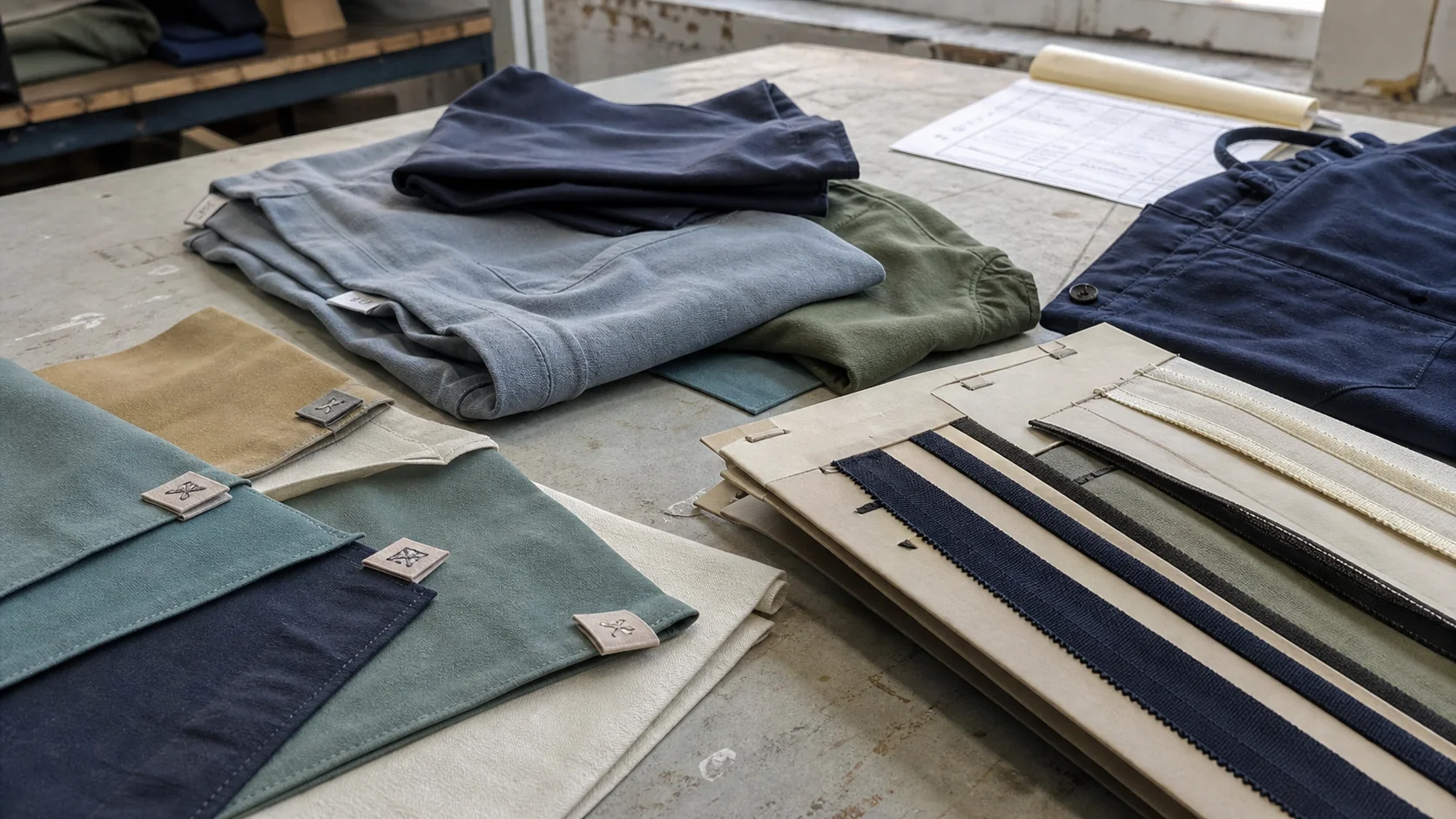
Plan a bulk micro embroidery tab order with the right stitch count, placement, durability, and approval steps for facility uniforms, tags, and...
Bulk Micro Embroidery Tabs for Facilities Managers - Fabrikn production reference
Bulk micro embroidery tab orders are a practical purchase for facilities teams that need durable, low-profile branding on uniforms, housekeeping gear, maintenance apparel, and soft goods. The appeal is simple: the tab is small, the branding stays visible, and the finish usually looks more refined than a large printed mark on a work garment. For facilities managers, that matters because apparel and accessory branding is rarely about marketing flair. It is about identification, consistency, and making sure the team looks controlled across shifts, sites, and service categories.
A good bulk micro embroidery tab program should be treated as a specification project, not a quick artwork upload. The right supplier can reproduce small details cleanly, but the design still needs to respect stitch limitations, backing options, thread choices, and the final fabric or garment it will be attached to. Buyers who rush that stage often end up with tabs that feel stiff, lose readability, or wear poorly after laundering. The better approach is to define the use case first, then order samples, then scale.
If you are sourcing through a decoration partner, it helps to compare service scope early. Some vendors only handle embroidery production, while others can support decoration planning, sampling, and shipping coordination. Fabrikn’s general service overview is a useful starting point for that kind of evaluation: https://fabrikn.com/services/.
Micro embroidery tabs are small embroidered patches or sewn-on labels designed to carry a logo, initials, department name, or a short identifier. In facilities environments, they are usually used on uniforms, aprons, caps, jackets, tote bags, and utility textiles. The word “micro” typically signals a compact size, not a different construction method. In practice, the product still relies on embroidered thread density, edge finishing, and a stable base material.
The most common constructions include:
Facilities buyers often prefer tabs over large chest logos when they need a subdued appearance. A small tab on a sleeve, pocket, hem, or collar can signal ownership without overwhelming the garment. That is especially useful for multi-department programs where color coding and role identification matter.
Facilities managers are usually balancing appearance, function, replacement cost, and turnaround speed. Micro embroidery tabs support all four when they are specified correctly. They are compact enough to produce in volume, they can be applied consistently, and they are easier to reorder than custom garments. When a team has seasonal staff, shifting headcount, or multiple sites, tabs provide a repeatable way to keep branding aligned.
There is also a procurement advantage. Bulk tabs are often cheaper to standardize than fully branded garment programs. Instead of replacing entire uniforms when branding changes, the buyer can switch tabs or add a department identifier. That helps extend the life of existing apparel inventory, which is a real cost control measure in larger facilities.
There is a tradeoff, though. Micro embroidery is not ideal for highly detailed logos, gradients, or tiny type. A design that looks sharp on screen may blur when translated into thread. If the brand mark is too fine, a woven label or printed transfer may be more appropriate. The smart purchasing move is to judge the decoration method against the logo itself, not the preferred category.
Spec discipline matters in bulk micro embroidery tab sourcing. A tab order can fail at the sample stage if the buyer leaves too much open to interpretation. For facilities managers, the most important details are size, artwork complexity, attachment method, and wash performance.
Micro embroidery works best with simplified artwork. Short department names, initials, and compact icons are usually safe. Fine lines, narrow lettering, and small enclosed spaces are where embroidery can break down. A practical starting size is often in the range of 1 to 3 inches wide, depending on placement and logo complexity. Smaller than that can still work, but only if the design is stripped down and the supplier has strong digitizing control.
Thread choice affects both appearance and durability. Polyester thread is the usual default for facilities use because it handles abrasion and repeated washing better than more delicate alternatives. Base fabrics can include twill, felt, satin, or woven backing material. For workwear, a firmer backing often holds shape better than a very soft base, especially if the tab must survive frequent industrial laundry cycles.
Color matching should be handled with care. Pantone references help, but thread matching is not identical to ink matching. Small shade variation is normal. If the program depends on exact brand tones, a lab dip or physical thread card approval is worth the extra time.
Sew-on remains the safest option for heavy-use facilities apparel. Heat-seal or adhesive backing may save labor during initial application, but it can fail if the garment fabric is textured, coated, or regularly exposed to heat and chemicals. Iron-on is usually best treated as a convenience option, not a default for long-term uniforms.
For orders that move across many sites, buyers should ask whether the supplier can standardize attachment points. A tab placed in a different position from one batch to the next creates a sloppy look and can confuse staff who rely on visual identification.
Edge finish affects how the tab wears. Merrowed borders are durable and familiar, but they add bulk. Laser-cut or heat-cut edges can feel cleaner on small tabs, though the edge quality must be controlled carefully to avoid fraying. Stitch density should be balanced. Too loose and the logo looks thin; too dense and the tab becomes stiff or puckered. In practical sourcing terms, the best result is usually the one that looks clear at normal viewing distance and still folds naturally with the garment.
The bulk order process for micro embroidery tabs should be treated as a sequence of approvals. That sequence reduces avoidable mistakes and makes the final shipment more predictable.
Start with the garment or textile the tab will be applied to. A tab for knit polos is not specified the same way as a tab for heavy outerwear or utility aprons. The fabric weight, wash cycle, and expected wear level all influence the right backing and stitch structure.
Send vector artwork whenever possible. Clean PDFs, AI, EPS, or high-resolution files are better than compressed images. The digitizer will need to simplify the design for embroidery. If the artwork includes too many tiny features, ask for a cleaned version before sampling. That is cheaper than discovering the problem after production starts.
For a first order, a sample approval step is not optional. Buyers should review size, shape, stitch direction, thread color, edge quality, and attachment method. A strike-off or pre-production sample gives the team a chance to check whether the logo remains readable at actual size. If the supplier skips this step on a large bulk order, the risk moves to the buyer.
Written approval should capture every operational detail: final dimensions, backing type, colors, placement notes, and packing instructions. If the facilities team needs tabs sorted by department, site, or garment type, that requirement should be stated before production begins. Sorting after arrival creates labor cost and can cause distribution errors.
Bulk embroidery tabs are often packed flat in poly bags, boxes, or divided cartons. For large facilities programs, carton labeling and quantity control matter as much as decoration quality. If the tabs are going directly into kit assembly or uniform distribution, ask for package counts that reduce handling time.
Pricing for bulk micro embroidery tabs is shaped by artwork complexity, stitch count, size, backing, edge finish, and order quantity. A simple one-color tab with a standard sew-on backing will usually price more competitively than a multi-color tab with fine text and specialty finishing. Buyers should expect unit cost to drop as quantity rises, but the curve is not always linear. Small changes in complexity can outweigh small changes in size.
Typical MOQ ranges vary by supplier, but facilities managers often see minimums around 100 to 300 pieces for simple stock-supported runs and 300 to 500 pieces or more for fully custom work. Larger factories may prefer higher quantities if the design requires a dedicated production setup. That does not always make them the best choice for a mid-sized facilities program. A slightly higher unit price can be justified if the supplier offers faster sample turnaround and clearer approval control.
There are hidden cost drivers worth watching:
A buyer should compare not only the unit price but also the total landed cost, including sampling, freight, import duties if relevant, and any repacking work needed on receipt.
Lead times for micro embroidery tabs depend on sample approval speed, artwork readiness, raw material availability, and production queue. A clean, straightforward order can move relatively quickly once the sample is approved. A more complex tab program with multiple SKUs, custom backing, or strict color matching will take longer. As a rule, buyers should assume that the sample stage is the schedule risk, not the stitch run itself.
Common lead-time dependencies include:
Approval delays can create downstream problems. If the facilities team is coordinating a uniform rollout, one late sample can push the whole distribution schedule. That is why it helps to set internal approval deadlines before asking for production quotes. A supplier may promise a short manufacturing window, but the project still stalls if the buyer spends a week waiting for stakeholder sign-off.
Inspection risk is real on micro embroidery because small defects can be hard to spot in production and even harder to correct after shipment. Problems can include off-center logos, loose thread tails, uneven borders, color drift, or tabs that are cut slightly out of square. In small items, even a minor defect becomes visible because the design has little room to absorb inconsistency.
Quality control for bulk micro embroidery tab orders should be practical and measurable. The team does not need a complicated audit process, but it does need a few fixed checks before final approval and again on arrival.
Before production, review the sample under normal use conditions. Hold it against the target garment color. Check whether the logo is readable from a normal working distance. Test the hand feel, because a tab that is too stiff can irritate staff or distort the garment surface. Confirm that the backing does not interfere with the intended attachment method.
On receipt, inspect a carton sample against the approved reference. Look for:
For larger orders, a simple AQL-style receiving check is often enough to catch major issues without slowing down distribution. If the order is going into multiple facilities, it is worth keeping one approved master sample in procurement records for reorder comparison. That saves time when the same tab is requested again months later.
Micro embroidery tabs fit a wide range of facility-side uses. The strongest applications are those where the brand mark needs to be visible but restrained. Housekeeping teams may use them on aprons and tunics. Maintenance teams may use them on work shirts, fleece layers, and caps. Frontline service teams may use them on jackets or tote bags to maintain a unified look without excessive decoration.
They are also useful for department identification. A small tab can help distinguish engineering, custodial, reception, security, or guest services without requiring a full printed panel. That can be valuable in complex campuses where staff visibility matters. In these settings, the tab is not just decoration. It supports operational clarity.
For seasonal programs, tabs can simplify inventory. A facilities department can order blank garments in advance, then add department-specific tabs when staffing is finalized. That reduces waste if role assignments change. It also makes replenishment more flexible when one site runs short and another has surplus uniforms.
Supplier evaluation should focus on repeatability, communication, and quality control rather than sales language. For bulk micro embroidery tabs, the best supplier is usually the one that can translate a small design accurately and keep the process moving without surprises.
Useful supplier questions include:
A credible supplier should answer these questions without overpromising. If a vendor claims every small logo can be embroidered perfectly, that is a warning sign. A more useful answer will explain which details may need simplification and what the tradeoff is between appearance, durability, and cost.
If the project requires a broader supplier conversation, it may help to compare company background and service scope before requesting samples. Fabrikn’s company overview is here: https://fabrikn.com/about-us/. For direct project inquiries, the contact page is here: https://fabrikn.com/contact-us/.
For most facilities managers, the best bulk micro embroidery tab order is not the cheapest one on paper. It is the one that balances readable artwork, dependable attachment, and predictable reordering. Sew-on backing is usually the safest default for long-life workwear. Polyester thread is usually the sensible choice for wash durability. A simplified logo almost always produces a better result than a detailed one forced into a tiny format.
The key tradeoff is between decoration ambition and operational reliability. A more decorative tab may look sharper in a presentation, but a simpler tab often survives the real world better. That judgment matters in facilities work, where garments get worn, washed, and replaced on a practical schedule. Buyers who plan around that reality usually get better long-term value.
Get a free quote from Fabrikn — your trusted B2B clothing manufacturer with 10+ years of experience. MOQ as low as 200 pieces.
Get a Free Quote →Typical MOQ ranges often start around 100 to 300 pieces for simpler runs and can move to 300 to 500 pieces or more for fully custom work. The exact minimum depends on setup complexity, thread count, and whether the supplier is using stock-supported materials.
They can be, but only if the backing, thread, and base fabric are chosen for repeated wash cycles. Sew-on construction with polyester thread is usually the safest option for heavy-use facilities apparel.
Only to a point. Small text, thin lines, and detailed icons often need to be simplified for embroidery. If the logo loses clarity at tab size, a woven label or printed option may be a better fit.
The buyer should approve the artwork, final dimensions, thread colors, backing type, edge finish, placement instructions, and packing requirements. A physical sample or strike-off is strongly recommended before bulk production.
The most common issues are unclear artwork, unrealistic size expectations, weak sample approval, and backing that does not match the garment or wash environment. Late internal approvals also create avoidable delays.
Sew-on is usually the better choice for long-term durability and industrial use. Heat-seal can be useful for convenience, but it should be tested carefully on the target fabric before committing to a large order.