
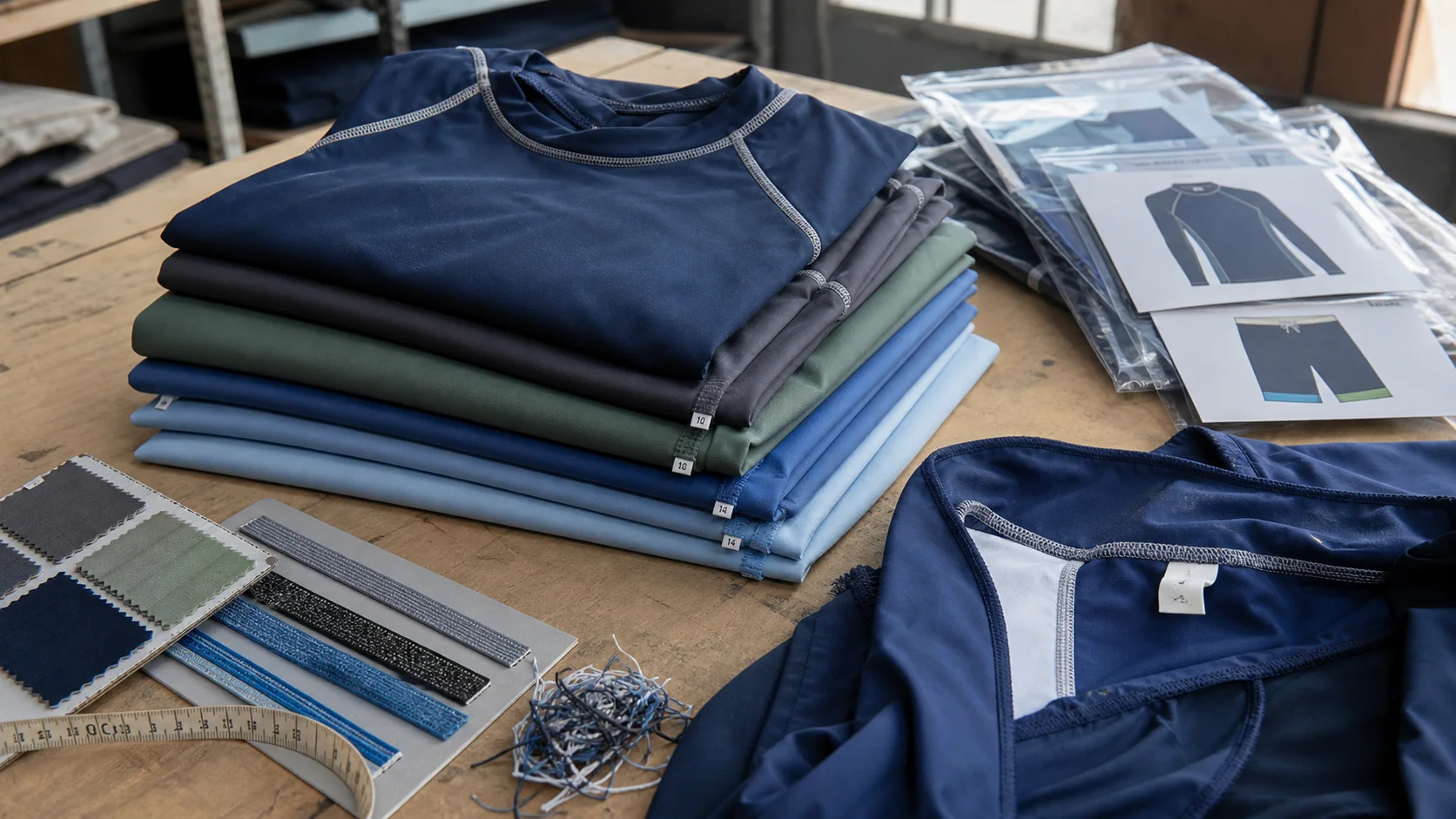
A buyer-focused outline for outdoor school programs evaluating rash guard size grading, fit consistency, and production specs before placing bulk student...
Bulk Rash Guard Size Grading Review for Schools - Activewear & Teamwear manufacturing guide
Bulk rash guard ordering looks simple until the size run arrives and the fit problems become visible. For outdoor schools, surf camps, swimming programs, sailing clubs, field education groups, and school trip operators, rash guards are not just branded apparel. They are functional uniforms used in wet, sunny, and high-movement environments. A poor grading plan can create avoidable returns, uncomfortable students, and last-minute shortages in the most common sizes.
Size grading is the system used to scale a garment pattern from one size to the next. In rash guards, grading is more sensitive than in a basic cotton T-shirt because the fabric stretches, the garment may be worn close to the body, and the sleeve, neckline, chest, waist, and body length all affect comfort. A youth medium that is too narrow in the chest may technically stretch onto the body, but it can still feel restrictive during paddling, swimming, or group sports. An adult small that is graded too long may bunch at the waist and ride up under a wetsuit or buoyancy vest.
Outdoor school buyers also face mixed wearer groups. One order may need youth sizes for younger students, adult sizes for instructors, plus extra room for students who prefer looser coverage. That makes size grading review a sourcing requirement, not a cosmetic detail.
The safest school rash guard program is built around realistic fit tolerance, a clear size ratio, and pre-production samples checked on actual body types where possible.
For buyers comparing custom production options, the starting point should be a supplier that can discuss grading, fit blocks, decoration placement, and bulk quality control in practical terms. Buyers can review manufacturing support through Fabrikn’s services when planning custom activewear and teamwear programs.
Before reviewing grading, buyers need to define the fit standard. Rash guards are commonly produced in three fit directions: compression fit, athletic regular fit, and relaxed school fit. Each has a different grading risk.
Compression rash guards sit close to the body and are often used in surf, swim, and high-performance training. They reduce drag and fabric movement, but they are less forgiving for mixed school groups. Compression fit can work for competitive teams, older students, or technical water sports programs. It is not always the best choice for general outdoor education because some students may feel exposed or uncomfortable.
In compression styles, small grading errors matter. A narrow neck opening, tight underarm, or short body length can make the garment difficult to put on and remove when wet. Buyers should request clear body measurements and garment measurements before committing to bulk production.
Athletic regular fit is usually the best middle ground for school programs. It follows the body without being skin-tight. The garment still performs well in water, but it gives students more comfort across different body shapes.
This fit is suitable for outdoor schools ordering one standard style across several age groups. It also allows modest layering over swimwear and under life jackets. The tradeoff is slightly more fabric movement in water compared with a true compression rash guard.
Relaxed fit rash guards are cut more like lightweight performance tops. They are often preferred for sun protection, beach days, camps, and mixed outdoor activities where water immersion is only part of the schedule.
The main risk is over-ordering loose sizes. If the fabric is too light or the body length is too long, relaxed rash guards can cling awkwardly when wet. Buyers should not assume that a larger fit automatically improves comfort. Good relaxed grading still needs controlled shoulder width, sleeve length, and hem position.
Fit Type Best Use Main Benefit Main Risk Compression Surf teams, swim training, performance groups Low drag and secure movement Less forgiving across mixed body shapes Athletic Regular Outdoor schools, camps, student programs Balanced comfort and performance Requires careful grading to avoid boxy fit Relaxed Sun protection, camps, beach activities Easy wearing and broad acceptance Can become baggy or clingy when wetA good bulk size breakdown starts with the wearer profile. Schools often order for students by grade level, age band, or program size. The mistake is assuming that age equals size. In practice, youth sizing varies widely, especially from ages 10 to 16, where height and body development differ sharply.
For younger school groups, youth sizes may cover most of the order. For middle school and high school programs, adult XS, S, and M often become important. Staff and instructors may require adult L, XL, and sometimes 2XL or 3XL. If the order is for annual use, buyers should include buffer stock in the most common sizes rather than splitting the exact headcount too tightly.
The following ratios are only planning references. Final quantities should be adjusted based on enrollment data, regional body size trends, gender mix, and whether the rash guards are issued permanently or loaned from an equipment pool.
Program Type Likely Size Focus Example Ratio Primary school outdoor program Youth S to Youth XL YS 15%, YM 30%, YL 30%, YXL 20%, Adult S 5% Middle school water program Youth L to Adult M YL 20%, YXL 25%, Adult XS 20%, Adult S 20%, Adult M 15% High school outdoor program Adult XS to XL XS 15%, S 25%, M 30%, L 20%, XL 10% Mixed student and instructor order Youth and adult full range Student sizes 85%, instructor sizes 15%When budgets allow, buyers should include a small overage of 3% to 8% in the most flexible sizes. Adult S, M, and L can often cover unexpected needs better than extreme sizes. For youth programs, Youth L and Youth XL are useful bridge sizes. The weakest strategy is ordering equal quantities across all sizes. That usually creates dead stock in the smallest and largest sizes while the middle sizes run out first.
Outdoor school buyers do not need to become pattern makers, but they should know which grading points affect rash guard performance. A supplier should be able to provide a measurement chart with size-by-size garment specs. The chart should include tolerances and identify whether measurements are taken flat, stretched, or on body.
Typical grading increments vary by supplier, fit block, and fabric stretch. As a practical reference, youth sizes may grade by roughly 2 to 4 cm in chest circumference between sizes, while adult sizes may grade by roughly 4 to 6 cm. Body length may increase by 2 to 4 cm per size in youth ranges and 1.5 to 3 cm in adult ranges. These are not universal rules. They are review points for checking whether the size chart looks logical.
Raglan sleeves are common in rash guards because they support movement and avoid a hard shoulder seam. Set-in sleeves can work well for fashion or teamwear looks, but they need careful armhole review. Long-sleeve styles need more attention than short-sleeve styles because wrist opening, sleeve length, and forearm tightness can trigger complaints.
The jump from Youth XL to Adult XS or Adult S is a common grading problem. Some suppliers treat Youth XL as a smaller adult size, while others use a child body block with shorter length and narrower shoulders. If students are in the 12 to 16 age range, buyers should request overlapping measurements for Youth XL, Adult XS, and Adult S.
A sensible school size range often includes both Youth XL and Adult XS. Removing one of them may simplify purchasing, but it can leave a fit gap. The tradeoff depends on budget, MOQ, and how exact the program needs to be.
Fabric choice directly affects size grading. A rash guard made with high-stretch nylon spandex will fit differently from one made with polyester spandex. Polyester is widely used for school and teamwear rash guards because it is durable, printable, and cost-effective. Nylon often feels smoother and can offer strong stretch recovery, but it may raise cost and requires careful color and sublimation planning.
Typical rash guard fabric weights often sit around 180 to 240 GSM. Lighter fabrics can dry quickly but may become transparent when stretched or wet. Heavier fabrics can improve durability and UPF coverage, but they may feel warm during land-based activities. For school use, a mid-weight polyester spandex fabric is often the practical choice unless the program has premium performance needs.
UPF claims must be handled carefully. Buyers should not rely on a verbal claim only. If the garment is marketed as UPF 50 or UPF 50+, ask what standard was used, whether testing applies to the fabric only or finished garment, and whether stretch, wetness, or repeated washing changes performance. Label claims should match available test support.
Decoration also affects fit and durability. Sublimation is common for polyester rash guards because the print becomes part of the fabric and does not add surface bulk. Screen print and heat transfer logos may work, but large prints can reduce stretch or crack if not specified correctly. For schools, a small chest logo, sleeve logo, or back identification print is usually safer than oversized high-density decoration.
Sample approval is where school buyers prevent most bulk problems. A supplier may offer a fit sample, size set, pre-production sample, or photo sample. The right approach depends on order size, schedule, and customization level.
A first fit sample may use available fabric if timing is tight, but the pre-production sample should be closer to bulk conditions. Fabric stretch and recovery can change the fit. A sample made from substitute fabric may approve the shape but not the final wearing experience.
Schools should test samples in realistic conditions where possible. A quick dry try-on is useful, but rash guards behave differently when wet. If the schedule allows, check range of motion, overhead arm movement, torso length during bending, sleeve comfort, and whether the neck feels restrictive. For younger students, ease of changing matters. A garment that performs well but is difficult to remove when wet can slow down group activities.
For custom production planning, buyers can use the inquiry route on Fabrikn’s contact page to share size ranges, artwork, expected order quantity, and delivery timing.
Minimum order quantities for bulk rash guards vary widely by supplier, fabric availability, customization, and size range. For general planning, buyers may see MOQs from around 100 to 300 pieces for simpler custom rash guards, while more complex programs may require 500 pieces or more. Low MOQs are possible in some cases, but unit cost usually rises and size flexibility may be limited.
For schools, the important question is not only total MOQ. It is MOQ per color, per artwork, and sometimes per size. A supplier may accept 300 pieces total but require one colorway. Another may allow mixed sizes but charge more for small runs in extended sizes. If instructor rash guards use a different color from student rash guards, that may create a second production line or separate MOQ requirement.
A realistic custom rash guard timeline often ranges from 5 to 10 weeks after final specification confirmation. Faster timelines may be possible for repeat orders, stock fabrics, and simple decoration. New development with size-set approval takes longer. Buyers should avoid placing first-time orders too close to trip dates, especially before summer camps or school holiday programs.
Rush production can solve a calendar problem but increases quality risk. Cutting, printing, sewing, and packing all need time. If one stage is compressed, inspection often suffers. The better purchasing decision is to approve a standard style and fit block early, then repeat it seasonally with updated quantities.
Rash guard inspection should focus on fit consistency, fabric behavior, sewing strength, decoration quality, and packing accuracy. School orders often include many sizes, which increases the chance of labeling or carton mistakes.
Measurement tolerance should be agreed before production. For stretch garments, a tolerance of roughly plus or minus 1 cm on smaller measurements and plus or minus 1.5 to 2 cm on larger measurements is often used, but the correct tolerance depends on the measurement point and construction. A strict tolerance may improve consistency but can increase rejection rates. A loose tolerance may reduce factory pressure but allow fit complaints.
Buyers should request packed-by-size carton markings if garments will be distributed to different campuses, trip groups, or activity leaders. Mixed cartons can save packing effort but create sorting work at the school. For a school buyer with limited receiving staff, size-separated packing is usually worth specifying.
A basic wash review is useful before bulk production or during repeat order evaluation. Check shrinkage, print fastness, seam recovery, and pilling. Chlorine exposure, salt water, sunscreen, and abrasion from boards or life jackets can shorten garment life. No rash guard is immune to hard use, but poor fabric recovery or weak seams will show quickly in outdoor school programs.
Care labels should be clear and realistic. Cold wash, line dry, no bleach, and avoiding rough surfaces are common recommendations. If the school uses central laundering, the buyer should tell the supplier in advance. Industrial washing can be harsher than home washing and may require stronger construction.
A strong supplier conversation saves time. School buyers should not rely only on catalog images or general activewear claims. Ask for the details that affect fit, production, and delivery.
It is also worth asking whether the supplier has a repeat-order process. Schools benefit from locking the pattern, fabric, color, and decoration placement after the first successful order. Repeating a proven program reduces development work and makes size forecasting easier each season.
Buyers wanting to understand a supplier’s broader production approach can review Fabrikn’s company information before submitting a technical brief.
The best rash guard for an outdoor school is rarely the most technical garment on the market. It is the style that fits the largest number of students comfortably, survives program use, arrives on time, and can be reordered without rebuilding the entire specification.
For most school buyers, an athletic regular fit in polyester spandex is the safest starting point. It balances cost, printability, durability, and wearer acceptance. Long sleeves offer stronger sun coverage, but short sleeves may be easier for younger students and warmer climates. If sun protection is the core purpose, long sleeves are worth the extra cost and fit review.
Compression fit should be used selectively. It is appropriate for performance water sports but less suitable for general school issue unless students are accustomed to close-fit gear. Relaxed fit can be useful for camps and beach programs, but it needs a controlled pattern so it does not become shapeless when wet.
Size range is another tradeoff. A broad range improves fit but can complicate MOQ and inventory. A narrow range reduces cost and administrative work but increases the chance that students are forced into poor sizes. The practical answer is usually a focused size range with extra stock in bridge sizes.
Buyer Decision Lower-Risk Choice Tradeoff Fit Athletic regular Less streamlined than compression but more acceptable across groups. Fabric Mid-weight polyester spandex May feel less premium than nylon but supports cost and printing. Sleeve length Long sleeve for sun programs Higher cost and more sleeve grading checks. Decoration Sublimation or small stretch-compatible logo Less texture than specialty prints but better movement. Size planning Data-based ratio with middle-size overage Requires more upfront planning than equal size splits.A school rash guard tech brief should be simple but complete. Missing details create assumptions, and assumptions create fit and delivery problems. Buyers should prepare the following before requesting final pricing.
Buyers should be cautious with any quote that skips the measurement chart or sample process. A low unit price can become expensive if the size grading is wrong and the school must reorder missing sizes. The most economical order is the one that students can actually wear.
Bulk rash guard size grading review should happen before purchase order approval, not after production. The review does not need to be complicated. It needs to be disciplined. Confirm the fit type, inspect the graded measurement chart, test the size transition from youth to adult, approve realistic samples, and specify inspection requirements.
Schools buying for outdoor programs should give special attention to the middle sizes, the Youth XL to Adult S bridge, sleeve and neck comfort, and carton-level size accuracy. These are the areas where bulk programs most often succeed or fail.
A well-built rash guard program can support student safety, school identity, and smoother activity management. A poorly graded program becomes an inventory problem. The difference is usually decided in the early sourcing steps: fit block selection, size ratio planning, sample review, and practical quality control.
Get a free quote from Fabrikn — your trusted B2B clothing manufacturer with 10+ years of experience. MOQ as low as 200 pieces.
Get a Free Quote →Size grading is the process of scaling a garment pattern from one size to another. For rash guards, grading affects chest width, sleeve length, body length, neck opening, arm width, and hem sweep. Since rash guards use stretch fabric, the grading must balance close fit with comfort and movement.
Athletic regular fit is usually the safest option for outdoor schools. It gives better comfort across mixed student body types than compression fit while still performing better in water than a loose T-shirt-style top.
Typical MOQs may range from about 100 to 300 pieces for simpler custom orders, with 500 pieces or more for complex designs, special fabrics, or multiple colorways. Buyers should ask whether the MOQ applies to the total order, each color, each artwork, or each size.
Many middle school and high school programs need both. Youth XL, Adult XS, and Adult S should be compared carefully because the transition between youth and adult blocks can create fit gaps. A size set is strongly recommended for mixed-age programs.
Polyester spandex is often the practical choice because it is durable, printable, and cost-effective. A mid-weight fabric around 180 to 240 GSM is common, but the final choice should consider climate, activity level, sun protection needs, and budget.
UPF claims can be important for outdoor programs, but buyers should request test support. The claim should relate to the actual fabric or finished garment, and the supplier should explain whether stretch, wetness, or washing may affect performance.
Use enrollment data, age bands, previous uniform records, and a small overage in common sizes. Equal quantities across all sizes are usually inefficient. Youth L, Youth XL, Adult S, and Adult M often need more attention in mixed student programs.
At minimum, buyers should approve a fit sample and a pre-production sample. For larger school orders, a size set is recommended. The pre-production sample should use bulk fabric, final trims, and approved artwork wherever possible.
The main risks are incorrect size labels, measurements outside tolerance, tight neck openings, uneven sleeves, weak seams, poor print placement, fabric transparency, and packing errors by size. These risks should be included in the inspection checklist before production starts.
For a first-time custom order, starting 8 to 12 weeks before the required delivery date is safer. Repeat orders can often move faster, but fabric availability, artwork changes, school approvals, and shipping conditions still affect timing.