
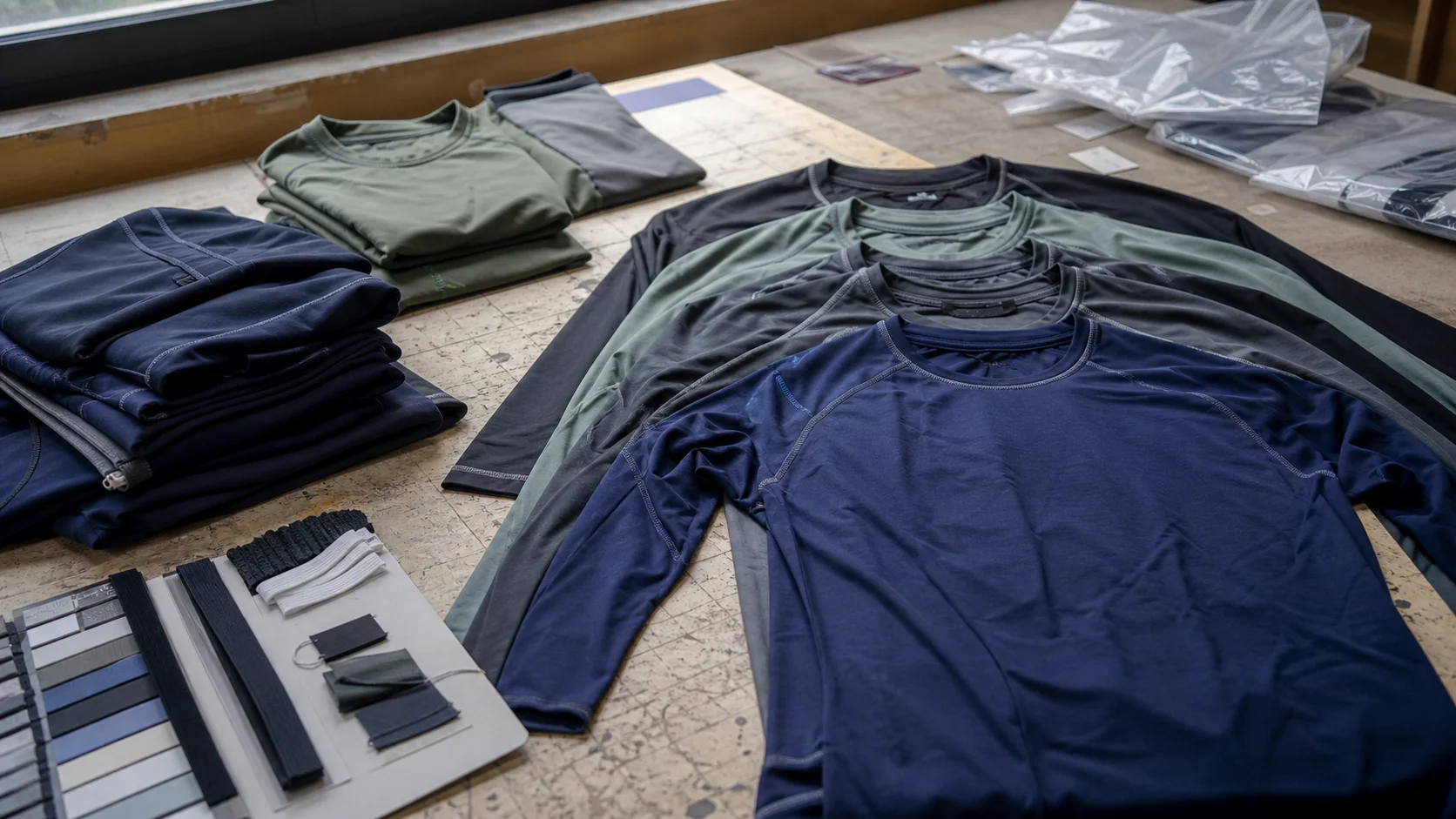
A product-specific SEO outline for warehouse safety buyers reviewing bulk rash guard size grading, fit consistency, movement clearance, labeling, and QC...
Bulk Rash Guard Size Grading Review for Safety Teams - Activewear & Teamwear manufacturing guide
Warehouse safety teams are not buying rash guards for beachwear. They are buying a fitted, stretch-based uniform layer that must work across mixed body types, repeated movement, heat exposure, washing cycles, and sometimes high-visibility or branded safety requirements. That makes size grading more important than it first appears.
A bulk rash guard size grading review for warehouse safety teams should focus on fit coverage, mobility, durability, labeling accuracy, and replenishment planning. The goal is not to make every worker look identical. The goal is to reduce fit-related complaints, avoid unsafe restriction during movement, and prevent waste from over-ordering the wrong sizes.
This review is written for sourcing managers, safety coordinators, procurement teams, and operations buyers comparing bulk rash guard programs for warehouse, logistics, fulfillment, cold-chain, maintenance, and industrial support teams.
Size grading is the process of scaling a garment pattern from one base size into a full size range. In bulk rash guard production, grading affects chest width, body length, sleeve length, bicep fit, neck opening, hem sweep, and overall compression. A poor grade can make small sizes too tight at the neck, large sizes too short in the body, or extended sizes too narrow across the shoulder and upper arm.
For warehouse safety teams, those issues are not cosmetic only. Workers bend, reach, lift, scan, drive, climb, push carts, and rotate through temperature zones. A rash guard that rides up during lifting, pulls across the shoulders, or compresses the forearm too tightly can distract the wearer and reduce acceptance of the uniform program.
Size grading also affects procurement cost. If the approved sample is only checked in one medium size, the bulk order may still fail in 2XL, 3XL, or XS. That creates avoidable returns, rework, replacement orders, and employee dissatisfaction. In a safety-team context, poor fit adoption can also undermine compliance with layering, visibility, or identification policies.
Buying judgment: do not approve a bulk rash guard program based on one attractive sample. Review the size grade, fit intent, stretch behavior, and wash performance before committing to a full team rollout.
A rash guard is usually designed closer to the body than a polo shirt, T-shirt, or work hoodie. It often uses polyester-spandex, nylon-spandex, or recycled performance blends with two-way or four-way stretch. That close fit can help with moisture management and reduce loose fabric, but it also leaves less room for grading mistakes.
Warehouse buyers should define the fit standard before requesting samples. “Compression fit,” “athletic fit,” and “regular fit” are not interchangeable. Compression rash guards sit close to the body and may feel restrictive to workers who are used to standard T-shirts. Athletic fit provides shape without heavy compression. Regular fit is more forgiving but may not match the expected rash guard profile.
For safety teams, a moderate athletic fit is often the safer commercial choice unless the garment is used as a specialist base layer. It gives better size tolerance across a mixed workforce and reduces the risk of employees sizing up too aggressively. A size-up trend can distort inventory planning because many workers who normally wear large may request XL or 2XL if the base fit is too tight.
A size curve estimates how many units to order in each size. For warehouse safety teams, the curve should be based on actual employee sizing data where possible, not a generic retail curve. Workforce demographics, job function, shift structure, and regional hiring patterns can change the size mix significantly.
If no previous garment data exists, start with a controlled fitting run before bulk ordering. This can be done with size-set samples or blank trial garments. Employees should try on the rash guard over the intended underlayer, if any. If the garment will be worn under a vest, jacket, or harness, that combination should be checked during the trial.
Bulk rash guard orders often include sizes from XS to 3XL, with some programs extending to 4XL or 5XL. Extended sizes should not be treated as an afterthought. They may require adjusted grading rules, longer body length, wider bicep width, and more careful neck opening control.
This table is only a starting point. A 200-person warehouse and a 2,000-person multi-site operation should not use the same curve without adjustment. For multi-site rollouts, request sizing data by location and job role. Pickers, drivers, maintenance technicians, supervisors, and cold-room teams may have different layering needs.
The tech pack should include a clear measurement chart for every size. For rash guards, the most important measurements are not limited to chest and length. Sleeve and neck dimensions matter because the fabric sits close to the body.
Review the point-of-measure diagram and tolerance table before sampling. Tolerances should be realistic for stretch fabric, but not so loose that the garment becomes unpredictable. A typical tolerance may be around plus or minus 1 cm for smaller measurements and plus or minus 1.5 cm to 2 cm for larger body measurements, depending on the construction and fabric behavior.
Raglan sleeves are common in activewear because they support movement and reduce shoulder seam pressure. Set-in sleeves can work, but they need better armhole shaping. Flatlock seams may improve comfort against the skin, although they can add cost and require consistent machine handling. Coverstitching is common for hems and cuffs, but skipped stitches must be monitored in inspection.
A practical buyer should ask for the graded spec sheet before approving a size set. The base size may look correct, while the grade jumps are too small in the upper sizes. That is a common reason why XL and 2XL garments feel shorter or tighter than expected.
Rash guard grading cannot be reviewed without fabric performance. Two garments with the same chest measurement can fit differently if one fabric has 12% spandex and another has 18% spandex, or if one fabric recovers poorly after stretching.
Common bulk rash guard fabrics include polyester-spandex jersey, nylon-spandex tricot, and polyester-elastane interlock. Polyester blends are usually cost-effective, colorfast, and suitable for sublimation printing. Nylon blends can feel smoother and stretch well, but they may cost more and can be more sensitive in printing and dyeing. Recycled polyester options are available, although buyers should confirm certification claims and MOQ implications.
For warehouse safety teams, opacity and recovery are often more important than maximum stretch. A very stretchy fabric may feel comfortable in a sample but lose shape after repeated wear. A heavier fabric may improve coverage but increase heat discomfort in warm facilities. A lighter fabric may dry faster but show more transparency and cling.
The best fabric choice depends on the operating environment. Hot indoor warehouses may need lighter, breathable fabrics. Cold-chain or refrigerated warehouse teams may prefer a slightly heavier base layer. Outdoor yard teams may require UPF performance, long sleeves, and higher colorfastness. One rash guard specification may not serve every facility equally well.
A proper approval process reduces the risk of receiving thousands of garments that fit differently from the sample. Sampling should be structured, documented, and tied to measurable specifications.
Not every order needs every stage in full. A simple repeat order may only require a pre-production confirmation if the factory, fabric, pattern, and trims are unchanged. A new safety-team program should not skip the size-set sample. That is where most grading issues become visible.
During fitting, ask wearers to perform realistic movements: overhead reach, forward bend, squat, arm cross, box lift simulation, and seated posture if forklift or vehicle use is part of the role. Check whether the hem rides up, sleeves twist, neck binds, or underarm seams pull. These movement checks are more useful than a mirror review.
Document comments by size. If all 2XL wearers report short body length, adjust the grade rather than telling every wearer to size up. Sizing up may fix length but create loose wrists, low necklines, or excess fabric at the torso.
Minimum order quantities vary by supplier, fabric, decoration method, and size range. For custom bulk rash guards, typical MOQ ranges may start around 100 to 300 pieces for simpler programs using available fabric and standard trims. Fully custom fabric, sublimation artwork, special color dyeing, private labels, reflective trims, or extended size grading may push practical MOQs into the 300 to 1,000-piece range or higher.
Small pilot orders are useful, but they can carry higher unit costs. Large orders reduce unit cost but increase the risk of being locked into the wrong size curve. The better approach is often a pilot size-set and controlled first order, followed by replenishment once real issue data is available.
Lead times are also conditional. A standard activewear program using available fabric may be faster than a fully custom program. Typical production lead times can range from four to ten weeks after sample approval, with additional time for development, lab dips, artwork confirmation, shipping, customs, and internal distribution. Peak season, fabric shortages, trim delays, and late artwork changes can extend the schedule.
For replenishment, ask whether the supplier can hold fabric, repeat the same color standard, and produce short runs by size. Some suppliers will accept lower repeat MOQs for core sizes, while others require a full production minimum. Extended sizes may be harder to replenish if they are cut in low quantities.
Companies comparing production support can review broader apparel development options through Fabrikn services. For order-specific requirements, a direct sourcing discussion through Fabrikn contact is usually more useful than relying on a generic online size chart.
Rash guards for warehouse safety teams may require more than a logo. Buyers should check trims and labeling early because these details affect comfort, compliance, and production timing.
Neck labels can irritate if they are bulky or poorly placed. Heat-transfer labels reduce irritation, but they must survive repeated washing. Woven labels are durable but may be uncomfortable against the neck. Care labels should include fiber content, wash instructions, size, country of origin where required, and any compliance information relevant to the market.
If the rash guard is part of a visibility program, clarify whether high-visibility color alone is enough or whether certified reflective performance is required. A bright neon fabric is not the same as compliant high-visibility PPE. Reflective tape can reduce stretch and create stiffness if placed across high-movement areas. It should be tested with the garment’s stretch pattern, not added after the fit is approved.
Sublimation is a strong option for all-over graphics and durable prints on polyester fabrics. It works best on light base fabrics and may not suit every safety color requirement. Heat transfers can be useful for logos and identification, but poor-quality transfers may crack, peel, or feel stiff. Screen printing can work on some stretch fabrics, but ink flexibility must be tested.
Bulk rash guard inspections should focus on measurement accuracy, stitch quality, fabric defects, color consistency, logo placement, and size labeling. Stretch garments can pass a casual visual check but fail in actual wear if measurements drift or seams crack under tension.
A final random inspection is useful, but an inline inspection can catch issues earlier. If a factory starts bulk production with the wrong sleeve length or incorrect neck binding tension, waiting until final inspection may leave limited options. Inline checks are especially valuable for new suppliers, new patterns, extended size ranges, and orders with reflective or printed trims.
Warehouse receiving teams benefit from carton-level accuracy. If 500 garments arrive with mixed-size cartons and poor labels, the internal distribution cost rises quickly. Ask for carton markings by style, color, size, quantity, purchase order number, and destination if the order ships to multiple sites.
For larger programs, the approved quality limit should be defined before production. Buyers should agree on how measurements will be checked, how many units will be inspected, and which defects are considered critical, major, or minor. Safety-related labeling errors, sharp trims, severe measurement defects, and incorrect reflective placement should be treated more seriously than small cosmetic issues.
The cheapest rash guard is not always the lowest-cost program. If the size grade is wrong, the fabric loses shape, or the decoration fails after washing, the operation pays again through replacements and complaints. Price still matters, but it should be judged against fit reliability and repeatability.
For most warehouse safety teams, the best buying decision is a balanced specification: mid-weight stretch fabric, athletic but not compression fit, tested size grading through at least one size set, durable labeling, and clear carton-level packing. This may cost more than a basic promotional rash guard, but it reduces operational risk.
A high-compression design should only be selected when the team specifically needs that fit and understands the wearing experience. A looser regular fit may be better for large, mixed teams where comfort and adoption matter more than a performance silhouette. Extended size support should be confirmed before the order is priced, not after the purchase order is issued.
Buyers evaluating apparel partners may also want to understand the supplier’s development process, communication structure, and ability to manage production details. General company information is available through Fabrikn about us, while technical discussions should start with the actual size range, fit goal, fabric target, and delivery schedule.
A structured rollout prevents most bulk rash guard problems. The process does not need to be complicated, but it must be controlled. Assign one owner for specifications, one owner for workforce sizing data, and one owner for receiving and distribution requirements.
After the first issue cycle, collect feedback by size and job role. Do not rely only on general comments such as “too tight” or “runs small.” Ask where the garment feels tight, whether it changes after washing, and whether workers sized up from their normal workwear size. This information improves the next purchase order and reduces dead stock.
A bulk rash guard size grading review for warehouse safety teams should be treated as a safety-uniform development task, not a promotional apparel purchase. The fit must support movement. The fabric must recover after stretch. The size curve must reflect the actual workforce. The inspection process must catch labeling, measurement, stitch, and packaging errors before distribution.
The strongest programs usually start with clear fit intent, a disciplined size-set review, and cautious first-order planning. Buyers should resist the temptation to rush straight from a medium sample into full production. Rash guards are less forgiving than standard T-shirts, and warehouse teams will expose fit problems quickly during daily work.
Good size grading does not eliminate every fit complaint, but it reduces predictable failures. For safety teams, that is the practical objective: reliable coverage, acceptable comfort, clear identification, and a repeatable supply plan that can support new hires, replacements, and multi-site growth.
Get a free quote from Fabrikn — your trusted B2B clothing manufacturer with 10+ years of experience. MOQ as low as 200 pieces.
Get a Free Quote →Size grading is the process of scaling a base garment pattern into multiple sizes. For rash guards, it affects chest width, body length, sleeve length, bicep fit, neck opening, and hem shape. Good grading helps each size fit as intended rather than simply becoming wider or narrower.
An athletic fit is often the most practical choice for mixed warehouse teams. It offers a closer activewear profile without the high rejection risk of compression fit. Teams that prioritize comfort over performance styling may prefer a regular fit.
Typical MOQs may start around 100 to 300 pieces for simpler custom programs using available fabric and standard trims. More complex programs with custom dyeing, sublimation, private labels, reflective details, or extended sizing may require 300 to 1,000 pieces or more.
A new program should usually include a fit sample, size-set sample, decoration or color sample, and pre-production sample. A top-of-production sample is also useful for larger orders or first-time suppliers. Repeat orders may need fewer stages if nothing has changed.
Chest width, body length, sleeve length, bicep width, cuff opening, neck opening, and hem sweep are key measurements. For warehouse teams, body length and upper-arm mobility are especially important because workers reach, lift, bend, and rotate throughout the shift.
Many rash guards use stretch fabrics in the range of about 180 gsm to 240 gsm, depending on the use case. Lighter fabrics can feel cooler but may be less opaque. Heavier fabrics can improve coverage but may feel warm in indoor warehouse environments.
Use a size-set fitting before bulk ordering, test realistic work movements, document feedback by size, and adjust the grade before production. A pilot order can also help confirm the size curve before a large rollout.
Common issues include incorrect size labels, measurement variance, skipped stitches, twisted sleeves, tight neck openings, print misalignment, shade variation, and poor carton labeling. Stretch garments should be inspected against approved measurement tolerances, not only by visual appearance.