
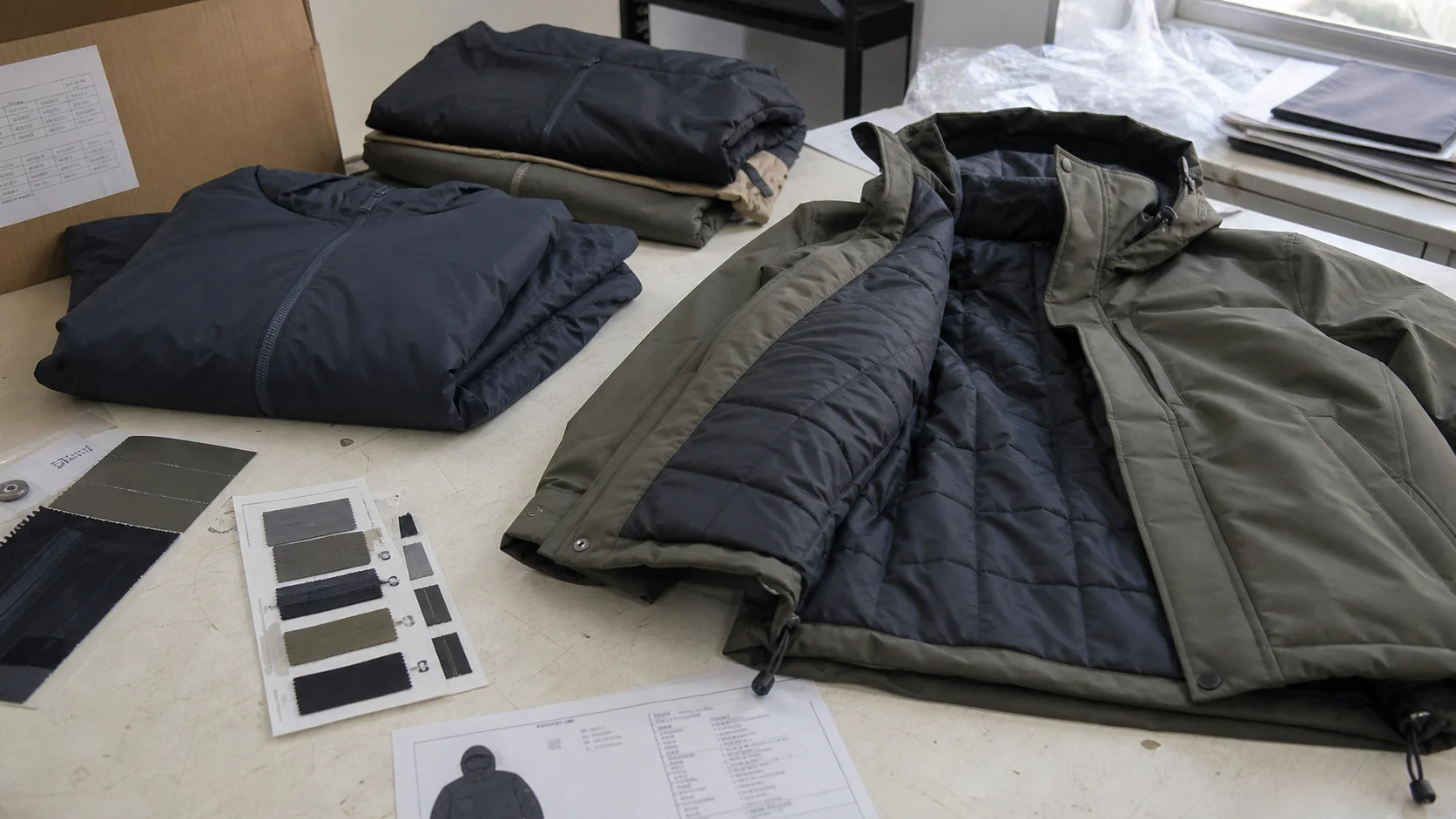
A focused outline for retailers developing bulk recycled jackets, covering trim sourcing decisions, material compatibility, compliance, costing, and commercialization details tied to jacket programs.
Bulk Recycled Jackets With Trim Sourcing Options - Fabrikn production reference
Bulk recycled jackets have moved well beyond a niche sustainability story. For retailers, they now sit at the intersection of commercial demand, margin control, regulatory scrutiny, and brand positioning. Buyers are under pressure to show material improvement in fiber choices, but they still need outerwear programs to hit target prices, land on time, and perform in use. That is where trim sourcing becomes more than a secondary detail.
A recycled jacket can look credible on paper while still creating avoidable development problems if the trims are overlooked. Zippers, snaps, drawcords, cord locks, labels, elastic, hook-and-loop tape, and patch materials all influence both product cost and sustainability claims. In many cases, trims are the reason an otherwise straightforward bulk order slows down.
For retailer product development teams, the main question is not whether recycled outerwear is possible. It is how to build a jacket program that balances recycled content, visual appeal, durability, and supply reliability. The most effective sourcing approach usually starts with clear technical priorities. Teams that define the shell fabric but leave trim decisions until late often face redesign cycles, color mismatch, testing delays, or price movement during costing review.
Bulk programs need practical alignment early. That means deciding which sustainability targets are mandatory, which trims can be standard stock, and where custom branded components are worth the extra lead time. Retailers that want a clearer development framework often start by reviewing production support and supplier capabilities through pages such as https://fabrikn.com/services/ before locking a sourcing calendar.
The term “bulk recycled jackets” covers several product types, and each one creates a different trim sourcing profile. Lightweight windbreakers, padded puffers, softshell jackets, fleece hybrids, and workwear-inspired utility jackets all use different construction methods. That matters because trim complexity tends to rise with function.
Typical recycled material options include recycled polyester from post-consumer bottles, recycled nylon from industrial or post-consumer waste streams, and blended constructions where only part of the garment contains recycled input. Some programs also use recycled linings, recycled insulation, or recycled pocketing. Buyers should not assume the same recycled percentage can be extended across every component. Shell and lining options are usually easier to source than matching recycled trims at scale.
In bulk outerwear development, a standard jacket bill of materials may include:
The sourcing challenge is straightforward: recycled shell fabric is often the headline material, but trims can determine the real execution difficulty. A retailer may approve a fabric quickly, then lose time sourcing a zipper tape color that matches the shell, or a branded puller that passes corrosion or wash testing. In outerwear, trims are visible and functional. A weak trim package can undermine both the sustainability message and the wearer experience.
Trim sourcing is where recycled jacket development becomes a commercial exercise rather than a concept exercise. Product teams usually choose between stock trims, semi-custom trims, and fully customized branded trims. Each route carries different tradeoffs.
Stock trims are the fastest route for bulk recycled jackets, especially when the retailer needs lower MOQs or compressed development timing. These may include standard zipper chains, stock pullers, basic elastic cords, plain webbing, common snap finishes, and generic woven labels. The main advantage is speed and reduced development risk. The main limitation is design flexibility.
Stock options work well for value-driven programs, test launches, or capsule developments where speed matters more than signature branding. They can also reduce deadstock risk because suppliers often source from trims already moving through their chain.
Semi-custom options are common in mid-volume retail programs. A buyer might select a standard zipper body but request a branded puller, or use stock webbing with a custom dye-to-match finish. This approach is usually a reasonable middle ground for retailers that need visual distinction without taking on the full burden of trim tooling and high MOQs.
For many jacket programs, this is the most practical sourcing tier. It preserves some design control while keeping replacement sourcing possible if one nominated trim mill falls behind.
Fully custom trim packages are best reserved for outerwear lines with strong margin support, repeat volume, or a clear brand reason for the investment. Custom rubber patches, logoed snaps, molded zipper pullers, debossed cord locks, engraved eyelets, and special packaging can elevate the final product. They can also extend the critical path considerably.
Typical issues with custom trims include mold charges, lab dip delays, minimum order barriers, and replacement difficulty if a trim fails testing. A custom part that looks sharp in a sample room may become the reason a bulk order misses ship windows.
Not every trim category has mature recycled sourcing options. Recycled zipper tape is more common than fully recycled zipper assemblies. Recycled polyester labels and tapes are usually easier to source than highly engineered performance trims. Recycled plastic cord locks may be available, but consistency in color, mechanical strength, and finish can vary by supplier.
This is where buying teams need a realistic hierarchy. If the shell and lining carry the bulk of the garment weight, it may be commercially smarter to prioritize verified recycled content there first, then improve trims where supply is reliable. Overreaching on every component can create approval delays without adding proportional value to the retail customer.
Trim sourcing also affects compliance claims. A garment marketed as recycled needs careful internal language if only selected components contain recycled content. Retailers should align marketing, technical, and sourcing teams so claims do not overstate the recycled composition of the full garment. This point matters even more when trims are mixed between recycled and conventional inputs.
Material declarations, test reports, and traceability records should be reviewed at the component level where needed. A practical supplier will flag where evidence is strong and where claims need to stay narrow. That is usually a better sourcing signal than broad sustainability language with limited technical backup.
Retailer product development for bulk recycled jackets should follow a disciplined path. Outerwear has too many dependent components to leave decisions open too long. The cleanest programs move from concept to approval in stages.
Start with target retail price, target FOB range, expected order volume, launch season, and performance requirements. A fashion windbreaker for spring has a very different trim profile than a winter insulated commuter jacket. Product teams should also clarify which sustainability standards are expected internally and what claim language the brand intends to use.
Shell fabric decisions drive much of the costing and appearance. Teams should confirm fabric composition, weight, finish, hand feel, and color expectations first. For recycled jackets, it is also useful to define whether the lining, padding, and pocketing must follow the same sustainability standard or whether those are preferred but not mandatory.
A trim matrix is one of the simplest ways to avoid development drift. This document should list each trim, its function, target material, finish, branding requirement, color requirement, testing need, and sourcing status. If a retailer wants a recycled or lower-impact alternative for any trim, that request should be recorded from the start.
Without a trim matrix, teams often review samples that still contain placeholder components. That slows real approval because the sample may look close to finished, but critical components are still unresolved.
For bulk outerwear, a normal sample sequence may include proto sample, fit sample, salesman sample, pre-production sample, and top-of-production review. Some suppliers combine stages depending on program urgency. Buyers should confirm which sample is intended to lock fit, which sample is intended to lock trims, and which sample is the final bulk reference.
Trim-heavy jackets need careful sample comments. A zipper can be approved for appearance but still need testing on smoothness and strength. A cord lock can be approved for look but still fail repeated use. Product teams should avoid broad comments like “approved if quality is okay” because they create interpretation gaps.
Color alignment is often harder than expected in recycled programs. Recycled base materials can behave differently in dyeing or finishing, and trims sourced from different vendors may not match perfectly under store lighting. Buyers should review shell fabric lab dips, printed artwork strike-offs, patch color standards, and zipper tape matching together where possible.
The pre-production sample should reflect actual bulk components, not idealized substitutes. This sounds obvious, but many preventable quality issues begin when development trims are swapped after approval because the original option had MOQ or lead-time problems. If a trim changes after PP approval, that change should trigger a documented re-approval path.
Retailers that need sourcing support across this full sequence often use supplier contact channels such as https://fabrikn.com/contact-us/ to review feasibility before bulk commitments are made.
MOQ and lead time are where many recycled outerwear programs become difficult. The garment MOQ may be workable, but the trim MOQs may not align with the retailer’s buy quantity.
For bulk recycled jackets, a common garment MOQ may fall around 300 to 1,000 pieces per style-color for simpler programs, though more technical or specialized developments can push higher depending on fabric booking and factory line efficiency. Custom trims can introduce separate MOQs that may range from a few hundred units for certain labels and stock-based adaptations to several thousand units for molded, engraved, or tool-based components.
That means a retailer ordering 500 jackets in two colors may find the garment order achievable, while the custom zipper puller or branded patch is not commercially efficient. In these cases, semi-custom trim choices often protect the margin better than forcing full customization.
Lead time for recycled jackets depends on fabric greige availability, recycled fiber sourcing, dyeing capacity, trim readiness, sample revision cycles, and shipping mode. A straightforward repeat style with existing fabric and stock trims may move much faster than a new style requiring custom insulation weight, branded pulls, and fresh wash or weather-resistance testing.
Buyers should pay special attention to the following dependencies:
It is usually safer to view the longest trim lead item as part of the critical path, not as an accessory that can be solved later.
Recycled materials do not automatically make a jacket prohibitively expensive, but they do reduce sourcing flexibility in some categories. Buyers often face these tradeoffs:
The strongest purchasing judgment is usually to spend where the customer notices clear value and simplify where branding adds little. For many retail programs, that means prioritizing the shell, insulation performance, zipper reliability, and overall silhouette before adding too many custom branded trim elements.
Bulk recycled jackets need inspection planning that goes beyond basic visual checks. Outerwear failures are expensive because repair is hard and returns are more likely when fit, function, or hardware performance is off.
A practical inspection plan should review measurement tolerance, construction consistency, trim attachment strength, pocket functionality, zipper operation, labeling accuracy, carton assortment, and appearance after packing. If the jacket is sold with water resistance, wind resistance, or warmth claims, testing and bulk consistency need to support those expectations.
Inspection risk rises when trims are substituted late or when multiple trim suppliers feed the same order. Even small hardware differences can affect the consumer impression. A matte black snap that shifts to a slightly glossy finish between lots may not fail technically, but it can still create a retail quality issue.
For trim-sensitive jacket programs, top-of-production review is worth the effort. Early confirmation of bulk-made units helps catch issues that samples do not always reveal, especially when line operators, pressing conditions, or bulk component lots differ from development conditions. Waiting until final inspection to catch trim or finish problems leaves little room to recover the ship window.
Retail buyers should judge suppliers on execution discipline, not just sustainability language. A good supplier for bulk recycled jackets with trim sourcing options should be able to explain what is standard, what is customizable, and what is likely to create MOQ or lead-time pressure. That level of clarity is usually more useful than broad assurances.
Key questions to ask include:
Retailers should also look for suppliers that can help simplify the bill of materials when needed. That is often a sign of commercial maturity. Not every jacket needs five branded trim details. In many cases, a cleaner trim architecture improves both margin and delivery confidence.
For brands evaluating a manufacturing partner’s background and sourcing orientation, it can be useful to review pages such as https://fabrikn.com/about-us/ alongside service capabilities and development support.
Bulk recycled jackets with trim sourcing for retailer product development require careful coordination between design intent and production reality. The recycled shell fabric may be the headline feature, but trim selection often determines whether the program lands smoothly or turns into a cycle of revisions, cost drift, and delayed approvals.
The practical path is usually clear: define the commercial brief early, prioritize the materials that carry the most weight and customer value, build a trim matrix before sampling moves too far, and match customization ambitions to actual MOQ and lead-time tolerance. Buyers who take this approach tend to protect both sustainability goals and margin discipline.
In outerwear, disciplined simplification is often a strength. A jacket with reliable recycled core materials, well-chosen trims, and strong quality control is usually a better retail product than an overbuilt concept burdened by difficult sourcing. That is the central tradeoff worth managing in sustainable fashion product development.
Get a free quote from Fabrikn — your trusted B2B clothing manufacturer with 10+ years of experience. MOQ as low as 200 pieces.
Get a Free Quote →Bulk recycled jackets are outerwear styles produced in volume using recycled materials in key components such as shell fabric, lining, insulation, or selected trims. In retail sourcing, the term usually refers to commercially scalable programs rather than one-off sustainable capsules.
The most important trims usually include zippers, snaps, drawcords, cord locks, labels, patches, hook-and-loop closures, and elastic components. These matter because they affect function, aesthetics, compliance language, and lead time.
A typical garment MOQ often starts around 300 to 1,000 pieces per style-color, depending on construction, fabric availability, and supplier setup. Custom trims may have separate MOQs that are higher than the garment order itself.
Not always. Some trim categories have stronger recycled sourcing options than others. Recycled tapes, labels, and certain plastic-based components are often easier to source than highly specialized performance trims or fully recycled hardware assemblies.
Trim choices can add tooling, color matching, sample approvals, testing, and supplier coordination. A custom zipper puller or branded patch may look minor, but it can become the longest lead item in the whole jacket program.
Retailers can reduce risk by locking the trim matrix early, using realistic sample approval stages, confirming bulk-ready components at pre-production stage, and planning inspections around trim function as well as garment appearance.