
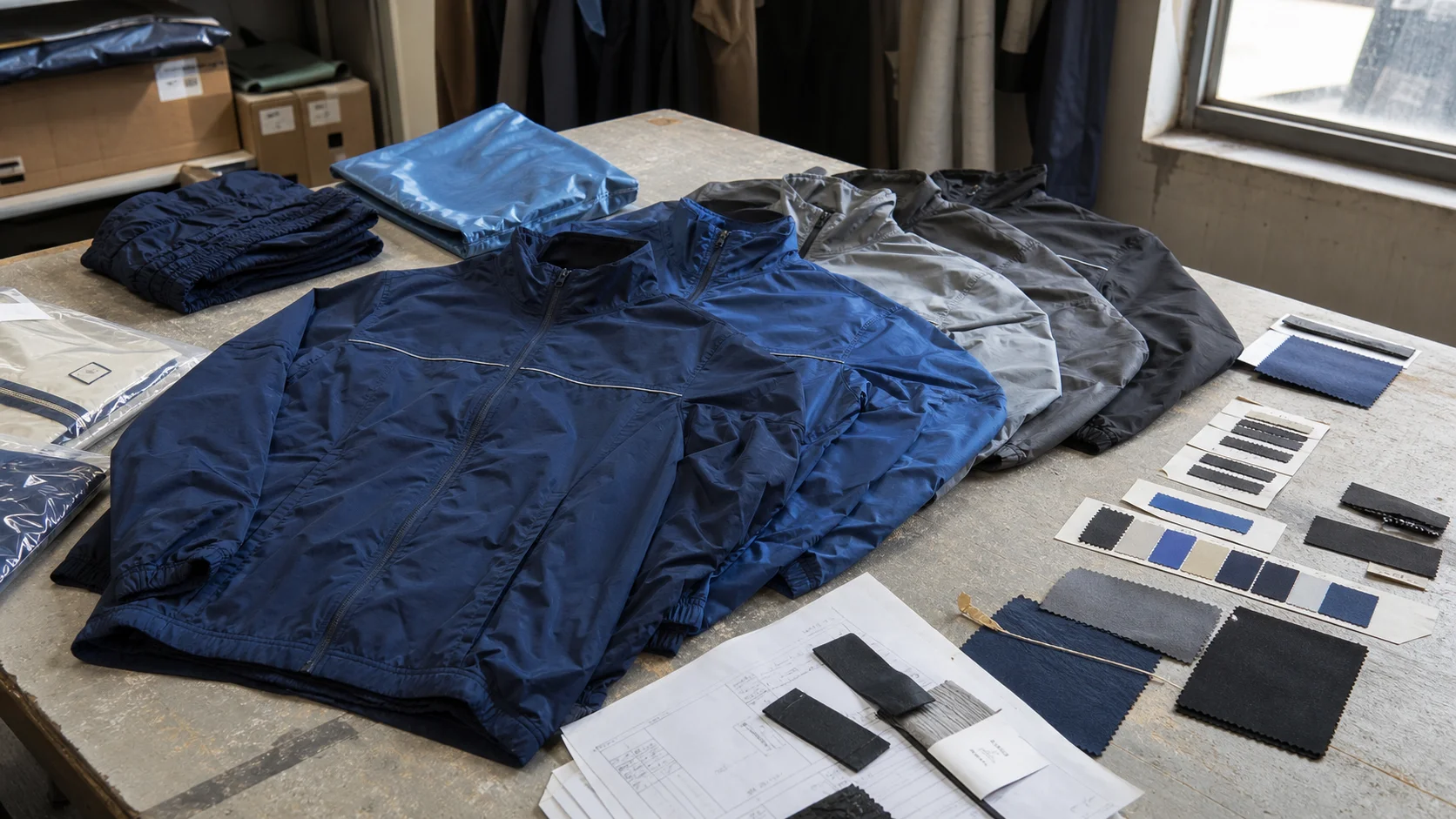
A buyer-focused outline for evaluating bulk recycled nylon jacket size grading for cleaning crews, with emphasis on fit consistency, mobility, layering,...
Recycled Nylon Jacket Size Grading Review for Crews - Sustainable Fashion manufacturing guide
Bulk recycled nylon jacket size grading review for cleaning crews is not a cosmetic exercise. It is a purchasing control point. Cleaning teams move, bend, load supplies, carry equipment, work indoors and outdoors, and often wear uniforms over polos, sweatshirts, or base layers. A jacket that looks acceptable on a flat measurement table can still fail in daily use if the grading is too narrow through the chest, too short at the back body, tight at the bicep, or poorly balanced across extended sizes.
For sustainable fashion buyers, recycled nylon adds another layer of decision-making. The fabric choice supports lower-impact sourcing compared with virgin nylon, but the garment still has to perform. If 15% of a bulk order is unwearable because the size spread was wrong, the sustainability claim weakens quickly. Returns, replacements, deadstock, and employee dissatisfaction all carry cost.
Cleaning crew jackets usually sit between corporate uniformwear and functional workwear. They need to look clean enough for client-facing facilities, but they cannot be graded like a slim retail fashion jacket. The wearer may be reaching above shoulder height, kneeling, pushing carts, operating floor machines, or stepping outside to service waste areas. Size grading must protect mobility first, then refine appearance.
This review focuses on practical sourcing decisions for companies placing bulk orders of recycled nylon jackets for janitorial, housekeeping, sanitation, and facility cleaning crews. It covers measurement points, size distribution, grading tolerances, fabric and trim considerations, sample approval steps, typical MOQ ranges, lead-time dependencies, and inspection risks that can affect final delivery.
Purchasing judgment: for cleaning crews, a slightly generous fit usually creates fewer problems than a narrow fit. The goal is not oversized fashion. The goal is repeatable mobility across the full size range.
A recycled nylon jacket program for cleaning crews usually starts with a simple request: “We need lightweight sustainable jackets in our brand colors, in sizes XS to 4XL.” The sourcing work behind that request is less simple. Bulk buyers need to define the base size, grading increments, garment construction, fabric performance, branding placement, and acceptance standards before production begins.
The main sizing risk is assuming that a standard size chart will fit every crew. Cleaning crews can be highly diverse in body shape, height, gender mix, age, and layering habits. A single unisex size chart may be efficient, but it can produce fit complaints if the grading is not reviewed carefully. Separate men’s and women’s patterns can improve fit, though they add complexity and may raise MOQ requirements.
For most bulk crew uniform programs, the jacket must satisfy four conditions:
Buyers evaluating suppliers can review broader apparel manufacturing support through Fabrikn’s services, especially when a jacket program requires development, sampling, production coordination, and quality control alignment.
Size grading should start with the workforce profile. A cleaning company with 40 staff members in one building has different needs from a national facility services provider ordering for multiple sites. The larger and more distributed the crew, the more important it is to establish a reliable size curve.
Unisex sizing is common for cleaning crew jackets because it simplifies ordering and inventory. It also works reasonably well for relaxed, straight-cut outerwear. The tradeoff is fit precision. A unisex jacket can be too broad at the shoulders for some wearers and too narrow at the hip for others, especially if the jacket is longer and designed to cover the seat.
Gender-specific sizing can improve comfort and appearance. A women’s block may need different shoulder width, bust shaping, waist suppression, hip allowance, sleeve length, and body length. The downside is higher SKU count. More SKUs can affect MOQ, production planning, warehousing, and reorder forecasting.
For many cleaning crew programs, a practical compromise is a unisex jacket with carefully reviewed hip, sleeve, and shoulder grading. If the workforce is predominantly women or has known fit issues with unisex uniforms, a separate women’s fit should be costed early rather than added after sample rejection.
A typical bulk cleaning crew jacket range may run from XS to 3XL or XS to 4XL. Some buyers need XXS or 5XL, especially for inclusive uniform programs. Extended sizes should not be treated as automatic mathematical enlargements. Large sizes often require pattern balancing, not just wider chest measurements.
Program Type Common Size Range Buying Consideration Small local crew S to 2XL Can use actual staff measurements, but allow extras for turnover. Mid-size facility team XS to 3XL Needs a basic size curve and try-on sample set. Multi-site cleaning provider XS to 4XL or 5XL Requires controlled grading, reorder planning, and inspection discipline. Client-facing premium uniform Men’s and women’s ranges Better fit, but higher SKU count and higher inventory risk.Many bulk orders overweight medium and large sizes. That may work for retail, but crew uniform orders should be based on actual wearer data when possible. A basic pre-order size survey can reduce waste. Fit samples are better than asking employees for their usual retail size, because retail sizing varies widely.
A cautious starting curve for a general adult unisex cleaning crew order might allocate a higher share to M, L, XL, and 2XL, with smaller quantities in XS, S, 3XL, and 4XL. The correct curve depends on workforce demographics. Buyers should also reserve a small overage for new hires and exchanges. An overage of 3% to 7% is common, but bulky outerwear inventory can become expensive if over-ordered.
Size grading is only useful when the points of measure are relevant to how the garment is used. For recycled nylon jackets worn by cleaning crews, the most important measurements are chest, sweep, shoulder, back length, sleeve length, bicep, armhole, cuff opening, neck opening, and across-back width.
Chest width must allow layering and movement. A cleaning crew jacket may be worn over a T-shirt in warm months and over a sweatshirt in colder facilities. If the finished garment chest is too close to body measurement, the wearer will feel tightness when reaching forward or pushing equipment.
For lightweight woven jackets, ease at the chest is usually more generous than fashion outerwear. The exact ease depends on lining, insulation, stretch, and intended climate. For uninsulated recycled nylon shells, buyers should still avoid a narrow chest grade because woven nylon generally does not stretch enough to compensate.
The sweep is a common failure point in crew jackets. If the jacket ends at or below the hip, the bottom opening must accommodate sitting, bending, and stepping. A straight-cut unisex jacket with inadequate sweep can ride up or feel tight across the hips.
Elastic hems and adjustable drawcords can help control shape, but they are not a substitute for correct sweep grading. Elastic that is too tight may improve flat appearance while causing discomfort in use.
Cleaning work involves frequent forward reach. Shoulder width and across-back measurement should be reviewed together. A jacket can measure correctly at the chest but still restrict movement if the back panel is too narrow or if the armhole is cut too high without enough sleeve mobility.
Raglan sleeves can improve movement and reduce shoulder fit issues across body types. Set-in sleeves look cleaner and more structured, but they require careful armhole and sleeve cap balance. For bulk cleaning crews, raglan or action-back details can be worth the added development attention if mobility is a priority.
Sleeve length must balance coverage with safety. Sleeves that are too short expose wrists during reaching. Sleeves that are too long can interfere with gloves, wiping, or equipment handling. Adjustable cuffs with hook-and-loop tabs, elastic, or snaps can improve fit across sizes.
Cuff openings should be checked with gloves if the crew uses them regularly. Tight cuffs can be irritating. Wide cuffs can drag or catch. The preferred specification depends on the cleaning environment.
Back length matters because cleaning work includes bending and kneeling. A jacket that rides up at the back can feel exposed and unprofessional. A slightly dropped back hem can improve coverage without making the front too long.
For facility teams that work indoors, an overly long jacket may be unnecessary and may restrict movement. For exterior or mixed indoor-outdoor cleaning teams, added back coverage can be useful, especially in wind or light rain.
Grading rules determine how each size changes from the base size. A supplier may have a standard grade, but buyers should not approve it blindly. A retail outerwear grade may not suit cleaning crew workwear.
Most factories develop the base pattern in a middle size, often M or L for unisex styles. The rest of the range is graded up and down. The larger the size range, the more likely it is that simple grading will distort fit. XS and 4XL cannot always be trusted if only a medium sample has been reviewed.
Common woven jacket grading may increase chest circumference by around 4 cm to 6 cm per size, though this varies by market, block, and intended fit. Sweep may follow chest, or it may grade differently to allow hip room. Sleeve length usually grades more slowly than width measurements. Shoulder width also grades gradually, because too much shoulder growth can make large sizes look sloppy.
Measurement Typical Grade Direction Review Priority Chest circumference Often increases 4 cm to 6 cm per size High, because it affects layering and reach. Sweep circumference May match or exceed chest grade High, especially for longer unisex jackets. Sleeve length Usually increases modestly per size Medium to high, depending on gloves and task safety. Bicep circumference Needs enough growth in larger sizes High for mobility and layering. Back length Usually increases gradually Medium, but important for bending coverage.Extended sizes need special attention. A 3XL or 4XL jacket cannot be solved by adding width only. The armhole, sleeve bicep, across-back, neck opening, pocket placement, zipper length, and hem shape all need review. If pockets stay too close together on larger sizes, the jacket looks poorly scaled. If sleeve length grows too much, the wearer may need alteration or cuff adjustment.
For large uniform programs, buyers should request fit samples in at least the base size and one upper size, such as 2XL or 3XL. If the order includes 4XL or 5XL, a production-size sample in that range is a sensible safeguard.
Smaller sizes can also fail. XS jackets may become too short, too narrow at the sweep, or too tight at the armhole if the grade is aggressive. If a unisex XS is intended for smaller-framed women, shoulder width and sleeve length deserve close attention. A jacket that fits in chest but has long sleeves may look unprofessional and interfere with work.
Recycled nylon is often selected for lightweight jackets because it can offer durability, wind resistance, and a smooth handfeel while supporting sustainability goals. The exact performance depends on yarn, weave, denier, coating, finishing, and lining. Buyers should treat “recycled nylon” as a material category, not a complete specification.
Cleaning crew jackets commonly use lightweight to midweight woven nylon shells. A specification might include recycled nylon content percentage, denier, weave type, fabric weight, water-repellent finish, color standard, and lining choice. If sustainability claims matter, buyers should request documentation for recycled content, such as recognized certification or supplier declarations appropriate to the market.
Recycled nylon can have different handfeel and recovery compared with virgin nylon depending on the source and processing. Most woven nylon shells have limited stretch unless spandex or mechanical stretch is built in. That means fit cannot rely on fabric forgiveness. The pattern and grading must create movement allowance.
Coated nylon can feel less breathable and less flexible than uncoated fabric. A waterproof or water-resistant coating may reduce drape and make tight areas feel tighter. A mesh lining can add comfort but may catch on inner garments if the fit is too close. A fleece lining increases warmth but also reduces internal room.
If the jacket is lined or lightly padded, the size specification must account for internal bulk. A sample approved in an unlined shell cannot automatically represent the fit of a lined production jacket. This is a common development shortcut that leads to fit complaints.
Nylon usually has lower wash shrinkage than many natural fibers, but heat exposure, finishing, lining behavior, and construction can still affect final dimensions. Bulk buyers should request pre-production fabric test data for dimensional stability, colorfastness, seam slippage, tear strength, and abrasion where relevant.
Cleaning crews may wash uniforms frequently. If jackets are machine washed and tumble dried, care labeling should reflect realistic use. A garment that requires delicate care may not suit crew operations unless the employer manages laundering centrally.
Sampling is where size grading decisions become visible. A disciplined sample process helps prevent production surprises. Buyers should avoid approving bulk recycled nylon jackets based only on a product photo, a stock size chart, or a single salesman sample.
The first step is to define the jacket clearly. The tech pack or product specification should include style description, size range, base size, points of measure, grade rules, tolerances, fabric details, trim details, branding method, color standards, packaging, labeling, and inspection requirements.
For branding, embroidery, heat transfer, woven patches, and reflective prints all affect production differently. Embroidery on lightweight nylon may need backing and tension control to avoid puckering. Heat transfers need testing for adhesion, wash durability, and coating compatibility. Reflective trims may add safety value but must be placed where they do not restrict seams or pocket function.
The fit sample checks silhouette, balance, and movement. It may be made in available fabric if final recycled nylon is not ready. That is acceptable only if the substitute fabric behaves similarly. A stiff substitute can mislead fit review, and a soft substitute can hide problems that appear later in final fabric.
Fit sample review should include standing, reaching forward, raising arms, bending, sitting, and wearing over the intended inner layer. For cleaning crew jackets, static fit is not enough. Mobility is part of the specification.
A size set sample shows how the garment grades across sizes. For bulk orders, this is one of the most important approval stages. Buyers should request at least key sizes rather than every size if budget is tight. A practical set might include S, L, 2XL, and 4XL for a unisex range. The exact selection depends on the size curve and risk areas.
At this stage, compare actual measurements with the size chart and tolerance. Look for visual distortion across sizes: pocket placement, hood size, collar height, zipper length, sleeve shape, hem balance, and logo scale. A logo that looks right on size L may look too large on XS or too small on 4XL.
The pre-production sample should use final fabric, final trims, final color, final branding, and final construction. It is the reference for bulk production. If the buyer approves a pre-production sample with unresolved issues, the factory may treat those issues as accepted.
Approval comments should be written clearly. Vague comments such as “make fit better” are not useful. Better comments include exact measurement changes, construction corrections, and visual references. If the sleeve bicep is tight, specify the required increase and confirm whether it affects armhole, sleeve cap, or both.
For larger orders, a top-of-production sample can confirm that the first bulk pieces match approval. This is especially useful when using recycled nylon fabrics, special trims, or new suppliers. Problems found at this stage can still be corrected before the full order is complete, though delays may occur.
Minimum order quantity depends on fabric availability, color, trim customization, factory capacity, and size range. Recycled nylon programs often have MOQ pressure because mills may require minimum yardage for custom colors, coatings, or certified recycled content.
For a relatively standard recycled nylon jacket using available fabric colors, MOQ may start around 300 to 500 pieces per style with some suppliers. Custom fabric color, custom lining, special trims, or extensive size ranges can push MOQ to 800, 1,000, or more pieces. If separate men’s and women’s fits are required, suppliers may apply MOQ per style or per color.
Order Scenario Typical MOQ Range Main Constraint Stock fabric, simple branding 300 to 500 pieces Factory sewing line and trim sourcing. Custom color recycled nylon 800 to 1,500 pieces Fabric dye lot and mill minimums. Men’s and women’s separate fits 500 to 1,000 pieces per fit Pattern, sampling, cutting, and SKU complexity. Extended sizes up to 5XL Varies by supplier Pattern development and fabric consumption.These ranges are typical buying references, not guaranteed quotes. Buyers should confirm whether MOQ is per style, per color, per size, or per purchase order. This detail matters. A supplier offering a low total MOQ may still require minimum quantities per size or charge surcharges for low-volume extended sizes.
Lead time for bulk recycled nylon jackets can range from roughly 8 to 16 weeks after approvals, depending on fabric and factory schedule. Development and sampling can add several weeks before the production clock begins. Custom recycled nylon fabric, lab dips, strike-offs, trims, packaging, and third-party tests can extend the timeline.
Key lead-time variables include:
Cleaning companies ordering for a contract launch should not plan jackets as a last-minute item. If uniforms must be ready for a new building opening or service start date, size survey and sample approval should begin early. A rushed order usually sacrifices either fit review, color control, or inspection discipline.
The lowest unit price is not always the lowest program cost. A cheaper jacket with poor grading can create exchange costs and staff complaints. A highly customized jacket can look excellent but may be hard to reorder in small quantities. Sustainable materials can support brand positioning, but recycled content claims need documentation and stable sourcing.
Buyers should decide where the jacket must be strong and where it can remain simple. For cleaning crews, money is usually better spent on fit, durable zippers, appropriate lining, reinforced stress points, and reliable color than on decorative complexity. If the budget is tight, reduce nonessential trims before reducing movement allowance.
For project discussions, buyers can use Fabrikn’s contact page to outline size range, order quantity, fabric direction, branding method, and delivery target before requesting a production pathway.
Bulk recycled nylon jacket inspection should cover measurements, construction, fabric quality, trims, branding, packing, and labeling. Size grading issues are often found too late because inspections focus only on visual defects. A good inspection plan measures multiple sizes, not just the base size.
Every garment specification needs tolerances. Common tolerances for woven jackets may vary by measurement, with larger allowances for long body measurements and smaller allowances for critical widths. The tolerance must be realistic for production while still protecting fit.
Risk increases when factories stack-cut slippery nylon fabric. Layers can shift, especially on curved parts such as armholes, sleeves, and hoods. If cutting control is weak, size variation appears across the order. Measurement audits should include pieces from different cartons and different sizes.
Recycled nylon jackets can show puckering if stitch tension is wrong. Lightweight nylon can also fray or slip at seams if seam allowance and stitch density are not suitable. High-stress areas include armholes, side seams, pocket openings, zipper ends, hood joins, cuffs, and hem adjustments.
Cleaning crews use jackets repeatedly, not occasionally. Pocket bags should be checked for strength if workers carry keys, gloves, small tools, or ID cards. Zippers need smooth operation. Pullers should be easy to use with gloves. Snaps should not tear through lightweight shell fabric.
Recycled nylon color control can be affected by dye lots, coatings, and fabric batches. Shade variation between panels is a visible defect, especially on solid navy, black, gray, or branded colors. If jackets include contrast panels, the inspection should verify placement and color consistency across sizes.
Buyers should set a color standard before bulk production. Lab dips, approved swatches, or Pantone references are useful, but final approval should consider the actual fabric and finish. Coated fabrics can reflect light differently from uncoated swatches.
Logo placement must be graded or controlled across sizes. A chest logo placed at the same distance from center front and shoulder may look acceptable, but it should not drift into the armhole on smaller sizes or sit too low on larger sizes. Embroidery puckering, print cracking, heat transfer peeling, and reflective trim misalignment are common inspection points.
Bulk uniform programs depend on clean distribution. Incorrect size labels create operational headaches even if the garments are well made. Carton markings, polybag labels, hangtags, and internal care labels should all match the purchase order.
Pre-sorted packing by location, department, or wearer can save time for large cleaning companies. It must be specified early. Last-minute packing instructions can disrupt production and increase error rates.
A structured buying checklist reduces the chance of approving a jacket that looks good in a sample room but fails in the field. The following points are practical for procurement teams, operations managers, and sustainable fashion buyers reviewing recycled nylon jacket production.
Purchasing judgment: do not rely on one approved medium sample for a full XS to 4XL crew order. The cost of a size set is usually easier to absorb than the cost of a poorly graded bulk shipment.
Clear communication with the supplier is a commercial advantage. It reduces revision loops, improves quote accuracy, and helps the factory understand where the jacket cannot fail. Buyers should provide a concise brief rather than a loose product idea.
A strong brief includes the wearer profile, order quantity, size range, preferred fit, fabric direction, sustainable material requirement, branding details, target price, delivery date, inspection requirement, and any known fit complaints from previous uniforms. If prior jackets were too tight in the arms or too short at the back, say so early.
It is also reasonable to ask the supplier for recommendations. A good manufacturing partner may suggest a different sleeve construction, larger sweep grade, stronger zipper, or revised lining based on the use case. Buyers should evaluate those suggestions commercially. Some changes are worth paying for; others add cost without improving field performance.
Companies reviewing manufacturing partners can read more about background and positioning through Fabrikn’s about page before deciding whether the supplier’s capabilities match a sustainable uniform program.
For bulk recycled nylon jacket size grading review for cleaning crews, the safest purchasing route is a function-first specification. Start with the real wearer and the real job. Define the size range honestly. Build enough ease into the chest, sweep, back, and sleeve. Treat extended sizes as development work, not simple scale-ups. Test the jacket over the layers workers will actually wear.
Recycled nylon can be a strong choice for sustainable crew outerwear, but the material does not rescue weak grading. If the jacket restricts movement, crews will avoid wearing it. If sizing is inconsistent, managers will spend time handling exchanges. If inspection misses measurement drift, the defect becomes visible only after distribution.
The practical target is a jacket that is durable enough for frequent use, clean enough for client-facing environments, inclusive enough for a diverse workforce, and controlled enough for repeat orders. That result comes from disciplined grading review, realistic sampling, clear supplier communication, and inspection standards that match the operational risk.
Get a free quote from Fabrikn — your trusted B2B clothing manufacturer with 10+ years of experience. MOQ as low as 200 pieces.
Get a Free Quote →Size grading is the process of increasing or decreasing a base jacket pattern across the full size range. For cleaning crew jackets, grading affects chest room, sweep, sleeve length, bicep, shoulder width, back length, and overall mobility.
Many programs use XS to 3XL or XS to 4XL. Some inclusive uniform programs require XXS or 5XL. Extended sizes should be reviewed with extra care because simple mathematical grading can distort fit.
Unisex sizing can work for relaxed recycled nylon jackets, especially when buyers need simple inventory management. It may not fit every body type well. If the workforce has known fit issues, separate men’s and women’s patterns may be worth the added cost and MOQ complexity.
Typical MOQs may start around 300 to 500 pieces for stock fabric and simple branding. Custom recycled nylon fabric, custom colors, separate fits, or complex trims can push MOQ toward 800 to 1,500 pieces or more. Buyers should confirm whether MOQ applies per style, color, or size.
Production may take roughly 8 to 16 weeks after final approvals, depending on fabric availability, trim sourcing, factory capacity, testing, and inspection. Sampling, lab dips, and size set approvals can add time before production begins.
Chest, sweep, bicep, armhole, across back, sleeve length, cuff opening, and back body length are the most important points. These measurements affect layering, reaching, bending, and daily comfort.
For bulk crew orders, a size set is strongly recommended. If a full size set is too costly, buyers should at least review the base size, one smaller size, and one or two larger sizes, especially if ordering 3XL or above.
Common risks include measurement variation, seam puckering, zipper defects, shade variation, weak pocket construction, incorrect size labels, branding misplacement, and inconsistent packing ratios. Slippery nylon fabric can also shift during cutting if production control is weak.
Nylon generally has lower shrinkage than many natural fibers, but final behavior depends on fabric construction, coating, lining, heat exposure, and laundering. Buyers should request dimensional stability testing and realistic care instructions.
A relaxed work fit is usually best. The jacket should not be baggy, but it must allow layering and movement. For cleaning crews, mobility and consistent sizing are more important than a slim retail silhouette.