
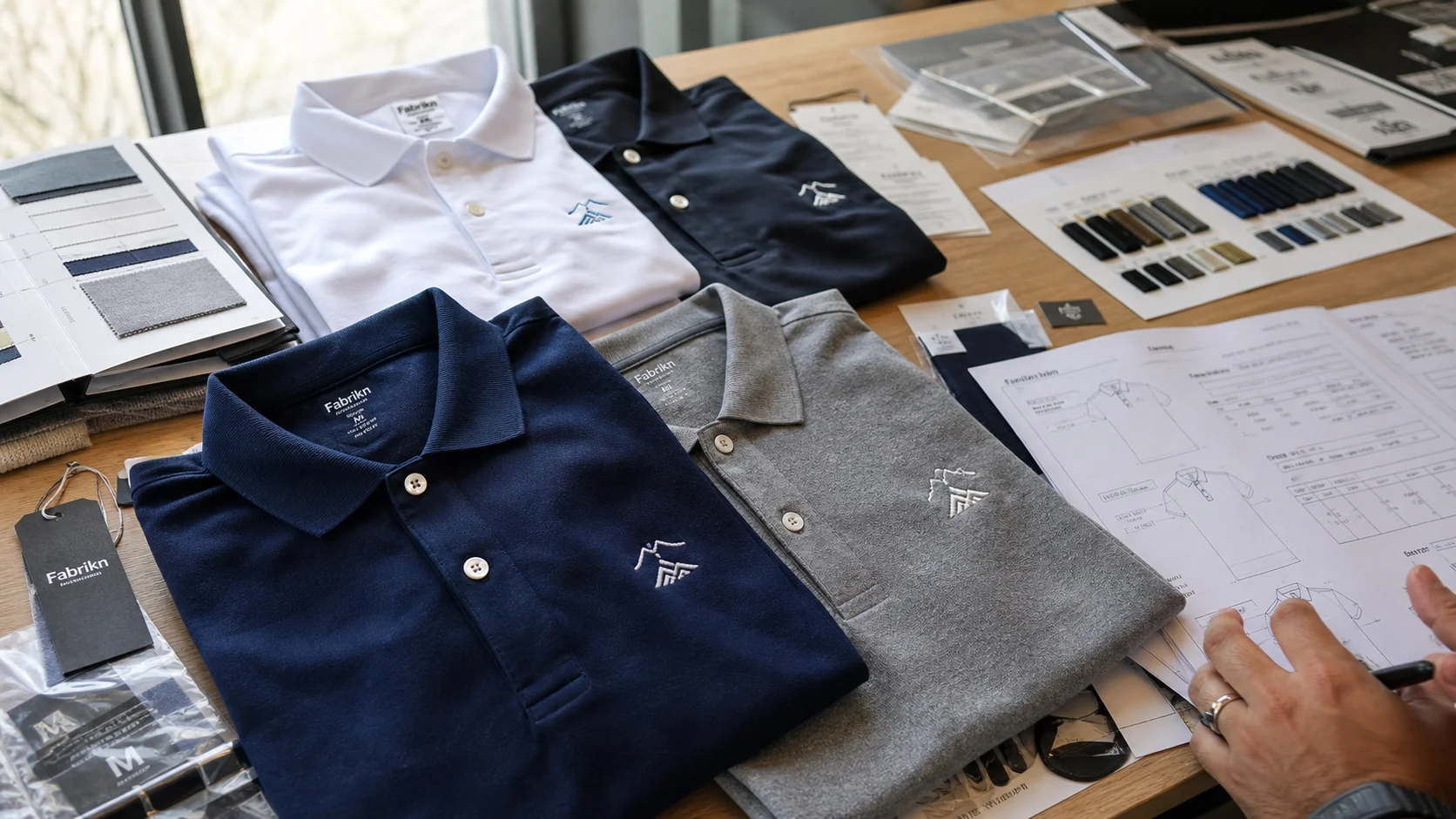
A focused outline for schoolwear sourcing teams evaluating bulk school uniforms with fabric testing, covering test methods, sample approvals, compliance checkpoints, and quote criteria for private label production.
Bulk School Uniforms With Fabric Testing Quotes - Fabrikn production reference
Bulk school uniforms are not a standard fashion buy. Schoolwear sourcing teams usually manage longer product life expectations, repeat replenishment, stricter appearance standards, and a customer base that notices inconsistency quickly. A blazer that pills after a few weeks, a polo that twists after washing, or a trouser fabric that shades off between deliveries can create claims that outlast the shipment itself.
That is why fabric testing needs to be treated as part of the commercial quote, not an optional technical extra. When a supplier provides pricing for bulk uniforms with fabric testing, the quote should show what is being tested, when it is being tested, and who pays if results fail. Many sourcing problems begin because the testing scope is vague while the price looks competitive.
For schoolwear, durability is the commercial issue. Parents expect garments to survive repeated washing, abrasion from daily wear, and a school year of hard use. Retailers and sourcing teams need stable sizing, shade continuity, and reliable trim performance across every reorder. A low initial FOB price can become expensive if it creates returns, chargebacks, or replacement stock pressure.
In practice, fabric testing helps buyers control four things:
Teams buying under a private label model should also remember that the end customer sees the brand name on the label, not the mill or factory behind it. That makes pre-production discipline more valuable than post-shipment explanations. If your sourcing calendar includes supplier benchmarking, development support, or production planning, it helps to review service scope early through pages such as /services/ and align expectations before quoting begins.
A usable quote for bulk school uniforms should do more than list garment prices. It should connect the commercial offer to the fabric and trim specification. Sourcing teams often lose time when a supplier quotes against an incomplete tech pack, assumes a substitute fabric, or excludes testing costs that appear later.
A strong quotation request for schoolwear should include:
When buyers ask for fabric testing quotes, suppliers should ideally separate cost lines so purchasing teams can see what is included. That usually means garment FOB price, development sample cost, lab testing cost, and any surcharge tied to special finishes or certified materials.
There is also a useful sourcing question that gets missed: are tests being done on greige fabric, dyed fabric, finished fabric, or finished garment? The answer affects risk. A fabric that passes in mill stage can still fail after fusing, washing, printing, embroidery, or bulk sewing. Schoolwear is especially exposed because garments are expected to keep shape and color over time.
Purchasing teams should push for quotes that state whether the supplier includes third-party lab testing or only internal checks. Internal checks are useful for process control, but they are not always enough when the buyer needs documented evidence for claims prevention or program approval.
Not every school uniform needs the same testing matrix, but some test areas come up repeatedly because they affect wear life and parent satisfaction. The most common mistake is under-testing basic items such as polos, shirts, trousers, and knitwear because they look simple on paper.
School uniforms are heavily judged on appearance retention. Navy, black, grey, maroon, bottle green, and white are common uniform shades, and all can present different risks. Colorfastness to washing, rubbing, perspiration, and light exposure should be reviewed based on the garment category and use case. Dark shades often need extra attention for crocking and wash-down.
Parents react quickly when a garment shrinks after home laundering. Shirts that reduce in body length, knit polos that torque, or trousers that change inseam after washing create fit complaints even when the base pattern was correct. Dimensional stability testing should match the care method on the label and the actual fabric finish used in bulk.
Sweaters, blazers, trousers, and knitted tops all face repeated friction in school settings. Backpack straps, desk edges, and frequent laundering accelerate surface wear. A soft handfeel may support sales, but overly brushed or loose-surface fabrics can pill faster. This is a classic tradeoff: comfort and softness sell, while tight construction and durable finishing often wear better.
Woven trousers, skirts, shirts, and shorts benefit from strength testing because schoolwear takes harder use than many casual garments. Lightweight fabric can reduce price and improve comfort in warm climates, but overly aggressive cost cutting on gsm often weakens the garment too far for the intended age group.
Uniform garments with fitted silhouettes, side seams, seat seams, armholes, and pleated constructions need attention here. A fabric can be strong in isolation but still perform poorly once stitched if the weave is open or the seam specification is not matched properly.
Knit polos and T-shirts are particularly exposed. If side seams twist after washing, the garment looks cheap even if the fabric itself is acceptable in other respects. This issue often appears when compacting, knitting balance, or finishing control is inconsistent.
Schoolwear programs serving younger age groups often require extra chemical compliance attention. Buyers should confirm restricted substance expectations early, especially if they are sourcing from multiple mills or using prints, coatings, or special finishes.
The practical point is simple: testing should reflect the real wear environment, not just the nominal garment category.
Schoolwear is not one product family. Different uniform categories require different technical attention, and sourcing teams get better outcomes when they avoid using one generic test template across the full range.
Garment Category Typical Fabric Types Key Testing Priorities Main Buying Risk Polo shirts Cotton/poly pique, CVC knit Spirality, shrinkage, colorfastness, pilling Twisting and wash distortion Dress shirts/blouses Poplin, oxford, poly/cotton woven Shrinkage, seam strength, wrinkle performance, shade Fit change after laundering Trousers/shorts Twill, gabardine, stretch woven Tear strength, abrasion, seam slippage, colorfastness Seat or knee wear-out Skirts Twill, suiting, polyester viscose blends Pleat retention, seam integrity, pilling, shade continuity Poor shape retention in use Blazers Suiting blends with lining and interlining Fusing performance, pilling, dimensional stability, appearance after cleaning Bubbling or panel distortion Sweaters/cardigans Cotton blends, acrylic blends, wool blends Pilling, growth, colorfastness, shape retention Surface wear and stretchingThis is where sourcing teams should be careful with “all-inclusive” quotes that look efficient but flatten the technical detail. A blazer and a pique polo should not be quoted under the same testing logic. The better approach is to prioritize by failure mode.
Fabric testing has limited value if the sample approval process is rushed. Bulk school uniform programs usually benefit from a staged sign-off sequence, especially where size grading, embroidery, stripe trims, woven badges, or color-matched components are involved.
A practical sample approval flow often looks like this:
For schoolwear, buyers should pay particular attention to badge placement, placket construction, collar stand shape, pleat formation, waistband extension, and reinforcement points. Small construction changes can affect durability and appearance more than teams expect.
It is also worth insisting that the pre-production sample reflects the real bulk method. If bulk trousers will use a specific pocketing weight, fusible quality, or zipper brand equivalent, the sample should not use development substitutes. Sampling shortcuts often hide bulk risks rather than resolve them.
If your internal process needs a clearer sourcing checkpoint structure, supplier discussion tends to move faster when commercial and technical teams share the same framework. Contact routes such as /contact-us/ are useful for aligning development scope, testing needs, and quotation assumptions before bulk commitment.
MOQ and lead time in schoolwear depend heavily on fabric type, dye method, trim customization, and whether the supplier is using stock-supported materials or custom development. Buyers should expect meaningful variation between simple polos and tailored outerwear.
Typical MOQ ranges in this category often look like:
These are planning ranges, not fixed rules. A buyer using custom-dyed suiting, logo trims, yarn-dyed stripes, or exclusive badges can see higher minimums because component suppliers may impose their own thresholds.
Lead time usually breaks into several parts:
A reasonable planning window for repeat schoolwear programs may be shorter when fabric is proven and trims are standard. New developments with custom colors, embroidery, tailored construction, or external test failures will usually need more time. Buyers should be cautious when a supplier offers an unusually short lead time on a first-time program without clarifying fabric readiness and lab capacity.
Cost tradeoffs should be judged in context. Lower-cost quotes sometimes rely on:
None of those choices are automatically wrong. Some are workable if the end market is price-sensitive and the specification is adjusted honestly. Problems begin when the quote implies one standard and delivers another.
Final inspection in schoolwear is usually not the place where problems should first appear, yet that is often what happens. Fabric testing and pre-production approval reduce risk, but bulk execution still creates failure points that deserve close monitoring.
The most common inspection risks include:
Buyers should also look beyond measurement tolerances. Appearance issues often generate more customer complaints than purely numeric defects. A garment can pass size check and still fail the shelf test if collar points are inconsistent or shade bands are visible under store lighting.
One disciplined approach is to align inspection checkpoints with the actual risk profile:
This reduces the chance of discovering systemic problems too late to correct economically.
Schoolwear sourcing teams often receive similar-looking quotes. The difference is usually hidden in process depth rather than headline price. That is why purchasing teams should compare suppliers on commercial reliability, technical clarity, and repeat-order discipline.
Questions worth asking include:
This is the point where buyers should make a practical judgment. A slightly higher quote can be the better commercial option if it includes tested fabric, clearer approvals, and lower risk of in-season disruption. Uniform programs are repeat businesses. Stability usually beats opportunistic savings.
Suppliers serving private label programs should also be able to explain how they manage buyer-specific labeling, packaging, and specification control. Background information on operating approach and category fit can often be reviewed through pages such as /about-us/ before opening full sourcing discussions.
Private label schoolwear sits in a difficult position. It has to look consistent on the rail, perform over time, hit a price target, and stay easy to replenish. That pushes sourcing teams into a constant balance between cost engineering and risk control.
Fabric testing is one of the few areas where a modest upfront investment can prevent expensive downstream problems. It helps buyers verify whether a fabric is suitable before brand reputation is tied to it. It also makes supplier comparison more honest, because quotes can be judged against the same technical baseline.
There is a clear purchasing lesson here. If a supplier cannot specify what testing is included, when approvals happen, what MOQ assumptions apply, and how bulk quality will be checked, the quote is not complete enough for a serious schoolwear decision. Teams should not wait for a claim history to discover that weakness.
The better buying model is straightforward:
That approach is especially important for annual or multi-season school uniform programs where replenishment accuracy matters as much as the opening order. A sourcing team that manages testing discipline well usually gains better forecast stability, cleaner reorders, and fewer quality disputes during the selling season.
For buyers in the Private Label Apparel category, bulk uniforms with fabric testing should be viewed as a sourcing system rather than a single purchase. The quote, the lab plan, the approval sequence, and the inspection method all need to connect. When they do, schoolwear sourcing becomes more predictable, and predictable programs usually scale better.
Get a free quote from Fabrikn — your trusted B2B clothing manufacturer with 10+ years of experience. MOQ as low as 200 pieces.
Get a Free Quote →It often includes the garment price plus separate or bundled charges for lab testing, sample development, and sometimes trim evaluation. Buyers should confirm which tests are included, whether a third-party lab is used, and what happens if a result fails.
Common ranges are about 300 to 800 pieces for basic polos, 500 to 1,000 for woven shirts, 500 to 1,200 for trousers or skirts, and 300 to 800 for tailored blazers. Actual minimums depend on fabric mill requirements, color count, trim customization, and whether materials are stock-supported or custom-developed.
The core list usually includes colorfastness, dimensional stability, pilling, abrasion, seam strength, seam slippage, and spirality for knitted items. Chemical compliance checks may also be required depending on the market and age group.
Samples confirm that the approved garment reflects the actual bulk fabric, trims, fit, and construction method. Without that step, buyers risk approving a look that does not match production reality.
They should compare exact fabric specs, included testing scope, sample stages, lead-time assumptions, inspection methods, and reorder control. The lowest price is not always the lowest total cost once claims and replacement risks are considered.