
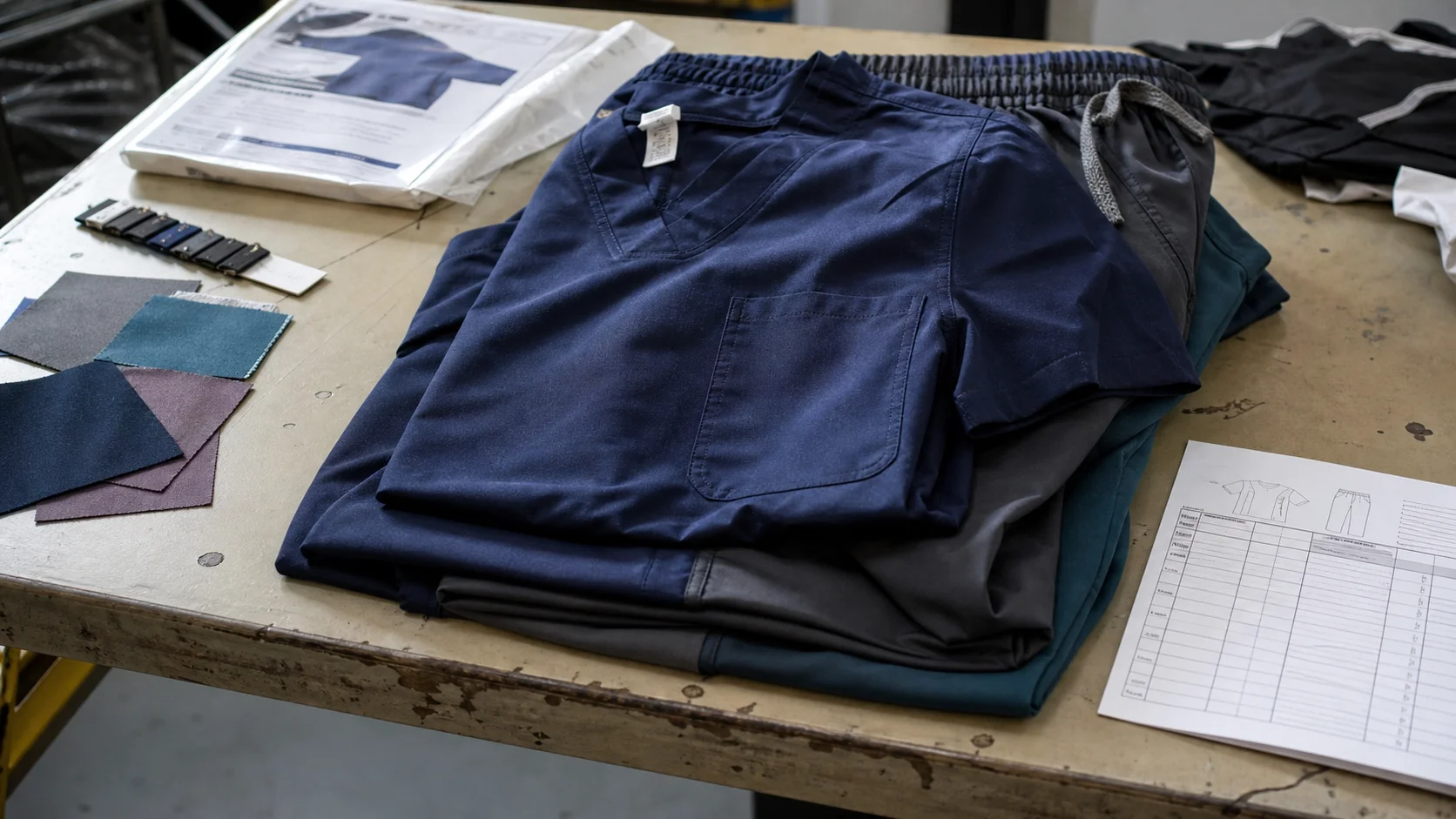
A practical SEO outline for pharmacy operations teams inspecting bulk scrub orders with AQL sampling, garment-specific defect criteria, labeling checks,...
Category: Quality & Inspection
Bulk Scrubs AQL Checklist for Pharmacy Buyers - Fabrikn production reference
Bulk scrubs are not a fashion purchase. For pharmacy operations teams, they are a working uniform that has to hold up under daily use, repeated laundering, close contact with customers, and the practical pressure of staff turnover. An AQL inspection checklist gives buying teams a way to control that risk before goods move into distribution.
AQL, or acceptable quality limit, is not a guarantee of perfection. It is a sampling method used to decide whether a lot is acceptable based on the number and type of defects found in a defined sample. In scrub programs, that matters because the cost of a poor batch is usually higher than the cost of a careful inspection. One lot with inconsistent sizing or weak stitching can trigger replacements, delays, and complaints from multiple sites.
Pharmacy buyers usually need a more disciplined approach than general apparel buyers because the uniform often touches brand presentation, hygiene expectations, and employee comfort at the same time. A clear inspection checklist helps align the supplier, the factory, the inspector, and the internal receiving team around the same standard.
AQL is most useful when it is paired with a written product spec. Without a spec, the inspection becomes judgment-based and easy to dispute.
For buyers comparing sourcing support options, it can help to start with a structured manufacturing partner such as fabrikn.com/services/ and then set the inspection terms before production begins. If the order is still in planning, the team at fabrikn.com/contact-us/ can be used as a reference point for scope and next-step discussion. Company background and capabilities are usually easier to assess when the buyer also reviews fabrikn.com/about-us/.
An inspection checklist only works when the purchase order already defines the product. That sounds obvious, but many bulk scrub issues start with vague instructions such as “navy scrubs, good quality, men’s and women’s sizes.” That level of description is not enough for a production line or a final inspection.
Pharmacy buyers should also define the minimum acceptable performance in use. For example, if the scrubs must survive repeated laundering in commercial wash conditions, that requirement should be written into the spec. If staff need multiple pockets for pens, keys, and devices, pocket dimensions should be measured and approved before bulk cutting begins.
A practical AQL checklist should cover the whole product, not just visible appearance. The best inspections combine visual checks, measurement checks, construction checks, labeling checks, and packaging checks. For scrub programs, the most common failure points are size inconsistency, thread defects, weak seams, fabric shading, and incorrect labeling.
Before the inspector opens a carton, the buyer should verify that the production records and the order records agree. If the paperwork is inconsistent, the lot may pass visually but still fail the order requirements.
Fabric issues are often harder to correct after cutting, which makes them expensive defects. If shade variation shows up at inspection, buyers should check whether the issue is lot-to-lot variation, panel-to-panel variation, or a true dye problem. Those are not the same risk and should not be treated as the same defect.
In scrub programs, grading mistakes are a frequent source of returns. A garment may pass as a medium but fail in extended sizes because the pattern did not scale correctly. Buyers should insist on checking at least the most commercially important sizes, not just the base size used for approval.
Construction quality matters more than surface appearance on a scrub set. Pharmacy staff move constantly, bend, lift, and reach. Weak seams in pocket corners or crotch seams usually show up after only a short period of wear if the factory has not controlled construction properly.
For pharmacy buyers, pocket failure is not a cosmetic issue. Staff often rely on scrub pockets for routine workflow items. If pockets are too shallow or poorly stitched, the garment is functionally weak even if it looks acceptable on a hanger.
Label errors are common and expensive. A wrong care label can create laundering damage, shrinkage complaints, or regulatory risk. If the product is intended for a controlled work environment, the buyer should make sure label placement does not create comfort issues or itch points.
Packaging is often treated as the last step, but poor packing can undo a good garment. Excess compression creates wrinkles and can distort the shape of knit or stretch scrubs. Weak cartons can lead to corner crush, especially in humid or long-haul shipping conditions.
The exact AQL levels depend on buyer policy and product risk. Many apparel programs use tighter controls for critical defects and a standard AQL threshold for major and minor defects. The key point is consistency: the same defect should be classified the same way across all lots.
In bulk scrubs, the fabric spec is not just a commercial preference. It determines comfort, laundering performance, opacity, shrinkage, and appearance after repeated wear. Trim choices affect durability and, in some cases, safety.
Typical scrub programs use blends designed to balance comfort and durability. Cotton-rich fabrics often feel better but can shrink more and wrinkle more. Polyester-rich fabrics usually hold shape better and dry faster, but the hand feel may be less preferred unless the finish is carefully chosen. Stretch blends usually improve movement, though the buyer should verify recovery so knees, seat areas, and elbows do not bag out too quickly.
Trim quality is a common weak point in low-cost bulk orders. The garment may pass visual inspection, yet fail in use if a low-grade zipper jams or a weak snap detaches after repeated laundering. That kind of failure usually creates more service work than a visible cosmetic issue.
A clean inspection result starts well before the final lot check. Good pharmacy buyers build an approval sequence that reduces disagreement later in the process.
Each approval stage reduces ambiguity. If the supplier only receives a final yes or no at the end, production risk is much higher. When the buyer signs off on the fabric, fit, and construction early, the factory has a clearer target and less excuse for deviation.
For larger ongoing programs, it is worth asking for a written corrective action response after any failed inspection. The response should identify the root cause, the corrective step, and the preventive step. That creates accountability and makes the next lot easier to manage.
Pharmacy buyers often ask for fast replenishment, but lead time is driven by more than sewing capacity. The final schedule depends on fabric availability, lab dip approval, trim sourcing, print or embroidery approvals, production queue, and inspection booking.
Those ranges are only directional. A buyer should not assume a supplier can support a low MOQ just because the design looks simple. Fabric minimums, dye lot requirements, and trim purchase minimums often set the real floor.
A realistic plan should include time for sample revision. Buyers sometimes compress development too aggressively, then pay for it with higher defect rates. A clearer schedule with controlled approvals is usually cheaper than a rushed order with inspection problems.
Pharmacy teams face different usage patterns than surgical or clinical teams, and that changes the risk profile. The garments still need to look professional, but the day-to-day wear may be dominated by customer interaction, stocking tasks, movement between front-of-house and back-of-house, and long shifts.
Pharmacy operations teams should pay special attention to laundering expectations. If the uniform is being washed centrally, the inspection should include wash performance evidence or at least documented testing. If the fabric pills, shrinks, or distorts after a few cycles, the real cost of the garment increases quickly.
Odor is another overlooked issue. Some synthetic fabrics arrive with a chemical smell from finishing or packing. That does not always indicate a safety problem, but it can create a negative first impression and should be checked during receiving.
Not every scrub detail deserves the same budget. Good sourcing is selective. Buyers should spend more on the areas that affect wear life and operational consistency, then control the elements that do not change performance much.
In most bulk scrub programs, simplicity is a strength. A well-made, repeatable style usually outperforms a complicated design that is harder for the factory to execute and harder for the buying team to approve. Buyers who want a scalable program should favor construction consistency over cosmetic complexity.
Before the order is placed, buyers should ask direct questions and expect direct answers. If the supplier cannot answer clearly, the inspection risk is already visible.
Good suppliers welcome these questions because they reduce late-stage disputes. Weak suppliers often answer in generalities. That is usually a signal to slow the order down rather than speeding it up.
A simple workflow helps pharmacy buyers stay consistent across orders:
That workflow is simple on purpose. Complexity should sit in the spec, not in the receiving room. If the inspection process requires constant interpretation, the buyer is probably compensating for a weak product brief.
A bulk scrubs AQL inspection checklist is most useful when it is practical, specific, and tied to a clear product spec. Pharmacy buyers need uniforms that look consistent, fit correctly, survive laundering, and support daily work without distraction. The inspection should verify not just appearance, but also construction, measurements, fabric performance, trims, labels, and packaging.
The strongest purchasing decisions tend to be the simplest: choose a reliable fabric, approve samples carefully, keep the design functional, and use AQL as a control tool rather than a paperwork exercise. That approach reduces surprises at receiving and lowers the chance of expensive reorders or staff complaints.
For buyers building a new program or tightening an existing one, a disciplined sourcing process is usually more valuable than chasing the lowest unit price. The best value comes from a product that can be repeated, inspected, and replenished without creating a new problem each season.
Get a free quote from Fabrikn — your trusted B2B clothing manufacturer with 10+ years of experience. MOQ as low as 200 pieces.
Get a Free Quote →Many apparel buyers use a tighter standard for critical defects and a common AQL threshold for major and minor defects, often around 2.5 for major defects and 4.0 for minor defects. The exact level should match the buyer’s risk tolerance and the supplier agreement.
Size inconsistency is one of the most common risks, followed by seam weakness, shade variation, and poor trim quality. These issues affect daily use and can create avoidable replacement costs.
Full inspection is rarely practical for large orders. AQL sampling is usually the standard approach, but the sample plan should be paired with clear specifications and defect definitions.
At minimum, buyers should review the fabric, trim, fit sample, and pre-production sample. Larger programs may also need a size set approval and a wash test before bulk cutting is released.
Fiber composition, fabric weight, shrinkage, colorfastness, opacity, and pilling resistance matter most. Stretch recovery is also important if the garment includes spandex.
Common reasons include inconsistent bulk dye lots, grading drift, poor workmanship on the production line, trim substitutions, and packaging errors. Sample approval reduces risk, but it does not replace production control.
Yes, if the supplier can control fabric, trims, and construction consistently. Low MOQ usually raises cost and sometimes limits fabric options, but it does not automatically reduce quality.
The buyer should document the defects by type, ask for a root-cause explanation, and require corrective action before any re-inspection or shipment release. The most useful response is specific and tied to the actual defect pattern.