
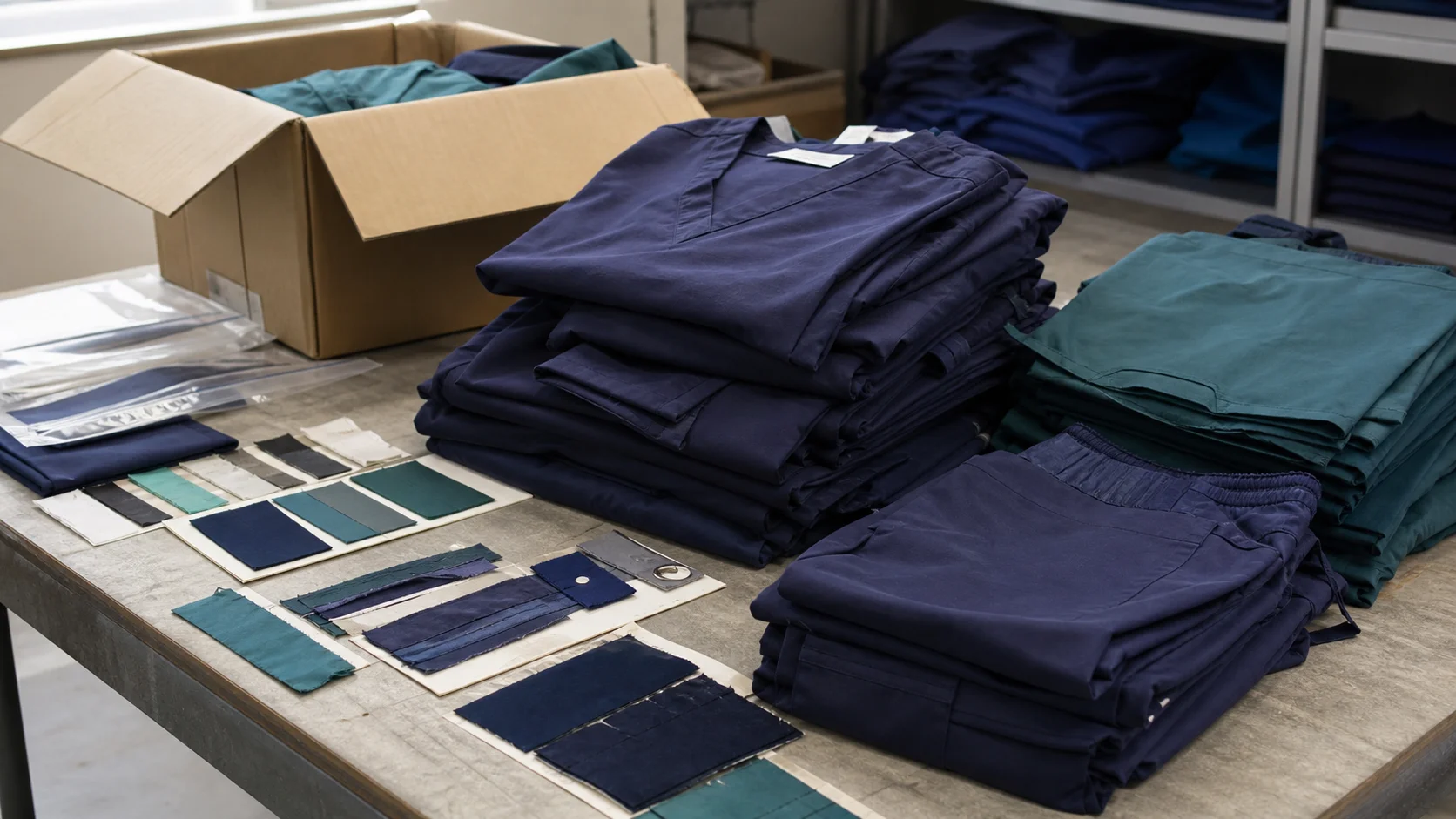
A practical bulk ordering guide for retail operations teams buying scrubs, covering sizing, fabric choices, decoration options, replenishment planning, and...
Retail teams sourcing bulk scrubs need more than a supplier quote. They need a clear buying process that balances price, fit consistency, fabric performance, labeling requirements, replenishment speed, and the risk of stockouts. Scrubs are repeat-purchase workwear, but they are not a simple commodity. Size curves vary by region, color matching can drift between dye lots, and low-cost quotes often hide the real cost of poor trim quality or weak seam construction.
This guide is written for retail operations teams planning a bulk scrubs bulk order. It focuses on practical sourcing decisions: how to evaluate MOQ, how to compare landed cost, what to ask for in samples, and where quality failures usually show up. If you are building a private-label or wholesale medical apparel program, the goal is to keep the assortment stable while protecting margin and avoiding inventory mistakes.
Bulk Scrubs Bulk Order Guide for Retail Teams - Fabrikn production reference
Bulk scrubs are usually purchased for resale, uniform programs, or recurring replenishment within retail and B2B channels. A retail operations team is not only buying garments. It is buying continuity: the same fabric hand, the same color, the same sizing profile, and the same trim package from one order to the next.
That matters because scrub buyers are sensitive to practical wear issues. Fabric that pills too quickly can damage repeat sales. Waistbands that twist or drawcords that fray can trigger complaints. A good bulk program is built around reliability rather than fashion churn.
For retail teams, the core challenge is finding the right balance between breadth and depth. A wide size and color matrix can improve sell-through, but it raises MOQ pressure and increases the risk of dead stock. A narrow assortment simplifies purchasing, yet may not meet demand across clinical, hospitality, dental, veterinary, and wellness buyers.
In bulk scrub sourcing, the cheapest unit price is rarely the lowest-risk choice. Retail teams should compare garment cost, freight, duties, sampling, defect risk, and replenishment speed as one package.
MOQ depends on fabric type, color count, size range, embellishment method, and whether the style is stock-supported or custom-developed. For standard bulk scrub programs, typical MOQs often fall into these rough ranges:
These are not fixed rules. A supplier may quote lower if they already hold greige fabric or finished body shells. MOQ can also rise if you split the order across many sizes or multiple colorways. A five-color program with seven sizes can be far more expensive to support than a single-color program with a tighter size curve.
Retail teams should also separate production MOQ from commercial MOQ. A supplier may agree to make a small quantity, but the unit price can become unworkable once cutting waste, labeling, and freight are added. In practice, the best MOQ is not always the smallest one. It is the one that supports a stable margin and a realistic inventory plan.
When comparing quotes, the first number is rarely the full story. Bulk scrub pricing usually includes fabric, sewing, trims, labels, packaging, QA allowance, and freight assumptions. Retail teams should ask for a breakdown or at least a clear commercial structure.
Cost Element What It Covers Common Risk Fabric Main body cloth, pocketing, waist inserts, facing material Weight changes, shade variation, pilling, shrinkage Trims Zippers, cords, elastics, snaps, labels, tape Quality inconsistency, lead-time delays, breakage Cut and sew Labor, pattern work, stitching, finishing Seam failure, uneven sizing, poor topstitching Decoration Embroidery, heat transfer, woven branding, custom tags Setup charges, placement issues, wash durability problems Packaging Polybag, size sticker, hangtag, carton pack Incorrect labeling, weak retail presentation Logistics Freight, export docs, customs handling, final delivery Underquoted freight, delays, surprise landed costThe lowest FOB quote may still become expensive if carton packing is weak, if labels need to be reworked, or if the factory underestimates sewing complexity. Retail buyers should think in landed cost terms. That means comparing the total cost to receive sellable goods at your warehouse or distribution center.
It is also worth checking whether the supplier quotes based on one size run or a full curve. A base-size quote can look attractive, but the cost may rise as you add plus sizes, petite lengths, or women’s and men’s fits. Scrub programs often need both gendered and unisex styles, which creates extra pattern and grading work.
Scrubs are expected to handle repeated wear, frequent washing, and long shifts. The spec sheet should reflect that reality. Retail teams should avoid vague descriptions like “soft stretch fabric” and ask for measurable details.
Common scrub fabrics include polyester-rayon-spandex blends, polyester-cotton blends, and performance stretch woven fabrics. Each one has tradeoffs:
Fabric weight should be confirmed in gsm or oz/yd². A fabric that is too light may look thin under strong retail lighting and feel less durable. A fabric that is too heavy may reduce comfort and increase cost. For bulk scrub programs, weight consistency matters as much as the target number. Buyers should request tolerance ranges and check whether the supplier can hold the same shade and hand feel across repeat orders.
Any performance claim should be tied to test method expectations. If a supplier says the fabric is colorfast or shrink-resistant, ask what standard or internal test was used. Retail teams do not need to over-engineer the spec, but they do need enough evidence to avoid post-delivery disputes.
Small components often create the biggest problems. For bulk scrubs, pay close attention to:
Retail buyers should treat trim substitutions cautiously. A supplier may propose an “equivalent” zipper or elastic when the original trim is unavailable. That can be acceptable if approved in writing and tested, but it should not be assumed to be harmless. Small trim changes can alter comfort, durability, and perceived quality.
A disciplined sample process reduces expensive surprises. For bulk scrub sourcing, the usual sequence is development sample, fit sample, pre-production sample, and then bulk production. Some programs combine steps when the style is simple, but retail teams should still insist on clear approvals.
This sample checks the concept, silhouette, and approximate fabric direction. It is useful for early feedback on pocket placement, neckline shape, pant rise, and overall styling. It should not be treated as the final standard.
The fit sample is where sizing and wearability are evaluated. Retail teams should check movement, inseam length, sleeve length, shoulder balance, waistband comfort, and pocket utility. If the scrub top pulls across the chest or the pant rises too low when seated, the issue should be corrected before grading is locked.
The pre-production sample should reflect the approved fabric, trims, labeling, and packaging. This is the point at which the buyer verifies that the factory can reproduce the agreed specification at scale. Any deviation here should be documented and resolved before bulk cut begins.
Once the pre-production sample is accepted, the buyer should confirm carton markings, size ratio, label content, and inspection requirements. This is also the moment to lock any tolerances for measurement, shade band acceptance, and allowable defect rate.
For sourcing teams that need broader support during development and order placement, it can help to review fabrikn.com/services/ for service options and production support information before submitting a final request for quote.
Lead time for bulk scrubs depends on fabric availability, trim sourcing, sample approval speed, factory capacity, and shipment method. A simple order using stock fabric may move relatively quickly. A custom program with unique colors, woven labels, and private packaging can take significantly longer.
Typical lead-time planning often looks like this:
The biggest schedule risks usually come from late approvals, color matching issues, and missing trims. A factory cannot start bulk cutting if the fabric shade is not approved or if a label detail is still being revised. Retail teams should build a buffer into the calendar and avoid assuming that every supplier milestone will move in parallel.
If the launch date is fixed, ask the supplier to identify the critical path. That will show whether fabric mill booking, trim procurement, and packing material delivery can all support the target ship date. It also helps reveal where a delay will have the greatest impact.
Bulk scrub orders often fail in predictable ways. The garment may look acceptable at first glance, but quality issues appear after wear, wash, or close retail inspection. A good inspection plan should focus on practical failure points.
Retail teams should request a final inspection against an agreed standard, ideally with sample size checks across the size curve. The check should include measurements, workmanship, carton count, label accuracy, and packaging presentation. If the program is large enough, a pre-shipment inspection is a sensible cost.
Inspection risks rise when the supplier is under time pressure. Factories that are rushing to meet a ship date may skip line checks or overlook packing errors. That is why a clean approval timeline matters. Rushed bulk orders often create more cost in returns and rework than they save in calendar time.
Scrubs are exposed to frequent laundering. A garment that passes visual inspection can still fail after repeated wash cycles. Retail teams should ask for basic wash test results when the program depends on performance claims. Shrinkage, seam twisting, and color loss are the practical issues that harm sell-through.
There are three common sourcing models for bulk scrubs: stock-supported wholesale, private-label production, and fully custom development. Each has a different risk profile.
This is the fastest route. It suits teams that need speed, smaller launch risk, or a test order before scaling. The downside is limited control over fit details, colors, and branding. Retail teams can still negotiate packaging and size assortment, but the product may not be exclusive.
This is often the best middle ground for retail operations. It allows custom labels, chosen fabrics from an approved range, and retail-ready packaging, while keeping development costs more manageable than fully custom construction. MOQ is usually higher than stock purchasing, but brand control is better.
This model suits teams building a differentiated scrub line with proprietary fits or premium performance fabric. It offers the most control and the highest barrier to direct comparison shopping. It also carries the most risk in development time, fit approvals, and minimum order commitment.
Retail buyers should also decide whether to source one core style and expand later, or launch multiple style variants at once. The first path is safer for inventory control. The second may help merchandising, but it multiplies size, color, and production complexity. In most cases, a narrower initial range is easier to manage and less likely to create dead stock.
For teams comparing vendors or trying to understand how a supplier handles custom work, it can be useful to review fabrikn.com/about-us/ and then follow up through fabrikn.com/contact-us/ with a structured request for quote.
Before issuing a purchase order, retail teams should make sure the commercial and technical details are aligned. A small omission at this stage can turn into a costly warehouse problem later.
A strong bulk order file should be easy to hand to procurement, QA, logistics, and sales without interpretation gaps. If multiple teams are touching the order, document control matters more than usual. One outdated size spec can affect the entire shipment.
The right bulk scrubs order is not the one with the most features. It is the one that fits your replenishment model, price point, and inventory tolerance. If your team sells into clinics or multi-unit accounts, consistency and reorderability usually matter more than novelty. If you are targeting premium retail customers, fabric hand feel and fit may justify a higher landed cost, but only if the style can hold quality over time.
Keep the first order disciplined. Start with the clearest seller sizes, the most reliable fabric option, and the least risky trim package. Build feedback from the first production run into the next order. That approach protects cash flow and reduces the chance of being stuck with a broad but fragile assortment.
For larger programs, the best suppliers are not just price-competitive. They are responsive on sampling, clear on MOQ, steady on fabric control, and willing to document the details that protect the retail side after delivery. If those basics are missing, the quote is not really cheap.
Get a free quote from Fabrikn — your trusted B2B clothing manufacturer with 10+ years of experience. MOQ as low as 200 pieces.
Get a Free Quote →Typical MOQ often ranges from 300 to 800 sets for standard stock-supported styles, and 500 to 1,000 sets or more for private-label programs. Custom fabrics, special trims, or multiple colorways can raise the minimum.
There is no single best option. Polyester-rayon-spandex is often chosen for comfort and drape, while polyester-cotton can work well for value programs. Performance stretch woven fabrics are usually better for premium lines, but they cost more.
Lead time depends on fabric readiness, sample approval speed, and factory capacity. A simple order may move in several weeks after approval, while custom programs can take longer. Freight time should be added separately.
Check fit, pocket placement, seam quality, measurement accuracy, fabric hand feel, color, labels, and packaging. The pre-production sample should match the approved spec as closely as possible.
Common problems include shade variation, wrong size packing, weak seams, poor trim quality, and late approval delays. Underquoted freight and unclear label requirements can also create avoidable cost.
Not automatically. Retail teams should compare landed cost, defect risk, sample quality, and the supplier’s ability to hold spec across repeat orders. A slightly higher quote can be the better commercial choice if it reduces rework and returns.