
Outline a product-specific SEO article on bulk cut-and-sew scrubs for clinic uniform distributors, covering fabric choices, pattern construction, fit...
Bulk Scrubs Cut and Sew for Clinic Distributors - Fabrikn production reference
Clinic uniform distributors need scrub programs that are repeatable, size-consistent, and simple to replenish. That is where bulk scrubs cut and sew production earns its value. It gives distributors more control over fabric choice, trim quality, pocket layout, fit grading, and decoration placement, while still supporting the volume levels required for institutional supply. For buyers serving clinics, urgent care groups, medical offices, and outpatient networks, the practical question is not whether custom scrubs can be made. It is whether the program can be built with stable specs, manageable lead times, and acceptable margin after sampling, freight, and inspection.
This article covers how bulk scrubs cut and sew works for clinic uniform distributors, what to specify before ordering, where quality issues usually appear, and how to judge production tradeoffs. It also addresses decoration and printing requirements, since logo placement, embroidery zones, and transfer compatibility often affect pattern design and manufacturing method. For broader production support, distributors often review a factory’s services, then confirm commercial contact points through the contact page before moving into sampling and costing.
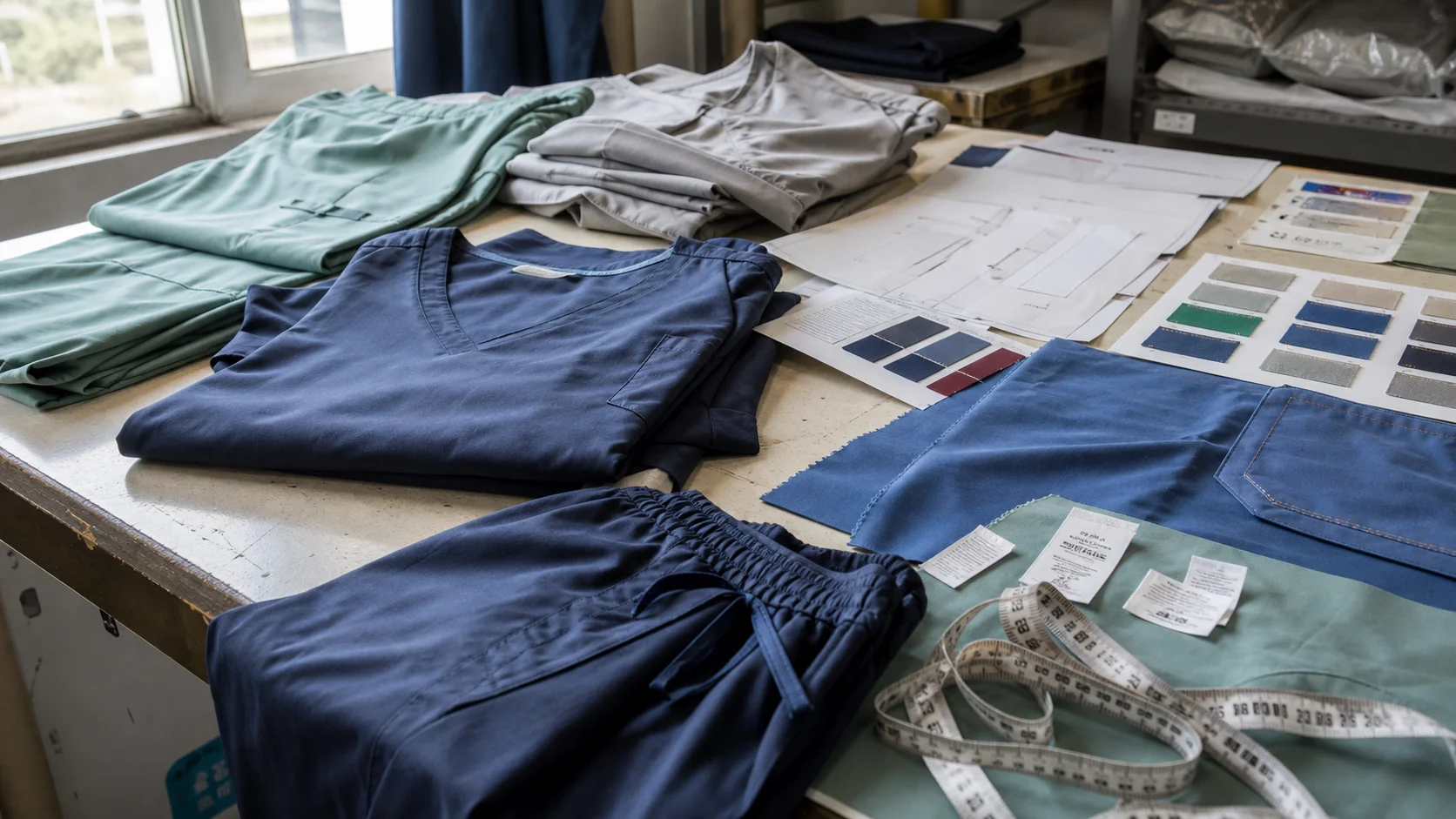
Cut and sew is the process of making garments from fabric roll goods rather than using stock blanks. In scrub production, that means the distributor can define the pattern, stitch construction, size curve, fabric composition, pocket count, and finishing details. A basic top may be built from front and back panels, sleeves, neckline binding, shoulder seams, side vents, and patch pockets. Pants may include an elastic or drawcord waistband, cargo pocket, utility pocket, and reinforced inseams.
For clinic distributors, the main benefit is control. Stock scrubs can be convenient, but they often force compromise on sizing, color consistency, and branding space. Custom cut and sew supports uniformity across multi-location accounts, which matters when one clinic wants a specific navy shade and another prefers a different fit block. It also gives room for operational features that medical staff actually use, such as badge loops, instrument pockets, action backs, or side slits for mobility.
That control comes with discipline. If the spec sheet is weak, the production run will expose every gap. A good scrub program starts with clear construction drawings, fabric test targets, and decoration placement rules. It is not enough to say “poly-cotton scrub set.” Buyers should define yarn content, weight, shrinkage tolerance, colorfastness target, seam type, and permitted variance. The tighter the spec, the less room there is for supplier interpretation.
Bulk production matters because clinic uniform purchasing is rarely a one-off order. Distributors need repeatable programs that can be replenished quarter after quarter without rediscovering the same fit and shade problems. Cut and sew supports that model better than retail rebranding or blank import programs. It also creates a stronger product ladder, with entry, mid, and premium options built from the same development logic.
There is also a merchandising advantage. Custom scrubs can be aligned to a distributor’s commercial structure: standard colors for high-volume clinic accounts, premium performance fabrics for larger systems, and limited decorated versions for branding packages. When the product is made to spec, distributors have more room to defend price because they are selling consistency and service, not just garment units.
That said, cut and sew is not always the cheapest route. Initial sampling, pattern development, grading, and color approval add time and cost. If a distributor only needs a short-term fill-in program, a stock garment with decoration may be the better commercial choice. When the account is stable and the reorder outlook is real, custom manufacturing is usually the stronger long-term play.
Most scrub production disputes start with missing or vague specifications. Distributors should not ask for a price before they have a working tech pack or at least a structured spec sheet. The supplier needs enough detail to estimate fabric usage, sewing time, decoration allowance, and yield loss. Broad descriptions create broad quotes, and broad quotes usually turn into revisions later.
For clinic scrubs, common fabric structures include polyester-cotton twill, polyester-rayon-spandex blends, and performance knits for tops or auxiliary layers. A typical woven scrub fabric may sit in the 150-200 gsm range, while performance knit tops often fall in a similar or slightly higher weight band depending on opacity and recovery targets. Buyers should confirm the exact blend, construction, and finish rather than assuming one fabric family will behave like another.
Useful fabric points to specify include pilling resistance, shrinkage tolerance, colorfastness, moisture handling, and hand feel. If the uniform will be laundered frequently through commercial programs, pre-shrunk behavior and wash durability matter more than a soft first touch. If decoration is involved, fabric surface also matters because some print methods and embroidery placements perform better on firmer, more stable cloth.
Scrub sizing should be built around the target user base, not copied from a retail size chart without review. Clinic distributors often need broader grading at the upper end, plus petite and tall options if the account size justifies it. The grading rule should be fixed before sampling, since changes later can affect every pattern piece and pocket position.
A practical approach is to approve a size set first, then test the fit on the most commercially important sizes, usually medium and large. If those are off, the full grade is often built on the wrong foundation. Buyers should also define whether the fit is classic, relaxed, or tailored, because the silhouette changes sewing tolerance and the amount of ease in the sleeve, hip, and rise.
Construction choices affect durability, cost, and speed. A simple top may use single-needle or overlock construction with coverstitch at hems, while higher-end pieces may require reinforced stress points, bartacks, and cleaner seam finishing. Pants often need stronger pocket bag construction and waistband recovery that survives repeated use.
Useful items to freeze in the tech pack include neckline shape, sleeve length, hem finish, pocket count, pocket depth, side vents, waistband style, and reinforcement points. Small changes in these areas can alter both labor time and wearer satisfaction. In practice, the first sample should prove the construction method, not just the general look.
Clinic distributors should approve color standards by lab dip, not by casual visual comparison. Navy, ceil blue, teal, black, and gray are common scrub colors, but the acceptable shade window needs to be explicit. Trim details such as zippers, drawcord tips, labels, and logo thread should be matched to the garment’s commercial role. A slightly cheaper trim is fine when the account is price-sensitive, but weak zippers or poor elastics can damage re-order confidence fast.
Labels, care content, and size identification also matter for distribution. Private-label programs often require woven labels, heat-transfer neck labels, or printed internal branding. The label method should be checked against decoration and comfort needs, especially for staff who wear scrubs all day.
Because this is a Decoration & Printing category, decoration needs to be planned alongside cut and sew, not added at the end as a loose afterthought. The most common requests are embroidery, heat transfer, silicone print, screen print, and woven branding accents. Not every method suits every fabric. A stretchy or lightly brushed material may distort under heavy embroidery, while some print systems require a stable surface and controlled heat settings.
For clinic accounts, decoration is usually restrained. Left chest logos, sleeve marks, and back-neck identifiers are typical. Large prints on scrubs can look commercial rather than clinical, and they may conflict with dress-code policies in some facilities. Distributors should determine whether the account wants visible branding, subtle identification, or no decoration beyond label customization.
Practical printing judgment matters here. If the program involves recurring logo use, embroidery is often more durable and easier to standardize across production runs. If cost or detail level requires print, the buyer should confirm wash performance, hand feel, and whether the print will remain legible after repeated industrial laundering. Decoration placement must also stay clear of seams, pocket openings, and high-friction areas.
In scrub programs, decoration should support uniformity, not fight the garment. The best placement is usually the one that survives repeated wear, washing, and volume replenishment without creating fit complaints or production delays.
MOQ for bulk scrubs cut and sew varies by factory structure, fabric availability, and decoration complexity. A common range for a custom scrub top or pant is roughly 300 to 1,000 pieces per style and color, though some suppliers may quote lower for development runs or higher for more efficient production lines. When multiple sizes, colors, and decorated variants are involved, the true commercial MOQ can rise quickly. Buyers should ask whether MOQ applies per style, per color, or per color-size combination.
Sampling should follow a disciplined sequence. A buyer usually starts with a development sample or proto sample to confirm shape and construction. After that comes a fit sample, then a color approval sample or lab dip stage, and finally a pre-production sample that reflects the approved fabric, trims, and decoration details. Skipping steps saves time only on paper. It usually moves the problem into bulk production, where corrections are more expensive.
Lead time depends on more than sewing capacity. Fabric booking, dyeing, trim sourcing, decoration method, and approval turnaround all affect the calendar. A simple bulk order may take several weeks after approvals, while a more customized program can run longer when mills and trim suppliers are tied into the schedule. The right question is not “How fast can you sew?” It is “What is the critical path from approved sample to packed carton?”
Distributors should also protect themselves against approval drift. If the buyer takes too long to sign off on fabric shade or logo placement, the production slot can move. That matters when clinic restock orders are tied to seasonal demand or contract start dates. A clear approval deadline helps keep the order on track.
Scrub programs are simple at first glance, which makes it easy to underestimate the risk points. The main failures are usually visible in the first inspection: inconsistent stitching, loose threads, shade variation, measurement drift, weak bartacks, pocket misplacement, and label or logo errors. If the supplier is using multiple lines or subcontracted steps, the risk of inconsistency rises unless the inspection plan is tight.
Common quality concerns include:
Inspection should cover both appearance and function. A scrub top that looks fine on the hanger may still fail when pockets are loaded or when the waistband is stretched through a fitting check. Buyers should request in-line checks and final inspection, not just a carton count. For larger orders, an independent third-party inspection is often worth the cost because it reduces ambiguity around tolerance and finish quality.
Documentation also matters. Packing lists, size ratios, carton marks, and barcode requirements should be confirmed before shipment. Distribution programs can unravel if label content is right but carton mapping is wrong. That problem is expensive because it delays put-away, allocation, and clinic delivery.
For clinic distributors, the right manufacturing partner is not simply the one with the lowest unit price. It is the one that can hold spec discipline across multiple replenishment cycles. That means the supplier should be able to quote clearly, sample methodically, and explain what affects lead time without hiding behind vague promises.
A practical evaluation should cover the following:
Distributors should also ask for a realistic view of minimums and substitution policy. If a trim becomes unavailable, what happens? Can the supplier propose an equivalent option without changing the garment’s appearance or performance? A good partner will treat this as a sourcing question, not a surprise. For background on the company approach, buyers often review the about page before narrowing the shortlist.
One useful sign is how the supplier handles sample comments. If comments are absorbed in a structured way, with revision notes that link back to the spec sheet, the bulk order is more likely to hold up. If responses are casual or fragmented, the bulk run usually carries more risk than the quote suggests.
Distributors do not need premium features everywhere. The better approach is to spend on elements that affect repeat satisfaction and save on details that add cost without changing utility. For scrubs, fabric stability, color consistency, and pocket durability deserve priority. Decorative complexity, excess topstitching, and custom packaging are secondary unless they are part of the account strategy.
Where to spend:
Where to save:
That tradeoff is especially important for clinic distributors managing multiple accounts. A product line that looks impressive in development but is hard to reorder will create operational drag. A slightly simpler scrub program with stable supply is usually the better commercial decision.
Bulk scrubs cut and sew for clinic uniform distributors works best when the program is treated as a controlled manufacturing project, not a loose apparel purchase. The buyer should define fabric, fit, trim, decoration, labeling, and inspection requirements before the first quote is accepted. That discipline protects margin, reduces rework, and makes replenishment easier once the account is live.
For distributors selling into clinical environments, the strongest scrub program is usually the one that balances clean decoration, dependable construction, and predictable reorder behavior. Start with a precise spec, expect a real sampling cycle, and judge suppliers by how well they manage detail under volume pressure. That is the difference between a one-time order and a durable uniform program.
Get a free quote from Fabrikn — your trusted B2B clothing manufacturer with 10+ years of experience. MOQ as low as 200 pieces.
Get a Free Quote →MOQs often start around 300 to 1,000 pieces per style and color, though the real minimum depends on fabric, sizes, and decoration. If a program has multiple colorways or logo variations, the effective MOQ may be higher.
Most programs go through at least a proto sample, a fit sample, a color approval stage, and a pre-production sample. Some simpler orders can move faster, but skipping approval steps increases the chance of bulk defects.
Poly-cotton woven fabrics and polyester-rayon-spandex blends are common. Weight, shrinkage, and wash durability matter more than fabric name alone. The right choice depends on the account’s laundering standards and comfort requirements.
Embroidery is often more durable for small logos and repeated laundering. Printing can work well when the design is flatter, more cost-sensitive, or needs a lighter hand feel. The fabric and placement should decide the method.
Shade variation, sizing drift, weak seams, pocket misalignment, and decoration errors are common. Buyers should check measurement tolerances, stitching quality, and wash performance before approving the bulk run.
Look for clear sampling discipline, transparent MOQ rules, repeat-order consistency, and practical understanding of decoration and laundering requirements. A supplier that explains tradeoffs clearly is usually easier to work with than one that only quotes a low price.