
A quality and inspection outline for pharmacy operations teams placing bulk scrubs orders, focused on mapping fit, fabric, decoration, color, compliance,...
Bulk Scrubs Order Risk Map for Pharmacy Buyers - Quality & Inspection manufacturing guide
Bulk scrub orders look simple on a purchase order. A pharmacy operations team may only see tops, pants, sizes, colors, logos, and delivery dates. The risk sits underneath those lines: fabric behavior after repeated laundering, shade variation between dye lots, inconsistent sizing, weak seams, pocket placement errors, delayed trims, poor packaging, and reorders that do not match the first shipment.
For pharmacy buyers, scrubs are not fashion merchandise. They are daily-use workwear for technicians, pharmacists, cleanroom support staff, inventory teams, and front-of-house pharmacy personnel. A poor order can affect staff presentation, comfort, hygiene routines, department identification, and onboarding schedules. The cost of replacement is usually higher than the original unit price because the buyer also pays in disruption.
A risk map helps pharmacy buyers move from “find a low unit price” to “control failure points before production starts.” The goal is not to overcomplicate the order. The goal is to identify where bulk scrub orders commonly fail and place checks at the right points: before sampling, before bulk cutting, during production, before shipment, and after receipt.
For sourcing teams comparing manufacturers, the evaluation should cover production capability, quality control process, communication discipline, and willingness to document specifications. A supplier that asks detailed questions early may feel slower at first. In practice, that supplier is often reducing the risk of remakes, deductions, and urgent replacement orders. Buyers can review apparel production support options through Fabrikn services when they need structured sourcing, development, or manufacturing guidance.
A bulk scrubs order risk map is a practical framework that ranks each purchasing risk by likelihood and operational impact. It should be simple enough for procurement, HR, operations, and quality teams to use together. The best format is usually a table with risk area, trigger point, buyer control, supplier evidence, and inspection method.
Pharmacy operations teams should treat the scrub order as a controlled uniform program, not a one-time apparel purchase. That means the buyer needs stable specifications, predictable reorders, and enough inspection discipline to catch defects before the garments reach staff. The risk map should cover at least eight areas: demand planning, fabric, color, fit, construction, trims, sampling, and logistics.
The highest-risk decisions usually happen before the factory begins bulk production. Once fabric is dyed, trims are purchased, and cutting starts, changes become expensive. A late size-ratio revision can create fabric shortages. A late logo position change can delay embroidery. A fabric substitution can affect shrinkage, hand feel, opacity, and color consistency. These are not minor technical issues when hundreds or thousands of garments are involved.
Direct purchasing judgment: the lowest quoted scrub price is rarely the lowest-risk option unless the buyer has locked fabric specs, approved fit samples, confirmed shade standards, and required pre-shipment inspection. Without those controls, the buyer is purchasing uncertainty.
Demand planning is often the first failure point in bulk scrub orders. Pharmacy teams may estimate quantities using headcount alone, but scrub demand depends on staff role, shift pattern, laundering practice, replacement cycle, and new-hire pipeline. A technician working full-time may need more sets than a part-time relief pharmacist. Cleanroom or compounding environments may require more frequent changes depending on internal protocols.
Size break risk appears when the order ratio does not match the actual workforce. Overbuying common sizes ties up budget. Underbuying extended sizes creates staff dissatisfaction and urgent reorder pressure. For pharmacy buyers, the safest approach is to collect current size data before ordering, then add a controlled buffer for turnover and new hires.
A typical bulk scrub order may range from 100 to 500 sets for a smaller pharmacy group, 500 to 2,000 sets for a regional operation, and above 2,000 sets for larger multi-site programs. These ranges are not fixed. Fabric type, customization, color, and supplier capacity all affect minimum order quantity. Some manufacturers may accept 100 to 300 pieces per color for stock fabric programs, while custom fabric dyeing may require 500 to 1,000 pieces per color or more.
Buyers should separate “initial issue” quantity from “replenishment” quantity. Initial issue covers the staff launch. Replenishment covers replacements, new hires, damaged garments, and size exchanges. A good risk map marks any order with no reorder plan as medium to high risk, especially if the scrub color or fabric is custom.
Fabric is the largest performance risk in a bulk scrubs order. Pharmacy staff need garments that tolerate frequent washing, long shifts, bending, reaching, stock handling, and customer-facing work. A fabric that feels acceptable in a single sample may perform poorly after repeated laundering or extended wear.
Common scrub fabrics include polyester-cotton blends, polyester-rayon-spandex blends, and polyester-spandex performance fabrics. A basic 65/35 polyester-cotton twill may offer durability and cost control, but it can feel less fluid than stretch blends. A rayon-spandex blend may feel softer and more comfortable, but buyers need to check pilling, shrinkage, seam recovery, and shade stability. Performance fabrics can be attractive for mobility and quick drying, but they may require closer testing for snagging, static, and heat sensitivity.
Fabric weight matters. Many scrub programs fall roughly between 150 gsm and 220 gsm, depending on fiber blend and weave. Lighter fabric may reduce heat stress but can create opacity and durability concerns. Heavier fabric may look more structured but can feel warm or stiff. Pharmacy buyers should not approve fabric based only on a supplier’s description such as “premium stretch” or “medical grade.” Those terms are not enough. A fabric specification should list composition, construction, weight, finish, color, stretch direction, and test expectations.
Shrinkage is a common inspection risk. Even small shrinkage can alter inseam, sleeve length, and body fit across a large staff population. For bulk orders, buyers should request wash test results or conduct their own laundry test on approved samples. A practical tolerance might require dimensional change within an agreed range after a defined number of wash cycles. The exact tolerance should match the fabric and use case, but it must be written into the specification.
Color risk becomes serious when scrubs are used for role identification. Pharmacy operations may assign navy to technicians, ceil blue to pharmacists, charcoal to inventory teams, or another color system for internal department coding. If the color is inconsistent, the uniform program loses clarity and looks poorly controlled.
Shade variation can occur between lab dip approval, bulk dyeing, cut panels, and repeat orders. Even stock colors are not immune to lot variation. A buyer who orders 600 navy tops now and 300 navy pants later may receive visibly different shades if the supplier cannot control dye lots or retain the same fabric source.
The buyer should approve a physical color standard, not only a screen image or written color name. Pantone references can help communication, but fabric dye behavior differs by fiber type and finish. A Pantone number should not replace a fabric lab dip or approved swatch. For custom colors, lab dip approval should be mandatory before bulk dyeing. For stock colors, the buyer should request a current fabric cutting from the actual production lot.
Colorfastness is also important. Pharmacy staff may wear scrubs under white coats, light jackets, or PPE. Poor crocking can transfer color. Poor wash fastness can cause fading, especially on darker shades. Buyers should pay close attention to dark navy, black, burgundy, royal blue, and bright departmental colors.
Purchasing tradeoff: stock colors usually reduce lead time and MOQ risk, while custom colors improve brand control but increase dye-lot, approval, and reorder risk. For most pharmacy uniform programs, stock colors are safer unless the brand requirement is strict.
Fit risk is one of the fastest ways to turn a bulk scrub order into an internal complaint. Pharmacy staff move constantly: reaching high shelves, bending to lower cabinets, working at counters, handling totes, and standing for long shifts. Scrubs that look acceptable on a fit form may pull across the shoulders, restrict the thigh, gap at the waist, or ride up during movement.
Buyers should decide early whether the program uses unisex, men’s, women’s, or mixed fit blocks. Unisex scrubs can simplify inventory and reduce SKU complexity, but they often create fit compromises. Gender-specific or body-specific fits improve acceptance but increase SKU count, sampling time, and reorder complexity. Petite and tall inseams can be important where staff size diversity is broad.
Construction risk usually appears in seams, pockets, waistbands, hems, and stress points. Pharmacy staff often rely on pockets for pens, small tools, phones, badges, and notes. Pocket depth and placement should be practical, not decorative. Weak pocket bartacks, thin pocket bags, and loose stitching can fail quickly.
Common construction checks include seam allowance, stitch density, overlock quality, bartack placement, waistband elastic recovery, drawcord strength, pocket alignment, and hem consistency. For stretch fabrics, seam type matters because rigid seams can pop when the fabric stretches. Buyers should ask how the supplier handles stress points at pocket corners, side seams, crotch seams, and shoulder seams.
Trim risk looks minor until it delays the order. Drawcords, elastic, snaps, buttons, zipper pulls, heat-transfer labels, woven labels, care labels, size stickers, polybags, and cartons all need approval. If one trim is late or incorrect, the production line may slow down or the shipment may require rework.
For pharmacy buyers, labeling has practical importance. Size labels must be easy to read during distribution. Care labels must match the fabric and laundering expectations. If scrubs are allocated by staff name, site, or department, packaging must support fast receiving and issue. A carton full of mixed sizes with unclear markings creates avoidable work for operations teams.
Logo application introduces another risk layer. Embroidery is durable and professional, but it can pucker light or stretch fabrics if backing and thread tension are not controlled. Heat transfer can look clean and lightweight, but buyers should test wash durability, cracking, peeling, and color change. Screen printing may work for some programs, but it is less common for premium-looking pharmacy scrubs.
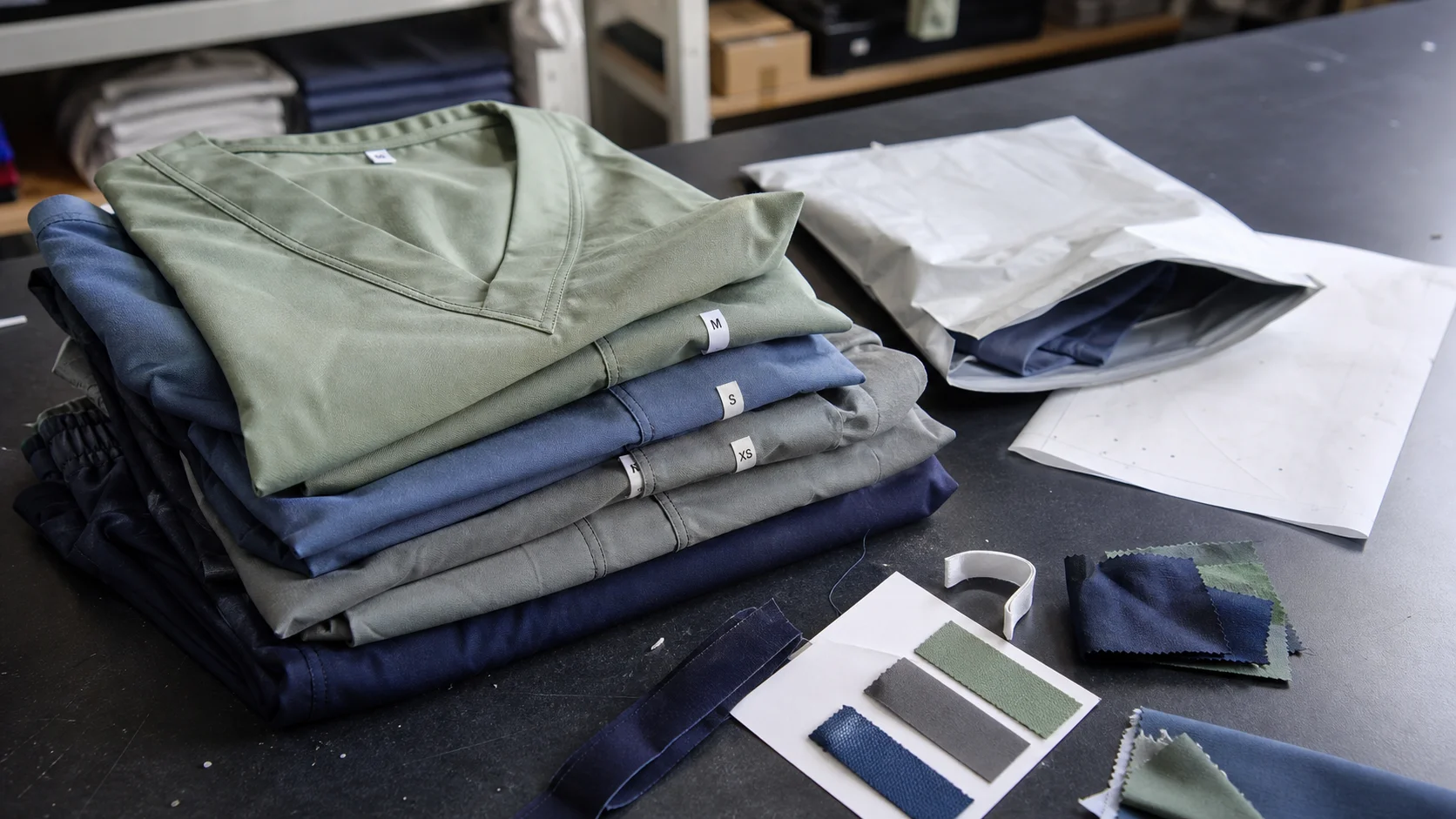
The buyer should request a trim card before bulk production. A trim card can show fabric, thread, drawcord, elastic, labels, buttons, zipper components, logo thread or transfer film, and packaging materials. It gives procurement and quality teams a physical reference if shipment disputes occur.
Sample approval is where many bulk scrub programs either become controlled or become risky. A single “nice-looking” sample is not enough. Pharmacy buyers should use a staged approval process that covers fit, fabric, color, trims, logo, wash performance, and packaging.
A typical sample process may include a proto sample, fit sample, size set, pre-production sample, and shipment sample. Not every order needs every stage, especially if the buyer is using an existing stock scrub style. A custom order with new fabric, new pattern, custom logo, and custom color should go through more approval steps.
The proto sample confirms general design direction. The fit sample confirms measurements and movement. The size set checks grading across sizes. The pre-production sample should represent actual bulk fabric, trims, color, labels, logo placement, and sewing method. The shipment sample or top-of-production sample checks whether production is matching the approved standard.
Buyers should avoid approving samples with vague comments such as “looks good” or “approved except minor changes.” Every change should be written clearly: increase chest by 2 cm, reduce pocket opening by 1 cm, move logo 1.5 cm higher, change drawcord to matching color, improve waistband elastic tension. Small ambiguities become large problems in bulk production.
Sample Stage Main Purpose Buyer Decision Risk If Skipped Proto Sample Check design concept and basic construction Approve direction or revise style Wrong style moves into fit stage Fit Sample Check measurements and mobility Approve pattern corrections Bulk order has staff fit complaints Size Set Check grading across sizes Approve full size range Only medium size fits correctly Pre-Production Sample Confirm bulk fabric, trims, logo, and workmanship Approve for bulk production Factory uses unapproved components Shipment Sample Verify production output before dispatch Approve shipment or request inspection Defects arrive at pharmacy sitesMinimum order quantity is not just a supplier preference. It is linked to fabric sourcing, dyeing, cutting efficiency, trim purchase minimums, sewing line setup, and packing labor. Pharmacy buyers should ask whether the MOQ applies per style, per color, per size, or per total order. The difference can materially change the buying plan.
For stock scrub styles with available fabric, a supplier may accept lower MOQs, sometimes around 100 to 300 pieces per style or color. For custom colors or custom fabric, MOQs may rise to 500 to 1,000 pieces per color. For fully custom development, including new pattern, fabric, trims, and branding, practical MOQs may be higher. These are typical ranges, not guarantees. Supplier capability and market conditions matter.
Price risk appears when buyers compare quotes without matching specifications. One supplier may quote a lighter fabric, fewer bartacks, simpler packaging, no wash testing, and no inspection. Another may quote stronger fabric, better trims, size-set sampling, and pre-shipment quality control. The second price may be higher but lower risk.
Reorder risk is especially important for pharmacy groups with ongoing hiring. If the first order uses a custom fabric or color, the buyer must confirm reorder MOQ, reorder lead time, and shade control. A small reorder of 80 sets may not be possible at the original price if the fabric mill requires a larger dye lot. Buyers should negotiate a replenishment structure before committing to a custom program.
Direct purchasing judgment: if annual scrub demand is uncertain or below 500 sets, a stock fabric and standard color program is usually safer than a fully custom scrub. Customization makes sense when the buyer has volume, timeline discipline, and a long-term reorder plan.
Lead time depends on more than sewing time. Fabric availability, lab dip approval, trim sourcing, sample revisions, production queue, inspection booking, export documentation, shipping mode, customs clearance, and final distribution all affect the delivery date. Pharmacy operations teams should work backward from launch date, not forward from purchase order date.
A simple stock scrub order may move faster if the supplier has fabric and trims ready. A custom order can take significantly longer because the buyer must approve fabric, fit, color, logo, and packaging before bulk production. As a cautious planning range, buyers might expect several weeks for stock or lightly customized programs and a longer timeline for custom-developed scrubs. Exact timing should be confirmed with the supplier based on current capacity and material availability.
Approval delays are a common hidden cause of late delivery. If the buyer takes ten days to approve a lab dip or sample, the production calendar moves. A risk map should assign decision owners for each approval step. Procurement may approve cost. Operations may approve fit and size ratio. Marketing or brand teams may approve logo and color. Quality may approve test requirements. Without clear ownership, the supplier waits and the launch date shrinks.
Shipping mode is another tradeoff. Air freight can rescue a late order but may erase cost savings. Sea freight is more economical for large programs but requires planning. Split shipments can help if urgent sizes are needed first, but they increase logistics complexity and receiving work.
Inspection is the last practical opportunity to catch defects before scrubs reach pharmacy staff. It should not be treated as a formality. A meaningful inspection checks quantity, workmanship, measurements, labeling, packing, color, odor, stains, and logo execution. It also verifies that the shipment matches the approved sample and purchase order.
Common scrub inspection defects include open seams, skipped stitches, uneven hems, loose threads, misaligned pockets, twisted legs, puckered embroidery, incorrect logo placement, shade variation, oil stains, wrong size labels, mixed-size packing, weak elastic, and measurement variance. Some defects are cosmetic. Others affect wearability or distribution.
Inspection sampling should be agreed before production. Many apparel buyers use AQL-based inspection methods, with defined acceptable quality limits for critical, major, and minor defects. Pharmacy buyers do not need to become inspection technicians, but they should define what counts as critical. A contaminated-looking stain, sharp trim issue, wrong logo, incorrect color, or severe size error may be unacceptable even if the overall defect percentage is low.
Measurement inspection deserves special attention. A garment can look well sewn but fail the size chart. Buyers should define measurement points and tolerances for chest, waist, hip, inseam, outseam, sleeve length, shoulder, across back, front rise, and leg opening. Tolerances may vary by garment type and fabric, but they should be agreed in writing.
If the order is large or mission-critical, an inline inspection during production can catch problems earlier than a final inspection. This is useful when the factory is producing a new style, using new operators, or working with stretch fabrics that require careful handling. A final inspection alone may identify defects too late for easy correction.
The table below gives pharmacy buyers a working risk map for bulk scrub orders. It can be adapted for internal procurement, supplier comparison, and pre-shipment control. The key is to use it early, before the order is locked.
Risk Area Typical Trigger Operational Impact Buyer Control Inspection Focus Size Ratio Order based on rough headcount Shortages in key sizes and excess inventory Collect staff size data and add controlled buffer Confirm carton quantity by size Fabric Supplier substitutes similar fabric Comfort, shrinkage, opacity, or durability complaints Approve fabric spec and physical swatch Check hand feel, weight, shrinkage, and defects Color Different dye lots or unapproved lab dip Department coding looks inconsistent Approve lab dip or production lot cutting Compare shipment against color standard Fit Sample approved on one body type only Staff complaints and exchange pressure Approve fit sample and size set Measure garments against spec Construction Weak seams or poor stress-point reinforcement Early garment failure Define stitch, seam, and bartack requirements Check pockets, crotch, side seams, hems, and waistband Logo Incorrect placement, thread, or transfer quality Brand inconsistency and rework cost Approve logo strike-off before bulk Measure placement and check durability appearance Labels Wrong size, care, or fiber content label Distribution errors and compliance concerns Approve label artwork and placement Verify labels in sampled garments Packaging Mixed cartons or unclear markings Receiving delays at pharmacy sites Require packing method by size and department Match cartons to packing list Lead Time Late approvals or material shortage Uniform launch delay Set approval owners and deadline calendar Monitor production milestones Reorder Custom fabric unavailable in small quantity New hires receive mismatched scrubs Agree reorder MOQ and shade policy Compare reorder against original standardA pharmacy buyer should issue a clear tech pack or specification file before requesting final quotes. This does not need to be overly complex, but it should remove guesswork. At minimum, it should include style images or reference samples, fabric requirements, size chart, color standards, logo artwork, trim details, packaging instructions, quality expectations, and delivery requirements.
The sourcing process should compare suppliers on more than price. Ask whether they have made similar scrub styles, whether they can provide size sets, how they manage shade control, what inspection process they use, and what happens if bulk production fails inspection. A supplier who cannot explain these points may still be able to sew garments, but the buyer carries more risk.
For buyers who need help translating operational requirements into production-ready specifications, contacting Fabrikn can be a useful next step. A clearer specification usually improves quote accuracy and reduces preventable disputes.
The best bulk scrub purchase is not always the most customized, and it is not always the cheapest. Pharmacy operations teams should choose the level of customization that matches their volume, timeline, and internal capacity to manage approvals. A small team with a tight deadline should usually prioritize stock colors, proven fabrics, and standard patterns. A larger operation with recurring demand can justify more custom development if it controls sampling, inspection, and reorders properly.
A practical risk map also supports internal alignment. Procurement may focus on cost. Operations may focus on staff acceptance. Quality may focus on inspection. HR may focus on onboarding and issue. Brand teams may focus on color and logo consistency. The risk map gives each team a visible role before the order becomes urgent.
Buyers should treat every bulk scrub order as a repeatable program. After delivery, record staff feedback, defect rates, exchange data, shrinkage complaints, reorder issues, and distribution problems. These records improve the next order and give the supplier clearer correction points. If the supplier performs well, the buyer gains a more stable uniform program. If the supplier performs poorly, the buyer has documented reasons to adjust specifications, renegotiate, or move production.
For companies evaluating apparel production partners, it can help to understand the sourcing and manufacturing approach behind the supplier relationship. More background is available on Fabrikn’s about page.
Get a free quote from Fabrikn — your trusted B2B clothing manufacturer with 10+ years of experience. MOQ as low as 200 pieces.
Get a Free Quote →A bulk scrubs order risk map is a purchasing and quality-control tool that identifies where a scrub order can fail. It usually covers size planning, fabric, color, fit, trims, sampling, MOQ, lead time, inspection, packaging, and reorder control.
Typical MOQs vary by supplier and specification. Stock scrub programs may start around 100 to 300 pieces per style or color. Custom fabric, custom color, or fully developed styles may require 500 to 1,000 pieces per color or more. Buyers should confirm whether MOQ applies by total order, style, color, or size.
The most useful sample stages are fit sample, size set, and pre-production sample. A custom order may also need proto samples, lab dips, logo strike-offs, wash tests, and shipment samples. The pre-production sample should represent actual bulk fabric, trims, logo, labels, and construction.
Collect current staff size data before ordering, allow tops and pants to be ordered separately where possible, include petite or tall options if needed, and maintain a controlled buffer for common sizes. Reorder planning is also important for new hires and replacements.
There is no single best fabric for every pharmacy operation. Polyester-cotton blends can be durable and cost-effective. Polyester-rayon-spandex blends can improve comfort and drape. Performance stretch fabrics can support mobility and quick drying. Buyers should compare fabric weight, shrinkage, opacity, pilling, colorfastness, and laundering performance before approval.
Common defects include open seams, skipped stitches, uneven hems, loose threads, misaligned pockets, weak bartacks, incorrect labels, wrong logo placement, shade variation, stains, measurement variance, and mixed-size packing. These should be checked before shipment whenever possible.
Stock scrubs are usually safer for lower quantities, faster timelines, and simple uniform programs. Custom scrubs are better when the buyer has enough volume, a stable reorder plan, and clear brand or operational requirements. The tradeoff is that custom programs require stronger approval and inspection controls.
Buyers should agree reorder MOQ, lead time, fabric availability, shade-control process, and price validity before placing the first order. They should also keep an approved fabric swatch, size chart, logo standard, and packing specification for future production runs.