
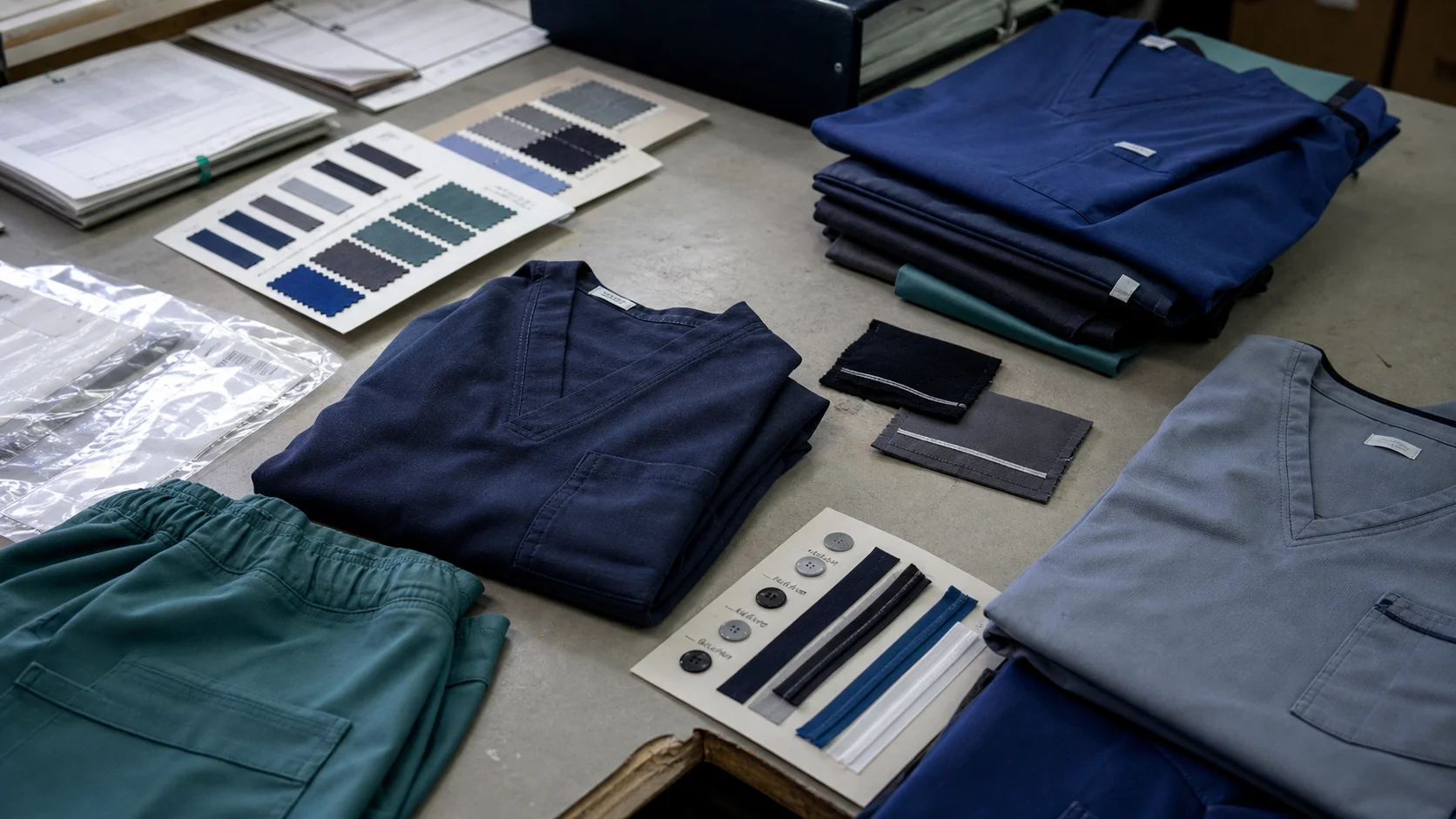
A detailed outline for distributors sourcing bulk scrubs with seam strength testing, focused on procurement criteria, test documentation, production risk, and cost decisions tied to garment durability.
Bulk Scrubs With Seam Strength Testing for Procurement - Fabrikn production reference
Buying bulk scrubs for distributor procurement is not just a fabric and color exercise. It is a durability decision. In medical apparel, seam failure creates a direct commercial problem because scrubs are expected to handle repeated laundering, movement, and size strain across a wide user base. A scrub set that looks acceptable at shipment can still turn into a return problem if crotch seams, inseams, pocket joins, shoulder seams, or side seams start opening after short use cycles.
That is why bulk scrubs with seam strength testing deserve more attention during sourcing. For distributors, the issue is straightforward: consistent seam performance reduces claims, protects repeat orders, and makes private label programs easier to scale. When product teams skip this requirement, they often focus too heavily on fabric hand feel, color cards, or low FOB targets and not enough on construction stability. That can be an expensive mistake.
Seam strength testing gives procurement teams a more objective way to judge whether a scrub top or pant is built for real wear. It does not guarantee zero defects in the field, but it helps screen out weak construction choices before the order goes into full production. In practical sourcing terms, this is one of the simplest ways to reduce downstream quality disputes.
Distributors buying for hospitals, resellers, uniform programs, and healthcare wholesalers usually need a balance of cost control, repeatability, and acceptable performance. Seam strength belongs in that balance. It should be written into the tech pack, reviewed during pre-production sampling, and checked again when bulk production starts.
Suppliers that can support structured development, testing coordination, and production control are generally easier to work with on this type of program. Buyers reviewing sourcing support options can start with pages such as https://fabrikn.com/services/ to understand how apparel development and manufacturing workflows are typically organized.
Seam strength testing measures how much force a sewn seam can withstand before the seam ruptures, yarns break, or slippage occurs. In scrub procurement, the point is not to turn garments into technical protective equipment. The point is to confirm that the construction is commercially durable for everyday use in healthcare settings.
For scrubs, testing attention usually goes to high-stress zones:
Buyers should distinguish between seam strength and seam slippage. They are related but not identical. A seam can stay intact while the fabric yarns pull away from the stitch line, which still creates a poor result. This matters especially in lighter scrub fabrics or blends with open constructions.
In procurement language, a useful seam strength requirement usually includes:
Buyers should not leave these points vague. If the purchase order only says “good quality seams,” the supplier and buyer may have very different interpretations.
Direct purchasing judgment: if a distributor is building a long-running scrub line, seam strength testing is usually a lower-cost preventive control than handling one season of field complaints.
Distributors often procure across multiple sizes, colors, and replenishment cycles. That makes consistency more important than a one-time showroom sample result. The earlier seam strength expectations are defined, the easier it is to control quality through development and production.
There are four practical reasons to specify seam strength testing at the quotation or development stage.
A factory can quote a lower number by reducing stitch density, using cheaper thread, simplifying seam types, or assigning less sewing time to reinforcement areas. Those choices may not be obvious from a basic sales sample. If testing is mandatory, weak engineering is harder to hide behind a low FOB.
Two scrub vendors may offer similar fabrics and similar styling, yet the construction level can be materially different. A consistent testing requirement narrows the gap between appearance-based quotations and actual product performance.
When a bulk order later shows seam issues, a defined pre-agreed test framework gives both sides a factual reference. That does not eliminate disputes, but it improves the buyer’s position.
Distributors selling under their own brand carry the market risk directly. Seam failures quickly damage trust in healthcare apparel because users expect utility first and styling second.
Buyers that need sourcing coordination across specs, testing, and supplier communication often benefit from using a more structured development process. A contact point such as https://fabrikn.com/contact-us/ is useful when turning a loose brief into a production-ready program.
In the MOQ, Cost & Sourcing category, seam strength testing should be treated as part of total procurement cost rather than as a separate inconvenience. It can add development steps and small testing expenses, but the bigger pricing question is how construction requirements affect the garment cost base.
MOQ for bulk scrubs varies by supplier model, fabric sourcing method, and whether the program is stock-based or custom.
These are working market ranges, not fixed rules. A supplier may accept lower MOQs with fewer colors, simpler packaging, or standard trims. Small MOQs can still carry higher unit costs because factory setup, marker efficiency, and testing overhead are spread across fewer units.
None of these cost drivers is dramatic in isolation. Together, they can move pricing enough to matter, especially in large volume tenders. The procurement decision is not whether seam strength should cost more. The real question is whether the extra build quality is worth more than the risk of replacements, credits, or lost accounts. In many scrub programs, the answer is yes.
If the budget is tight, buyers usually get better value by protecting critical seam performance and simplifying non-essential trims than by stripping construction quality out of the garment. Fancy drawcord ends, retail-heavy packaging, and decorative details are easier to remove than seam durability problems are to fix after delivery.
Procurement Factor Lower-Cost Choice Higher-Control Choice Buyer Tradeoff MOQ Lower opening order Higher volume commitment Lower MOQ reduces exposure but often raises unit cost Testing Factory internal checks only Third-party or buyer-defined testing External testing improves evidence but adds time and cost Seam Construction Basic sewing build Reinforced stress-point construction Better durability usually costs modestly more Fabric Program Stock fabric Custom fabric development Stock shortens lead time but limits controlSeam strength does not depend on stitching alone. It is shaped by the interaction between fabric, needle, thread, seam type, stitch density, and garment fit.
Common scrub fabrics include polyester-cotton blends, polyester-rayon-spandex blends, and polyester-rich mechanical stretch constructions. Typical scrub weights often sit in the range of about 140 to 210 gsm, depending on the target market and silhouette.
From a sourcing standpoint, buyers should review:
A soft hand feel can help sales, but very soft finishing on a lightweight fabric may not support the same seam behavior as a more stable construction. That is why scrub buying should not rely on touch alone.
Procurement teams do not need to dictate every machine setting, but they should ask for clear sewing specs. Useful checkpoints include:
For scrub pants, crotch and inseam engineering deserves special attention. For tops, side seam openings, pockets, and underarm areas are common stress points. If the garment has stretch fabric, the seam construction should accommodate that stretch. A non-matching seam build can fail even when the fabric itself is acceptable.
Distributors should expect seam strength requirements to influence the sample approval process. A practical workflow usually includes more than one sample stage.
Buyers should resist approving bulk based only on an early showroom sample. Proto samples are often made with substitute materials or handled by more experienced sample operators than the regular production line. The pre-production sample is the more meaningful checkpoint.
A careful purchasing approach is to tie approval to both appearance and measurable performance. That means the sample comment sheet should cover seam appearance, stitch security, puckering, reinforcement, and any requested test outcome.
Direct purchasing judgment: if a supplier pushes hard to skip pre-production confirmation on a custom scrub program, that is a sourcing risk signal, not a speed advantage.
Lead times for bulk scrubs with seam strength testing depend on whether the order uses stock fabric or custom development, whether trims are standard, and whether third-party testing is required.
Typical planning ranges in the market often look like this:
Those timelines shift when there are fabric dyeing queues, trim sourcing delays, holiday congestion, or repeated sample comments. Testing itself is rarely the only source of delay. More often, the real lead-time issue is that testing exposes a construction problem and the supplier then has to rework the sample or adjust production methods.
That is still a better outcome than discovering the same weakness after shipment.
Buyers should map lead time from approval dependencies, not from optimistic sales promises. The critical path usually includes:
Teams evaluating a sourcing partner’s process transparency may find background information at https://fabrikn.com/about-us/ helpful before moving into quotation and development discussions.
Seam strength testing is important, but it does not replace inline and final inspection. A lab-tested sample can pass while bulk production still drifts if line control is weak.
Distributors should ask how quality is controlled during production, not just at the end. Inline checks matter because seam problems are easier to correct before thousands of units are finished. Final random inspection is still valuable, but it is a late filter.
For procurement teams, the key judgment is simple: a supplier that cannot explain its in-line controls clearly is not a strong candidate for a repeat scrub program, even if the opening quote looks attractive.
When sourcing bulk scrubs with seam strength testing for distributor procurement, buyers should ask direct operational questions. That tends to reveal more than polished presentations do.
These questions are useful because they force discussion around process, not just price. In scrub sourcing, process usually determines whether a competitive quote remains competitive after claims, delays, and replacements are factored in.
Bulk scrubs with seam strength testing are a practical sourcing choice for distributors that care about repeatability, fewer returns, and better brand protection. The value is not in testing for its own sake. The value is in using seam strength requirements to improve how scrub garments are specified, sampled, priced, and controlled before shipment.
For most distributor procurement programs, the best approach is to define the seam performance requirement early, align it with fabric and construction specs, confirm it during sample approval, and monitor it again during production. That is a more disciplined path than chasing the lowest initial quote and hoping the product holds up in use.
Strong procurement results usually come from balanced decisions. Keep MOQ realistic. Protect the seam areas that matter most. Use sample approvals properly. Watch lead-time dependencies closely. Treat inspection as an active control, not a final formality. Buyers who do that are usually in a better position to scale a scrub line without carrying avoidable quality risk.
Get a free quote from Fabrikn — your trusted B2B clothing manufacturer with 10+ years of experience. MOQ as low as 200 pieces.
Get a Free Quote →Typical MOQs often start around 300 to 800 sets for simpler stock-fabric programs and can move to 800 to 2,000 sets per colorway for more customized private label orders. Exact MOQ depends on fabric source, color count, trim customization, and packaging needs.
It helps verify that scrub seams can withstand routine wear and laundering, especially in high-stress areas such as crotch seams, inseams, side seams, and pockets. For distributors, this can reduce returns, claims, and repeat-order quality issues.
No. Some suppliers perform internal testing, while others can coordinate third-party lab testing on request. Third-party testing gives stronger independent documentation, but it also adds cost and can extend lead time.
Key factors include fabric stability, stitch density, seam type, thread quality, reinforcement at stress points, seam allowance, and whether the seam build matches the fabric stretch characteristics.
Yes, but buyers should expect some tradeoffs. Lower volume programs may have higher unit costs because development and testing overhead are spread across fewer pieces. Some suppliers may also limit customization at very low quantities.
The pre-production sample is usually the most useful approval stage because it should reflect bulk-intended fabric, trims, and sewing construction. Early proto samples are helpful for design direction but are less reliable for final quality decisions.