
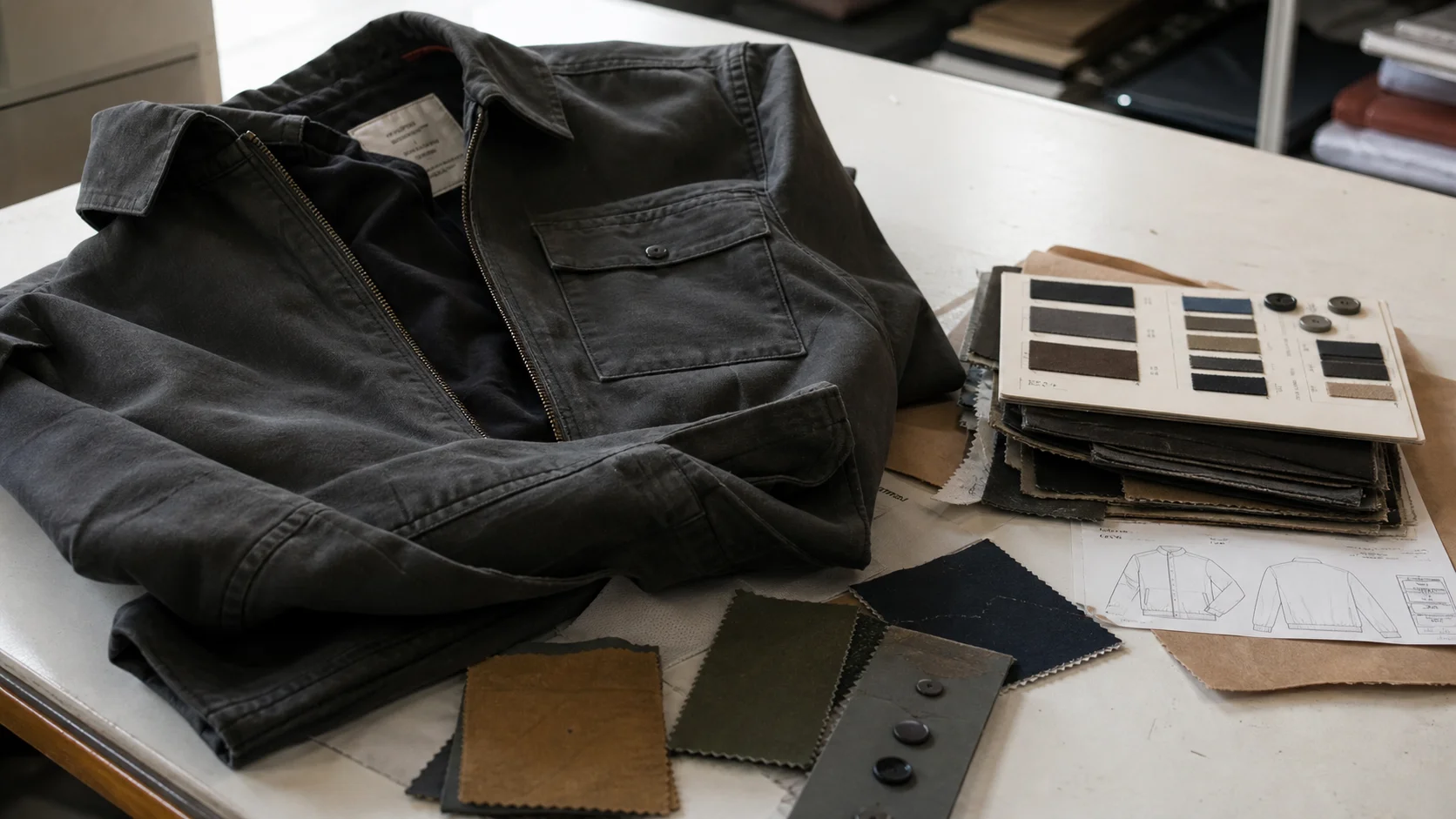
A focused outline for workwear retailers evaluating custom work jackets with compliance testing, covering fabric performance, decoration durability,...
Custom Work Jackets With Compliance Testing Buyers - Fabrikn production reference
Custom work jackets sit in a difficult sourcing category. They are expected to look commercial enough for retail, tough enough for repeated industrial use, and compliant enough to reduce avoidable product risk. For workwear retailers, that combination changes the buying process. A basic fashion outerwear program can often move on silhouette, price, and decoration options alone. A work jacket program usually cannot.
When buyers search for custom jackets with compliance testing for workwear retailers, they are usually trying to solve more than one problem at the same time. They want a private label product that fits their brand identity, but they also need testable materials, reliable documentation, and manufacturing controls that will hold up under routine quality checks. The sourcing question is not just, “Can this factory make jackets?” It is, “Can this supplier make my jacket consistently, with the right materials, and support the test requirements my market expects?”
That distinction matters because compliance failures do not stay isolated. A failed colorfastness result can trigger rework. A fabric substitution can invalidate approved test reports. A trim with the wrong coating can cause restricted substance concerns. Even small mismatches between approved samples and bulk production can become expensive when the jacket is sold into professional workwear channels.
For private label apparel buyers, the safest approach is practical: lock the specification early, test the right items at the right stage, and treat compliance as part of product development rather than a final step before shipment. Retailers that do this well usually reduce delays, reduce claims, and protect margin better over time.
If you are reviewing manufacturing options for private label workwear, it helps to start with a supplier that understands development, sourcing, and production controls in one workflow. Fabrik’s services page is a useful starting point for evaluating whether the support structure matches a compliance-sensitive jacket program.
Not every custom work jacket needs the same compliance profile. Buyers often group these products together, but the technical requirements vary sharply depending on the end use. A warehouse softshell jacket is not the same as a heavy-duty canvas utility jacket. A hi-vis outer layer is not the same as a branded service technician jacket for light field work.
Most retailer demand falls into a few common private label categories:
The purchasing decision changes based on the category. Heavy cotton canvas jackets tend to emphasize abrasion resistance, seam strength, zipper performance, and wash durability. Softshell programs usually require closer control of laminated fabric performance, water repellency, color consistency, and bonding quality. Hi-vis jackets bring another level of caution because reflective trims, fluorescent fabrics, and labeling accuracy can all affect whether the product meets the intended standard.
Retailers should be careful not to over-specify features that the market will not pay for. There is no sourcing advantage in adding expensive performance testing to a jacket sold only as general-purpose branded outerwear if no claim is being made. The opposite mistake is more common and more dangerous: under-specifying a jacket that is marketed with functional claims such as high visibility, water resistance, flame-related protection, or industrial wash suitability.
Good buying decisions in this category come from aligning the product claim, the end-use environment, and the test plan. That is where many workwear programs either stay efficient or become expensive.
Compliance testing for work jackets can cover several layers: legal chemical compliance, physical performance testing, care and labeling accuracy, and category-specific standards. Buyers do not need every possible test on every style, but they do need a clear framework.
This is often the baseline requirement for retailers. Depending on destination market and retailer policy, buyers may request testing for restricted substances such as azo dyes, formaldehyde, lead, phthalates, or other chemicals covered by brand RSLs or market regulations. Chemical compliance should not be handled casually. A low-cost trim supplier can create a disproportionate risk if zipper pulls, PVC patches, prints, or reflective components are not screened properly.
For workwear jackets, common performance checks may include:
These tests are not decorative paperwork. They help confirm whether the jacket will perform across its expected life cycle. A retailer selling into trade, utility, farm supply, industrial, or corporate uniform channels usually benefits from setting minimum performance thresholds before bulk production begins.
Some work jackets need more specialized evaluation. High-visibility products may need testing tied to applicable visibility standards in the target market. Flame-resistant or protective jackets require even greater caution because those claims involve technical certification logic, not just marketing language. Buyers should avoid using protective terminology in product listings unless the jacket materials, construction, labeling, and testing all support that claim.
A useful purchasing rule is simple: only claim what the approved bill of materials and verified test results can support. Anything else increases liability with little upside.
Even a physically sound jacket can create problems if the labeling is incomplete or inaccurate. Country of origin, fiber content, care instructions, size information, warning language where applicable, and trackable PO or lot information all deserve attention. Workwear returns often expose labeling errors quickly because end users wash these garments more aggressively than typical casualwear.
Retailers that need support structuring specifications and compliance-ready development conversations can review a supplier background before outreach. Fabrik’s about us page can help buyers understand the company profile before moving into technical discussions.
Compliance problems in custom work jackets often start with the bill of materials. Buyers sometimes focus on the outer shell and overlook the rest of the package. In reality, jacket compliance is influenced by shell fabric, lining, insulation, zippers, snaps, drawcords, rib, reflective tape, labels, prints, and packaging components.
Typical shell options for work jackets include cotton duck, cotton-poly canvas, twill, oxford polyester, ripstop blends, and bonded softshell constructions. Buyers should specify fiber content, fabric weight, finish type, color standard, and performance requirement in measurable terms. “Durable canvas” is not a usable technical standard. “10 oz cotton-poly canvas, enzyme washed, colorfastness minimum grade target, shrinkage limit after care test” is far more actionable.
Fabric weight should be realistic for the channel. Lighter shells may lower cost and improve mobility, but they can disappoint buyers expecting traditional ruggedness. Heavier shells feel more substantial on the rack, yet they increase freight cost and can complicate wash performance if finishing is not stable.
Quilted polyester lining, fleece lining, sherpa lining, and padded insulation are common choices. Buyers should confirm whether the lining shade needs to match the shell, whether insulation weight must be consistent across size runs, and whether bulk handfeel should match the approved sample. Insulation variance is a common issue in outerwear programs because small changes in loft or GSM can affect warmth, appearance, and fit.
Hardware can easily become a weak point. Low-grade zippers may fail function tests or create consumer complaints long before the garment fabric shows wear. For work jackets, it is usually worth specifying zipper brand standard, tape quality, tooth type, puller finish, and salt-spray or coating expectations if relevant. Snaps, rivets, and cord-end hardware should also be reviewed for finish durability and restricted substance exposure.
If the jacket includes reflective tape or fluorescent panels, buyers should not assume visual similarity equals compliance equivalence. Substitute reflective trims are a known risk area. The approved sample may pass an initial test, while bulk production uses a near-match component that has different performance characteristics. That kind of substitution can undermine the entire program.
Heat transfers, screen prints, woven labels, care labels, hangtags, and polybags all matter. Retailer compliance manuals often include requirements for these components, and they should be locked before production. A compliant shell fabric paired with non-compliant print chemistry or packaging can still fail the shipment review.
Component What to Specify Common Risk Shell fabric Fiber content, GSM/oz, weave, finish, color standard Unapproved substitution or unstable finishing Lining Material, weight, color, attachment method Shade mismatch or inconsistent bulk feel Insulation Type, GSM, loft expectation, panel placement Uneven fill and size-to-size inconsistency Zippers/snaps Material, finish, pull strength, function standard Premature failure or chemical non-compliance Reflective trims Width, placement, test requirement, approved source Bulk substitution after sample approval Labels/prints Content, care, artwork, ink/transfer standard Label errors or restricted substance issuesFor custom jackets with compliance testing, the development calendar should be tighter than a basic promotional apparel order. Retailers often underestimate how many approval points are needed before cutting bulk.
A typical workflow looks like this:
The pre-production sample is often the most important checkpoint. Buyers should treat it as the closest representation of bulk reality. If the fabric, lining, zipper, insulation, label package, and decoration are not truly bulk-intended at this stage, the approval has limited value.
Testing strategy also needs to be defined early. Some retailers test component materials first, then confirm on finished garments. Others focus on final garment testing. There is no universal single route because the right sequence depends on the claim, retailer policy, market, and risk level. The key point is that testing should match the actual approved BOM, not a development-stage placeholder version.
One practical sourcing judgment: buyers who rush from first sample to bulk PO often create their own delays later. Spending more time at pre-production is usually cheaper than discovering a problem after cutting thousands of units.
MOQ for private label work jackets varies by fabric complexity, trim customization, and whether the style uses stock or custom-developed materials. For straightforward jackets using available fabrics and standard trims, buyers may see MOQs starting around 300 to 500 pieces per style, sometimes split across colors with limits. For more customized outerwear programs with special washes, laminated fabrics, branded hardware, or compliance-sensitive trim sourcing, MOQs often move into the 800 to 1,500 piece range per style or color.
Those numbers are not fixed rules. They are typical commercial ranges. A supplier may accept lower quantities for sampling conversion or mixed programs, but very low MOQs tend to increase cost per unit and narrow material choices. That tradeoff needs to be judged honestly. Retailers chasing low MOQs and heavy customization at the same time often get the least efficient outcome.
As a broad working range, development and sampling may take several weeks to a few months depending on complexity. Bulk production after approvals often falls in the range of roughly 60 to 120 days, but outerwear programs can extend beyond that when custom fabrics, testing failures, or peak-season capacity issues are involved.
Pricing also reflects risk. Buyers sometimes compare a tested work jacket against an untested fashion jacket and assume the lower quote is automatically better. It rarely is. Compliance-ready sourcing adds cost through better materials, documentation, testing, process control, and supplier coordination. The question is not whether testing adds cost. It does. The real question is whether that cost is lower than the margin damage created by returns, relabeling, shipment holds, or failed marketplace expectations. In most serious workwear channels, the answer is yes.
Shipment delays in work jacket programs usually come from a predictable set of problems. Buyers can reduce them, but only if they know where they tend to appear.
This is one of the most serious risks. A mill change, trim shortage, or last-minute replacement may look commercially acceptable but fail the approved standard. Buyers should require clear BOM control and written substitution approval procedures.
Jackets with multi-panel construction, contrast yokes, or matching pants programs are vulnerable to shading issues. Dark colors, washed fabrics, and mixed-material garments need tighter review. Shade problems may not fail laboratory compliance testing, but they can still fail final inspection or create retail rejection.
Outerwear tolerances are often wider than knit tops, but fit inconsistency still matters. Layering allowance, sleeve pitch, chest ease, and body length can vary if the factory changes padding bulk, lining tension, or pattern grading execution. Size sets should be reviewed carefully, especially for extended size runs.
Embroidery placement, patch attachment, reflective tape positioning, and care label content are regular failure points. Label errors are particularly frustrating because the garment may be physically fine but commercially blocked. Retailers should approve all packaging and labeling artwork with the same discipline used for garment construction.
Testing after production is already packed is a weak position. If a result fails, the options become expensive: retest, rework, relabel, hold, or cancel. Testing should be scheduled early enough that failures can still be corrected inside the production window.
A sensible risk-control method includes inline inspection, pre-final review, and final random inspection, backed by document matching against the approved sample and BOM. That combination is more reliable than depending on a single end-stage check.
Workwear retailers should screen suppliers with a stricter lens than they would use for basic promotional outerwear. The right supplier is not simply the one offering the widest style gallery. It is the one that can manage specification discipline.
Key questions worth asking include:
Retailers should also judge communication quality, not just unit cost. Work jackets involve more variables than a simple T-shirt program. If a supplier cannot discuss shell weight, seam construction, trim source control, test dependencies, and approval flow clearly, the jacket program may become reactive instead of controlled.
One useful commercial sign is whether the supplier talks in concrete terms about materials and process, rather than making broad promises. Buyers in this category need operational clarity more than sales language.
For direct sourcing discussions, technical questions, or quotation requests, Fabrik’s contact us page is the practical next step.
Custom jackets with compliance testing are a strong fit for retailers that want to build a durable private label position rather than compete only on commodity pricing. The category suits workwear stores, industrial distributors, farm and ranch chains, safety retailers, uniform resellers, and B2B dealer networks that need brand differentiation with lower product risk.
The main advantage is control. Private label allows the buyer to set pocket layouts, branding, fits, color stories, insulation weights, and feature priorities around its customer base. Compliance testing adds a second layer of control by helping verify that the finished product supports the quality and safety expectations attached to those choices.
There is a tradeoff. These programs require more development discipline than basic outerwear buying. The retailer must commit to clearer specifications, more approvals, and more realistic timelines. That extra structure is not wasted effort. In workwear, it is often what separates repeatable programs from unstable ones.
For buyers entering the category, the most effective route is usually to begin with a commercially proven jacket type, keep the BOM manageable, define the claim set carefully, and build testing requirements around actual market need. Trying to launch with every feature, every trim upgrade, and every performance promise at once tends to slow the program and inflate cost.
A better strategy is staged complexity: start with a strong core jacket, confirm fit and quality, then add more specialized variants once the supply chain is stable. That is usually the cleaner path to margin, consistency, and retail confidence.
Get a free quote from Fabrikn — your trusted B2B clothing manufacturer with 10+ years of experience. MOQ as low as 200 pieces.
Get a Free Quote →It often includes chemical compliance checks, physical performance tests, labeling review, and any category-specific testing linked to product claims. The exact scope depends on the market, retailer policy, and whether the jacket is making claims such as high visibility, water resistance, or industrial durability.
For many programs, MOQ starts around 300 to 500 pieces for simpler styles using available materials. More customized jackets with special fabrics, branded hardware, or more demanding compliance control often land closer to 800 to 1,500 pieces per style or color.
Lead time depends on sampling rounds, fabric sourcing, trim development, testing schedules, and factory capacity. After approvals, bulk production for work jackets commonly falls around 60 to 120 days, though complex outerwear can take longer.
Both approaches are used. Some buyers test materials first and then confirm on finished garments. Others emphasize garment-stage testing. The best route depends on the risk profile, retailer requirements, and the claims attached to the product.
The main risks are unapproved fabric or trim substitution, failed chemical tests, poor zipper or hardware performance, shade variation, measurement inconsistency, and incorrect labels or packaging. Most of these risks can be reduced with tighter BOM control and earlier approvals.
In most serious workwear channels, yes. Testing and process control increase upfront cost, but they often reduce returns, shipment holds, relabeling, and reputation damage. For retailers building a long-term private label workwear line, that tradeoff is usually commercially sound.