
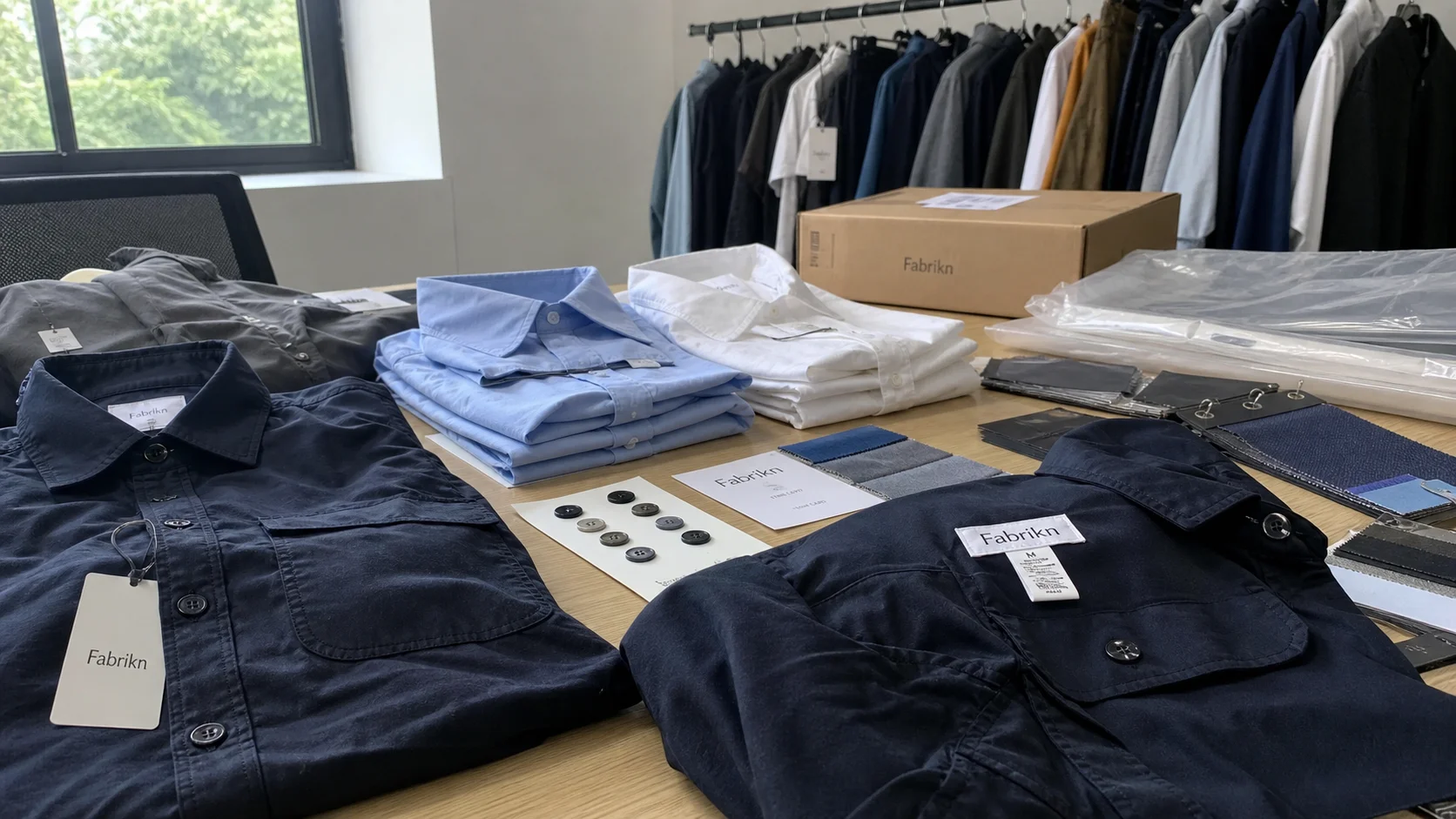
A detailed outline for club uniform importers evaluating white label tracksuits with embroidery MOQ, including cost drivers, logo placement, sizing runs,...
White Label Embroidered Tracksuits MOQ for Importers - Fabrikn production reference
White label embroidered tracksuits are private-brand garments produced by a manufacturer and finished with the importer’s label, logo placement, packaging preferences, and size breakdown. For club uniform importers, this model is often more practical than developing a fully custom pattern from zero. It shortens development time, keeps fit risk lower, and usually leads to a more manageable minimum order quantity than a fully bespoke cut-and-sew program.
The key distinction is simple. A white label tracksuit generally starts from an established factory block, proven fabric program, or repeat production line. The importer then customizes brand identity elements such as chest embroidery, back logo embroidery, woven labels, hangtags, polybag stickers, and color selection within the supplier’s workable range. This matters because MOQ is rarely driven by the word “tracksuit” alone. MOQ is driven by how far the product moves away from an existing production setup.
For club uniform programs, embroidery is a common requirement because it gives a durable, premium look compared with heat transfer decoration. That said, embroidery adds production steps, stitch programming, backing decisions, hooping controls, and potential panel distortion risk. Buyers should treat embroidered white label tracksuits as a middle ground: less complex than a fully engineered teamwear line, but more demanding than plain stock garments with a printed logo.
If you are building a sourcing plan and need a manufacturing overview, it helps to review a supplier’s production scope before quoting. A general service outline such as https://fabrikn.com/services/ can help frame whether the supplier handles development, labeling, packaging, and bulk production in one workflow.
MOQ is one of the first commercial filters in club uniform buying because demand is usually fragmented. A school club, sports association, gym chain, academy, or amateur team distributor may need coordinated styles, but not always in very high volume per color or per logo. That creates tension between supplier efficiency and importer flexibility.
From the manufacturer’s side, MOQ protects line planning, fabric purchasing, trim procurement, embroidery setup cost recovery, and finishing efficiency. From the importer’s side, MOQ affects inventory exposure, cash flow, and whether the order can be split across sizes without leaving dead stock in slower-moving size ratios.
This becomes even more important for tracksuits because the order is often really two garments treated as a set: jacket plus pants. A factory may quote MOQ per set, per style, per color, or even per fabric colorway. Buyers need to clarify the unit basis early. A “300 MOQ” can mean 300 full sets, 300 jackets and 300 pants, or 300 pieces total split between tops and bottoms. Those are very different commitments.
There is also a branding issue. Club uniform importers often want multiple embroidered logos across different clubs while keeping the same base tracksuit. That sounds efficient, but many suppliers will treat each embroidery program as a separate SKU family if logos, placements, or thread colors change too much. In practice, low-volume logo splits are where white label programs often become expensive.
For white label tracksuits with embroidery, a practical market range is usually:
These figures are typical ranges, not universal rules. Some suppliers accept lower MOQs when they already hold greige fabric, stock trims, standard zipper colors, and active machine capacity. Others will insist on higher thresholds if they must knit or dye fabric specifically for the order.
Club uniform importers should also separate sample MOQ from bulk MOQ. Factories may offer proto samples, fit samples, or salesman samples without a bulk commitment, but the sample cost per unit is usually much higher. A low-cost sample does not always indicate a low bulk MOQ. Buyers who assume otherwise often lose time during quotation.
A useful sourcing judgment is this: if the program needs matching jackets and pants, embroidery on chest and thigh, custom neck labels, woven size labels, branded drawcord tips, and color-matched rib, then a supplier quoting an unusually tiny MOQ may be pricing optimistically or overlooking setup cost. That can lead to later revisions, delay, or quality shortcuts.
MOQ is shaped by a few operational realities more than by negotiation alone.
If the tracksuit uses standard polyester tricot, interlock, brushed fleece, or common poly-cotton blends already running in the mill, MOQ can stay lower. If the buyer requests a precise GSM, special mechanical stretch, anti-pill finish, moisture-management treatment, or a custom pantone shade, MOQ usually rises because the mill has its own minimum knitting, dyeing, or finishing requirement.
One colorway is easier to place than four. Each added color can trigger separate dye lots, trim matching, embroidery thread matching, and packing complexity. Buyers sometimes spread a modest order across too many colors, then wonder why pricing and MOQ worsen.
A small left-chest logo with standard fill stitching is straightforward. Large back embroidery, applique plus embroidery, metallic thread, 3D puff effects, or multiple placements raise machine time and rejection risk. Factories often push MOQ up when embroidery adds too much handling time per garment.
Balanced size curves are easier to manufacture. If a club order is heavily weighted toward extreme sizes, the supplier may require extra quantity or a surcharge because marker efficiency and cutting balance become less favorable.
Generic zippers, elastic, drawcords, and care labels keep MOQ manageable. Custom molded zipper pullers, branded elastic waistbands, printed taping, and bespoke packaging all create separate procurement minimums.
Individual set packing, barcode labeling, size stickers, carton assortment rules, and retailer-ready packing can all affect factory willingness on MOQ. Complex assortments create more labor at the end of production than many buyers expect.
Embroidery should never be quoted as a vague “logo included” item. Importers need a basic embroidery specification sheet even for white label programs.
This matters because not every tracksuit fabric behaves well under embroidery. Lightweight knits can tunnel or pucker. Brushed fleece can swallow stitch definition. Stretch fabrics can distort if the embroidery backing and hoop tension are not controlled well. A supplier that is strong in plain activewear is not automatically strong in embroidered teamwear.
For club uniforms, the safest buying route is often moderate-density embroidery placed on stable panels. Chest and upper thigh placements tend to be easier to control than large back logos on highly stretchy fabric. If your brand brief demands oversized embroidery, ask for strike-off approval and fabric-specific embroidery sampling before confirming bulk.
A quote without a fabric and trim framework is not reliable. White label tracksuits can look similar in photos while being commercially very different in production.
For club uniform importers, fabric choice should follow end use, not trend alone. Polyester tricot and interlock are usually the safer commercial options for repeat programs because they are easier to standardize across seasons. Fleece can feel premium for leisurewear clubs, but bulk, warmth, and shade variation risk need closer attention.
Buyers who lock these points before quotation usually get more dependable pricing. Buyers who request an indicative price with no trim detail often receive a number that changes later once real components are selected.
A disciplined sample process is where importers protect MOQ decisions from turning into claims later. The usual workflow for embroidered white label tracksuits includes several checkpoints.
The most overlooked step is logo strike-off approval. Buyers sometimes approve a digital logo rendering but never approve the physical embroidered result on the actual fabric. That is not enough. Thread coverage, edge clarity, puckering, and color perception need physical confirmation.
Another practical point: a fit sample in substitute fabric should not be treated as the final standard for drape or embroidery behavior. If the production fabric changes materially, request a pre-production sample. That extra step can save a bulk rejection.
If you are comparing suppliers, it is worth checking whether they clearly explain their development process and communication structure. A page such as https://fabrikn.com/about-us/ can help buyers assess whether the company presents itself as a development-oriented manufacturing partner or only as a trading front.
Lead times for white label embroidered tracksuits depend less on one fixed calendar and more on dependency points. A realistic sourcing window often looks like this:
Stage Typical Time Range Main Dependency Quotation and review 3 to 7 days Clear specs and artwork Sample development 7 to 21 days Fabric availability and logo setup Approval revisions 5 to 14 days Buyer feedback speed Bulk material booking 7 to 21 days Fabric mill and trim supplier capacity Bulk production 25 to 45 days Order quantity and line loading Inspection and shipment prep 3 to 7 days Packing completion and QC releaseIn many cases, total lead time lands around 45 to 75 days after final sample approval and deposit confirmation. That can extend if fabric is custom dyed, embroidery is heavy, or the order sits near peak season.
The main buying lesson is simple: do not promise delivery to club customers based only on sewing time. Embroidered tracksuits are often delayed by front-end approvals, especially artwork clarification and fit signoff. Importers who compress development usually pay for it with rework in bulk.
MOQ and cost are tightly linked, but unit price should never be assessed in isolation. A cheap quotation at the wrong MOQ can become expensive once stock risk, claims, and replenishment problems are added.
For importers, the real commercial test is whether the supplier can hold acceptable quality at the quoted MOQ without substituting components. This is where very low prices become risky. Tracksuits can hide quality cuts that only show up later: thinner fabric than approved, weak zipper tape, poor embroidery backing, unstable elastic recovery, or off-shade thread matching.
There is also a replenishment tradeoff. A lower MOQ can be attractive for trial orders, but if the supplier cannot repeat fabric shade and embroidery appearance consistently on the second order, the first MOQ advantage disappears. Club uniforms often require continuity. Repeatability matters almost as much as entry price.
Inspection on embroidered tracksuits should focus on both garment construction and decoration control. Standard apparel checks are not enough.
One common risk in club uniform orders is set mismatch. Jackets and pants can be cut from different dye lots or packed incorrectly when production is rushed. Importers should insist that inspection checks treat the tracksuit as a coordinated set, not just as separate garments.
Another risk is embroidery registration drift. Even when the logo itself is stitched cleanly, placement can shift if pattern panels are not consistently guided during hooping. A few millimeters may seem minor in factory terms, but it is visible on uniforms. Placement tolerance should be agreed in advance.
Good MOQ negotiation is rarely about pushing a supplier blindly lower. It is about simplifying the program so the supplier can say yes without losing control.
Importers can also ask the right structural questions:
This line of questioning often reveals practical solutions. A factory may accept a lower MOQ if the buyer drops one embroidery location, uses a stock zipper, or keeps all garments in one base color. Those are smart tradeoffs when testing a market.
For white label embroidered tracksuits, buyers generally compare three supplier models: stock-based sellers, OEM apparel manufacturers, and development-focused private label partners.
Stock-based sellers can move quickly and may allow low opening quantities, but branding flexibility is limited. OEM manufacturers usually offer stronger control over sizing, labeling, fabric, and embroidery, though MOQs tend to be more structured. Development-focused partners can be valuable when the buyer needs long-term club uniform continuity and scalable repeat orders, but the onboarding process is often more spec-heavy.
The right choice depends on the importer’s business model. If the goal is fast market entry with a basic club tracksuit, a simpler white label route may be enough. If the goal is to build a reliable multi-season uniform line with repeat club programs, supplier process discipline matters more than the lowest opening MOQ.
When buyers are ready to compare specifications or request a production discussion, a direct inquiry channel such as https://fabrikn.com/contact-us/ is the right next step. Clear tech packs, artwork files, target quantities, and size ratios will produce much better MOQ feedback than a broad request for “best price.”
White label tracksuits with embroidery MOQ for club uniform importers should be evaluated as a sourcing system, not just a number on a quote sheet. In most cases, the workable MOQ sits somewhere between 100 and 500 sets depending on fabric commitments, logo complexity, trim customization, and color spread. That range narrows quickly when buyers ask for stable repeat quality and tighter branding control.
The strongest purchasing strategy is usually to launch with a commercially disciplined program: proven fabric, limited colors, controlled embroidery placement, standard trims, and a clear sample approval path. That reduces risk on both sides and gives the importer a better chance of securing a practical MOQ without inviting preventable quality problems.
For club uniform business, continuity often matters more than chasing the absolute lowest opening order. A supplier that can repeat fit, shade, embroidery quality, and labeling accurately over time is usually the better commercial decision. MOQ should support that goal, not undermine it.
Get a free quote from Fabrikn — your trusted B2B clothing manufacturer with 10+ years of experience. MOQ as low as 200 pieces.
Get a Free Quote →A common range is 100 to 300 sets for relatively standard programs and 300 to 500 sets for more customized styles. The exact MOQ depends on fabric sourcing, embroidery complexity, color count, and trim requirements.
It can be counted either way. Some suppliers quote by full set, while others quote by total pieces or by separate jacket and pant quantities. Buyers should confirm the unit basis before comparing offers.
Usually yes, but size mixing should be confirmed in advance. Most suppliers allow a standard size ratio within the MOQ, while unusual breakdowns or heavy extremes in the size curve can trigger surcharges or restrictions.
It often can, especially when logos are large, placed in several positions, or vary across club accounts. Simple chest embroidery on a stable fabric usually has less MOQ impact than oversized or multi-location embroidery.
Polyester tricot and polyester interlock are often safer commercial choices because they are stable, repeatable, and commonly used in teamwear. Very stretchy or lightweight fabrics need more careful embroidery control.
After final sample approval, bulk production often takes about 25 to 45 days, with total order timing frequently landing around 45 to 75 days depending on material lead times, revisions, and shipping arrangements.
The most important checkpoints are fit sample approval, embroidery strike-off approval, label and packaging confirmation, and pre-production sample approval in the intended fabric. Skipping any of these raises the risk of bulk disputes.
The safest way is to simplify the program: use stock fabrics and trims, reduce color options, keep embroidery placements limited, and start with a standard size curve. Lowering MOQ by stripping out critical quality controls is rarely a good tradeoff.