
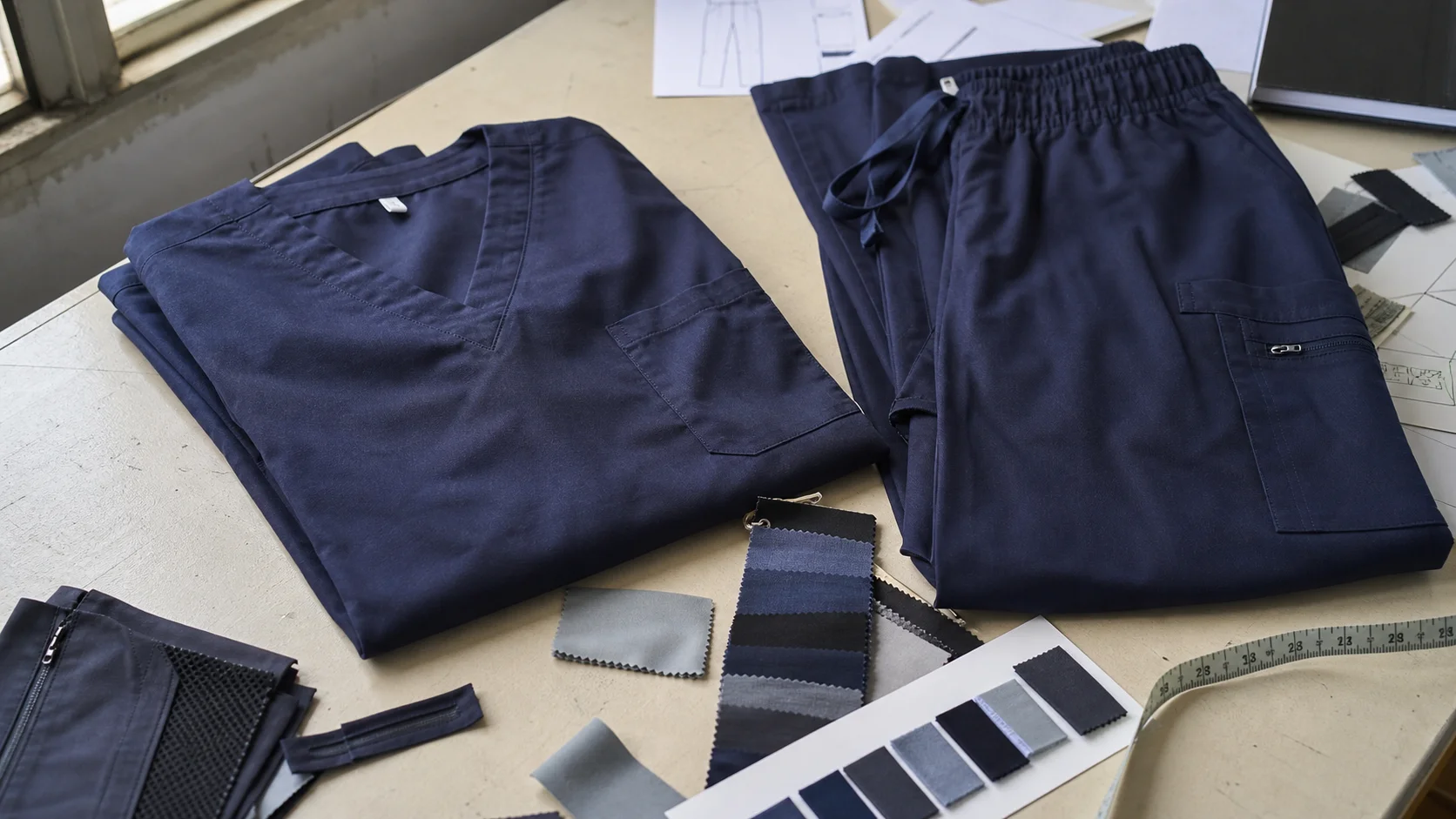
A buyer-focused outline for reviewing bulk scrubs size grading before sourcing uniforms for gym, wellness, recovery, or training staff programs.
Bulk Scrubs Size Grading Review for Buyers - Fabrikn production reference
Bulk scrubs size grading is not just a technical pattern issue. For gym program buyers, wellness operators, recovery centers, training academies, and staff uniform managers, it directly affects wearer satisfaction, repeat ordering, returns, and total program cost. A scrub set that looks acceptable on one fit model can fail across the actual size range if grading is loose, inconsistent, or copied from a different garment category.
The phrase “scrubs” often suggests medical apparel, but many gym and wellness programs now use scrub-inspired uniforms for staff in recovery lounges, physiotherapy areas, massage zones, spa services, nutrition clinics, and hygiene-sensitive training spaces. These garments need a cleaner look than casual activewear, but they also need more mobility than rigid medical uniforms. That combination makes size grading more important, not less.
In bulk programs, one bad size grade can create a chain reaction. Medium may fit well, large may become too boxy, extra-large may pull at the hip, and smaller sizes may lose shoulder mobility. Buyers then face complaints that sound subjective: “the top feels short,” “the pants twist,” “the waist is tight,” or “the same size fits differently than last order.” Many of these problems begin with grading rules, fabric behavior, and size-ratio planning.
A practical buyer should review size grading before confirming bulk production, especially when ordering for a mixed staff group. Gym program teams often include coaches, front-desk staff, therapists, cleaners, nutrition staff, and recovery specialists. Their body types, movement patterns, and fit expectations vary. A tight “fashion” scrub may look sharp in a showroom but fail when staff bend, squat, reach, clean equipment, or assist clients.
Buying judgment: a scrub uniform program should be graded for the real work environment, not only for a catalog photo. The best size chart is one that reduces complaints across the full team, even if it is less dramatic in styling.
Before comparing factories, quotations, or MOQ options, buyers should define how the scrubs will be used. Size grading depends on the intended fit, fabric stretch, garment function, and employee movement. A recovery-room attendant and a strength coach may both wear a scrub-style top, but their mobility needs are not identical.
Start with the program type. Are the scrubs for front-of-house wellness staff, physical therapy assistants, spa technicians, cleaning teams, sports medicine professionals, or a mixed gym staff uniform? A single pattern may work across several roles, but only if the grading allows enough ease at the chest, shoulder, hip, thigh, and rise.
Next, define whether the buyer needs unisex, men’s, women’s, or gender-neutral fits. Unisex scrubs can simplify purchasing and inventory, especially at lower MOQs, but they often create fit compromises. Women’s fits may improve hip and bust shaping, while men’s fits may require broader shoulder and longer rise planning. Gender-neutral patterns can work well when the design is intentionally developed with modern proportions rather than simply relabeled as unisex.
Buyers should also clarify whether the program needs tops only, pants only, or full sets. Full sets are more complex because top and bottom size demand rarely matches perfectly. A staff member may wear medium top and large pants, or large top and medium pants. If the factory requires fixed sets, the buyer may carry dead stock in unwanted combinations.
Buyers looking for custom uniform development may review manufacturing and sourcing support through Fabrikn services. A structured development process is especially useful when size grading, fabric selection, and production MOQ need to be balanced before purchase orders are placed.
Size grading is the process of increasing or decreasing a base pattern into other sizes. In bulk scrubs, the base size is often medium for unisex, medium or large for men’s, and small or medium for women’s. The grade rules determine how much measurement changes between each size.
For example, a top may increase by 2 inches around the chest between sizes, while the shoulder may increase by 0.5 inch and the body length by 0.75 inch. Pants may increase at the waist, hip, thigh, inseam, rise, and leg opening. The challenge is that bodies do not scale evenly. A simple “add the same amount everywhere” approach can make larger sizes too long, too wide, or too distorted.
Scrub sizing also has a special issue: the garment needs functional ease. A finished chest measurement is not the same as body chest measurement. If the wearer has a 40-inch chest, the garment may need 4 to 6 inches of ease depending on fabric, style, and work activity. Stretch fabric may need less ease than rigid woven fabric, but scrubs should not rely entirely on stretch to solve poor grading.
Buyers should avoid approving only the middle size. A production-ready size grading review should include at least one base size, one small size, and one extended size. If budget allows, review the smallest and largest sizes in the planned range. Fit problems often hide at the edges of the size chart.
Size ratio is the distribution of units across sizes. A typical ratio for a general adult bulk scrub order may concentrate around M, L, and XL. For example, a 500-unit top order might be split across XS, S, M, L, XL, 2XL, and 3XL, with the highest quantities in M through XL. That said, gym staff demographics can differ widely. A strength-focused program may need more XL and 2XL. A spa or wellness front-desk program may skew toward S and M. A student academy may require broader variation.
Using a generic size ratio is convenient but risky. Buyers should collect staff size data where possible. If exact staff sizing is not available, review previous uniform issue records, return data, or employee self-report forms. For first-time programs, it is safer to place a balanced initial order and reserve budget for replenishment after the first wear cycle.
Gym program scrubs sit between medical utility and active uniform design. The garment should look clean, hold its shape, and allow movement. A buyer should not accept a scrub pattern that restricts reaching, pulling, bending, or sitting, because staff will notice immediately.
For tops, the most important fit points are shoulder width, armhole depth, sleeve opening, chest ease, sweep, and body length. A top that is too narrow across the back can restrict arm movement. A low armhole may feel relaxed when standing but awkward when reaching. A short body length may ride up when staff bend or assist clients. A wide sweep can look sloppy if the program wants a sharper wellness aesthetic.
For pants, the critical measurements are waist, hip, front rise, back rise, thigh, knee, inseam, and leg opening. Gym and recovery staff often bend and squat more than hospital administrators or reception teams. The back rise must provide coverage, and the thigh must have enough room for movement. A narrow jogger-style scrub pant can work if the fabric has stretch and the knee is graded correctly. Without enough ease, the pant may pull across the seat and thigh.
Fit also depends on styling. V-neck tops, mock-wrap tops, mandarin collar tops, and zip-front tops all grade differently. Jogger pants, straight-leg pants, cargo pants, and tapered pants require different leg opening and knee rules. A buyer should not assume one size chart can be applied to every scrub design without adjustment.
Fabric selection has a direct effect on size grading. A rigid woven scrub fabric needs more wearing ease than a four-way stretch fabric. A polyester-rich fabric may hold dimensions better after washing, while a cotton-rich blend may feel comfortable but shrink more if not controlled. Rayon or viscose blends can drape well, but they may require careful shrinkage testing and seam stability review.
Common scrub fabric options include polyester-cotton twill, polyester-rayon-spandex blends, nylon-spandex performance woven, and polyester-spandex stretch fabric. For gym and wellness programs, stretch blends are usually more practical because staff need mobility. The tradeoff is that stretch fabrics can cost more, show seam puckering if poorly sewn, and require better elastic recovery testing.
Buyers should request fabric specifications before sample approval. Useful specs include fiber content, fabric weight, width, stretch percentage, recovery percentage, shrinkage after wash, colorfastness, pilling rating, and care instructions. For gym programs, moisture management may matter, but claims like “antimicrobial,” “odor resistant,” or “quick dry” should be supported by test standards if they are used in marketing or staff-facing documentation.
Shrinkage is a key grading risk. If a scrub top shrinks 3% in length after washing, a 29-inch body length can lose nearly 0.9 inch. That may be acceptable in one style but unacceptable in a shorter top. If pants shrink in inseam, staff may complain after the first laundry cycle. Buyers should ask whether the factory’s measurements are before wash or after wash. A responsible specification should state the measurement condition clearly.
Purchasing judgment: do not approve final grading on unwashed samples if the bulk order will be industrially washed, heavily laundered, or worn in sweat-prone gym environments. Wash testing is cheaper than replacing a full uniform issue.
MOQ is one of the biggest sourcing constraints in bulk scrubs. Factories may quote different minimums depending on whether the order uses stock fabric, custom-dyed fabric, custom trims, separate men’s and women’s patterns, extended sizes, or special packaging. Size grading can increase cost because it adds pattern work, sample sets, cutting complexity, and inventory variation.
Typical MOQ ranges vary by supplier and product complexity. For stock fabric scrubs with basic branding, some suppliers may support around 100 to 300 sets per color. For custom colors or custom fabric, buyers may see 500 to 1,000 sets per color, especially if fabric dyeing is required. For fully custom development with multiple fits, contrast trims, private labels, and extended size ranges, MOQ can move higher. These are typical planning ranges, not guaranteed terms.
Small gym programs often want many sizes, multiple colors, and low unit quantities. This combination is difficult. A buyer asking for 80 sets across three colors, ten sizes, two fits, and custom-dyed fabric may receive high pricing or supplier pushback. The practical path is to reduce complexity: choose one core color, use stock fabric, limit trim variation, and start with the most necessary size range.
Size grading also affects marker efficiency. In cutting production, the factory lays pattern pieces onto fabric markers. A balanced size ratio can improve fabric utilization. An order with many extreme sizes, very few middle sizes, or separate short runs may waste more fabric and raise cost. Extended sizes may carry surcharge because they consume more fabric and require separate inspection attention.
Buyers should also consider the cost of size exchanges. A slightly higher development cost for better grading may save money if it reduces returns, staff dissatisfaction, and urgent reorder freight. The cheapest unit price is not always the cheapest program cost.
A reliable bulk scrubs program should move through structured sample approval. Skipping this process may save a few weeks at the start but creates larger risk during production. The goal is not to chase endless revisions. The goal is to approve a clear, measurable standard that the factory can reproduce.
For gym program buyers, a short wear test is valuable. Staff should wear the sample during normal tasks: reaching for supplies, bending to clean equipment, walking, sitting, assisting clients, and laundering after use. Feedback should be structured rather than casual. Ask testers about shoulder mobility, waistband comfort, pocket position, heat retention, fabric noise, and whether the garment still looks professional after movement.
Wear testing should not become an open-ended design committee. Too many subjective comments can delay production and confuse the supplier. Buyers should separate fit defects from preference comments. A tight thigh during squatting is a functional issue. A preference for a different neckline may be a style issue. Both matter, but they should not be treated the same way in approval decisions.
For branding, test the logo method on the real fabric. Embroidery can distort lightweight stretch fabric if backing and stitch density are not controlled. Heat transfers can crack, peel, or feel stiff if the wrong transfer is used. Woven patches add perceived value but can irritate if placed poorly. Logo placement should be measured from fixed garment points, not estimated visually.
Lead time depends on fabric availability, sample rounds, color approval, trim sourcing, factory capacity, order quantity, and inspection schedule. Buyers should be cautious with suppliers promising unusually fast custom production without explaining what is already in stock and what still needs development.
For simple stock-fabric scrub programs, production may take roughly 3 to 6 weeks after final sample and deposit, depending on quantity and factory schedule. For custom fabric, custom dye, extended sizing, or multi-fit programs, 6 to 12 weeks is more realistic. Shipping, customs, and local distribution add more time. Air freight can rescue urgent launches but may erase cost savings.
Lead time begins after approvals are complete, not after the first conversation. Delayed feedback on samples, late logo files, unclear size ratios, and changing color choices can push the schedule. Buyers should lock the size chart, artwork, label content, care instructions, packaging method, and purchase quantity before production starts.
Buyers comparing sourcing models can use Fabrikn’s company information to understand how sourcing support, production coordination, and apparel development context may fit a bulk uniform program. The key is not only finding a factory. The buyer needs a process that controls specifications before cost and delivery problems appear.
Inspection for bulk scrubs should cover more than visible defects. Since size grading is central to the order, measurement inspection is essential. A shipment can look clean but still fail if the medium and large sizes are outside tolerance or if left and right legs do not match.
Measurement tolerance should be agreed before production. Common apparel tolerances may range from plus or minus 0.25 inch on small points to plus or minus 0.75 inch on larger body measurements, depending on the garment area and product type. Scrubs with elastic waistbands need both relaxed and extended waistband measurements. Stretch fabrics need careful handling during measurement because pulling the garment can create false results.
Carton packing also matters. If a gym chain distributes uniforms to multiple locations, incorrect size packing can create operational problems. Buyers should request a packing list by size, color, and destination. For staff issue programs, individual name packing may be useful, but it increases labor cost and requires accurate staff data.
Inspection should ideally happen before final shipment. Once goods arrive with size defects, the buyer has fewer options. Rework may be expensive, replacements may take weeks, and staff launch dates may be missed. A pre-shipment inspection cannot guarantee perfection, but it reduces the probability of avoidable defects.
The best purchasing decision depends on order size, timeline, fit expectations, and budget. Buyers should be honest about constraints. A low-MOQ order with custom grading, multiple colors, extended sizes, and premium fabric is possible only if the supplier has flexible development capacity or if the buyer accepts higher unit cost.
For smaller gym programs, the practical choice is often stock fabric with custom branding and limited styling changes. This keeps MOQ and lead time manageable. The tradeoff is less control over fit and grading. Buyers should still request a size chart, measure samples, and test at least the key sizes before ordering.
For mid-sized programs, a custom style in stock fabric can be the strongest option. It gives better control over pocket layout, neckline, waistband, and staff fit without triggering the cost of custom fabric dyeing. This route works well when the buyer needs a branded scrub uniform that looks specific to the gym but does not require a proprietary textile.
For larger gym chains or wellness networks, custom grading is worth serious attention. Separate men’s and women’s fits, extended size validation, and structured replenishment planning can improve long-term uniform performance. The upfront development cost may be higher, but the program becomes easier to repeat if specifications are documented properly.
Buyers should also ask suppliers how reorders are handled. If the first production uses a fabric that later becomes unavailable, color and handfeel may change. If patterns are not archived correctly, the second order may fit differently. Reorder consistency is a major part of sourcing quality, especially for programs that issue uniforms to new staff throughout the year.
For buyers ready to discuss a custom scrub or uniform sourcing brief, the next practical step is to prepare target size range, quantity by size, fabric preference, branding method, launch date, and inspection requirements. A clear brief usually receives a better quote than a vague request for “bulk scrubs.” Buyers can start a sourcing conversation through the Fabrikn contact page.
Before confirming a bulk scrubs purchase order, review the program as a whole. Size grading cannot be judged separately from fabric, MOQ, fit, branding, and inspection. A buyer who controls these points early will usually have fewer problems at delivery.
Checklist Item Buyer Status Why It Matters Target wearer roles defined Required Movement and fit needs vary by role. Size range confirmed Required Prevents missing sizes and poor ratio planning. Top and pant ratio reviewed Required Reduces dead stock and exchange pressure. Fabric specs received Required Stretch, shrinkage, and recovery affect fit. Size set sampled Strongly recommended Confirms grading beyond the base size. Wash test completed Strongly recommended Identifies shrinkage and color issues before bulk. Logo method tested Required for branded orders Prevents puckering, peeling, and placement errors. Inspection tolerances documented Required Creates an objective quality standard.Bulk scrubs size grading review is a purchasing discipline. It helps buyers avoid overbuying, underfitting, and approving garments that look fine only in the sample size. For gym program buyers, the right grading decision supports staff comfort, brand consistency, and smoother replenishment. A lower quoted unit price may be attractive, but a uniform program succeeds when the garments fit the team, survive washing, and arrive in the right sizes at the right time.
Get a free quote from Fabrikn — your trusted B2B clothing manufacturer with 10+ years of experience. MOQ as low as 200 pieces.
Get a Free Quote →Size grading is the process of scaling a base scrub pattern into smaller and larger sizes. It controls how chest, waist, hip, shoulder, rise, inseam, thigh, and length measurements change across the size range. Good grading keeps fit consistent from small sizes to extended sizes.
Gym and wellness staff move more than many traditional office uniform wearers. They bend, reach, clean equipment, assist clients, and may work long shifts. Poor grading can restrict movement, cause waistband discomfort, create seam stress, and increase exchanges after uniforms are issued.
Typical MOQ can range from about 100 to 300 sets per color for custom scrubs using stock fabric. Custom colors, custom trims, multiple fits, or extended sizes may push MOQ toward 500 to 1,000 sets or more. Exact MOQ depends on supplier capacity, fabric source, and development complexity.
Unisex scrubs simplify inventory and can work for lower-MOQ programs, but they often compromise fit. Separate fits usually improve comfort and appearance, especially across broad staff groups. The tradeoff is higher development cost, more SKUs, and more complex size-ratio planning.
At minimum, buyers should approve a fit sample and a pre-production sample. For broader size ranges, a size set is strongly recommended. A good size set includes the base size plus at least one smaller and one larger size, with extended sizes checked when they are part of the order.
Stretch woven fabrics such as polyester-spandex, nylon-spandex, or poly-rayon-spandex blends are often practical for gym and wellness environments. They support movement and a cleaner fit. Buyers should still test shrinkage, recovery, pilling, colorfastness, and wash performance before approving bulk production.
Yes. The strongest cost-control options are using stock fabric, limiting color choices, reducing unnecessary trim complexity, and collecting accurate size data before ordering. Cutting sample review too aggressively is usually a poor saving, because fit issues can cost more after delivery.
The main risks include incorrect size labels, inconsistent measurements, poor elastic recovery, seam stress, pocket placement errors, shade mismatch between tops and pants, logo defects, and shrinkage after washing. Measurement checks and wash tests should be part of the quality plan.
Fixed sets are simpler for packing and purchasing, but they can create fit problems because many wearers need different top and pant sizes. Separate top and pant ordering gives better fit flexibility and can reduce exchanges, though it requires more inventory management.
Buyers should contact a sourcing partner before finalizing the size chart, fabric choice, and MOQ assumptions. Early review helps identify whether the program is better suited to stock scrubs, custom styling in stock fabric, or a fully developed custom scrub uniform.