
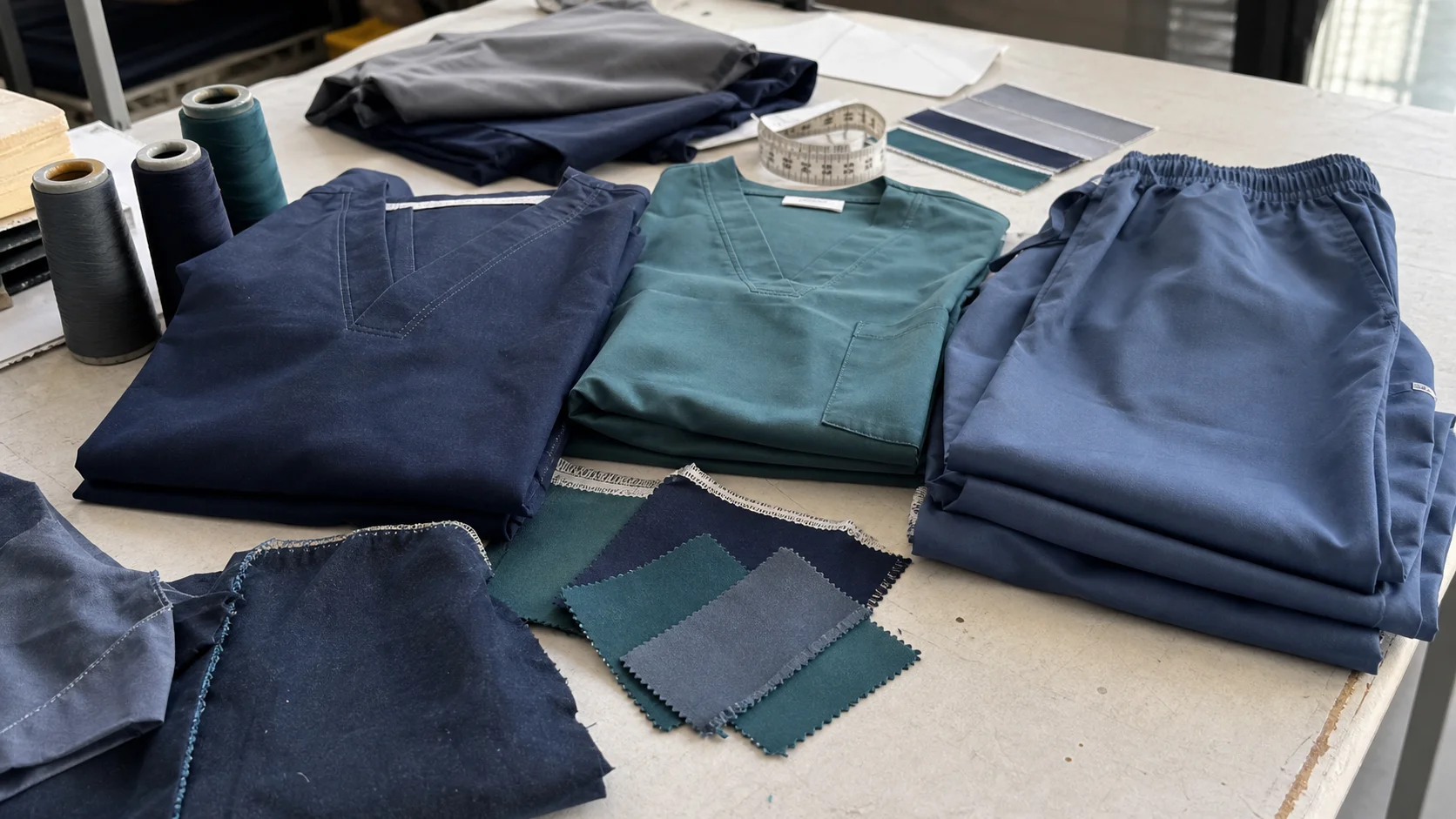
A detailed outline for healthcare apparel wholesalers evaluating bulk scrubs with size grading, covering fit consistency, grading specs, private label development, compliance details, and production planning for scalable uniform programs.
Bulk Scrubs With Size Grading for Wholesale Buyers - Fabrikn production reference
Bulk scrubs with size grading are a core product category for healthcare apparel wholesalers that need consistent fit, dependable replenishment, and scalable private label options. In practical sourcing terms, the challenge is not simply finding a factory that can sew scrub tops and pants. The real issue is finding a manufacturing partner that can grade patterns accurately across a full size range while keeping measurements, fabric behavior, and production quality under control.
For wholesale buyers, size grading affects sell-through, return rates, reorder confidence, and brand reputation. A scrub set that fits well in medium but loses proportion in larger or smaller sizes will create avoidable problems in institutional supply, retail resale, and uniform distribution programs. This is especially relevant in healthcare apparel, where users expect comfort during long shifts, freedom of movement, and reliable modesty across repeated laundering cycles.
Buyers developing private label healthcare uniforms should treat grading as a technical requirement, not a finishing detail. The grading rules used for neck width, shoulder slope, chest, hip, rise, thigh, inseam, and sleeve opening all influence how scrubs perform on the job. One weak point in the grade can distort the entire fit profile.
That is why experienced wholesale buyers usually ask deeper questions early: What base size is used for development? How many fit samples are reviewed before pre-production? Does the supplier grade straight sizing only, or can they support plus sizes, petite lengths, and tall inseams? Can they keep consistency across repeat orders if the same style is reordered six months later?
Scrub sourcing also sits at the intersection of cost control and wearability. Aggressive cost-cutting may reduce fabric weight, simplify pocket construction, or compress the grading review stage. Those shortcuts often create problems later. A lower FOB price can look attractive during quotation, but poor grading can be much more expensive once returns, size exchanges, and stock imbalances show up.
Wholesale buyers looking for tailored production support can review broader manufacturing capabilities on /services/. For supplier discussions tied to product development or order planning, the most useful approach is to arrive with a clear spec pack and a defined size architecture from the start.
Size grading is the process of scaling a base pattern into a complete size range. In scrubs, this matters more than many buyers first expect. Healthcare garments are functional uniforms, not occasional-wear fashion pieces. Users bend, lift, walk for extended hours, sit frequently, reach overhead, and carry tools in pockets. The fit needs to stay balanced through movement.
When grading is poorly handled, the problem rarely appears in one obvious place alone. A top may become too short in extended sizes, armholes may tighten disproportionately, pockets may sit too high or too low, or pants may gain width without enough rise adjustment. Those flaws are common when a supplier grades mechanically without reviewing how the garment actually wears on the body.
For wholesalers, proper grading supports several commercial outcomes:
There is also a planning advantage. Buyers who understand grading can build size assortments more intelligently. Instead of ordering a generic S-XL spread, they can allocate quantities based on actual end-market demand, then confirm that pattern grading supports those proportions.
In bulk scrub sourcing, a clean size chart is not enough. Buyers need confidence that the garment remains proportionate from the smallest to the largest size offered.
A large share of fit disputes start with incomplete technical briefs. Wholesale buyers often focus on style image, color, and logo placement first. Those details matter, but scrub manufacturing becomes far more predictable when the specification package includes grading-related instructions from the beginning.
At minimum, buyers should define:
Many scrub buyers also overlook labeling structure. If the program is private label, the supplier should know whether the order needs branded main labels, size pip labels, care labels, carton marks, UPC stickers, polybag warnings, and carton assortment labels. A factory may quote sewing capacity accurately but still delay production if trim and packaging details are incomplete.
Private label wholesalers that are still shaping their product brief can usually benefit from sharing development requirements early through /contact-us/. Early clarification reduces the chance of repeating samples because the grade rules were not aligned to the market goal.
In practical terms, grading begins with an approved base pattern, often built around a core size such as women’s medium or men’s large, depending on the brand strategy. From there, the pattern maker applies grade rules to expand or reduce dimensions across the size range.
For scrub tops, the most common graded points include:
For scrub pants, buyers should pay close attention to:
The point worth stressing is that grading is not just adding the same increment everywhere. A sensible grade rule reflects how bodies change through sizes and how fabric behaves in motion. A straight chest increment with no meaningful change to shoulder or armhole can create strain. A wider pant without rise adjustment may feel restrictive when sitting or bending.
Buyers should also ask whether extended sizes are derived from the same grade logic as core sizes or whether they receive adjusted fit engineering. In many categories, plus sizes need more than a linear extension. The same is true for petite and tall lengths, where inseam change alone may not be enough.
Scrub wholesalers often serve more than one channel. A distributor selling to hospitals may need broad, forgiving unisex fits. A private label reseller targeting clinics, dental groups, or specialty retail may want a more modern silhouette with stretch and shape retention. The fit block chosen for development should match that commercial position.
Common fit structures include:
The tradeoff is straightforward. A broad unisex block is easier to scale operationally and may reduce SKU count. It often sacrifices some fit precision for specific wearer groups. Gender-specific or body-specific blocks improve wearability but increase development time, pattern work, and inventory complexity.
That is not a reason to avoid them. It simply means the buyer should match the fit architecture to the sales model. If the wholesale program depends on repeat business and branded differentiation, a sharper fit strategy often pays off. If the program is price-led and intended for large institutional issue, simplicity may be the stronger commercial choice.
Fabric selection has a direct effect on grading performance. Two garments with the same measurement chart can wear very differently if one uses a rigid 65/35 polyester-cotton poplin and the other uses a polyester-rayon-spandex stretch twill. The more structured the fabric, the more precise grading and ease allocation need to be.
Typical scrub fabric options include:
Common fabric weights for scrubs often fall in a moderate range, roughly around 150 to 210 GSM depending on weave, blend, and end use. Lighter fabric can improve comfort in hot climates but may raise concerns around opacity and pocket sag. Heavier fabric can feel more durable but may reduce breathability and increase shipping weight.
Trim details also need purchasing judgment. Drawcord quality, elastic recovery, zipper specification, bartack density, and thread performance are not minor matters in healthcare garments. Low-grade elastic can lose recovery after repeated industrial or commercial washing. Weak bartacks can fail where tools or hands repeatedly stress pockets.
Wholesale buyers should ask for:
These details are especially important when the size range includes extended fits. Heavier wear zones and higher seam stress make construction discipline more important, not less.
A reliable sampling process is where strong scrub programs are usually won or lost. Buyers who only approve a single showroom sample often discover avoidable problems once bulk production begins. In graded apparel, one attractive sample is not enough proof of scale readiness.
A more dependable approval path usually includes the following steps:
The size set stage matters greatly for bulk scrubs with grading. Buyers do not always need every size sampled physically, but they should review enough of the range to catch proportion drift. A practical approach is to review the smallest core size, a base size, a larger core size, and at least one extended size if offered.
Measurement review should cover both flat specs and visual balance. A garment can pass the tape measure and still wear poorly if a pocket is placed awkwardly or if side vents scale badly across sizes. Buyers should also pay attention to the wash process. A scrub top that fits properly before wash may shorten too much after laundering if shrinkage was underestimated.
The most expensive mistake at this stage is rushing to bulk because a delivery deadline is tight. If the grading has not been checked in a size set, the risk transfers directly into inventory.
MOQ and lead time for wholesale scrubs vary by fabric availability, customization level, size range complexity, and whether the order uses stock materials or custom-dyed production. Buyers should expect lower MOQs for simpler programs and higher thresholds once private labeling, custom color, or broad grading ranges are added.
Typical MOQ patterns in the market often look like this:
Program Type Typical MOQ Range Notes Basic stock fabric scrub styles 300-800 pieces per style Often easier for core colors and simpler branding Private label scrubs with custom labels and packaging 500-1,500 pieces per style Depends on trim sourcing and fabric readiness Custom color or custom fabric development 1,000-3,000+ pieces per color or style Usually driven by dye lot and mill minimums Extended size programs with multiple inseams Higher effective MOQ due to SKU spread Small runs become harder to balance efficientlyLead times also depend on whether the supplier already has approved patterns and proven fabric sources for scrubs. A straightforward repeat order can move much faster than a first-time private label program. As a rough commercial guide:
Buyers should be cautious with broad promises on “fast delivery” if the size range is complex. Graded scrub orders with petite, tall, and plus extensions create more markers, more cutting complexity, and more packing variation. That does not make them impractical. It simply means planning should be more disciplined.
Inspection risks in bulk scrubs go beyond obvious sewing defects. In graded programs, the most costly issues often show up at the measurement and assortment level.
Common quality risks include:
Buyers should request an inspection plan that reflects these risks. In many cases, random finished-garment inspection is not enough unless measurements are checked by size. A sensible quality process often includes fabric inspection, inline sewing checks, measurement audits, pre-final review, and final random inspection based on approved specs and packing ratios.
One practical point stands out: size ratio packing errors can damage a wholesale order even when garment quality is acceptable. A buyer may receive the correct total unit count but the wrong size mix, which creates immediate fulfillment issues. That is why carton assortment verification deserves its own checkpoint.
For wholesalers, grading accuracy and packing accuracy are linked. If either fails, the order can become commercially difficult to use.
Private label scrubs remain attractive because healthcare buyers want product differentiation without taking on full manufacturing infrastructure. A well-structured private label program lets wholesalers control branding, fit profile, fabric positioning, packaging, and channel strategy while outsourcing production execution.
Bulk scrubs with size grading are especially well suited to private label because fit can become a defensible point of difference. Many scrub products compete on price alone. Buyers that invest in consistent grading, practical pocket layouts, and fabric selections matched to real clinical use can build a stronger offer.
Private label options may include:
The tradeoff is that private label requires tighter development discipline. Once the wholesaler’s name is on the garment, fit inconsistency becomes a brand problem rather than a supplier problem. That is why many buyers spend more time validating graded specs before scale-up.
Company background and broader manufacturing positioning can also help buyers understand whether a supplier is aligned with long-term private label development. For that context, see /about-us/.
Choosing a supplier for wholesale scrubs is not only about price per piece. Buyers should judge suppliers on their ability to manage pattern accuracy, material consistency, communication clarity, and repeat-order discipline. A low quote has limited value if the grade fails in extended sizes or if bulk measurements drift outside tolerance.
Useful supplier evaluation questions include:
It is also worth asking how many sample rounds are included before the factory treats revisions as redevelopment. Some suppliers quote attractive rates up front but leave key fitting work undefined. That tends to create cost creep later.
The strongest purchasing position comes from balancing four factors:
If one of those factors is weak, the order may still proceed, but the buyer should do so knowingly. In healthcare apparel, repeatability usually matters more than chasing the lowest initial price.
Bulk scrubs with size grading for healthcare apparel wholesalers require more technical control than many standard uniform products. The garment category looks simple on the surface, yet performance in the market depends on a chain of details: the base block, grade rules, fabric behavior, trim durability, size-set validation, packing accuracy, and repeat-order consistency.
For wholesale buyers, the smartest approach is to define fit architecture early, validate grading through samples rather than assumptions, and treat size integrity as a commercial issue as much as a technical one. Good grading protects margins, improves customer confidence, and strengthens private label value over time.
In short, a reliable scrub supplier should do more than cut and sew. They should help translate a size strategy into a scalable production program that works across core and extended ranges. Buyers who source that way usually gain better long-term results than those who purchase on price alone.
Get a free quote from Fabrikn — your trusted B2B clothing manufacturer with 10+ years of experience. MOQ as low as 200 pieces.
Get a Free Quote →Size grading means scaling an approved base scrub pattern into a complete size range using defined measurement increments. In wholesale scrubs, it affects chest, hip, rise, inseam, sleeve, shoulder, and other points that determine fit consistency across sizes.
Typical MOQs often start around 300 to 800 pieces per style for simpler scrub programs using available fabrics, while private label or custom fabric programs may run from 500 to 1,500 pieces or more. Final MOQ depends on style complexity, color count, trim customization, and size spread.
A practical process usually includes a proto sample, fit sample, size set review, and pre-production sample. Buyers with extended size ranges should strongly consider checking multiple sizes physically rather than approving only the base size.
There is no single best option for every buyer. Polyester-cotton blends are common for durability and easy care, while stretch blends can improve comfort and modern fit. The right choice depends on end use, price point, laundering conditions, and the expected feel of the garment.
Scrubs are workwear used through long shifts and repeated washing. If grading is off, users may experience tight armholes, short tops, restrictive rises, or poor pocket placement. For wholesalers, that often leads to returns, exchange pressure, and weaker reorder confidence.
Yes, but the program becomes more complex. Buyers should expect broader pattern work, more SKU management, and potentially higher effective MOQ because inventory is spread across more size and length combinations.
The main risks include inaccurate grading, measurement tolerance failures, shade variation, shrinkage after washing, weak pocket reinforcement, mislabeling, and incorrect size ratio packing. Those issues should be checked during sampling and final inspection.
The most practical steps are to provide a detailed tech pack, approve a clear graded size chart, review size set samples, confirm fabric performance after wash, and verify measurement tolerances before bulk shipment.