
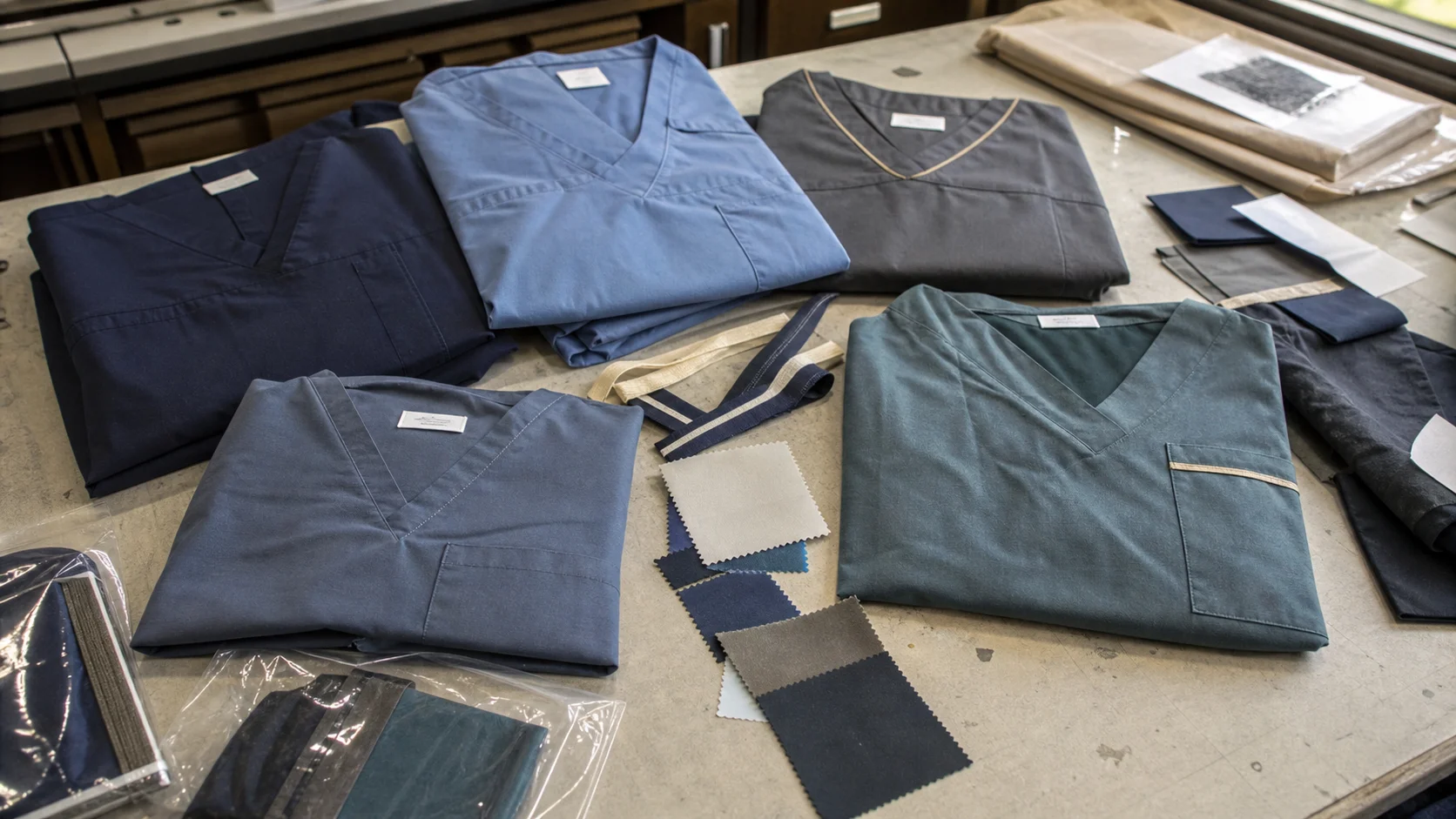
A quality-focused outline for hotel procurement teams reviewing bulk scrubs trim, including drawcords, pocketing, labels, zippers, elastic, snaps, and seam...
Scrubs Trim Sourcing Review for Hotel Buyers - Quality & Inspection manufacturing guide
Bulk scrubs trim sourcing is rarely the first issue hotel procurement teams discuss when planning spa, clinic, housekeeping, wellness, or back-of-house uniform programs. Fabric, color, silhouette, and price usually take priority. Trim decisions are often left to the supplier until the sample arrives. That is where avoidable quality problems begin.
For hotels, scrubs are not just medical-style workwear. They may be used by spa therapists, wellness staff, salon teams, housekeeping supervisors, laundry staff, maintenance teams, resort clinic employees, and cleaning contractors working on-property. The garment needs to look controlled, wash consistently, fit a wide staff base, and survive frequent commercial laundering. Trims decide whether that happens smoothly.
This sourcing review is written for hotel procurement teams buying scrubs in bulk, especially when coordinating across multiple properties, job roles, or operating departments. The focus is practical: drawcords, elastic, buttons, zippers, labels, pocketing, thread, snaps, badges, packaging, and other trim components that affect inspection, durability, comfort, and reorder consistency.
For broader uniform sourcing support, hotel buyers can review related production services at fabrikn.com/services/, company background at fabrikn.com/about-us/, or discuss project requirements through fabrikn.com/contact-us/.
Scrubs appear simple, but a bulk hotel order can expose weak trim decisions quickly. A drawcord that twists after washing, waistband elastic that relaxes early, pocket stitching that tears under daily use, or a label that irritates staff can create complaints long before the garment fabric fails.
Hotel uniform programs also have a visibility problem. Staff uniforms are reviewed by department heads, brand teams, HR, operations, laundry managers, and sometimes ownership. A small trim defect across 2,000 units becomes a brand presentation issue, not just a garment issue.
Trim quality affects five areas procurement teams should track:
A hotel buyer should not treat trims as minor accessories. In bulk scrubs production, trims are part of the garment engineering. Poor trim control can turn an otherwise acceptable uniform order into a costly replacement problem.
The first practical step is to identify every trim used in the scrub set. A top and pant may look basic, yet the bill of materials can include more than a dozen trim items. Each one should be specified, costed, sampled, and inspected.
Elastic is one of the highest-risk trims in scrub pants. Hotel staff may bend, lift, walk long distances, or work in warm conditions. Weak elastic creates poor fit and staff dissatisfaction. For bulk orders, buyers should request details on elastic width, composition, stretch ratio, recovery performance, and laundering tolerance.
Common waistband elastic widths for scrub pants range from around 25 mm to 40 mm. Wider elastic often improves comfort and stability, but it increases cost and may feel bulky if the waistband is not engineered correctly. A narrower elastic can reduce cost, yet it may roll or dig into the body during active work.
Drawcords may be functional, decorative, or both. For hotel scrubs, a functional drawcord is useful when staff sizing varies across departments. The buyer should confirm cord type, diameter, end finish, color matching, and whether the cord is tacked at the center back to prevent loss during laundering.
Flat drawcords are usually easier to tie and can look cleaner. Round cords can feel durable but may slip more easily. Plastic or metal cord tips may improve appearance, but they can add laundry risk if not secured properly. For commercial hotel laundering, simple sealed or bar-tacked ends are often safer than decorative hardware.
Buttons are less common on basic scrubs but may appear on fashion scrub tops, spa tunics, mock-wrap styles, or Mandarin-collar designs. Snaps may be used for modesty closures or shoulder openings. Buyers should check attachment strength and wash resistance.
For hotel environments, snaps can look neat but require careful quality control. Weak snap setting leads to loose components, fabric tearing, or closure failure. Metal snaps may also raise corrosion concerns if exposed to chemicals or high-humidity storage.
Zippers may be used in scrub pants, chest pockets, security pockets, or specialty utility garments. They add function but also introduce failure risk. Coil zippers are flexible and common for apparel. Metal zippers can look stronger but may be unnecessary for scrubs and can feel heavy.
Hotel procurement teams should confirm zipper length, tape color, slider type, puller style, and whether the zipper is from a nominated supplier or a generic source. A zipper pocket may be worth the added cost for maintenance or clinic staff, but it is often unnecessary for spa or housekeeping scrubs.
Pockets are heavily used in hotel workwear. Staff may carry keys, pens, small tools, room cards, radios, gloves, or notepads. Scrub pocket trims include pocket bags, binding, bartacks, reinforcement tape, and sometimes hidden compartments.
The key point is not simply the number of pockets. It is pocket construction. A patch pocket with weak top corners will fail quickly. Buyers should specify bartacks at stress points, pocket opening shape, and pocket depth. Pocket placement should also be reviewed on real-size samples, not just a technical drawing.
Thread is often overlooked because it is not visible as a separate trim in costing discussions. It is still a trim and should be controlled. Polyester thread is common for scrubs because of its strength and wash resistance. Cotton thread may not be suitable for many commercial laundering programs.
Buyers should confirm thread color matching, seam type, stitch density, and whether contrast stitching is intentional. A thread shade that looks acceptable on one sample can look inconsistent across bulk if the supplier does not lock the shade reference.
Labels include main brand labels, size labels, care labels, country-of-origin labels, department identifiers, RFID labels, barcode stickers, and packaging labels. Hotel buyers should confirm what is legally required in the destination market and what is operationally required by internal uniform tracking systems.
Woven labels look premium but can irritate skin if placed poorly. Printed heat-transfer labels reduce bulk and improve comfort, but they must be tested for wash durability. Care labels should remain readable after repeated laundering. If a hotel uses centralized laundry, barcode or RFID solutions may be worth reviewing, but they add cost and require system compatibility.
Logo application is sometimes treated as decoration rather than trim, but procurement should include it in the trim review. Embroidery backing can scratch skin. Patch edges can curl. Heat transfers can crack if the wrong film is used. Placement inconsistency can make uniforms look uneven across staff.
For hotel scrubs, embroidery is usually durable and brand-appropriate, but it can add lead time and sampling rounds. Heat transfer branding may be cleaner for lightweight fabrics, though it must pass wash testing. A removable name badge may be more flexible than embroidered names when staff turnover is high.
Bulk scrubs trim sourcing should begin with a controlled bill of materials. The buyer should not rely on vague terms such as “standard elastic,” “matching drawcord,” or “normal label.” Those phrases leave room for supplier substitution.
A practical trim specification should include:
For hotel procurement teams, the best approach is to combine visual approval with measurable criteria. A drawcord photo is helpful, but a photo cannot confirm cord diameter, tensile strength, shrinkage, or colorfastness. A label mockup is useful, but it does not prove wash durability or legal compliance.
Trim Item Key Specification Procurement Risk Buyer Judgment Waistband elastic Width, stretch, recovery, composition Rolling, relaxation, poor fit Do not reduce width purely to save cost if staff mobility is high. Drawcord Shape, diameter, color, end finish Loss in laundry, fraying, shade mismatch Center-back tacking is often worth the small production effort. Zipper Type, length, tape color, slider quality Jamming, broken pullers, inconsistent shade Use zippers only where the function justifies inspection risk. Labels Content, placement, material, print durability Discomfort, legal errors, unreadable care text Approve both artwork and physical label quality before bulk. Thread Type, count, color, stitch density Seam failure, puckering, shade inconsistency Thread should be part of the BOM, not left unspecified.MOQ planning is one of the main reasons hotel buyers should review trims early. A scrub garment factory may accept a moderate apparel MOQ, but trim suppliers often have their own minimums. Those minimums can affect cost, color choice, delivery timing, and reorder strategy.
Typical ranges vary by supplier and market, but hotel procurement teams can use the following as planning benchmarks:
These ranges are not fixed rules. They are practical planning signals. A 600-set hotel scrub order can become inefficient if every trim is custom dyed, logoed, or uniquely packaged. A 5,000-set program can support more customization because trim MOQs are spread across a larger quantity.
Hotel buyers should be direct about the tradeoff. If the order is small or medium-sized, use stock trims where they do not harm brand presentation or durability. If the order supports a long-term program with repeat replenishment, custom trims may be worthwhile because they improve consistency and brand control.
Sampling should not be reduced to “approve the garment look.” Trim approval needs its own checklist. A sample can look correct at first review but fail after washing, stretching, or wear testing.
The development sample confirms silhouette, general construction, pocket layout, trim direction, and comfort. At this stage, trims may be close substitutes if final bulk trims are not ready. The buyer should clearly mark any substitute trim and require final trim approval later.
The fit sample should use trim dimensions close to bulk production. Elastic width, waistband height, drawcord placement, pocket depth, and label positioning all affect fit and comfort. Procurement teams should involve department representatives when possible, especially if scrubs are used by active staff.
A size set helps confirm that trim grading works across sizes. Waist elastic and drawcord length should not be copied poorly from one size to another. A small size with too much drawcord looks untidy. A larger size with short drawcords creates function problems.
The pre-production sample should use actual bulk fabric and actual bulk trims. This is the critical approval stage. Buyers should compare every trim against the bill of materials: elastic, drawcord, labels, thread, pocket reinforcements, closures, packaging stickers, and logo applications.
At minimum, procurement teams should request wash testing aligned with the intended care method. Hotel laundry conditions can be harsher than home washing. If the scrubs will be commercially laundered, the supplier should know wash temperature, drying method, chemical exposure, and expected cycle count.
A simple but useful review includes measuring shrinkage, checking elastic recovery, inspecting label readability, reviewing drawcord twisting, and checking seam puckering after washing. For high-volume programs, third-party lab testing may be justified.
Scrubs lead time depends on more than sewing capacity. Trim sourcing can delay production when buyers approve the garment style but leave labels, drawcords, or logo components unresolved.
Common lead-time dependencies include:
For planning, a straightforward stock-trim scrub order may move faster than a heavily branded program. Typical production lead times for bulk scrubs may range from about 30 to 60 days after final approval, depending on quantity, fabric availability, trim availability, factory capacity, and inspection requirements. Custom trims, lab testing, or multi-property packaging can extend the timeline.
The safest procurement practice is to approve trims before cutting bulk fabric. If trims arrive late, factories may cut and hold panels, but this creates scheduling pressure and can increase the risk of mismatched components or rushed finishing.
Trim inspection should be built into incoming material checks, in-line production checks, and final random inspection. Waiting until final inspection can catch the problem, but it may be too late to correct without rework.
Incoming inspection verifies that trims received by the factory match the approved standard. Buyers should expect the factory to check quantity, shade, size, defects, and basic function before production starts.
Important incoming checks include:
In-line checks confirm that trims are being applied correctly. A trim can be approved but still sewn incorrectly. Common issues include wrong label placement, uneven drawcord exits, twisted elastic, missing bartacks, loose button attachment, skipped stitching, and incorrect pocket placement.
Hotel buyers should ask for production photos or inspection reports at defined points, especially on larger programs. This is not a replacement for formal inspection, but it can catch obvious problems before hundreds of units are completed.
Final inspection should review both garment appearance and trim function. Inspectors should check a statistically relevant sample based on the agreed AQL level. Many apparel inspections use general inspection levels and AQL thresholds such as 2.5 for major defects and 4.0 for minor defects, but the final standard should be agreed before production.
Trim-related final inspection risks include:
Procurement teams should define critical defects before inspection. For example, a missing legal care label may be more serious than a slightly off-center internal label. A broken zipper on a security pocket may be major. A loose decorative thread may be minor. Clear classification avoids disputes when inspection results are reviewed.
Different hotel departments need different scrub trim decisions. A single standard scrub set can simplify procurement, but it may not serve every use case equally well.
Spa scrubs should feel soft, quiet, and polished. Trims should avoid bulk and scratchiness. Heat-transfer neck labels may improve comfort. Drawcords should be neat and color-matched. Large utility pockets may not be necessary unless staff carry tools or treatment items.
Brand presentation matters in guest-facing spa environments. A subtle embroidered logo or woven side tab can look professional, but the backing should not irritate the wearer. Premium trims may be justified here because guests see the uniform closely.
Housekeeping scrubs need durability and ease of laundering. Elastic recovery, pocket reinforcement, and seam strength are more important than decorative trims. Staff may carry keys, cleaning cards, gloves, and small tools, so pockets should be tested for load and placement.
For laundry teams, trims should tolerate heat and repeated wash cycles. Decorative hardware should be avoided unless necessary. A robust care label and clear size identification can help with sorting and reissue.
Medical or first-aid teams may need more functional pockets, pen slots, ID badge loops, or antimicrobial fabric claims. Any performance claim should be verified and not treated as a trim decision alone. If the garment includes badge loops or utility tabs, attachment strength should be checked.
Color coding may be useful for role identification. In that case, trim shade control matters because the trim can undermine the visual system if it shifts between orders.
Maintenance staff may not use classic scrubs, but some hotels choose scrub-style sets for comfort in warm climates or indoor service areas. Utility trims such as reinforced pockets, key loops, and zipper compartments may be useful. The tradeoff is higher cost and more inspection points.
Procurement should avoid overbuilding the garment if the role does not require it. Every zipper, snap, loop, and pocket adds cost and another possible failure point.
Trim savings can be attractive in a competitive tender, but the cheapest trim choice is not always the lowest-cost decision over the uniform life cycle. Hotel procurement teams should compare unit price against replacement rate, staff complaints, laundry performance, and reorder control.
The best purchasing judgment is to spend money where trims support durability, comfort, and operational control. Spend less where trims are decorative, invisible, or not meaningful to the wearer or hotel brand.
Trim sourcing cannot be separated from fabric selection. A lightweight stretch scrub fabric behaves differently from a heavier polyester-cotton twill. The wrong trim can distort the garment or reduce comfort.
Common scrub fabrics include polyester-cotton blends, polyester-rayon blends, cotton-rich blends, mechanical stretch fabrics, and spandex-containing stretch fabrics. Each fabric type has implications for trim selection.
Procurement teams should request a complete fabric and trim compatibility review before approving bulk. If the scrub includes stretch fabric, confirm whether the thread and seam construction allow movement. If the scrub includes embroidery, review puckering after wash. If the garment uses heat-transfer labels, test them on the exact fabric quality used for bulk production.
Packaging is part of trim sourcing in bulk hotel orders. It affects receiving, allocation, inventory control, and staff distribution. A garment can pass quality inspection but still cause operational problems if packaging is poorly planned.
Hotel buyers should confirm whether scrubs are packed by set, by garment type, by size, by department, by property, or by employee allocation. Each method has tradeoffs.
Packaging Method Best Use Risk Procurement View Individual garment polybag Large central inventory More sorting required Flexible for replenishment but slower for initial issue. Top and pant packed as set Quick staff distribution Size mismatch if staff need different top and pant sizes Useful only when size pairing is predictable. Department allocation pack Multi-department rollout Labeling errors can disrupt receiving Good for openings and rebrands if data is accurate. Property-specific cartons Group hotel programs Higher packing complexity Worth considering when shipping to multiple locations.Size stickers, carton labels, barcode stickers, and packing lists must be checked like any other trim. Incorrect packaging data can create costly manual sorting, especially when a hotel group is distributing uniforms across several properties.
Before issuing a purchase order, hotel procurement teams should ask trim-specific questions. These questions help expose whether the supplier has real control over the bill of materials or is relying on last-minute sourcing.
A supplier that cannot answer these questions may still be able to produce simple scrubs, but the risk increases for hotel programs with multiple sizes, colors, departments, or properties. Procurement teams should require written confirmation, not just verbal assurance.
A checklist helps keep approval disciplined. It also gives internal stakeholders a clear way to review the garment before production starts.
Approval Area What to Check Who Should Review Comfort trims Elastic feel, label placement, drawcord handling Procurement, HR, department users Brand trims Logo size, placement, color, label artwork Brand team, procurement Functional trims Pockets, zippers, snaps, badge loops, bartacks Operations, department managers Laundry trims Elastic recovery, label readability, colorfastness Laundry manager, supplier QC Packaging trims Stickers, barcodes, carton marks, allocation labels Procurement, warehouse, receiving teamThis checklist should be attached to the purchase file with approved samples, shade references, technical drawings, and inspection requirements. For repeat programs, keeping the approved trim library is one of the best ways to avoid drift between orders.
Bulk scrubs trim sourcing is a practical quality-control issue, not a design detail to settle late in production. Hotel procurement teams should treat trims as part of the uniform specification from the first RFQ. That means asking for the bill of materials, reviewing MOQs, approving real bulk trims, testing laundry performance, and defining inspection standards before the order is cut.
The most reliable buying strategy is not to customize every trim. It is to customize only where the hotel gains value: brand consistency, wearer comfort, operational identification, or garment durability. Stock trims are often the better choice for smaller orders, fast replenishment, or departments where function matters more than decoration.
For large hotel groups, trim discipline supports long-term uniform control. The same elastic, label, drawcord, thread, and packaging standard can be repeated across purchase cycles. That reduces disputes, improves inspection outcomes, and makes reordering more predictable.
Hotel buyers reviewing scrub programs should insist on clear specifications, actual pre-production samples, documented trim approvals, and realistic lead times. These steps are not excessive. They are the difference between a uniform that looks acceptable in a sample room and one that performs across daily hotel operations.
Get a free quote from Fabrikn — your trusted B2B clothing manufacturer with 10+ years of experience. MOQ as low as 200 pieces.
Get a Free Quote →Start with waistband elastic, drawcords, labels, thread, pocket reinforcement, and any logo application. These trims affect comfort, laundering, durability, and brand consistency. Zippers, snaps, RFID labels, and special packaging should be reviewed if they are part of the program.
Typical MOQs vary by supplier and trim type. Woven labels may start around 1,000 to 5,000 pieces. Custom drawcords or dyed elastic may require 1,000 to 3,000 meters or more. Custom buttons, snaps, and logo hardware can require several thousand pieces. Buyers should confirm trim MOQs before approving designs.
Use custom trims when they improve brand control, reorder consistency, or operational function. Use stock trims when the order is smaller, timing is tight, or the custom detail does not add meaningful value. Stock trims can be a better purchasing decision if they are durable, available, and visually acceptable.
Trims should be checked on the pre-production sample using actual bulk fabric. Recommended checks include wash testing, elastic recovery review, drawcord security, label readability, logo durability, pocket stress points, zipper function, and snap or button attachment strength.
Custom trims often need artwork approval, color matching, lab dips, strike-offs, production time, and delivery to the garment factory. Logo labels, embroidery, RFID tags, and special packaging can add extra coordination. Late trim approval can delay cutting, sewing, finishing, and final inspection.
Common defects include missing labels, wrong size labels, twisted elastic, uneven drawcords, weak pocket bartacks, broken zipper sliders, loose buttons or snaps, unreadable care labels, logo placement errors, and mismatched packaging stickers.
Heat-transfer labels can be suitable when comfort is important, especially at the neck or waistband. They should be tested on the exact bulk fabric and wash method. Poor-quality transfers can crack, peel, fade, or become unreadable after repeated laundering.
A scrub trim BOM should list every trim item, material, size, color reference, placement, supplier, application method, performance requirement, and packaging detail. It should include thread, labels, elastic, drawcords, pocket reinforcements, closures, logo applications, stickers, and carton labels.