
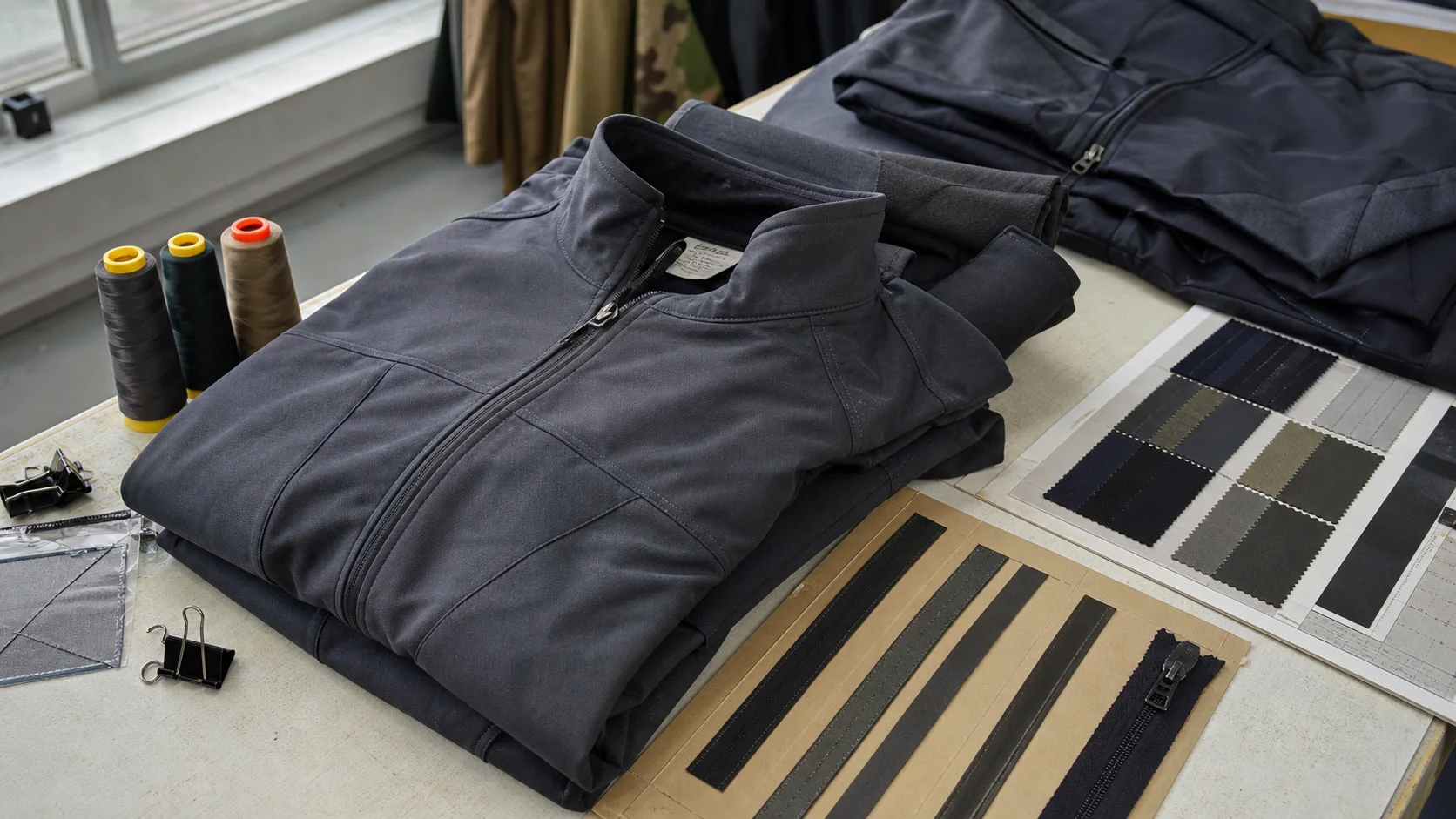
A production control brief for security contractors ordering bulk softshell jackets, covering fabric specs, branding, fit, weather performance, QA...
Security contractors buy softshell jackets for a simple reason: the garment has to work in the field, hold up to repeated wear, and present a consistent team image. A weak QC brief turns that into a margin problem fast. One batch may fit differently from the next, reflective trim may peel, logos may distort, or water resistance may be lower than the buyer expected. For uniform programs, those defects do not stay small. They show up as reorders, returns, and inconsistent appearance across a contract crew.
This brief outlines how to control bulk softshell jacket production for security contractors. It focuses on the points that matter in sourcing: fabric construction, trim selection, fit, lab and inline checks, sample approval, inspection risk, and lead-time pressure. The aim is not to over-engineer the jacket. The aim is to make the production run predictable enough that the buyer can approve it with confidence.
If you are building a larger uniform program, it also helps to align the factory on scope and communication early. A sourcing partner such as Fabrikn services can support development, while contacting the team early reduces back-and-forth once the production file is locked. Background on company capability is usually worth reviewing as part of vendor selection, so about-us is also relevant when evaluating fit for the program.
Bulk Softshell Jacket QC Brief for Security Contractors - Outerwear & Jackets manufacturing guide
A softshell jacket for security contractors sits between outerwear and uniform. It has to move well enough for patrol work, vehicle entry, radio use, and layered wear. It also has to look clean in front of clients and the public. That creates a narrower target than standard retail outerwear.
The product usually needs a balance of wind resistance, moderate water repellency, abrasion resistance, and stable decoration placement. Full waterproof construction is often unnecessary and can raise cost, stiffness, and lead time. A good softshell for security teams usually prioritizes moderate weather protection, a professional surface, and reliable repeatability across sizes and colorways.
For security contractors, the jacket also functions as a visible part of the uniform system. That means the QC brief should cover not only durability, but also appearance consistency. Panel shade differences, logo placement drift, zipper color mismatch, and loose seam finishes all become more visible on dark uniforms and in low light environments.
The production brief should define the garment before any sample is approved. If the spec is vague, the factory will fill in the gaps with its own standard construction, and that is where disputes begin. A strong brief gives the supplier a clear target on fabric, trims, construction, and performance.
Most bulk softshell jackets for security use a bonded or laminated fabric structure. The outer face is usually a polyester or polyester-spandex blend, often with a woven or tightly knit surface. The back side may be a brushed fleece, grid fleece, or smooth tricot. The selection depends on the climate and the uniform program.
A lighter fabric may improve comfort for warm climates, but it can reduce abrasion resistance. A heavier fabric looks more substantial and can improve perceived quality, yet it may feel too warm for long shifts. The right choice depends on whether the jacket is used for outdoor patrol, parking enforcement, access control, or mixed indoor-outdoor duty.
Security contractors often choose black, navy, charcoal, or dark grey. These colors are practical, but they also make shade variation more visible across panels and among size runs. The QC brief should require a master shade standard and approve bulk lab dips or color standards before cutting.
If the jacket includes contrast panels or reflective elements, the brief should lock those placements early. Small differences in stripe width, reflective tape position, or zipper tape color create an inconsistent appearance in group orders.
Trims are a frequent failure point in bulk uniform production because they are easy to overlook during development and costly to correct later. The brief should list every visible and functional trim.
A useful rule: if the buyer will inspect it visually at arm’s length, it needs to be on the spec sheet. If it needs to hold up in the field, it needs a durability requirement as well.
The same jacket can be built in several different ways. That flexibility is useful for retail, but it is a risk in uniform production. Lock the construction details before the factory begins bulk.
For security contractors, the pocket layout matters more than many buyers expect. Staff typically need hand pockets, chest storage, or an internal pocket for small tools and documentation. Pockets that are too shallow, poorly reinforced, or awkwardly placed will be judged quickly in field use.
Bulk softshell jacket orders for security contractors often sit in the middle of the MOQ spectrum. A common minimum can range from 300 to 800 pieces per colorway, though some factories ask for more if multiple trims, special logos, or unusual fabrics are involved. Small logo runs or highly customized trim packages may push the MOQ upward.
Sampling should not be treated as a formality. It is where the buyer eliminates ambiguity before the order becomes expensive.
The pre-production sample is the important gate. It should reflect the actual production materials, not substitution materials. A sample made with different fabric weight or different zipper tape is not a reliable approval reference.
The QC brief should require signed approval on the following items before bulk starts:
If the order includes multiple departments or branch locations, the buyer should request a final reference sample retained by production control and a buyer-approved sealed sample on the client side. That reduces arguments when a later shipment is questioned.
Softshell jackets should be controlled at material receipt, cutting, sewing, finishing, and final packing. Waiting until final inspection is a weak strategy. By then, many issues are expensive to correct.
Fabric and trim checks should begin before cutting. The factory should verify roll length, shade, width, and defects on fabric rolls. Trims should be checked for consistency and functionality.
For bonded softshells, delamination risk should be treated seriously. A roll may look acceptable at first glance and still fail when handled, washed, or exposed to temperature stress. The brief should require the supplier to flag any signs of separation, bubbles, or adhesive weakness before cutting begins.
Cutting issues create downstream sewing defects. If the panel stack is off-grain or blade pressure is uneven, fit and symmetry problems appear later. The factory should monitor marker efficiency, panel direction, and notches. For dark garments, small cut errors can hide until the jacket is assembled, which makes early checks valuable.
Logo placement should be measured from fixed points, not estimated by eye. Chest logos and sleeve patches need clear reference points in the tech pack. If the buyer expects paired uniforms to match, the tolerance must be explicit.
Sewing defects on softshell jackets often show up as puckering, skipped stitches, uneven topstitching, or misaligned seams. Stretch fabrics are more sensitive than woven workwear, so operators need the right needle, thread, and tension settings. A generic sewing setup can damage the face fabric or flatten the bonded structure.
Common sewing checks should include:
If the jacket includes embroidery or heat transfer decoration, the QC brief should set a standard for distortion, puckering, and adhesive edge quality. Large logos on stretch surfaces can fail if the decoration method is not chosen carefully.
The final stage is not just folding and boxing. It is also the last chance to catch cosmetic defects. The factory should check for loose threads, marks, broken zippers, wrong labels, and contamination from chalk, oil, or thread debris. Packaging should protect the surface finish and prevent crushing of collars or reflective details.
Uniform buyers often underestimate packout control. A clean jacket can look poor if it arrives creased, compressed, or mixed with the wrong size ratio. Size stickers, carton markings, and packing lists must match the purchase order exactly.
Inspection for softshell jackets should focus on the defects that affect appearance, function, and repeatability. Cosmetic issues matter more on security uniforms than on low-visibility workwear because the garment is part of the front-facing presentation of the contractor.
Inspection should also verify that the jacket still meets the buyer’s intended use after handling. A jacket can pass visual inspection and still feel unsuitable if it is too stiff, too warm, or too noisy in motion. Those issues are not always obvious in a static hang check.
Testing should be proportional to the order size and risk profile. For a standard bulk security contract, the most practical checks are dimensional, visual, and basic performance tests. More demanding protocols may be useful when the garment will be exposed to heavy weather or frequent laundering.
Test Area What to Check Why It Matters Dimensions Chest, body length, sleeve length, cuff opening Confirms grading and fit consistency Color Shade match across panels and repeat lots Uniform appearance across teams Zippers Open/close function, pull resistance, alignment Daily usability and failure prevention Seams Stitch balance, seam strength, reinforcement Durability under movement and wear Wash durability Size retention, pilling, trim integrity Predicts service life in uniform useWhen the buyer expects frequent laundering, wash testing becomes more important. Softshell fabrics can change hand feel or appearance after repeated wash cycles if the fiber blend, coating, or DWR treatment is not stable.
Lead time depends on fabric sourcing, sample approvals, decoration method, order size, and the factory’s production load. A realistic bulk softshell jacket program often takes 45 to 90 days after sample approval and deposit, though complex styles can take longer. If the fabric is custom-developed or has a special finish, the schedule should include extra time for lab dips, strike-offs, and bulk material reservation.
Security contractors should plan around operational dates rather than hopeful factory promises. If uniforms are needed for a contract start date, the order should move backward from that date with enough buffer for sample correction, inspection, and shipping delays.
The most common schedule risks are:
For the cleanest result, the buyer should freeze the spec before production starts. Last-minute changes in collar height, pocket style, or logo location often create avoidable delay and cost. When the order is tied to a contract launch, change control matters as much as craftsmanship.
Bulk buyers often need to choose between several acceptable options. The right decision depends on field use, budget, and brand presentation. A good QC brief states the tradeoff explicitly rather than assuming the factory will guess correctly.
A softer, lighter jacket is easier to wear for long shifts and in milder climates. A heavier jacket tends to hold up better and feel more substantial. Security teams working outdoor events may prefer the sturdier option, while indoor or mixed-site teams may value comfort and mobility more.
Large embroidered logos can look premium but may add stiffness. Heat transfers can offer a cleaner appearance and lower cost, though they need careful wash testing. Reflective elements improve visibility and uniform identification, but they can narrow color and design flexibility. The right answer depends on whether the jacket is mainly corporate uniform, patrol wear, or high-visibility support gear.
Fast production can be tempting when a contract start date is close. A rushed schedule usually creates a weaker QC process. If the order is large, the buyer should decide where speed is worth the risk and where it is not. Cutting the sample approval cycle short is usually a false economy. A mistake found before bulk is inexpensive. The same mistake found after shipment is not.
In uniform programs, the cheapest jacket is rarely the cheapest purchase. Rework, replacement, and appearance inconsistency usually cost more than a modest upgrade in fabric or QA discipline.
A practical supplier brief should fit on a few pages, but it must still be specific enough to prevent interpretation drift. The best briefs are written for production, not marketing.
If the buyer is outsourcing product development or production management, a capable partner can help translate this brief into factory language and hold the line on approvals. For that kind of support, it is worth reviewing services early in the sourcing process and using contact-us before the order is locked.
The most useful habit is to attach photos or annotated reference samples to the brief. Written specs alone leave too much room for interpretation when the style is simple and the margins are tight.
Bulk softshell jacket production for security contractors depends on control, not assumptions. The jacket has to balance appearance, comfort, and durability while staying consistent across sizes and repeat orders. That only happens when the buyer locks the fabric, trim, fit, decoration, and inspection plan before bulk starts.
A strong QC brief reduces surprises. It gives the factory a measurable target, helps the buyer protect margin, and makes the final uniform presentation more reliable. For security work, that consistency matters because the jacket is part of the team’s visible standard. If the production file is clear, the bulk order is far more likely to arrive on time and in usable condition.
Get a free quote from Fabrikn — your trusted B2B clothing manufacturer with 10+ years of experience. MOQ as low as 200 pieces.
Get a Free Quote →Typical MOQ ranges are often 300 to 800 pieces per colorway, though the exact minimum depends on fabric availability, decoration complexity, and trim requirements. Custom fabric, special reflective details, or multiple logo placements can push the MOQ higher.
The buyer should approve the fabric, trim quality, color shade, logo placement, fit sample, and pre-production sample. Bulk should not start until the production sample reflects the actual materials and construction that will be used in the order.
The most common issues are color variation, zipper problems, seam puckering, logo placement errors, loose finishing, and fabric surface defects. Bonding issues and delamination are also important risks in laminated softshell constructions.
After approval, many bulk orders take about 45 to 90 days, depending on fabric sourcing, sampling, decoration method, and factory capacity. Complex programs or custom materials can take longer.
Yes, if the jacket is specified for the climate and use case. Softshell works well when the buyer wants moderate weather protection, mobility, and a polished uniform look without the bulk of a heavy waterproof shell.
The brief should include garment purpose, fabric composition and weight, color standard, trim list, logo method, size range, grading tolerance, packaging requirements, and inspection expectations. The more specific the brief, the fewer production disputes appear later.