
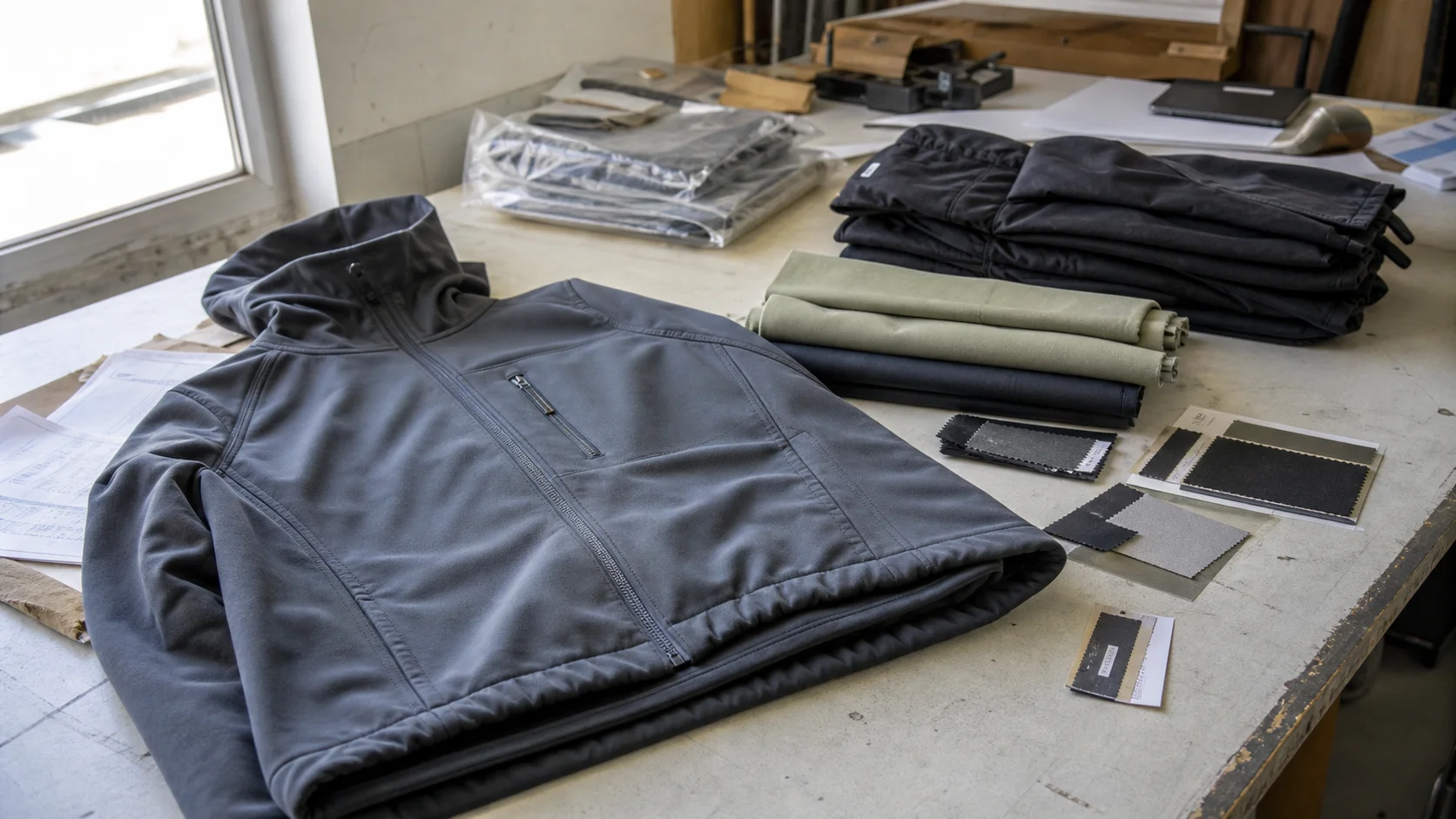
A product-specific shrinkage control outline for fitness club buyers ordering bulk softshell jackets, covering fabric behavior, testing points, tolerance...
Softshell Jacket Shrinkage Plan for Club Buyers - Quality & Inspection manufacturing guide
Bulk softshell jacket shrinkage control is not just a factory technical issue. For fitness club buyers, it is a commercial risk that can affect member uniforms, instructor outerwear, retail merchandise, team kits, and branded launch campaigns. A jacket that fits well at delivery but becomes tight across the chest, short at the sleeve, or distorted at the hem after washing will create returns, complaints, and poor brand perception.
Softshell jackets are especially sensitive because they often combine woven face fabrics, stretch yarns, fleece backings, TPU or PU membranes, bonded layers, zippers, elastic trims, embroidery, heat transfers, and printed branding. Each component may react differently to heat, moisture, pressure, washing, and drying. A shrinkage plan should control the full chain: fabric selection, lab testing, sample approval, bulk cutting, sewing, finishing, packing, and final inspection.
This guide is written for club buyers sourcing bulk softshell jackets from apparel suppliers. It focuses on the practical steps needed before placing production, during sampling, and before shipment. The goal is not to eliminate every millimeter of movement. The goal is to set realistic tolerances, test properly, and prevent avoidable size failures in bulk orders.
Fitness club apparel has a different usage pattern from ordinary promotional clothing. Staff and instructors may wear softshell jackets daily between indoor and outdoor areas. Members may buy them as lifestyle merchandise. Team coordinators may order them for events, outdoor classes, or corporate wellness programs. That means the jacket must keep its size and appearance through repeated use and regular laundering.
A shrinkage issue in club outerwear can be expensive because sizing is usually distributed across many people. If 300 jackets are issued to staff and the sleeves shrink after the first wash, replacing only a few sizes may not solve the problem. The buyer may need partial remakes, refunds, size exchanges, or emergency stock from another supplier.
Softshell jackets are often ordered with club logos, staff names, department labels, sponsor marks, or event branding. Once decorated, they are harder to rework. Embroidery can pucker after washing if fabric shrinkage is not controlled. Heat transfers may crack if the underlying fabric moves too much. Seam alignment can look uneven when bonded panels shrink at different rates.
For club buyers, the purchasing judgment is simple: if the jacket is branded, fitted, and expected to be washed regularly, shrinkage testing should be treated as a core approval step, not a minor lab detail.
Most bulk complaints are not caused by dramatic shrinkage. Many are caused by moderate movement that pushes the garment outside acceptable fit. A sleeve shortening by 1.5 cm may not sound serious on paper, but on a slim-fit instructor jacket it can make the product feel undersized. A hem sweep shrinking unevenly can make the jacket ride up over training pants. A bonded fleece backing shrinking more than the face layer can create curling or twisting that customers read as poor workmanship.
Softshell shrinkage is usually linked to fiber behavior, fabric construction, bonding quality, heat exposure, and garment finishing. Buyers do not need to become textile engineers, but they should understand which variables create risk.
Common softshell fabrics include polyester, polyester-spandex blends, nylon-spandex blends, recycled polyester, and bonded polyester fleece. Polyester is generally stable, but fabric construction still matters. Spandex adds stretch and comfort, yet it can increase dimensional change if the fabric is not properly heat-set. Nylon can be comfortable and strong, but it may react differently to heat and humidity compared with polyester.
For fitness club buyers, polyester-spandex softshells are popular because they offer stretch for movement. The tradeoff is that stretch fabric requires tighter control in cutting, sewing, pressing, and washing tests. A low-cost fabric with poor heat-setting may pass visual approval at sample stage but fail after home laundering.
Many softshell jackets use a three-layer structure: woven or knit face fabric, membrane, and fleece backing. Some use two-layer bonded constructions. Shrinkage risk increases when the layers do not move together. The face may remain stable while the fleece backing contracts. The result can be wrinkling, bubbling, twisting, or stiffness.
Bond strength is also important. If bonding is weak, washing can create delamination. This may be mistaken for shrinkage by the end customer, but it is a separate quality failure. A good shrinkage control plan should include both dimensional stability and bonding performance checks.
Softshell fabrics need proper heat-setting before cutting, especially when spandex is present. If the fabric mill or supplier skips adequate stabilization, the garment may shrink during washing or even during factory pressing. Heat exposure during embroidery backing application, heat-transfer branding, or seam sealing can also affect local areas.
Buyers should ask whether the fabric is pre-shrunk, heat-set, or relaxed before cutting. The answer should be supported by test results, not just a sales statement. A supplier does not need to disclose proprietary mill details, but they should provide performance data from the actual bulk fabric or a clearly identified equivalent.
Shrinkage test results depend heavily on wash method. A jacket may pass cold wash and line dry but fail warm wash and tumble dry. Club buyers should define expected care conditions early. Staff uniforms may be washed quickly and frequently, sometimes against the care label. Retail members may use normal household cycles.
A cautious specification often uses machine wash cold or 30°C, gentle cycle, no bleach, low spin, and hang dry. If tumble drying is likely in real use, it should be tested. There is no value in approving a jacket under ideal conditions if the intended user will wash and dry it more aggressively.
The buyer’s tech pack or product specification should include enough detail to prevent uncontrolled substitutions. Softshell jackets may look similar in photos while performing very differently in shrinkage tests.
Fabric weight is a buying tradeoff. Heavier bonded softshell often feels premium and protects better against wind, but it can be bulkier, warmer, and more expensive. Lightweight softshell improves movement and may suit active staff, but it can show seam defects more easily and may require tighter control of stretch recovery.
Trims can create local shrinkage or distortion if they react differently from the main fabric. Zippers, elastic cuffs, drawcords, binding tape, reflective tape, labels, thread, and decorative applications should be reviewed during wash testing.
For club buyers placing branded orders, decoration should not be approved only on a flat swatch. It should be tested on the actual garment panel or sample jacket. A logo that looks clean before washing may pucker if the fabric shrinks around the stitch area.
There is no universal shrinkage tolerance that fits every softshell jacket. The acceptable level depends on fabric type, fit, size range, branding method, and care instructions. Still, club buyers need a practical starting point for supplier discussions.
Item Typical Target Buyer Comment Main fabric dimensional change Within 2% after specified wash cycles Good target for stable polyester softshell; stretch fabrics may need careful validation. Garment length change Within 1.5–2.0 cm, depending on size Set by measurement tolerance, not only percentage. Sleeve length change Within 1.0–1.5 cm Critical for staff uniform satisfaction. Chest width change Within 1.0–1.5 cm Needs stricter control for slim-fit club retail jackets. Twisting or skewing No visible distortion affecting wear Should be judged visually and by measurement. Logo distortion No puckering, cracking, or obvious deformation Must be checked after wash, not only before packing.A 2% fabric shrinkage target is often reasonable for softshell, but buyers should not rely on fabric percentage alone. Garment measurements matter more to the wearer. If the fabric shrinks within target but the jacket loses too much sleeve length, the product still fails commercially.
For club uniforms, a slightly relaxed fit can reduce complaint risk. A very sharp athletic fit may look better in marketing images, but it leaves less tolerance for fabric movement, body variation, and layering. If the jacket will be worn over hoodies or staff polos, that should be reflected in the fit approval.
A shrinkage control plan should begin before bulk fabric cutting. Testing after the goods are finished is too late for meaningful correction. The buyer should require tests at fabric stage, sample stage, and final garment stage.
Before cutting bulk fabric, the supplier should test the actual fabric lot intended for production. If the supplier uses substitute fabric, a new test is needed. Club buyers should avoid approving shrinkage results from a different color, different fabric weight, or previous order unless the risk is low and the order is small.
Fabric shrinkage should be marked clearly in the test report. Vague comments such as “acceptable” are not enough for a bulk order. The report should show the actual dimensional change percentages.
Garment-level testing is essential because seams, zippers, trims, embroidery, and pressing can influence the result. A sample jacket should be measured before washing, washed according to the agreed method, dried, conditioned, and measured again.
Important measurement points include center front length, back length, chest width, waist width, hem sweep, sleeve length, shoulder width, cuff opening, and collar height if relevant. For women’s fitted styles, waist shaping and hip sweep also need attention. For unisex club jackets, the size grading should be checked because a tolerance that works in size L may not work in size XS.
Club branding is often the most visible failure point. Embroidery, heat transfer logos, silicone prints, reflective prints, and woven patches should be washed on the actual jacket fabric. The approval should cover both appearance and measurement impact.
If a large back logo is required, risk increases. Large heat applications can change fabric hand feel and may restrict stretch. A smaller chest logo is usually safer. This is a clear purchasing tradeoff: larger branding improves visibility but can increase wash and comfort risk.
Sample approval should be structured. A softshell jacket may look acceptable in a photo but still fail shrinkage control. Buyers should request physical samples whenever the order value or brand exposure justifies it.
The first fit sample checks design, pattern, sizing, construction, and general fabric hand feel. At this stage, the buyer should confirm whether the jacket is intended as slim fit, regular fit, or relaxed fit. Fitness clubs often prefer a clean athletic profile, but the garment must still allow arm movement.
Fit comments should be specific. “Make it better fitted” is not enough. Use measurable instructions such as reduce chest by 1 cm, extend sleeve by 1.5 cm, lower armhole slightly, or increase hem sweep for layering.
A size set sample helps confirm grading across the full size range. This is important for club orders because staff and members may require XS through 3XL or larger. Shrinkage risk can feel different across sizes. Small sizes have less margin for measurement loss, while larger sizes may show more visible twisting if fabric relaxation is uneven.
If the order includes both men’s and women’s fits, do not assume the same shrinkage result applies to both. Different patterns and seam placements can react differently during washing.
The pre-production sample should use confirmed bulk fabric, bulk trims, approved decoration, and final construction methods. This is the sample that should be washed and measured before production release.
For buyers who need sourcing support, product development, or supplier coordination, fabrikn.com outlines relevant apparel production services at https://fabrikn.com/services/.
Once the pre-production sample is approved, the supplier should maintain controls that prevent bulk variation. Many shrinkage problems are introduced during production because fabric is rushed, cut under tension, mixed by lot, or pressed inconsistently.
Stretch softshell should be relaxed before cutting. If fabric is rolled tightly or laid under tension, cut panels may contract later. Relaxation time depends on fabric type, roll condition, and supplier practice. For stretch fabrics, a common practice is to allow the fabric to relax for several hours or overnight before cutting, but the exact requirement should be confirmed by the supplier’s fabric behavior and test results.
Buyers can ask the supplier to document fabric relaxation in the production file. This does not need to be overcomplicated, but it should be part of the factory’s cutting control.
Fabric lots can vary in shrinkage, shade, and stretch. If a bulk order uses multiple fabric lots, the supplier should manage lot segregation. Mixing lots within one jacket can create uneven shrinkage or shade variation after washing.
For example, if sleeves are cut from one lot and body panels from another, a difference in dimensional stability may cause twisting or seam pulling after laundering. The same concern applies to contrast panels used in club-color designs.
Softshell panels must be cut on the correct grain direction. Off-grain cutting can cause twisting after washing. Stretch direction also matters. A fabric with two-way stretch should be placed correctly so the garment supports movement without distorting.
Cutting mistakes may not appear at first inspection. They often show after washing or wear. That is why wash testing selected bulk garments is useful before shipment, especially for larger orders.
Sewing tension should be balanced. If seams are stretched during sewing, panels may recover unevenly after washing. If thread tension is too tight, puckering can appear. If the needle damages the fabric or membrane, waterproof performance and seam appearance may suffer.
Seam type should match the jacket’s purpose. A basic club softshell may use standard lockstitch and overlock construction. A more technical jacket may require seam sealing or specialty stitching. Each added technical feature can increase cost and quality-control complexity.
Excessive heat can affect spandex, bonding layers, DWR finish, transfer logos, and reflective trims. Pressing temperature and dwell time should be controlled. Heat marks on softshell are common when operators treat it like ordinary woven fabric.
Buyers should ask the supplier to confirm whether any heat-transfer decoration is compatible with the fabric. A logo applied at too high a temperature may look acceptable at first but cause local shrinkage, shine, or hard patches.
Final inspection should not only count defects. It should verify whether the bulk goods match the approved sample and shrinkage plan. For significant orders, a third-party or buyer-side inspection can reduce shipment risk. The inspection scope should be written clearly in the purchase order or quality manual.
Measurement inspection should compare bulk garments with the approved size specification. Tolerances are usually set by point of measurement. For softshell jackets, common commercial tolerances may be around 1 cm for smaller points and 1.5–2 cm for larger body measurements, but each buyer should define tolerances by style, size, and fit sensitivity.
For higher-risk orders, ask the supplier or inspector to wash a small number of bulk garments from different sizes and lots before shipment. This is not a replacement for earlier testing, but it can catch production variation.
Check Recommended Action Risk Reduced Pre-wash measurements Measure selected garments against approved spec Confirms bulk sewing accuracy Post-wash measurements Wash and remeasure using agreed care method Identifies shrinkage beyond tolerance Logo review Inspect embroidery, transfer, and patches after washing Reduces branding failure risk Bonding review Check bubbling, delamination, and hand feel Reduces fabric performance complaints Fit review Compare washed garment to approved fit sample Captures practical wear issuesA shipment can pass general AQL inspection and still have shrinkage risk if no wash test is included. AQL checks visible defects from the packed goods. Shrinkage testing requires an extra step and time allowance.
Shrinkage control affects lead time. Buyers who place urgent orders and skip testing are accepting higher risk. This may be acceptable for low-cost event giveaways, but it is not a sound approach for staff uniforms or retail merchandise carrying the club brand.
MOQ depends on fabric availability, color, construction, decoration, and supplier setup. As a practical range, stock-fabric softshell jackets with custom logo decoration may start around 100–300 pieces per style or color with some suppliers. Fully custom softshell jackets using custom fabric colors, custom trims, and private labeling may require 500–1,000 pieces or more per style or color. Technical bonded fabrics or custom-dyed materials can push MOQ higher.
Lower MOQ usually means fewer customization options and less control over fabric engineering. Higher MOQ can improve cost and specification control, but it increases inventory exposure. Club buyers should match MOQ strategy to the purpose of the jacket. A staff uniform program may justify a more controlled custom order. A one-time event sale may be better served by a stock softshell style with tested decoration.
A reasonable sourcing calendar should include time for fabric testing, sample making, wash testing, buyer review, revisions, production, inspection, and shipping. If the launch date is fixed, such as a club opening or seasonal membership campaign, shrinkage approval should be scheduled early.
Buyers discussing timelines, quality steps, and order planning can use the contact route at https://fabrikn.com/contact-us/ to start a structured sourcing conversation.
A shrinkage control plan works best when it is written into the order documents. Verbal expectations are difficult to enforce after production begins. The purchase order, tech pack, or quality agreement should include the required testing, tolerances, and approval steps.
Club buyers often focus on unit price first, but shrinkage control is part of true landed value. A jacket that costs slightly less but produces complaints after washing is not cheaper. The more fitted, branded, and visible the garment is, the more important pre-production testing becomes.
Every sourcing decision has a tradeoff. A buyer does not need the most technical softshell for every club program. The right plan depends on how the jacket will be used.
For staff uniforms, durability and fit consistency should carry more weight than novelty details. A stable midweight polyester softshell with controlled stretch, reliable zippers, and modest branding may perform better than a complex jacket with multiple contrast panels and large heat-transfer graphics.
For member retail, appearance and comfort matter more. Buyers may choose a softer hand feel, athletic fit, and more premium trims. That raises the importance of size set approval and after-wash fit checks. Retail customers are less forgiving when they pay directly for branded merchandise.
For events or short promotional campaigns, buyers may accept simpler construction and stock fabrics. Shrinkage testing should still be done, but the level of customization may be reduced to protect schedule and budget.
For outdoor training teams, performance requirements may include wind resistance, water repellency, breathability, and reflective visibility. Each performance feature adds testing considerations. Waterproof ratings, seam sealing, and DWR performance after washing may need separate standards beyond shrinkage control.
The care label should reflect realistic use and tested performance. A care instruction that is too delicate may reduce supplier liability but frustrate users. A care instruction that is too aggressive may expose the garment to failure.
Common care instructions for softshell jackets may include machine wash cold or 30°C, wash inside out, close zippers before washing, use mild detergent, do not bleach, do not use fabric softener if it affects water repellency, hang dry, do not iron decoration, and do not dry clean unless tested. If tumble dry is not approved, the label should say so clearly.
For club staff, buyers may also provide a simple washing note during distribution. This is useful when jackets are issued in bulk. A short care card or internal email can reduce misuse, especially for decorated garments.
Good documentation makes quality disputes easier to resolve. It also helps reorder the same jacket later with fewer surprises. Buyers should keep the approved tech pack, fabric test reports, pre-production sample records, measurement specs, wash test photos, logo approval files, inspection reports, care label wording, and supplier confirmations.
For reorder programs, the buyer should not assume that the next production run will match automatically. Fabric mills may change yarn lots, bonding conditions, dyeing recipes, or finishing settings. A reorder should confirm whether the same fabric and trims are being used. If anything changes, repeat key shrinkage and appearance tests.
Background on sourcing approach and company information can be reviewed at https://fabrikn.com/about-us/.
A bulk softshell jacket shrinkage control plan should be proportionate to the risk. For a small stock-style logo order, basic sample wash testing and measurement checks may be enough. For a custom club uniform program with fitted sizing and embroidered logos, fabric-stage testing, pre-production wash approval, bulk lot control, and pre-shipment washed garment checks are strongly recommended.
The safest buying approach is to approve performance before committing to full production. A low unit price cannot compensate for unstable sizing. Softshell jackets carry more quality risk than basic T-shirts because they combine stretch, bonding, trims, and branding. Fitness club buyers should treat shrinkage control as part of the product specification, not as a factory afterthought.
When the order is visible, branded, and repeated across staff or members, the buyer should insist on written tolerances, actual test results, and approved washed samples. That is the practical route to fewer returns, cleaner launches, and better long-term apparel value.
Get a free quote from Fabrikn — your trusted B2B clothing manufacturer with 10+ years of experience. MOQ as low as 200 pieces.
Get a Free Quote →A common target is within 2% dimensional change for the main fabric after the agreed wash method. Garment measurements should also be controlled, especially sleeve length, body length, chest width, and hem sweep. For fitted club jackets, measurement tolerances may need to be stricter than fabric percentage alone.
Testing should start before bulk cutting. Fabric testing and pre-production sample wash testing are the most useful stages. Final washed-garment checks before shipment can catch production variation, but they should not be the first shrinkage control step.
Embroidery does not usually shrink like fabric, but it can cause puckering if the fabric around it moves after washing. The risk is higher with dense stitching, large logos, unstable backing, or stretch softshell fabric. Buyers should approve embroidery after wash testing on the actual jacket fabric.
Heat transfers can work well, but compatibility must be tested. Softshell fabrics may show heat marks, local shrinkage, peeling, or reduced stretch if the transfer temperature, pressure, or adhesive is unsuitable. Large transfers carry more risk than small chest logos.
Stock softshell jackets with custom logos may start around 100–300 pieces depending on supplier and stock availability. Fully custom cut-and-sew softshell jackets often require around 500–1,000 pieces or more per style or color, especially when custom fabric, trims, or dyeing are involved.
One wash cycle can identify immediate shrinkage, but three cycles provide a better view of stability for uniforms and retail merchandise. If the jacket will be washed frequently by staff, multi-cycle testing is safer.
Only if the fabric, trims, bonding, and decoration have been tested for tumble drying. Many softshell jackets are safer with hang drying. If tumble drying is not approved, the care label should state this clearly.
The main risks include sleeve and body length shrinkage, zipper waviness, side seam twisting, hem curling, logo puckering, transfer peeling, bonding delamination, shade variation, and incorrect care labels. Washed-garment inspection is useful for higher-risk bulk orders.
Not always. Different colors may have different dyeing or finishing behavior, especially dark shades, bright colors, or custom-dyed fabric. For important orders, test each major color or at least confirm that the fabric lots share the same tested construction and finishing process.
A practical plan should include fabric specifications, shrinkage tolerance, wash method, sample approval steps, decoration testing, fabric relaxation before cutting, lot control, measurement inspection, care label confirmation, and pre-shipment checks where needed.