
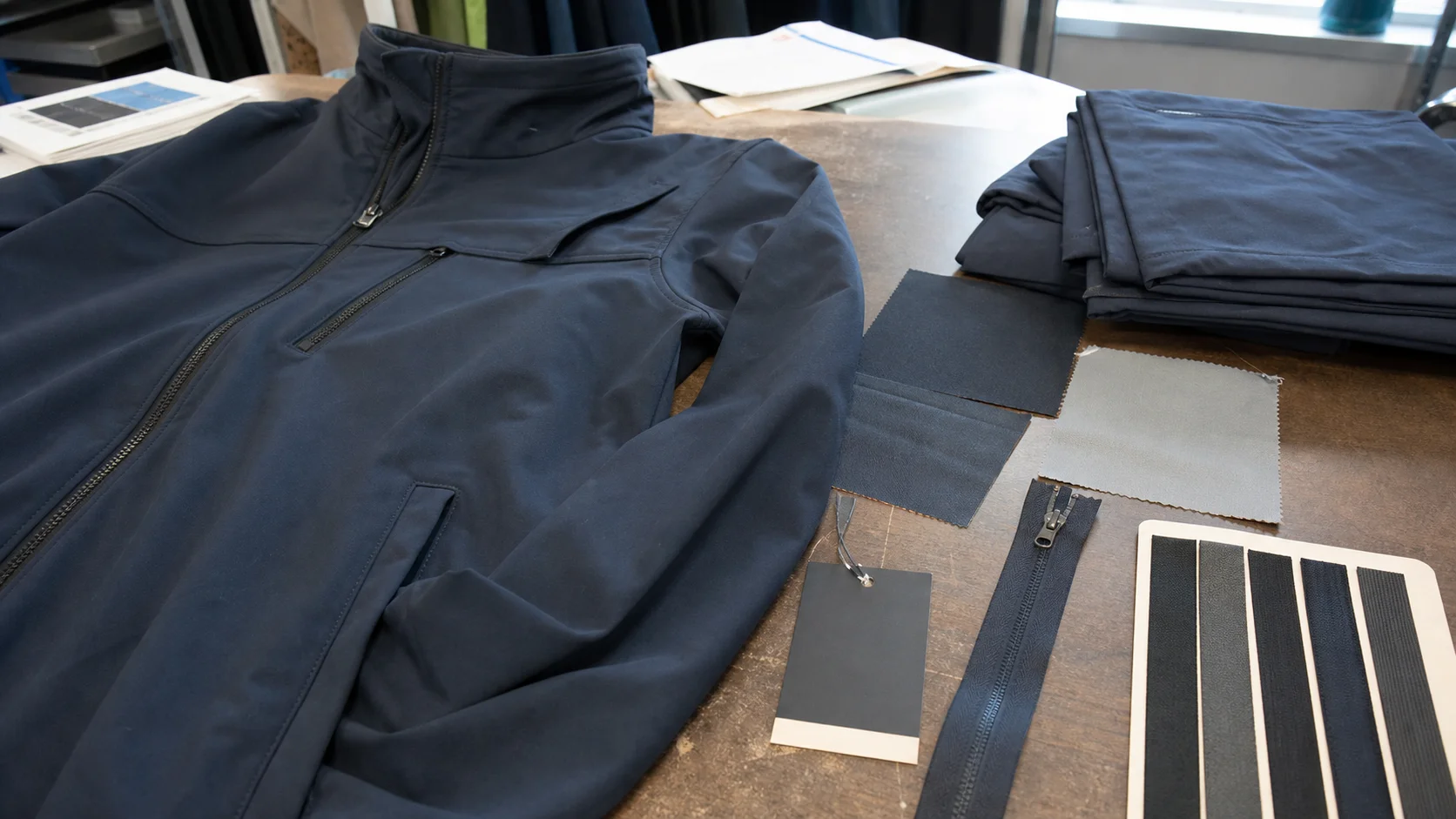
A focused outline for buyers sourcing bulk softshell jackets with screen printing for logistics uniforms, covering print placement, fabric performance, layering needs, artwork prep, testing, and production details specific to fleet-ready outerwear programs.
Bulk Softshell Jackets Screen Printing Supplier - Fabrikn production reference
For logistics teams, outerwear is not a branding extra. It is working equipment. Couriers, warehouse supervisors, drivers, dispatch teams, and field coordinators often move between indoor and outdoor environments in the same shift. That makes jacket selection a sourcing decision with direct impact on comfort, durability, and brand consistency.
A reliable bulk softshell jackets screen printing supplier can support that balance when the program is specified correctly. Softshell jackets are widely used in logistics uniform sourcing because they offer moderate weather protection, cleaner corporate presentation than fleece, and lower bulk than padded outerwear. They also give purchasing teams enough surface area for chest, sleeve, or back logo application.
The important part is this: not every softshell jacket is equally suitable for screen printing, and not every screen printer is equipped to manage layered technical garments at production scale. Buyers that focus only on unit price often end up with avoidable issues such as print cracking, poor adhesion on water-resistant finishes, color mismatch across size runs, or delivery delays caused by unresolved sample approvals.
If your sourcing objective is a repeatable logistics uniform program, the supplier needs to handle more than decoration. They should be able to align jacket construction, fabric performance, logo placement, carton planning, and inspection controls with your operational needs. Buyers comparing vendors can review services early to see whether a supplier is structured for development, production, and customization rather than only basic order taking.
Softshell jackets sit in a practical middle ground. They are usually lighter and more flexible than heavy work jackets, while offering better wind resistance and cleaner uniform appearance than sweatshirts or basic fleece. For delivery, transport, and warehouse teams, that matters because uniform use is rarely limited to one fixed environment.
Most logistics operations need outerwear that covers three priorities:
A 2-layer or 3-layer softshell can meet those needs when the specification is realistic. It will not replace a fully waterproof rain jacket in severe weather, but it often performs better for daily wear because breathability and stretch are easier to manage. That tradeoff makes sense for many uniform programs where staff need a jacket for most shifts, not only storm conditions.
From a sourcing standpoint, softshell styles also offer merchandising consistency. Men’s and women’s fits, removable hood options, reflective piping, and multiple pocket layouts can be developed within one program while maintaining the same brand look. That gives procurement teams room to segment by role without redesigning the entire outerwear package.
When buyers search for a bulk softshell jackets screen printing supplier, the first filter should be capability fit, not only price. Many factories can sew jackets. Many printers can print logos. Fewer suppliers can consistently combine technical outerwear manufacturing with decoration that holds up through field use and repeated washing.
Start with construction capability. Ask whether the supplier regularly handles bonded fabrics, laminated softshell materials, zipper installations, pocket reinforcements, and size-set grading for outerwear. A supplier with strong T-shirt printing experience is not automatically a strong softshell supplier.
Then review decoration process knowledge. Screen printing on softshell jackets requires attention to surface texture, water-repellent finishes, print curing limits, and panel accessibility. A supplier should be able to explain which logo placements are production-safe and which ones create risk. That explanation matters more than a simple yes to every request.
Buyer evaluation should also include these operational checkpoints:
If the order is part of a longer-term uniform program, ask whether the supplier can reserve or re-source close fabric equivalents for continuity. Softshell programs often fail on the second order, not the first, because the original fabric is unavailable or a substitute is used without proper wear and color review.
Buyers that need a more detailed production discussion before quotation can usually save time by opening specification requirements early through a supplier contact channel such as contact-us. That tends to reduce quoting gaps later, especially for mixed decoration, role-based colorways, or branch-level packing instructions.
Screen printing remains a popular choice for logistics uniform jackets because it can be cost-efficient at scale and visually strong for bold logos. Still, the method is only reliable when matched with the right fabric and logo design.
Softshell jackets typically have a woven face, sometimes with stretch content and often with a durable water-repellent finish. Those features can interfere with ink adhesion if the supplier does not test properly. A large back print may look fine at approval stage but fail after wash or flex wear if the ink system is not suited to the fabric surface.
Key checks include:
Chest logos are usually the safest option for logistics uniforms. They present the brand clearly and carry lower distortion risk. Sleeve prints can work, though they require careful placement around curvature and seam allowance. Large back prints are common for visibility, but buyers should confirm the print area is free from excessive panel shaping or ventilation seams.
There is also a practical tradeoff between screen printing and embroidery. Screen printing generally works better for larger logos and lower per-unit decoration cost at volume. Embroidery usually offers stronger perceived durability for small chest logos but can create puckering on bonded fabric or reduce waterproof integrity if needle penetration is not planned well. Some buyers use a mixed approach: embroidered chest logo and printed back mark. That can work, though it adds coordination and cost.
The best supplier response is not automatic agreement. It is a technical recommendation based on your logo size, color count, fabric finish, and wear conditions.
For logistics uniform sourcing, the softshell fabric spec should be tied to actual use conditions rather than broad marketing terms. Buyers do not always need the highest waterproof rating. They do need a construction that withstands routine wear, mild weather exposure, and repeated laundering.
Common softshell compositions include 94% polyester / 6% spandex or 96% polyester / 4% elastane, often bonded to microfleece or brushed inner layers. Typical fabric weights for logistics jackets fall around 280 to 340 gsm, depending on climate, expected insulation, and price target.
Useful specification points to review include:
Trim choices matter more than many buyers expect. Zippers should be selected for smooth operation and field durability, not only appearance. Reverse coil front zippers are common on corporate softshells, but heavier-duty options may suit delivery teams better. Zipper pullers should be easy to grip, especially if workers use gloves. Elastic cuffs can improve comfort, while adjustable tabs may provide a neater fit but add cost and component variability.
Pocket layout should reflect the job. A jacket for route delivery staff may need secure zip hand pockets and an internal phone pocket. A warehouse supervisor may prefer cleaner styling with fewer external features. Once pockets are added, remember that logo placement flexibility becomes narrower.
Reflective details are another sourcing decision. If visibility support is needed but the jacket is not a full high-visibility garment, reflective piping or segmented reflective heat transfer can add function. That said, reflective applications can limit logo areas and increase inspection points.
Company background and production positioning can also matter when buyers assess fit for an ongoing program. A supplier profile such as about-us can help clarify whether the business is set up for long-term apparel development or only transactional reselling.
MOQ for bulk softshell jackets varies widely depending on whether you are buying stock styles with custom printing or developing a fully custom uniform jacket. Buyers should separate those two models because lead times, sampling steps, and pricing logic are different.
Very low MOQ requests are possible in some cases, but they usually come with tradeoffs. Unit cost rises, color options narrow, and decoration setup cost is spread across fewer units. For logistics uniform sourcing, a slightly higher opening order can be more economical if the program is likely to repeat.
Skipping the pre-production sample is one of the most common procurement mistakes in decorated outerwear. A lab dip or fabric swatch does not confirm how the final jacket, trim combination, and logo application will perform together. The pre-production sample should represent the approved fabric, color, logo size, print placement, zipper selection, and labeling approach as closely as possible.
Lead time is usually driven by material readiness and approval speed more than sewing time alone. Typical bulk production may range from 45 to 90 days after final approval, but that range moves based on fabric availability, printing complexity, seasonality, and order size.
Main dependencies include:
Buyers planning peak-season logistics recruitment should build extra buffer into softshell orders. Outerwear delays are usually harder to absorb than delays on basic tops because replacement styles are less interchangeable.
Bulk outerwear orders carry more failure points than simple knit uniform programs. The risk is manageable, but only if inspection criteria are defined early.
Frequent issues include print adhesion failure, inaccurate logo placement, color shading across production lots, delamination after washing, zipper defects, and size inconsistency in layered fabrics. Softshell fabrics can also show pressure marks or panel imprints if packing and handling are not controlled well.
Screen printing creates its own risk profile. Fine-line logos may lose edge clarity on textured surfaces. Large solid prints may show pinholes or uneven coverage. Dark garments can require underbase handling that affects handfeel and stretch performance.
Practical inspection points should include:
AQL inspection can be used, but buyers should not assume a generic final inspection covers all functional concerns. Decoration durability and bonded fabric performance often need targeted checkpoints. If the order includes multiple logos or mixed placement by department, packing accuracy deserves extra attention because misallocated uniforms create avoidable downstream cost.
In softshell sourcing, the cheapest quote is often the most expensive correction later. Cost needs to be read against fabric quality, print suitability, trim standard, and repeat-order reliability.
The main cost drivers are usually fabric construction, jacket complexity, logo color count, number of print locations, zipper quality, and packaging method. A basic 2-pocket jacket with one chest print will be much easier to control than a hooded style with reflective trim, internal pocketing, custom pullers, and front-plus-back printing.
Cost Factor Lower-Cost Option Higher-Cost Option Buyer Tradeoff Fabric Standard stock bonded polyester Custom-weight stretch softshell Lower cost may reduce repeat consistency Decoration One-color chest print Multi-location multi-color print More branding impact, more risk and setup cost Trims Standard zipper and puller Branded or heavy-duty trim package Better function and identity, higher component cost Sampling Minimal sample rounds Full proto and PPS process Faster start, but higher approval risk Packing Bulk pack by size Branch-assorted end-user pack Saves warehouse sorting later, adds factory handlingFor most logistics buyers, the best value is usually not the lowest specification. It is the most stable specification. A proven fabric, controlled print method, and disciplined sample process tend to outperform aggressive cost-cutting on a program that needs repeatability.
Before confirming a purchase order, buyers should press for clear operational answers. Vague reassurance is not enough on decorated outerwear.
Those questions are not excessive. They are standard safeguards when sourcing bulk softshell jackets for logistics uniform use. The supplier that answers them clearly is usually easier to work with once production begins.
Choosing a bulk softshell jackets screen printing supplier for logistics uniform sourcing is not only a branding decision. It is a product-performance, process-control, and repeatability decision. The right supplier should be able to align garment construction with field use, recommend print methods that suit bonded softshell fabric, and manage approvals without rushing critical steps.
For buyers, the strongest purchasing position comes from clear specifications and realistic tradeoff decisions. Define the wear environment. Set logo priorities. Confirm fabric and trim standards. Approve a true pre-production sample. Review inspection criteria before bulk output starts.
Softshell jackets can be an excellent outerwear choice for logistics teams when the program is built around real use rather than generic promotional sourcing. A supplier that understands both outerwear production and screen printing limitations will usually deliver better long-term value than a vendor competing only on opening price.
Get a free quote from Fabrikn — your trusted B2B clothing manufacturer with 10+ years of experience. MOQ as low as 200 pieces.
Get a Free Quote →For stock jackets with custom printing, MOQ often starts around 100 to 300 pieces per colorway. Fully custom softshell jacket programs often start around 300 to 800 pieces per style and color, depending on fabric sourcing and trim customization.
No. Suitability depends on the fabric face, stretch level, water-repellent treatment, and logo design. Some softshells print well, while others are better suited to alternative decoration methods or adjusted artwork.
Many orders fall in a 45 to 90 day window after final sample approval. Fabric availability, custom dyeing, decoration complexity, and packing requirements can extend that timeline.
Print performance on treated or stretch softshell fabric is one of the biggest risks. Poor adhesion, cracking, or inconsistent placement can become expensive at scale if testing and pre-production approval are rushed.
It depends on logo size, detail, fabric behavior, and budget. Screen printing is often cost-efficient for larger logos and volume orders. Embroidery can work well for small chest logos, though it may create puckering on some bonded fabrics.
Buyers should focus on fabric composition, gsm, bonded construction, water resistance level, breathability, zipper durability, pocket function, print compatibility, and size consistency. Those factors usually matter more than broad marketing claims alone.