
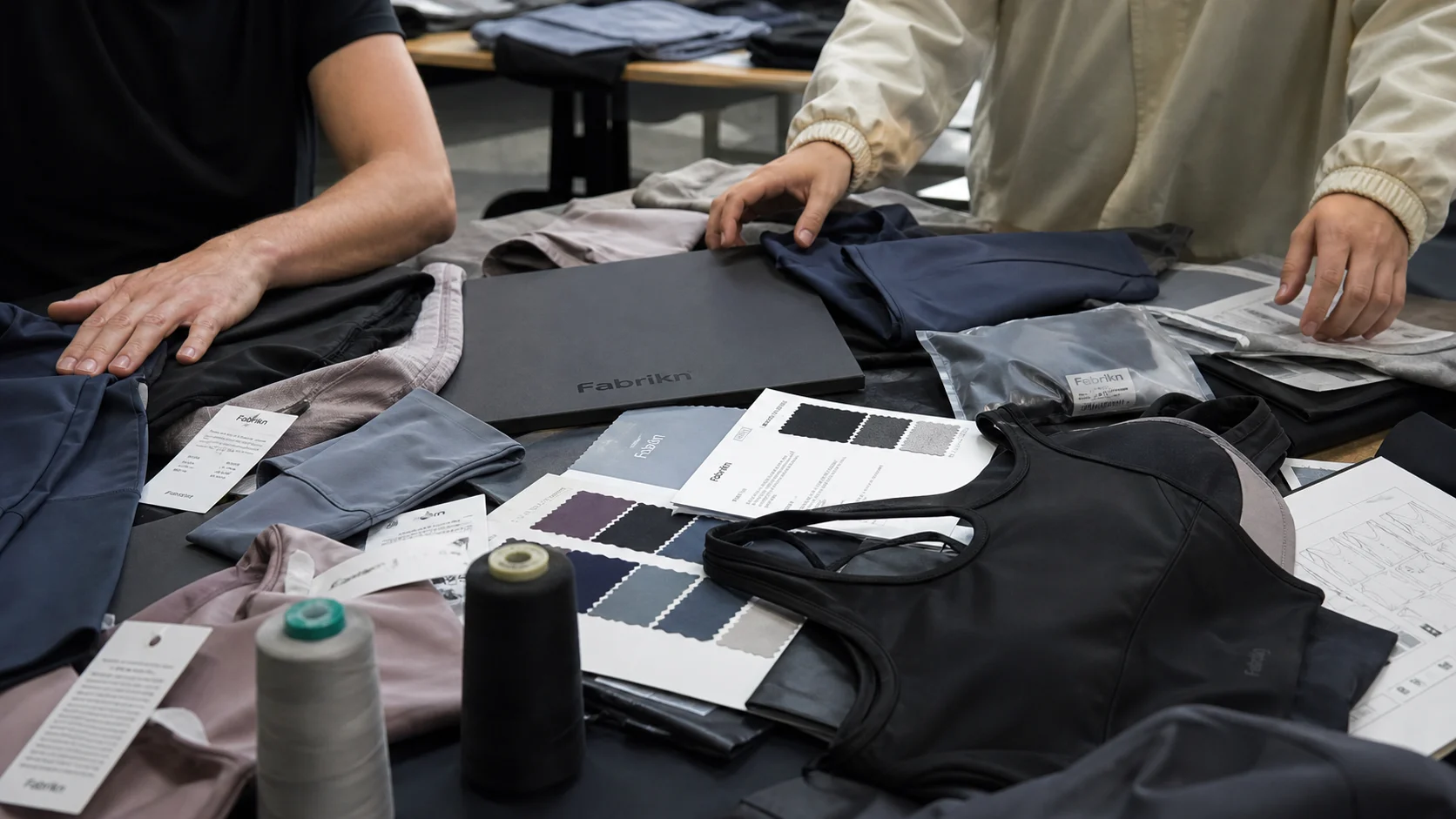
A focused outline for sourcing teams evaluating OEM activewear sets through seam strength requirements, MOQ structure, testing standards, and production decisions tied to performancewear durability.
OEM Activewear Set Seam Strength MOQ Options - Fabrikn production reference
For performancewear sourcing teams, seam strength is not a small technical point. It is one of the first factors that separates a commercially safe activewear set from a return-heavy program. When buyers evaluate OEM activewear sets, they often focus on fabric handfeel, color, logo application, and target FOB. Those items matter, but they do not protect the garment when a consumer stretches through squats, lunges, runs, or repeated wash cycles.
The practical question is not just whether a factory can make leggings and sports bras. The real question is whether the factory can make them at the right seam standard, with the right decoration method, and at a minimum order quantity that still makes commercial sense.
This is where sourcing teams need a balanced approach. Low MOQ options can be useful for market testing, influencer capsules, pilot launches, and seasonal drops. Yet low MOQs can also narrow fabric choices, reduce customization efficiency, and create inconsistency in seam construction if the production line is trying to adapt bulk methods to micro volumes. Large MOQs can unlock better fabric booking, more stable trim sourcing, and cleaner production planning, but they also increase stock risk if fit or demand is not proven.
For teams comparing suppliers, the best purchasing decisions usually come from connecting four variables early: fabric stretch and recovery, seam engineering, decoration placement, and MOQ structure. If one of those is treated separately, problems tend to show up late in sampling or after shipment.
Brands looking for broader production support can review available options on Fabrikn’s services page. Teams that are still vetting a production partner can also review the company background on the about us page or start a project discussion via the contact page.
Activewear sets are built for repeated strain. That strain does not come only from exercise intensity. It comes from fabric extension, body movement, fit compression, laundering, heat exposure, and friction at key panels. In practical sourcing terms, seam strength has to be considered as a system result rather than a single sewing metric.
A seam can fail for several reasons:
For leggings, the most sensitive areas are usually the crotch intersection, center back rise, inseam, waistband join, and side seam or side panel transitions. For sports bras, the highest-risk areas are underbust seams, strap joins, armhole edges, neckline curves, removable cup openings, and elastic attachment points.
Buyers sometimes ask for “strong seams” without defining the end use. That creates quoting noise. A low-impact lounge set and a high-compression training set do not need the same seam package. If the garment is expected to support HIIT, running, or studio training, the tolerance for seam grin, popped stitches, and edge tunneling is much lower.
The safest sourcing position is to define the performance category at the tech pack stage. A supplier can then judge whether a four-thread overlock, six-thread flatlock, coverstitch, bonded seam, or reinforced join is appropriate for the style.
Many MOQ and quality disputes begin because the RFQ is incomplete. When the request is vague, the quote may assume a simpler construction than the buyer expects. Later, once proper seam standards or decoration placements are added, the MOQ or price moves upward. That is not unusual. It is often the natural result of missing technical information.
Before asking for OEM pricing on activewear sets, sourcing teams should specify the following:
This level of detail matters because MOQ is rarely just a sewing-line issue. MOQ is influenced by fabric mill minimums, dye lot control, trim minimums, print setup, pattern grading, cup mold availability, elastic procurement, and label packaging.
As a working range, OEM activewear set MOQs often fall into these brackets:
These are not fixed rules. They are common market patterns. A buyer asking for custom-milled fabric, silicone heat transfers, contrast flatlock, branded jacquard elastic, and multi-piece set packaging should expect MOQ pressure to rise quickly.
Seam strength is not only about whether the garment tears. It is also about whether the seam remains comfortable, visually clean, and stable after repeated use. In activewear, the wrong seam can technically hold but still fail commercially because it chafes, tunnels, twists, or distorts printed areas.
There is no single “best” seam for every set. Flatlock can improve comfort and reduce bulk, but it may cost more and may not suit every fabric recovery profile. Overlock with coverstitch is commercially efficient and widely available, but it needs proper tension control to avoid popping or waviness on elastane-rich fabric. Bonded construction looks clean and premium, yet it introduces adhesive durability risk and often pushes MOQ higher due to process specialization.
Purchasing judgment: if the brand position is mid-market and the activity level is moderate to high, a well-controlled overlock plus coverstitch program often gives a better cost-to-reliability balance than rushing into bonded construction for visual reasons alone.
MOQ is one of the most negotiated points in OEM performancewear sourcing, but the headline number can be misleading. Buyers should ask whether MOQ applies per style, per color, per set, per fabric, or per total order. Those distinctions change the real commitment.
Low MOQ activewear programs are usually best suited for:
Typical low MOQ ranges are often around 100–200 sets per color for stock-supported materials or partially standardized construction. The tradeoff is that fabric choices may be restricted to in-stock bases, trim customization may be simplified, and color matching options may be less flexible.
For many sourcing teams, this is the most workable zone. Roughly 200–500 sets per style/color often allows better material planning, more stable production scheduling, and improved consistency on seam execution. This range can support custom labels, moderate decoration, and a more brand-specific fit package without pushing every input into premium minimums.
Once the program includes custom-knit or custom-dyed fabric, specialized compression targets, molded bra components, branded elastics, multiple print placements, or intricate matching across sets, MOQ commonly rises to 500 units or more per style/color. Some fabric mills may require even higher thresholds for custom yarn, finish, or color booking.
MOQ Level Typical Range Best Use Case Main Tradeoff Low 100–200 sets Market testing, capsules, limited launches Fewer fabric and trim options Mid 200–500 sets Core seasonal programs Still some material minimum constraints High 500–1,000+ sets Fully custom branded performancewear Higher inventory exposureThe best buying decision is not always the lowest MOQ. If the order is too small to support the right fabric, seam process, and decoration method, the apparent savings can disappear through re-sampling, quality claims, or weak sell-through.
Because this topic sits in Decoration & Printing, sourcing teams should look carefully at how branding and visual finishes interact with seam performance. This part is often underestimated.
In activewear sets, common decoration methods include:
Each method affects seam behavior differently. Silicone or thick heat transfers can stiffen a stretch panel if the placement is too large or too close to a high-extension seam. Screen prints may crack if the ink system is not suited to the fabric stretch. Embroidery can create needle perforation stress and puckering, especially on compressive leggings. Sublimation is efficient for all-over graphics on polyester bases, but it does not suit every nylon-rich premium handfeel program.
The main sourcing question is not just whether the logo looks sharp on a sample. It is whether the decoration still performs after stretch, wash, perspiration exposure, and repeated movement.
Buyers should review these decoration points before bulk approval:
Purchasing judgment: for high-stretch leggings, small clean transfers placed away from seam intersections usually outperform large decorative graphics placed across panels that need maximum extension.
Sample approval is where seam strength and MOQ planning should come together. A rushed sample process often creates false confidence. One salesman sample can look good while the bulk program still carries risk. Sourcing teams should build approvals in stages.
At each stage, the buyer should review more than appearance. Activewear sets should be assessed for seam extension, recovery, transparency under strain, print stretch, elastic stability, and wear comfort.
Reasonable testing and review checkpoints may include:
For sourcing teams under schedule pressure, the most practical mistake to avoid is combining fit approval and bulk material approval into one rushed step. If fabric behavior changes between development fabric and actual bulk fabric, seam strength and print behavior can shift with it.
Lead time for OEM activewear sets depends heavily on what is actually being customized. A simple two-piece set made in stock fabric with standard labels and basic heat transfer branding may move much faster than a fully custom compression set with dyed trims and multiple decoration applications.
As a broad working guide, sourcing teams often see timelines such as:
Lead times expand when any of these inputs are not locked early:
One useful sourcing habit is to ask which component controls the calendar. In many activewear programs, the sewing line is not the bottleneck. Fabric, decoration setup, or trim development often decides whether the booking is realistic.
Inspection in performancewear should not be treated as a generic apparel check. Seam risks in activewear sets are highly specific, and they can be missed if the QC team focuses mainly on cosmetic appearance.
During inline and final inspection, the highest-priority risk points usually include:
Set matching is especially important. Even if each individual piece passes inspection, the program can still fail at retail if the sports bra and leggings do not match in shade, print position, or handfeel. This is common when components are cut from different dye lots or processed separately without good lot control.
A careful QC checklist for activewear should include both relaxed and stretched visual checks. Some seam or print issues only appear when the panel is extended. If inspection happens only in a flat, relaxed state, buyers may miss the exact problem the consumer will see during wear.
Performancewear sourcing is full of decisions that look cheaper at first and cost more later. The strongest buyers are not the ones who demand every premium option. They are the ones who know where premium inputs matter and where simpler construction is commercially smarter.
Here are a few practical tradeoffs:
If the brand’s main sales argument is performance credibility, seam strength deserves budget protection. Cutting cost on thread quality, stitch control, or seam testing is rarely the right place to save. If the product is more fashion-led and lower impact, the construction spec can sometimes be simplified without hurting the commercial result.
The right buying judgment is to align seam package, decoration method, and MOQ with the real use case of the garment. That sounds obvious, yet many sourcing problems start when a garment is marketed as training-ready while being costed and developed closer to loungewear.
For sourcing teams buying OEM activewear sets, seam strength and MOQ should be evaluated together, not as separate decisions. The seam package affects durability, comfort, and return risk. MOQ affects which fabrics, trims, colors, and decoration methods are realistically available. Once decoration and printing enter the mix, the interaction becomes even more important because logos and graphics can either support the product story or undermine panel stretch and seam reliability.
The most dependable sourcing process starts with a clear technical brief, realistic MOQ expectations, disciplined sample approvals, and inspection methods that test garments in both relaxed and stretched conditions. Teams that buy this way usually avoid the most expensive mistakes: weak seam performance, unstable decoration, and order quantities that do not match the true complexity of the program.
If you are comparing OEM options for performancewear development, review production capabilities through /services/, learn more about the company through /about-us/, or open a sourcing discussion at /contact-us/.
Get a free quote from Fabrikn — your trusted B2B clothing manufacturer with 10+ years of experience. MOQ as low as 200 pieces.
Get a Free Quote →Typical MOQ often starts around 100–200 sets for simpler stock-supported programs and may rise to 200–500 sets for standard custom private label orders. Fully custom performancewear with specialized fabrics, trims, or decoration can move to 500 units or more per style/color.
Activewear garments are exposed to repeated stretch, recovery, friction, and wash cycles. Weak seams can lead to popped stitches, seam grin, distortion, and customer returns, especially in leggings and sports bras designed for training use.
Common seam constructions include overlock, flatlock, coverstitch, elastic-bound seams, and in some premium programs, bonded seams. The best choice depends on fabric stretch, garment use, comfort targets, and cost limits.
Decoration can reduce panel stretch or create stress near seams if it is too rigid, too large, or poorly placed. Heat transfers, screen prints, and embroidery should be evaluated for stretch compatibility, wash durability, and distance from high-tension areas.
Buyers should approve fit, fabric, trims, seam construction, decoration placement, measurements, wash performance, and pre-production samples. A size set is also useful when grading or compression fit is critical.
Key risks include popped or skipped stitches, seam distortion, waistband twisting, decoration peeling or cracking, needle damage to stretch fabric, and shade mismatch between pieces in the same set.