
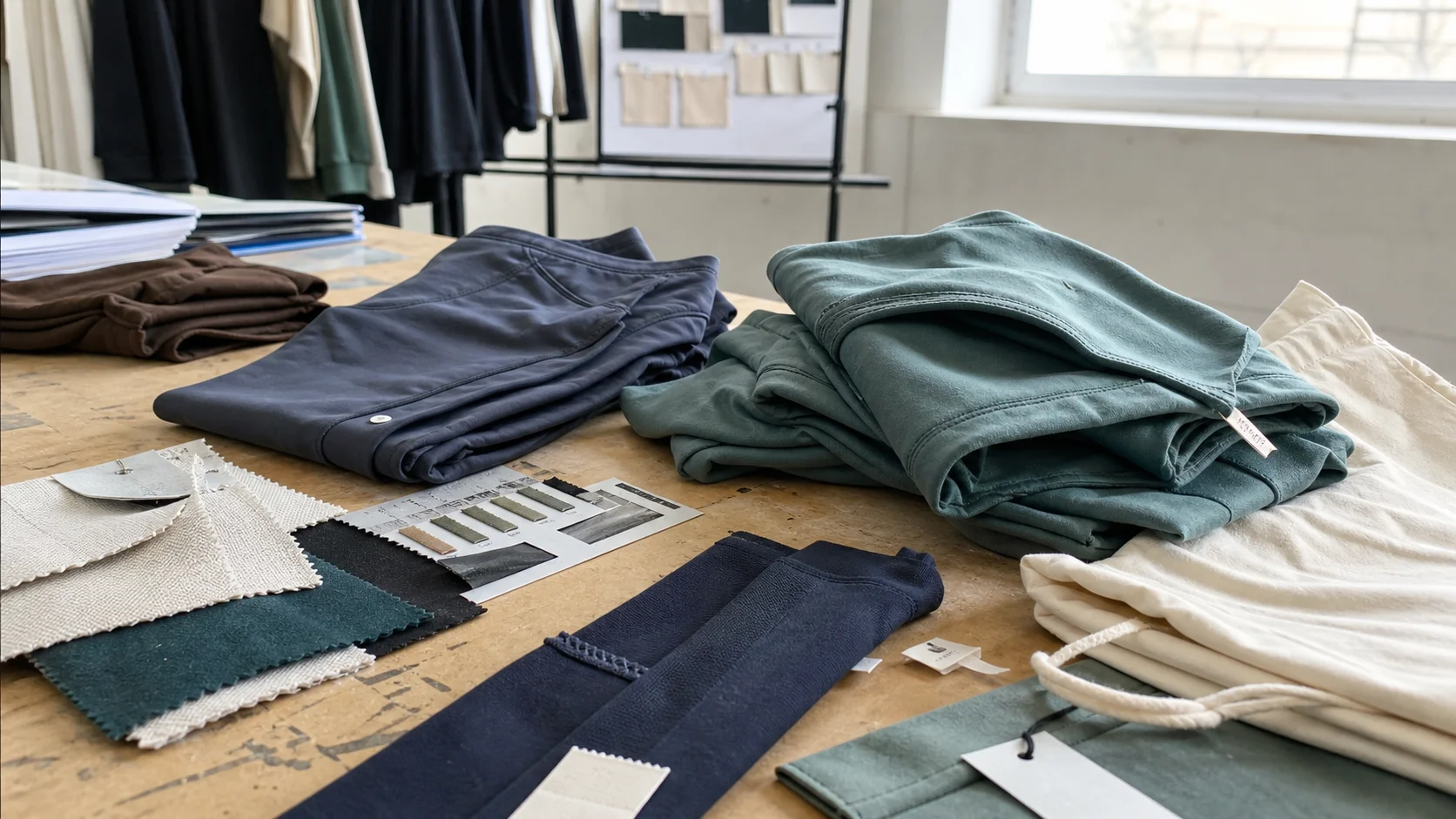
A focused outline for boutique gym brands evaluating OEM activewear set trim sourcing, MOQ drivers, and cost tradeoffs tied to labels, elastics, drawcords, and other set-specific components.
OEM Activewear Set Trim MOQ for Boutique Buyers - Fabrikn production reference
For boutique gym brands, trim sourcing is often where an otherwise manageable OEM activewear order becomes difficult. Fabric gets most of the attention, yet trims can quietly decide whether a launch stays profitable, hits the target delivery window, or gets pushed into costly redesign.
In activewear, “trim” covers the non-fabric components that finish the garment and support branding, fit, performance, and packaging. That includes elastic, drawcords, aglets, zipper pulls, care labels, heat-transfer logos, size labels, woven brand labels, hangtags, polybags, silicone patches, bra cup components, and other accessories used across leggings, sports bras, shorts, jackets, and coordinated sets.
The problem for small and mid-volume buyers is simple: trim suppliers often work on higher minimums than boutique brands expect. A factory may accept a cut-and-sew MOQ of 100 to 300 sets per color, but a branded elastic supplier may want 1,000 to 3,000 meters, and a custom molded zipper pull vendor may quote a minimum far above the garment order. That mismatch creates waste, delays, or compromises in design.
Buyers sourcing OEM activewear sets need to evaluate trim MOQ as early as tech pack development, not after sample confirmation. Leaving it late usually leads to one of three outcomes: switching trims after fit approval, paying surcharge-heavy small-lot pricing, or carrying dead stock that ties up cash.
For brands still building repeat volume, the smartest purchasing approach is usually selective customization. Keep visual brand identity where the customer notices it most, and simplify trims that add complexity without improving sell-through. That tradeoff is not glamorous, but it protects margin and speeds replenishment.
If you are comparing manufacturers or want support structuring an OEM program, it helps to review the sourcing process in a practical way through pages such as /services/ and /about-us/ before finalizing a trim-heavy product plan.
Trim MOQ is the minimum quantity a supplier requires to produce or supply a specific trim item. In practice, that minimum may be measured by pieces, meters, kilograms, rolls, or order value rather than garment count.
That distinction matters. A boutique buyer might assume that ordering 200 activewear sets means all supporting materials can be purchased at 200 units. In reality, different trims follow different production logic:
OEM activewear sets complicate this further because one order commonly includes multiple coordinated garments. A set may contain a sports bra and leggings, or a top and shorts, with separate trim needs for each piece. Even if the garments share the same color family, the trim consumption ratio can differ sharply between styles.
For example, one leggings style may use waistband elastic, gusset seam labels, and inside branding, while a sports bra may need adjustable rings, sliders, underband elastic, pad opening labels, and removable cup packaging. The result is a trim map that is more fragmented than a basic T-shirt order.
Buyers should also separate stock trim MOQ from custom trim MOQ. Stock trims, meaning ready-made items already available in standard colors and sizes, typically support lower order quantities and faster delivery. Custom trims carry stronger branding value, but MOQs rise because vendors must allocate setup time, material runs, and color control to a smaller project.
Not every activewear set uses the same trim package. Performance category, price point, and branding level all affect the bill of materials. Still, most boutique gym brands will encounter the following trim groups:
Each category behaves differently from an MOQ standpoint. Labels and hangtags are usually easier to scale at small volumes than custom jacquard elastic or molded accessories. Packaging often looks cheap per unit, but fully custom packaging across many SKUs can create unnecessary inventory burden for smaller brands.
The most practical route for boutique buyers is to rank trims by customer-facing value. A reflective logo placement or clean branded waistband may justify the MOQ. A custom inner size label color or molded cord-end shape often does not, at least not for a first production run.
Many buyers are surprised when a factory agrees to a relatively accessible garment MOQ but the supporting trims do not follow suit. There are operational reasons for that gap.
Custom jacquard elastic is a clear example. A supplier must prepare yarn, set patterning, confirm color placement, and run a machine efficiently enough to justify the order. A boutique brand ordering only a few hundred sets may not consume enough elastic to reach that threshold. The vendor may still accept the order, but the surcharge can be significant.
Heat transfers show a different version of the same issue. The unit price may seem low, but separate logo sizes, placements, or finishes can create multiple production batches. If your bra and legging use different dimensions or placements, the MOQ can apply to each logo variation rather than the collection as a whole.
That is why boutique buyers should never evaluate MOQ only at the garment level. The real sourcing question is whether the trim architecture fits the volume plan.
MOQ varies by supplier, material, finish, country of manufacture, and whether the trim is stock or custom. The ranges below are practical market expectations, not universal rules. They are useful for budgeting and factory discussions, but buyers should still confirm exact numbers for each project.
Trim Type Typical Boutique-Friendly MOQ Common Custom MOQ Range Notes Printed care labels 500-1,000 pieces 1,000-3,000 pieces Usually manageable; size breakdown matters Woven brand labels 500-1,000 pieces 1,000-5,000 pieces Damask and fold type affect pricing Heat-transfer logos 200-500 pieces per artwork 500-2,000 pieces per artwork Each size or color variation may count separately Jacquard elastic Rare at low volume 1,000-3,000 meters or more Strong branding value, but hard for startups Plain dyed elastic 300-500 meters 500-2,000 meters Stock colors reduce risk Drawcords 500-1,000 pieces 1,000-3,000 pieces Pantone matching can increase minimums Custom zipper pulls Often not practical 1,000-5,000 pieces Tooling charges may apply Hangtags 500-1,000 pieces 1,000-3,000 pieces Low unit cost, but multiple styles add complexity Printed polybags 1,000 pieces 2,000-10,000 pieces Good place to avoid over-customization early Bra cups/inserts 500-1,000 pairs 1,000-3,000 pairs Shape, density, and color drive availabilityThese ranges show why small brands benefit from trim consolidation. If one collection uses three waistband constructions, two drawcord types, four logo applications, and custom packaging, the order can become commercially inefficient long before fabric MOQ becomes the main issue.
MOQ is not only a quantity issue. It directly affects cost structure.
When a boutique buyer misses a supplier’s preferred minimum, one of the following usually happens:
From a purchasing perspective, the last option is often the least damaging if the style is likely to repeat. Buying extra elastic or labels can make sense when the collection is core, evergreen, or planned for restock. It is much riskier for seasonal colors, short-term launches, or untested fits.
There is also a hidden cost issue many boutique buyers overlook: low utilization. If you order 2,000 custom labels for a 300-set launch, the leftover inventory may look like future value on paper. In reality, it becomes usable only if later production matches the same branding format, care content, and country-of-origin requirements. Brand evolution can make that leftover stock obsolete.
Unit cost also rises when too many trim variants split volume. A single logo transfer used across all pieces and colors typically prices better than separate reflective, matte, and raised versions used in small quantities. The same logic applies to hangtags, polybags, and waistband solutions.
For boutique gym brands, the cheapest trim is not always the best choice, but the most customized trim is rarely the smartest first choice.
That is the practical middle ground: spend on trims that shape perceived value and brand recognition, then standardize the rest.
Good trim sourcing starts before sample making. Waiting until pre-production creates avoidable redesign work.
Create a detailed bill of materials for each activewear set. Include trim type, width, composition, color, finish, application method, consumption per garment, and whether it is stock or custom. Without that document, MOQ discussions stay vague and errors move downstream.
Separate trims into three groups:
This ranking helps when the factory comes back with MOQ issues. Buyers who do this early can simplify quickly without compromising the full concept.
Use one care label format, one hangtag size, one polybag size range where realistic, and one main logo execution across the collection. Standardization improves buying leverage and reduces trim mismatch during packing.
Factories sometimes quote “MOQ per style” without breaking down the subcomponents. Buyers should request a trim-by-trim MOQ review, especially for branded elastic, custom hardware, cups, and transfer logos.
If the brand plans recurring drops, it may be sensible to develop a trim library: one branded elastic, one set of labels, one packaging standard, and one approved logo transfer system reused across launches. That approach improves reorder efficiency.
Buyers who need help structuring this kind of product development conversation can use /contact-us/ to discuss feasibility before locking in too many custom details.
Trim problems often begin in sampling because approvals happen out of sequence. For OEM activewear sets, the workflow should be disciplined.
That last point is important. A pre-production sample should use trims that genuinely represent bulk production wherever possible. If the fit sample uses substitute elastic or a temporary transfer, buyers are not approving the actual product. In activewear, small trim changes can affect comfort, support, stretch recovery, and appearance.
For example, a sports bra underband elastic with different rebound or surface friction can change wear feel. A thicker heat transfer on leggings can alter stretch response and crack risk. A zipper tape with the wrong stiffness can distort a fitted jacket front. None of these are minor issues in performance apparel.
Buyers should ask suppliers for the following trim approval checkpoints:
A cautious sourcing process can feel slower at sampling stage, but it saves expensive correction later in bulk.
Trim lead time is often more variable than garment sewing time. Boutique brands that plan only around factory cut-and-sew calendars tend to underestimate the true production schedule.
Lead time depends on several linked factors:
A simple woven label may move quickly once artwork is approved. Custom jacquard elastic or proprietary zipper pull development can take much longer, especially if initial sampling exposes color or quality issues.
There is also a sequencing issue. Factories can sometimes start cutting fabric before every trim arrives, but only to a point. Missing care labels may not stop sewing immediately. Missing waistband elastic or underband components usually will. Missing packaging trims may delay final packing and shipment release even if garments are sewn.
As a practical rule, boutique buyers should budget extra time for any trim that is:
Rush production often amplifies trim risk rather than solving it. A delayed trim on a compressed timeline can force last-minute substitutions, and that is where brand consistency starts to slip.
Trim quality issues in activewear are easy to underestimate because many faults appear only after stretch, wash, friction, or repeated wear. Inspection should cover more than visual appearance.
For boutique buyers, one of the highest-risk areas is substitution without clear approval. If the originally discussed trim misses schedule or minimums, the factory may propose an alternative. That can be acceptable, but only when the replacement is reviewed against function, appearance, and compliance needs. Silent substitution is where many quality disputes begin.
Inspection should also account for the fact that activewear trims interact with stretch fabrics differently than trims on rigid garments. A logo that looks fine on the table may distort badly when worn. An elastic that measures correctly when flat may feel too firm in live use. That is why performance-focused approvals matter.
Boutique gym brands usually do best when they avoid two extremes: over-customizing every detail, or stripping the product down so far that branding disappears. The commercial answer sits between those positions.
In most first or second production runs, the best trim investments are usually:
The trims worth delaying until volume grows are often:
From a sourcing standpoint, boutique buyers should ask a simple question for each trim: does this component help fit, function, or sell-through enough to justify its MOQ and lead time burden? If the answer is unclear, keep it standard.
This is especially true for OEM activewear sets, where fit consistency and fabric performance already demand careful development. Trims should support that process, not overwhelm it.
A sensible launch strategy often looks like this:
That approach may sound conservative, but it is usually the stronger commercial decision. Small brands rarely fail because they used one standard polybag. They fail because capital gets trapped in over-developed details that customers barely notice and suppliers price inefficiently.
For boutique buyers, trim MOQ is not just a supplier condition. It is a design and margin decision. The earlier it is managed, the cleaner the sourcing outcome will be.
Get a free quote from Fabrikn — your trusted B2B clothing manufacturer with 10+ years of experience. MOQ as low as 200 pieces.
Get a Free Quote →It depends on the trim type. Boutique-friendly quantities may start around 200 to 500 pieces for some heat transfers, 500 to 1,000 pieces for labels and hangtags, and 1,000 meters or more for custom jacquard elastic. Functional custom trims usually require higher minimums than stock trims.
Sometimes, but usually with tradeoffs. Low-quantity custom trim orders may carry surcharges, limited color options, longer lead times, or a requirement to buy excess trim for future use. Stock trims with selective branding are often more efficient for early-stage brands.
Custom jacquard elastic, molded zipper pulls, branded hardware, and some specialized bra components are commonly harder at small volumes. These items often involve setup costs or material runs that are not economical for very short production.
Usually only in a limited way. Basic branded stickers, simple hangtags, or standard packaging with one brand element are often safer than fully custom packaging programs. Excess packaging inventory becomes dead stock quickly if the brand changes size mix, artwork, or presentation.
Use fewer trim variations, standardize components across styles, choose stock options where possible, and confirm trim minimums before final sample approval. A clear BOM and pre-production sample using bulk-intended trims also reduce late-stage surprises.
Yes. Missing or unapproved trims can hold up sample approval, bulk cutting decisions, sewing, or final packing. Delays are especially serious when the trim affects garment function, such as elastic, bra hardware, or closures.