
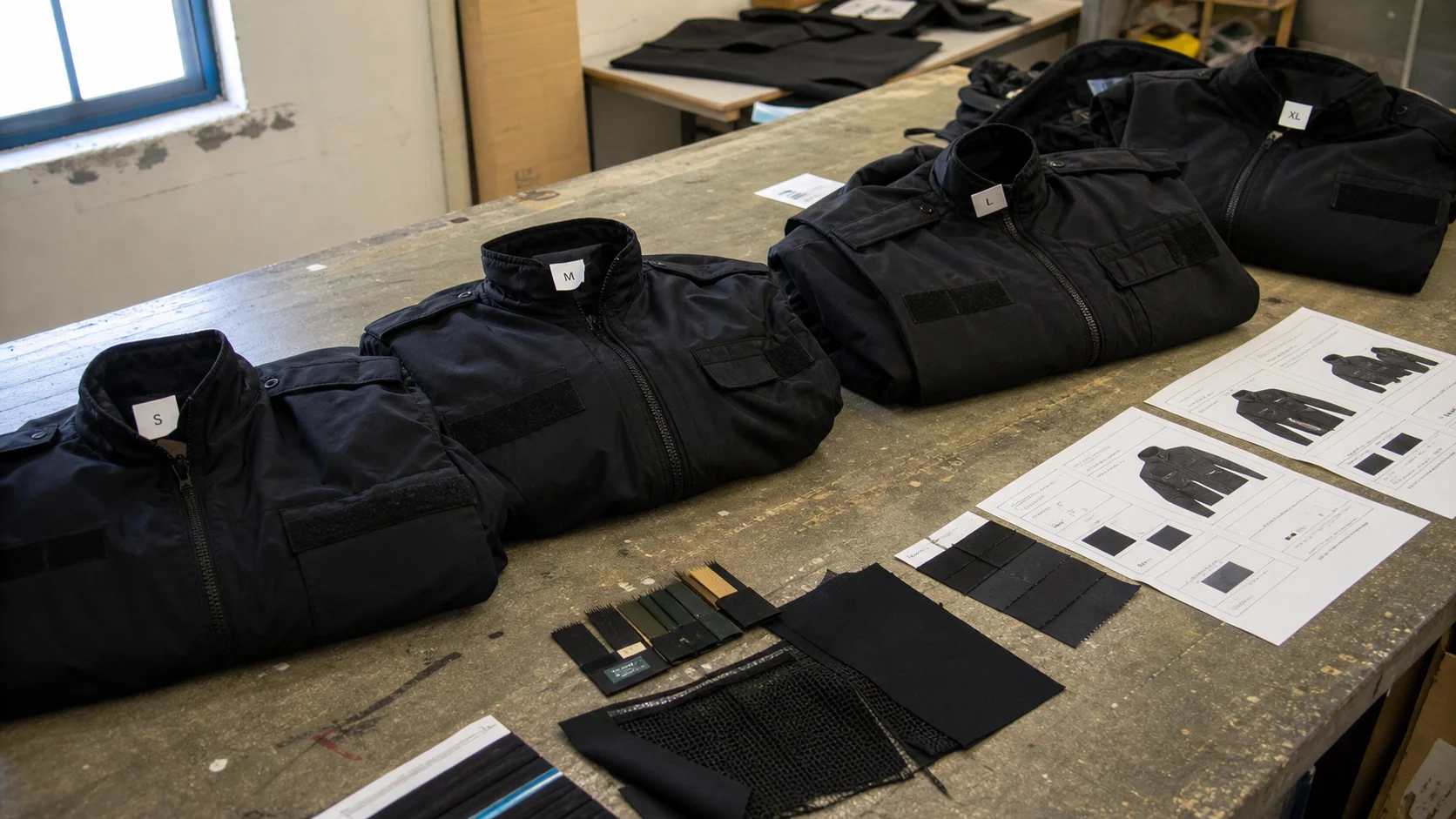
A product-specific SEO outline for evaluating bulk storm jacket size grading, fit consistency, and production details for cleaning crews working in wet,...
Storm Jacket Size Grading Review for Crews - Fabrikn production reference
Bulk storm jacket size grading review for cleaning crews is not a cosmetic detail. It is a purchasing control point that affects worker comfort, garment usability, return rates, replacement costs, and brand presentation across a distributed workforce. Cleaning teams often work before opening hours, after closing, near loading bays, in wet parking areas, around building entrances, and sometimes between indoor and outdoor zones within the same shift. A storm jacket that looks acceptable on a hanger can fail quickly if the size grading does not support bending, reaching, layering, and fast movement.
For B2B buyers, the main issue is not whether a jacket comes in small, medium, large, and extra large. The real question is whether each size grows correctly across the body, sleeve, shoulder, hood, and hem while keeping the intended protective function. Poor grading creates predictable problems. Smaller sizes may feel too tight over uniform shirts. Larger sizes may gain too much body width without enough sleeve balance. Hoods may become oversized and unstable. Cuffs may not seal well. The jacket may fit one sample size but fail across the full order.
Cleaning crew outerwear also has a different fit requirement from retail fashion jackets. The garment must look tidy but cannot be too close-fitting. It must allow movement but should not be so loose that it catches on carts, equipment handles, door hardware, or shelving. It must allow light to moderate layering without turning into a bulky shell that slows workers down. Size grading is the tool that keeps this balance consistent from XS through 4XL, 5XL, or larger where required.
When sourcing storm jackets in bulk, buyers should review grading before committing to production. A careful review should include measurement charts, fit samples, wearer trial feedback, fabric behavior, trim placement, and inspection tolerances. This is especially important for cleaning service providers, facilities management companies, hospitality groups, education contractors, healthcare support teams, and municipal cleaning operations that may need consistent outerwear across multiple sites.
Purchasing judgment: do not approve a storm jacket program based only on one medium or large sample. Bulk crew orders need size-set review because the worst fit problems often appear at the smallest and largest sizes.
Cleaning crews use storm jackets in practical, repetitive conditions. The jacket may be worn while unloading supplies, moving bins, pressure washing entry zones, cleaning outdoor seating, crossing exposed areas, or handling waste collection routes. These tasks create fit demands that are different from a commuter jacket or promotional shell.
The wearer needs enough shoulder and back room to reach forward. Sleeve length must remain usable when arms extend. The hem should cover the lower back during bending without becoming long enough to interfere with movement. The hood should provide coverage without blocking side vision. Cuffs need adjustment or elastic control so rain does not run inside the sleeve. If the crew wears gloves, cuff construction becomes more important.
Layering is another grading factor. Many cleaning crews wear polo shirts, work shirts, fleece layers, thermal tops, or high-visibility vests depending on the site. A storm jacket for summer rain may need a lighter fit allowance than a jacket intended for cold-weather shifts. Buyers should define the layering assumption before approving measurements. A jacket graded for a single uniform shirt may feel undersized when worn over a sweatshirt.
There is also a gender and body-shape consideration. Some buyers use a unisex jacket to simplify ordering and inventory. That can work, but only if the grading has been reviewed carefully. Unisex outerwear often fits male body shapes better in the base block and may create excess shoulder width or tight hip circumference for some wearers. A separate women’s cut can improve fit, but it increases SKU complexity, MOQ pressure, inventory planning, and sample development time.
The right answer depends on workforce profile, budget, and replenishment needs. For many cleaning crew programs, a well-graded unisex jacket with broad size coverage is the most manageable option. For higher-retention uniform programs or customer-facing crews, offering both men’s/unisex and women’s fits may reduce complaints and improve appearance.
Size grading is the systematic increase or decrease of measurements from a base size. For storm jackets, the base size is often medium or large, depending on the supplier’s standard. The grading rule determines how much chest, waist, hem, shoulder, sleeve length, body length, hood size, cuff opening, and other points change between sizes.
A basic size chart may show chest width and body length, but that is not enough for bulk approval. Cleaning crew storm jackets should be reviewed with a full technical measurement chart. At minimum, buyers should request measurements for:
Storm jackets usually require more ease than shirts. A common buying mistake is comparing jacket chest measurements directly to polo or sweatshirt measurements without allowing for outerwear layering. The jacket needs enough room over the base uniform. If waterproof or water-resistant fabric has limited stretch, extra mobility ease becomes even more important.
Grading increments vary by brand standard and target market. A typical adult unisex outerwear grade may increase half-chest by about 1 inch to 1.5 inches per size, meaning total chest grows by about 2 inches to 3 inches. Body length may increase by about 0.5 inch to 1 inch per size, although many suppliers use smaller length increments across middle sizes and more caution at extended sizes. Sleeve length may increase by about 0.5 inch per size, but this depends on whether the sleeve is measured from shoulder point, center back, or collar seam.
These are general ranges, not fixed rules. The right grade depends on the pattern block, intended fit, fabric thickness, lining, and workforce body profile. Buyers should ask the supplier to explain the grading logic rather than simply accepting a standard chart.
The chest measurement is often the first point buyers check, but the upper back is just as important for cleaning crews. Workers frequently push carts, carry supplies, lift bags, and reach across surfaces. If the upper back is tight, the jacket may pull across the shoulder blades even when the chest looks acceptable at rest.
For a storm jacket, the fit model should test forward reach. Ask the wearer to extend both arms forward, bend slightly, and simulate pushing or carrying. If the back pulls sharply or the sleeve rides too far up the arm, the grading may need adjustment. This issue often appears in larger sizes when the chest grade increases but the sleeve and back shaping do not keep up.
Shoulder grading needs balance. Too narrow, and movement is restricted. Too wide, and the jacket looks sloppy while sleeve heads drop too far down the arm. Dropped shoulders may be acceptable in some relaxed outerwear designs, but they can become a problem for workwear if sleeve length and cuff control are not adjusted.
For unisex storm jackets, shoulder fit should be reviewed on multiple body types. A jacket that fits broad shoulders may overwhelm smaller wearers. If the order includes many XS, S, 3XL, and 4XL units, the shoulder grade deserves extra attention.
Sleeve length is one of the most visible grading risks in bulk outerwear. In small sizes, sleeves may run too long if the grade is not reduced enough from the base size. In extended sizes, sleeves may not grow enough, especially for taller workers. Adjustable cuffs help manage variation, but they do not fully solve poor sleeve grading.
Hook-and-loop cuffs, snap tabs, elastic cuffs, or partial elastic with tab adjustment are common options. Hook-and-loop offers flexibility but can collect lint and lose grip if low-quality materials are used. Elastic is simple and cost-effective, but tight elastic may feel uncomfortable during long shifts. Snap tabs look cleaner but offer fewer adjustment positions.
Cleaning crews bend frequently. A storm jacket should provide enough back coverage so the lower back is not exposed when the wearer leans forward. At the same time, a jacket that is too long can interfere with crouching, climbing steps, sitting in service vehicles, or moving quickly between tasks.
Back body length should be reviewed by size. Some jackets use a slight drop tail for extra coverage. This is useful for outdoor cleaning and wet weather, but it must be controlled so it does not look uneven or bulky in larger sizes.
Hood grading is often overlooked. A hood that fits the base sample can become too small in larger sizes or too large in smaller sizes. Cleaning crews need visibility and secure coverage. If the hood opening is too wide, rain protection drops. If the hood is too deep, it can obstruct side vision.
For workwear storm jackets, adjustable drawcords, toggles, or elastic binding can improve hood function. Drawcord use should be reviewed against workplace safety policies, especially where cords could catch on equipment. Some buyers prefer detachable hoods for flexibility, but detachable parts increase trim cost and can create replacement issues.
Pocket placement changes with grading if the pattern is not controlled. On larger sizes, pockets may sit too far apart or too low. On smaller sizes, pockets may crowd the front zipper. Cleaning crew jackets often need secure pockets for keys, access cards, small tools, or phones. Pocket bags should be large enough without sagging or interfering with movement.
Zippered pockets cost more than open welt or flap pockets, but they are often worth considering for crews moving between indoor and outdoor tasks. If the garment is used in heavy rain, pocket construction should be reviewed for water entry risk.
Bulk storm jacket size planning should start with workforce data. Guessing size ratios is risky, especially for cleaning crews with mixed ages, genders, body shapes, and regional labor pools. If prior uniform data is available, use it. If not, collect wearer measurements or run a size trial before placing a large order.
A common adult unisex size range for cleaning crew outerwear is XS to 4XL. Some programs may require XXS, 5XL, or 6XL. Extended sizes can be important for inclusivity and worker comfort, but they may trigger higher MOQs, surcharges, pattern development fees, or longer lead times.
Program Type Suggested Size Range Purchasing Notes Small local crew S to 3XL, with limited XS/4XL if needed Use actual staff sizing where possible. Avoid overbuying rare sizes unless turnover is high. Regional cleaning contractor XS to 4XL Maintain buffer stock in M to 2XL. Confirm replenishment terms for edge sizes. National facilities program XS to 5XL or broader Request full size-set samples. Consider separate grading review for extended sizes. Customer-facing hospitality cleaning team Men’s/unisex and women’s options, often XS to 4XL Better fit presentation, but more SKUs and higher inventory complexity.Order ratios depend heavily on workforce profile. A basic unisex distribution may concentrate in M, L, XL, and 2XL, with lower quantities in XS, S, 3XL, and 4XL. A rough starting point for planning might be 5% XS, 10% S, 20% M, 25% L, 20% XL, 12% 2XL, 5% 3XL, and 3% 4XL. This is only a planning model. It should be corrected with real employee data before purchase.
For buyers with seasonal turnover, it may be better to hold extra stock in common sizes rather than ordering too tightly. At the same time, excessive inventory in slow-moving sizes ties up budget. The best purchasing approach is to combine an initial bulk order with a clear replenishment plan.
Storm jacket grading cannot be separated from fabric and trim choices. The same measurement chart can feel different depending on shell fabric weight, coating, lining, seam construction, and hardware.
Common storm jacket shell fabrics include polyester pongee, polyester taslan, nylon taslan, polyester oxford, and laminated performance fabrics. Polyester is widely used because it is cost-effective, color-stable, and suitable for many water-resistant finishes. Nylon may offer a softer hand or higher abrasion performance in some constructions, but it can cost more and may behave differently in dyeing and finishing.
For cleaning crews, a practical shell often needs water resistance, wind protection, and moderate durability rather than high-end mountaineering performance. Buyers should clarify whether the jacket is water-resistant or waterproof. These are not the same. Water-resistant jackets may handle light rain but can leak under sustained exposure. Waterproof jackets usually require membrane or coating performance plus seam sealing or seam taping, depending on the claim.
PU coating, TPU film, or laminated membranes can improve water protection. The tradeoff is breathability, handfeel, cost, and production complexity. Cleaning work can be physically active, so a jacket that traps heat may be uncomfortable even if it blocks rain well.
If the crew works in mild rain and short outdoor intervals, a water-resistant shell with good ventilation may be more practical than a fully waterproof sealed jacket. If crews work for long periods outdoors, waterproof construction becomes more important. Buyers should specify expected conditions rather than asking for the “best” jacket in general terms.
Mesh lining improves airflow and reduces cling. Taffeta lining slides easily over uniform layers. Fleece lining adds warmth but changes fit significantly and may require more body and sleeve ease. Quilted lining adds insulation but increases bulk at seams and armholes.
When reviewing grading, the fit sample must use the correct lining. A shell-only sample cannot accurately represent a lined production jacket. If the supplier changes lining after sample approval, measurements and comfort may change.
Front zipper quality affects usability and longevity. Cleaning crews may open and close jackets frequently during shifts. A low-quality zipper can become a high-complaint component. Buyers should specify zipper type, slider quality, puller size, and whether storm flaps are required.
Plastic molded zippers are common for outerwear and can be durable. Coil zippers are flexible and often used on lighter jackets. Waterproof zippers increase cost and may be stiffer. For many cleaning crew jackets, a standard zipper with an effective storm flap is a practical balance.
Seam allowance, seam taping, and seam placement affect fit and weather performance. Taped seams are important for waterproof claims, but they add production time and require process control. Poor tape adhesion can fail during wear or laundering. Seams around shoulders, hood, armholes, and pockets are common leakage points.
Cleaning crew jackets may be laundered more frequently than casual outerwear. Buyers should request care instructions and review whether coating, reflective trims, heat transfers, embroidery, or seam tape can tolerate the expected cleaning process.
Some cleaning crews work near traffic lanes, parking lots, loading docks, or waste collection zones. Reflective piping, reflective tape, or high-visibility color blocking may be required. These details affect pattern placement and grading. Reflective tape must remain correctly positioned across sizes, especially around chest, sleeves, and back.
High-visibility compliance depends on the standard required in the buyer’s market and work environment. Do not assume that adding reflective tape makes a garment compliant. If compliance is needed, specify the applicable standard and request supporting documentation.
A disciplined sample process reduces expensive mistakes. Bulk storm jacket orders should not move directly from quotation to production without proper sample review, especially when size grading is part of the brief.
Start with a clear product brief. Include target wearer, use conditions, size range, fabric, lining, trims, colors, branding, packaging, and expected delivery date. Provide a measurement chart if available. If not, ask the supplier to propose one and explain the fit standard.
Buyers working on custom outerwear programs can review service options through Fabrikn’s services page to understand how development, sourcing, and production coordination can be structured.
The proto sample confirms the design direction, construction feasibility, and general fit. It may use substitute fabric or trims if the correct materials are not ready, but substitutes should be documented. Do not treat a proto as final approval unless all major materials and measurements match the intended production spec.
The fit sample should be made in the base size using correct or near-correct fabric, lining, and trims. Review chest, shoulder, sleeve, hood, body length, pocket placement, and movement. Wearer trials should include actual cleaning motions, not just standing front and side photos.
The size-set sample is the critical stage for grading review. It includes multiple sizes, often the full range or selected sizes such as S, L, 2XL, and 4XL. For large programs, full size-set review is preferable. Edge sizes should always be checked because grading errors are more visible there.
During size-set review, compare actual measurements against the approved chart and tolerance. Common tolerances for outerwear may be around plus or minus 0.5 inch for many width points and plus or minus 0.75 inch to 1 inch for some length points, depending on the construction and buyer standard. Tolerances should be agreed before production.
The pre-production sample should represent final approved materials, trims, labels, branding, packaging, and workmanship. This is the final checkpoint before bulk cutting. If the pre-production sample is approved with comments, those comments must be clear and measurable. Vague notes such as “make fit better” are not enough.
Production should begin only after written approval of measurement chart, graded size rules, fabric standard, color standard, trim list, logo placement, packaging method, and inspection criteria. This documentation protects both buyer and supplier when questions arise later.
Purchasing judgment: if the schedule does not allow size-set review, reduce the risk by limiting size range, using a proven supplier block, or placing a smaller first order. Skipping grading review on a broad-size bulk order is rarely worth the short-term time saving.
MOQ and lead time vary by supplier, fabric availability, customization level, and country of production. Buyers should treat any quoted number as conditional until the supplier confirms fabric, trims, size range, color count, and branding method.
Order Type Typical MOQ Range Lead-Time Considerations Blank or lightly customized stock jacket 50 to 300 pieces Fastest option if sizes and colors are in stock. Fit customization is limited. Private label storm jacket using existing block 300 to 800 pieces Moderate lead time. Branding, color, and trim changes may be possible. Custom storm jacket with graded size set 500 to 1,500 pieces Longer development due to pattern, samples, fabric sourcing, and approvals. Waterproof jacket with seam taping 800 to 2,000 pieces Requires more technical production control and inspection time.Typical development and production timelines can range from 6 to 14 weeks after order confirmation, depending on material readiness and sample approvals. Custom fabric, lab dips, printed lining, reflective compliance testing, seam sealing, and extended size grading can add time. Peak season capacity can also affect delivery.
Buyers often ask for low MOQ, full customization, broad size range, fast delivery, and low unit cost at the same time. In practice, those goals conflict. A lower MOQ usually means using available fabrics and existing patterns. Full customization usually requires more sampling, higher MOQ, and longer lead time. Broad size ranges increase pattern work and inventory complexity. Waterproof construction raises cost and inspection requirements.
A practical sourcing strategy is to separate must-have requirements from preferences. For cleaning crews, must-haves may include water resistance, safe movement, correct size grading, durable zipper, secure pockets, and company branding. Nice-to-haves may include premium membrane, multiple color panels, detachable hood, or complex pocket systems. Spending budget on fit and durable core trims usually creates more value than adding features that workers may not use.
Inspection should be planned before production, not after cartons are packed. Storm jackets have several risk areas that require specific attention.
Outerwear measurements can vary due to fabric handling, seam bulk, lining tension, quilting, and finishing. Inspectors should measure multiple units across sizes. The inspection plan should include edge sizes, not only the most common sizes.
Common measurement issues include uneven sleeve length, inconsistent body length, tight armholes, mismatched hood dimensions, and hem width outside tolerance. If the jacket has elastic or drawcord adjustment, the measurement method must define whether the garment is measured relaxed, extended, or closed.
Storm jackets often use shell fabric, lining, zipper tape, drawcord, labels, reflective trim, and embroidery threads. Shade matching across components can be difficult. Buyers should approve color standards before production and allow realistic tolerance for different material types. Dark navy, black, charcoal, royal blue, and safety colors can all show variation depending on fabric and lighting.
If the jacket is sold as water-resistant or waterproof, testing should match the claim. Basic water spray checks can identify obvious problems, but they are not a substitute for formal lab testing where performance claims are important. Seam leakage is a particular concern around shoulders, hood seams, pocket entries, and zipper areas.
Zippers should run smoothly without catching lining or storm flap fabric. Snaps should be secure but not so tight that they damage the fabric. Pullers should be large enough for gloved or wet hands if the crew works outdoors. Inspectors should check function repeatedly, not only visually.
Reflective tape or piping must be aligned and securely attached. Heat-applied reflective trims can peel if application temperature, pressure, or dwell time is wrong. Sewn reflective tape can pucker if tension is poorly controlled. Placement should be checked against the graded pattern so visibility remains consistent across sizes.
Embroidery, heat transfer, woven patches, and screen printing all carry risks. Embroidery can create puckering on lightweight shells. Heat transfers can peel on coated fabrics if compatibility is poor. Screen printing may crack if the fabric stretches or coating resists ink adhesion. Buyers should request branding tests on the actual shell fabric before bulk production.
For buyers planning a new jacket order or correcting an existing uniform issue, direct consultation can help clarify specs before production. The Fabrikn contact page is the most direct route for discussing requirements, timelines, and sourcing constraints.
A bulk storm jacket order for cleaning crews should be reviewed with a checklist that connects fit, grading, fabric, trims, and operational use. The goal is to avoid approving a jacket that meets a price target but fails in the field.
There is no single best storm jacket specification for every cleaning crew. The right choice depends on risk, budget, and operating conditions. A fully waterproof, seam-taped jacket may be justified for crews working long outdoor shifts in sustained rain. For crews moving between buildings, a breathable water-resistant jacket may be more comfortable and cost-effective.
A unisex jacket simplifies procurement and reduces SKU load, but fit will be less precise across body types. Separate gender fits improve appearance and comfort for some teams, but they raise inventory and MOQ pressure. Extended sizes improve inclusivity and reduce wearer complaints, but buyers must check grading carefully because scaling a standard block into 5XL or 6XL without adjustment can create poor proportions.
Low-cost zippers, weak cuff tabs, and poor pocket construction can undermine the whole program. If the budget is tight, prioritize fit, shell durability, zipper quality, and weather protection before adding decorative details. For cleaning crews, practical function beats complex styling.
Supplier selection also matters. A supplier that can explain grading, sample stages, tolerance control, and inspection risks is usually a safer choice than one offering only a low unit price. Buyers can learn more about company background and sourcing focus through Fabrikn’s about page.
For many cleaning crew programs, a balanced storm jacket specification may include a polyester or nylon shell with durable water-repellent finish, mesh or taffeta lining, adjustable cuffs, storm flap, secure zippered pockets, adjustable hood, and controlled unisex grading from XS to 4XL. If the crew faces stronger weather exposure, consider waterproof coating or membrane with seam sealing at critical seams.
The measurement chart should allow layering while avoiding excess bulk. The base size should be tested over the actual uniform. Edge sizes should be reviewed through size-set samples. Branding should be tested on final fabric, especially if using heat transfer or embroidery. Inspection should include measurements, seam quality, zipper function, water-resistance checks, color shade review, and packing accuracy.
Buyers should document every approval. A storm jacket program has too many variables to rely on verbal confirmation. Approved samples, spec sheets, graded measurements, trim cards, lab dips, logo artwork, care labels, and inspection standards should all be retained. This documentation is also useful for reorders, where suppliers may change fabric lots, trims, or production lines unless the standard is clearly locked.
Bulk storm jacket size grading review for cleaning crews is a practical sourcing step that protects the buyer from fit complaints, wasted inventory, and inconsistent worker presentation. The jacket must support movement, layering, rain protection, and repeated use. That requires more than a basic size chart.
The strongest purchasing process starts with a clear use case, then moves through technical specifications, fit sample review, size-set approval, controlled production, and inspection. Buyers should pay special attention to chest and back mobility, sleeve grading, hood function, cuff control, body length, pocket placement, fabric behavior, and trim durability.
A low unit price is not valuable if the jacket restricts movement, leaks early, or fits poorly across the size range. A well-graded storm jacket may cost more upfront, but it is usually easier to issue, easier to reorder, and more acceptable to the crew. For cleaning operations where outerwear is part of daily work, fit consistency is not a luxury. It is part of the uniform’s performance.
Get a free quote from Fabrikn — your trusted B2B clothing manufacturer with 10+ years of experience. MOQ as low as 200 pieces.
Get a Free Quote →Size grading is the process of increasing or decreasing garment measurements across sizes from a base pattern. For storm jackets, this includes chest, shoulder, sleeve, body length, hood, cuffs, hem, and pocket placement.
Cleaning crews bend, reach, carry supplies, push carts, and move between indoor and outdoor areas. Poor grading can restrict movement, create sleeve problems, reduce weather protection, and cause inconsistent fit across the workforce.
A common unisex range is XS to 4XL. Larger programs may need XXS, 5XL, or 6XL. Extended sizes should be reviewed carefully because standard grading may not work well at the far end of the range.
Unisex jackets simplify ordering and inventory. Separate fits can improve comfort and appearance, but they add SKUs, sampling work, MOQ pressure, and stock planning complexity. The best choice depends on workforce profile and budget.
Stock or lightly customized jackets may start around 50 to 300 pieces. Private label jackets often fall around 300 to 800 pieces. Fully custom storm jackets may require 500 to 1,500 pieces or more, depending on fabric, trims, size range, and construction.
Typical timelines may range from 6 to 14 weeks after order confirmation. Sampling, fabric sourcing, lab dips, trim approvals, seam taping, branding tests, and size-set review can extend the schedule.
Buyers should check chest, waist or mid-body, hem, shoulder, sleeve length, bicep, cuff opening, front and back length, hood dimensions, collar height, and pocket placement. Edge sizes should be measured, not only the base size.
Not always. Waterproof jackets provide stronger rain protection but can cost more, feel stiffer, and reduce breathability. Water-resistant jackets may be more comfortable and economical for crews with short outdoor exposure.
Common risks include measurement variance, zipper defects, seam leakage, poor hood fit, sleeve length inconsistency, reflective trim misplacement, shade variation, branding defects, and carton packing errors by size.
Buyers should approve the final pre-production sample, full measurement chart, size grading, fabric standard, trim card, color standard, logo placement, care label, packaging method, inspection criteria, and delivery schedule.