
A practical SEO outline for retail operations teams auditing bulk thermal parkas before store rollout, covering labeling, insulation, fit, safety,...
Bulk Thermal Parka Compliance Checklist for Retail Ops - Quality & Inspection manufacturing guide
Bulk thermal parka programs carry more compliance risk than lighter seasonal apparel because there are more materials, more performance claims, more trim components, and more points where production can drift from the approved sample. For retail operations teams, the issue is not only whether the parka looks good on a hanger. The issue is whether every carton arriving at the DC can be received, scanned, allocated, displayed, and sold without chargebacks, relabeling, customer complaints, or regulatory exposure.
This checklist is written for sourcing, merchandising, QA, logistics, and retail operations teams managing bulk thermal parka orders. It focuses on practical controls: what to define before purchase order placement, what to verify during sampling, what to inspect before shipment, and what to watch when goods arrive. Thermal parkas are often promoted as cold-weather, insulated, water-resistant, wind-blocking, or outdoor-ready products, so documentation must match the claims being made at retail.
For broader production support, teams can review manufacturing service capabilities at Fabrikn services, learn more about company background at Fabrikn about us, or discuss a specific bulk parka program through Fabrikn contact us.
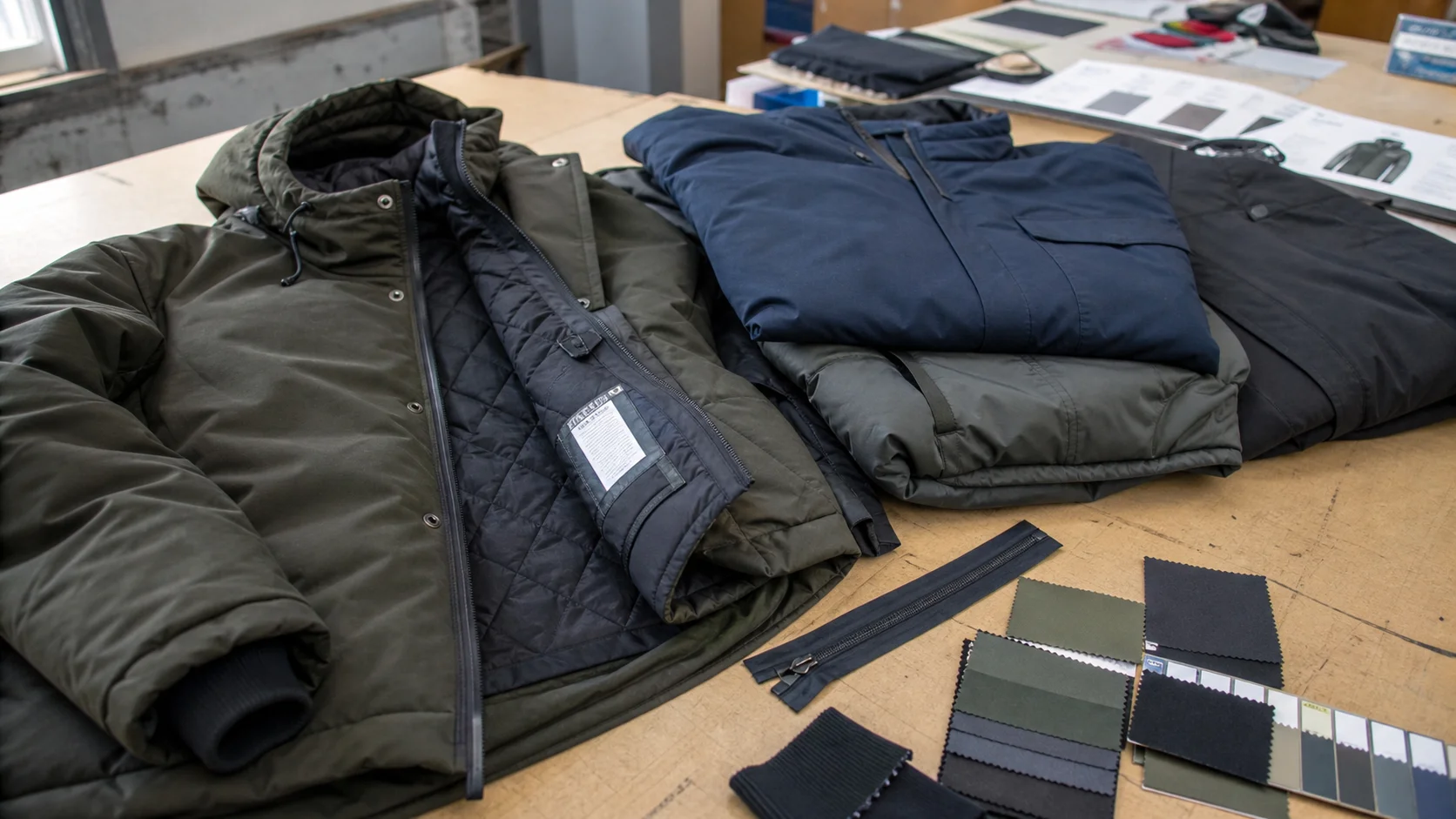
A thermal parka is a layered product. Shell fabric, coating or laminate, padding, lining, zipper systems, snaps, drawcords, elastic, labels, hangtags, polybags, and cartons all need to align with the purchase order and market requirements. A simple fleece hoodie may have fewer testing and labeling concerns. A bulk parka can fail commercially even when the garment is technically wearable, because retail operations depend on consistency.
Retail teams usually feel the cost of non-compliance after the factory has already shipped. Wrong carton markings slow receiving. Incorrect barcodes delay allocation. Fiber content errors create relabeling costs. Water-resistant claims without supporting test data can trigger legal or customer-service risk. Poor insulation distribution creates returns. Weak zippers create negative reviews. Color variance across sizes makes the floor set look fragmented.
The most effective approach is to treat compliance as a purchase-order condition, not a final-inspection scramble. The supplier should know exactly which standards apply, which documents are required, which samples need approval, and which defects will lead to rejection before production begins.
Practical purchasing judgment: if the parka will be sold under a performance message such as “thermal,” “weather-resistant,” or “outdoor,” do not rely on visual approval alone. Require material specifications, approved test reports, and shipment inspection tied to the actual bulk lot.
The pre-PO stage is where many future problems can be removed. Once bulk fabric is booked and trims are ordered, changes become expensive and may affect delivery. Retail operations should align with sourcing and QA before issuing the purchase order.
Compliance requirements depend on where the parka will be sold. A product shipped to the United States, European Union, United Kingdom, Canada, or other markets may need different labeling formats, language requirements, chemical restrictions, and children’s product controls. Teams should document the intended market at style level.
Not every outerwear supplier is suitable for thermal parka production. A factory may sew lightweight jackets well but struggle with bulky insulation, quilting alignment, waterproof zipper handling, seam sealing, or hood construction. Retail teams should require capability confirmation before committing to large volume.
The purchase order should state who pays for testing, who arranges inspection, who approves labels, and who owns corrective action if failures occur. Vague responsibility usually leads to delays when production is already underway.
A strong technical package is the anchor for parka compliance. It should include more than a sketch and size chart. Thermal parkas require detailed construction notes because small specification gaps can lead to major production variation.
Thermal parkas are bulky, so measurement tolerances must be realistic. A tolerance that works for a woven shirt may be too tight for insulated outerwear. At the same time, loose tolerances create fit inconsistency across the size run.
Measurement Point Typical Tolerance Guidance Retail Risk if Uncontrolled Chest width Often around +/- 1 cm to +/- 1.5 cm depending on size range and construction Fit complaints, size exchanges, inconsistent size runs Body length Often around +/- 1 cm to +/- 1.5 cm Uneven appearance on mannequins and product imagery mismatch Sleeve length Often around +/- 1 cm Returns from poor arm coverage or excessive sleeve length Hood opening Often around +/- 1 cm, tighter if fixed hood shape is important Poor coverage, uncomfortable fit, inconsistent styling Pocket placement Often around +/- 0.5 cm to +/- 1 cm Visual defects, poor hand entry, mismatched left and right panelsExact tolerances should be agreed based on style complexity, fabric thickness, size range, and retailer standards. The important point is to approve them before production, then inspect against the same document.
The material specification is where thermal parka performance begins. Bulk production should not proceed from generic descriptions such as “polyester shell” or “warm padding.” Retail teams need enough detail to verify that production matches the approved product.
Shell fabric affects appearance, hand feel, durability, water resistance, wind resistance, and print or embroidery compatibility. The specification should be written clearly enough that the supplier cannot substitute a lower-cost fabric without approval.
Insulation is often the main selling point. It also creates inspection challenges because thickness and warmth are not always obvious from visual inspection. If the retail message says “thermal,” the product should have an insulation specification that can be checked.
For value-driven fashion parkas, synthetic polyester padding is common because it is cost-effective and easier to source at scale. For higher-end outdoor programs, insulation performance claims may require stronger testing and tighter material control. The tradeoff is simple: stronger claims help sell the garment, but they increase documentation and failure risk if not properly supported.
Lining affects comfort, sleeve entry, warmth perception, and durability. A low-quality lining can tear at the armhole, catch on inner garments, or create static problems.
Trims are a common failure point in bulk parka production. Zippers, snaps, toggles, drawcords, hook-and-loop tape, elastic cuffs, and stoppers all need defined specifications and tests.
Purchasing judgment: do not approve “or equivalent” trims without a control process. Equivalent trims should match function, appearance, durability, chemical compliance, and retail presentation, not just price.
Retail operations teams often inherit labeling problems after goods arrive. This is why label and packaging compliance should be reviewed during sample approval, not after production. A parka may pass garment inspection and still fail receiving because the barcode, carton label, care label, or size sticker is wrong.
Care labels must match the actual product composition and market rules. Outerwear can include multiple components, so the label should distinguish shell, lining, filling, and trim where required. Recycled content claims should be supported by the correct documentation and chain-of-custody requirements if the retailer uses them.
Size errors create expensive downstream work. A parka carton with mixed incorrect size stickers can be difficult to fix quickly because each garment is bulky and handling time is high.
Thermal parkas take up space. Poor packaging can increase freight cost, damage garments, or create receiving delays. Carton size and weight also affect warehouse handling.
Sampling is not a single photo approval. A proper parka sampling workflow reduces the risk of rework and failed inspection. The buyer and supplier should agree on which samples are required and what each sample must prove.
Retail operations should treat the pre-production sample as the controlling sample for bulk production. If the factory uses substitute fabric, trims, labels, or insulation after approval, a new approval should be required. This is especially important when lead times tighten and suppliers try to recover schedule by changing material sources.
Testing should match both the product and the claims. A basic fashion parka may need colorfastness, dimensional stability, seam strength, and chemical compliance. A technical outdoor parka may require water resistance, thermal performance, abrasion, tear strength, and component durability. Children’s outerwear may require additional safety controls.
Performance wording must be supported. “Water-resistant” is different from “waterproof.” “Thermal” can be interpreted broadly, but the product still needs a defensible insulation specification. “Recycled” requires documentation that matches the retailer’s claim standard.
Retail Claim Typical Support Needed Risk if Unsupported Thermal or insulated Fill type, fill weight, construction details, possible thermal testing depending on market claim Customer complaints, misleading claim risk, inconsistent warmth perception Water-resistant Spray rating, water repellency test, coating or DWR documentation Returns after wet-weather use, claim challenge Waterproof Hydrostatic pressure, seam sealing details, garment-level performance review High failure risk if seams, zippers, and construction are not aligned Wind-resistant Air permeability or related fabric test Marketing overstatement, poor outdoor performance Recycled material Supplier certification, transaction records, fiber content claim review Documentation failure, retailer claim riskTesting lead time should be built into the production calendar. Standard fabric and garment tests may take several working days once samples reach the lab. More complex chemical or performance testing can take longer. If test failure occurs late, shipment can miss the retail floor set. Testing should start as soon as bulk materials are available, not after finished goods are packed.
Bulk parka production should be controlled at multiple points. Waiting until final inspection gives the factory little room to correct systemic problems such as wrong quilting spacing, poor padding distribution, incorrect seam allowance, or defective zipper application.
Fabric and insulation should be checked before cutting. Once fabric is cut, shade variation and defects are harder to manage.
Outerwear panels can shift during cutting, particularly with slippery synthetic shell fabric or thick layups. Poor cutting creates measurement problems and mismatched seams.
Thermal parkas require attention to seam bulk, needle damage, topstitching, zipper alignment, hood attachment, and pocket construction. Sewing defects are visible and functional.
Finishing should not damage performance finishes or create packing problems. Heavy steaming or pressing can flatten insulation, affect coatings, or create shine marks on synthetic fabric.
Final inspection should confirm that bulk production matches the approved standard and can ship without creating retail operations problems. A typical inspection may use AQL sampling, though the exact AQL level depends on the buyer’s policy, product risk, and order value. Many apparel inspections use general inspection level II with separate acceptable quality limits for critical, major, and minor defects, but retail programs may set stricter rules for branded outerwear.
Inspectors should measure selected garments across size and color. Parkas should be laid flat in a consistent way, because insulation bulk can change measurement results. The inspection report should state the method used if measurement disputes are likely.
Simple function tests catch many retail complaints before shipment. They should be repeated across the sample lot, not only on one display garment.
For retail operations, packing inspection is as important as garment inspection. Wrong carton assortments can delay allocation and force DC rework.
Once bulk thermal parkas arrive, retail operations teams need fast verification. DC receiving is not the place to discover major specification errors, but it should catch shipment-level issues before goods move to stores or e-commerce fulfillment.
Thermal parkas often sell through both stores and online channels. The same compliance controls help both channels, but e-commerce has additional sensitivity to product content accuracy. If the online listing says the parka has a detachable hood, fleece lining, or water-resistant shell, the shipped product must match.
Minimum order quantity and lead time depend on fabric, insulation, trim customization, factory capacity, and seasonality. Bulk thermal parkas usually require more planning than basic apparel because fabric mills, padding suppliers, zipper suppliers, and testing labs all influence the schedule.
MOQ varies widely by supplier and material. The ranges below are practical reference points, not fixed rules.
Program Type Typical MOQ Range Notes Stock fabric fashion parka About 300 to 800 pieces per style/color More feasible when using available shell fabric, standard lining, and existing trims Custom color or custom trim parka About 800 to 1,500 pieces per style/color Fabric dyeing, zipper color matching, and custom labels can raise MOQ Performance outerwear parka About 1,000 to 3,000 pieces per style/color Testing, coating, lamination, seam sealing, or nominated trims may increase minimums Down or specialty insulation parka About 1,000 to 3,000+ pieces per style/color Fill sourcing, traceability, and production handling add complexitySmaller MOQ can be possible, but unit cost often rises and material options narrow. Larger volume gives better cost leverage but increases exposure if the fit, claim, or label is wrong. For a new retail program, a cautious first bulk order can be better than chasing the lowest possible unit cost on unproven construction.
Thermal parka lead time usually includes design confirmation, sampling, fabric booking, trim booking, lab testing, production, inspection, packing, and transport. Typical production lead times can range from 60 to 120 days after final approvals, with longer timelines during peak outerwear season or when specialty materials are used.
Tradeoff: air freight can rescue a late delivery, but parkas are bulky and expensive to fly. It is usually cheaper to protect the calendar at sample, fabric, and testing stages than to recover schedule after production slips.
The table below summarizes frequent failure points in bulk thermal parka programs and the controls retail operations teams should expect before shipment.
Risk Area Typical Problem Recommended Control Material substitution Factory changes shell fabric, lining, insulation, or trim to meet cost or timing Require approved BOM, material swatches, test reports, and written approval for substitutions Color inconsistency Shade varies between panels, sizes, or production lots Approve lab dips, inspect bulk rolls, segregate shade lots, review final garments under standard light Insulation variation Garments feel uneven, thin, lumpy, or underfilled Specify fill weight by zone, inspect padding before sewing, check finished garment weight if appropriate Weak closures Zippers jam, snaps detach, drawcord stoppers fail Specify trims clearly, conduct pull and function tests, inspect during inline and final stages Unsupported claims Marketing says waterproof, thermal, recycled, or windproof without evidence Align product copy with test reports, supplier declarations, and actual construction Incorrect labels Wrong fiber content, care instructions, country of origin, language, or size marking Approve label artwork and content before production, inspect labels during packing Barcode errors UPC, EAN, carton barcode, or price ticket does not scan or maps to wrong SKU Scan approved samples and final cartons, cross-check against item master Carton mismatch Carton contents do not match label or packing list Use packing audits, carton drop checks if required, and final inspection carton verification Moisture damage Mold, odor, damp cartons, or coating damage after transit Control factory storage, dry garments before packing, use moisture indicators or desiccants where neededThe following checklist can be adapted for purchase-order files, supplier onboarding, QA inspection instructions, and retail operations handoff.
Bulk thermal parka compliance is not achieved by one inspection at the end of production. It is built through clear product definition, controlled materials, disciplined sampling, appropriate testing, accurate labeling, and shipment-level verification. Retail operations teams should push for early alignment because most costly problems are preventable before production starts.
The main tradeoff is between speed, cost, and control. Using stock materials can reduce MOQ and lead time, but limits differentiation. Custom fabric and trims improve brand presentation, but increase minimums, testing pressure, and schedule risk. Stronger performance claims can support higher retail pricing, but only when the product and documents can defend those claims.
For most retail teams, the safest operating model is to lock the technical package early, approve a true bulk-material pre-production sample, test before the shipment window becomes tight, and inspect both garments and cartons before release. That approach does not remove every risk, but it gives teams a practical system for managing quality, compliance, and retail readiness across bulk thermal parka orders.
Get a free quote from Fabrikn — your trusted B2B clothing manufacturer with 10+ years of experience. MOQ as low as 200 pieces.
Get a Free Quote →A strong checklist should include product specifications, fabric and insulation requirements, trim approvals, label compliance, performance testing, sample approvals, production controls, final inspection, carton verification, and DC receiving checks. Thermal parkas have more components than basic apparel, so the checklist should cover both garment quality and retail operations requirements.
Typical MOQ can range from about 300 to 800 pieces per style/color for stock fabric programs, around 800 to 1,500 pieces for custom color or trim programs, and 1,000 to 3,000+ pieces for performance or specialty insulation parkas. Actual MOQ depends on the supplier, fabric mill, trim requirements, color count, size range, and production season.
A practical production timeline is often 60 to 120 days after final approvals, but the schedule depends on fabric booking, trim sourcing, testing, sample approval speed, factory capacity, and shipping method. Custom coatings, laminated fabrics, down filling, branded trims, and failed lab tests can extend the timeline.
Common tests include fiber content, colorfastness, dimensional stability, seam strength, tear strength, zipper durability, snap attachment, restricted substances, and packaging checks. If the parka is sold with water-resistant, waterproof, wind-resistant, recycled, or thermal performance claims, additional supporting tests and documentation may be needed.
Retail teams should approve barcode artwork before production, scan tickets and carton labels during sample review, verify UPC or EAN data against the item master, and include barcode checks in final inspection. Carton labels should match the actual packed contents, purchase order, size ratio, color, and destination routing.
Common failures include uneven insulation, poor zipper function, open seams, skipped stitches, shade variation, incorrect measurements, weak snaps, wrong labels, barcode errors, carton mismatches, stains, odor, and packing defects. Many of these issues can be reduced through material inspection, inline checks, and a complete pre-shipment inspection.
Photo approval is risky for thermal parkas because photos cannot reliably confirm fabric weight, insulation distribution, zipper strength, label accuracy, measurement tolerance, or performance claims. A physical pre-production sample made with bulk materials should be approved whenever possible, especially for large-volume retail orders.
Ownership should be shared across sourcing, QA, merchandising, logistics, and retail operations. Sourcing controls supplier and cost decisions, QA manages product and inspection standards, merchandising controls claims and presentation, logistics manages routing and carton requirements, and retail operations ensures goods can be received, allocated, and sold correctly.