
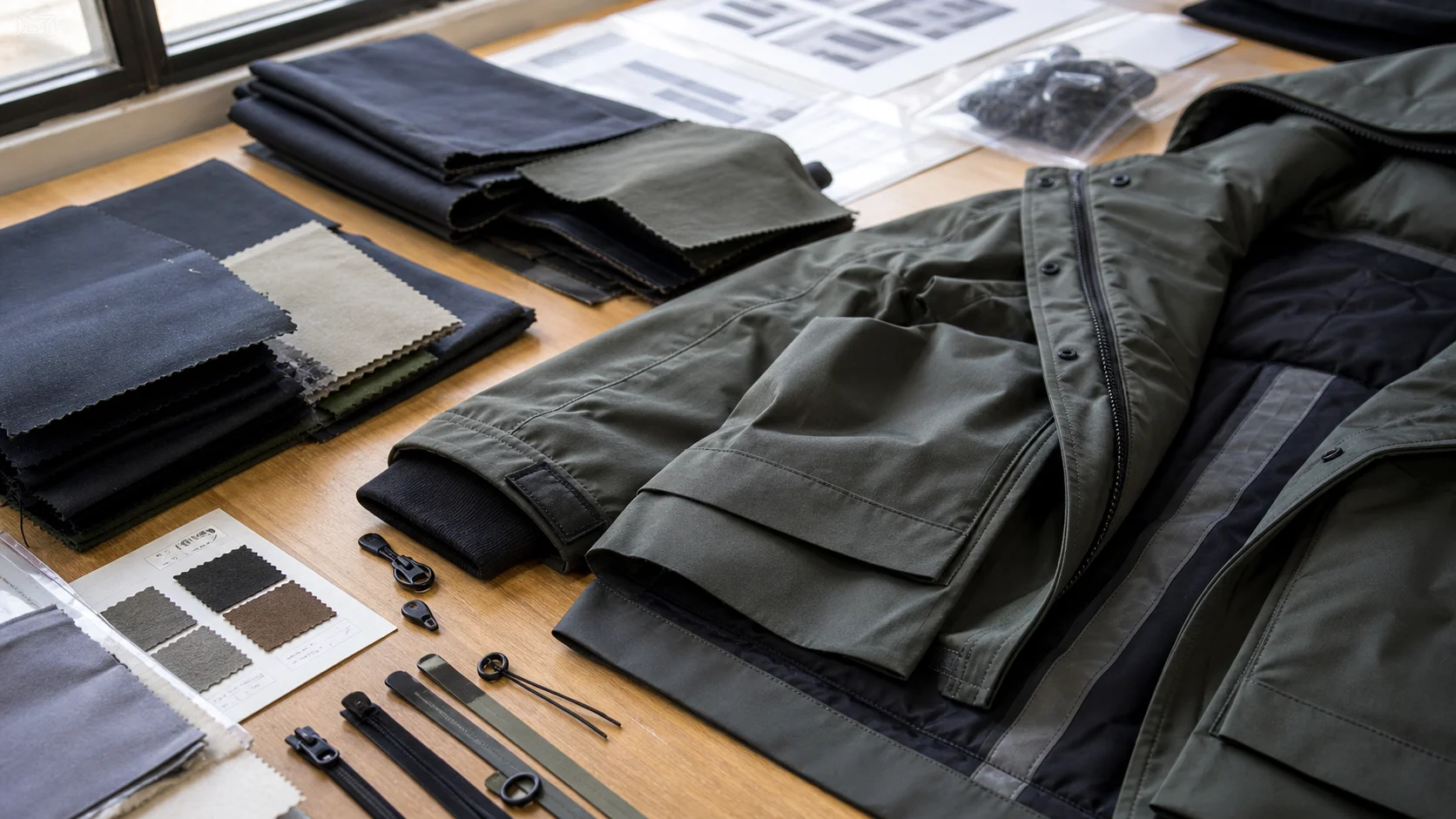
A product-specific outline for transport hub procurement teams evaluating bulk thermal parka fabrics, insulation, weather resistance, durability,...
Thermal Parka Fabric Tests for Hub Buyers - Outerwear & Jackets manufacturing guide
Bulk thermal parka fabric testing is not a formality for transport hub buyers. It is the difference between a uniform program that survives winter operations and one that generates complaints, replacements, and avoidable cost. Airport ground crews, rail station teams, ferry terminal staff, freight handlers, bus depot supervisors, and security teams work in open-air, semi-covered, and constantly changing environments. A parka that looks acceptable in a showroom can fail quickly when exposed to wind, wet snow, oil marks, repeated abrasion, seat belts, radio clips, backpack straps, and long shifts outdoors.
The main buying challenge is that thermal performance cannot be judged by hand feel alone. A thick shell may not be warm. A soft lining may not handle condensation. A waterproof coating may pass a basic water test but crack after laundering. A high-fill insulation may compress at the shoulders and lose loft after a few weeks of wear. For transport hub buyers, the safest approach is to test the complete fabric package before committing to bulk production.
This guide explains the practical tests that matter when sourcing thermal parkas in bulk. It focuses on fabric and material performance, but it also covers trims, sampling, MOQ expectations, lead-time dependencies, and inspection risks. The goal is not to over-test every style. The goal is to test the right things before money is locked into fabric, trims, and production capacity.
Purchasing judgment: if a parka is being used by outdoor transport staff in winter, do not approve bulk fabric based only on GSM, photos, and one salesman sample. Request test reports, confirm the exact fabric composition, and run a wear-relevant sample review before approving production.
Transport hub outerwear sits between workwear, corporate uniform, and weather protection. It must look consistent across teams, carry branding cleanly, and perform under unpredictable conditions. This is different from fashion outerwear, where appearance and seasonal trend may carry more weight than long-term operational wear.
Hub buyers usually need thermal parkas for several staff groups. Ground handlers may need high abrasion resistance and high-visibility panels. Security staff may need clean branding, warmth, and enough mobility for patrol work. Passenger service teams may need a smarter appearance with moderate warmth. Maintenance teams may need stronger shell fabric, darker colors, and more durable closures. Trying to force one fabric specification across every role can reduce cost, but it may create performance gaps.
In a bulk program, the fabric package should be matched to the use case. A parka for an exposed airport ramp should typically have stronger weather resistance than a jacket for an indoor-outdoor terminal support team. A rail platform supervisor may need wind protection and stain resistance more than extreme cold insulation. A logistics yard worker may need reinforced fabric zones because of constant contact with crates, straps, and equipment.
Good sourcing starts with a wear map. Buyers should define where the garment will be worn, how long staff remain outdoors, whether staff sit or bend often, how frequently garments are laundered, and whether high-visibility elements are required. This information guides the test plan and prevents paying for features that do not solve the operational problem.
A thermal parka is not one fabric. It is a system. The outer shell, membrane or coating, insulation, lining, interlining, seam tape, thread, zipper tape, snaps, hook-and-loop, drawcords, reflective trims, badges, and embroidery backing all affect performance. Testing only the outer shell gives an incomplete picture.
The shell fabric is the first defense against abrasion, wind, rain, sleet, and stains. Common bulk parka shells include polyester oxford, nylon taslan, polyester pongee, polyester twill, ripstop nylon, and mechanical stretch polyester. For hub buyers, polyester oxford and nylon/polyester blends are often chosen for durability and price balance. Nylon may offer stronger abrasion performance at a lighter weight, but it can cost more and may require tighter color control. Polyester is stable, widely available, and usually easier to manage in bulk uniform colors.
Typical shell weights for transport-oriented parkas often sit around 150-250 GSM, depending on weave, coating, and reinforcement needs. Lighter shells can improve mobility, but may be weaker at elbows, cuffs, and pocket edges. Heavier shells can feel more protective, but may reduce comfort during long shifts or when staff move between heated interiors and cold outdoor zones.
Waterproof and windproof performance usually comes from a PU coating, TPU membrane, laminated film, or durable water repellent treatment. A DWR finish helps rain bead on the surface, but it is not the same as waterproof construction. A membrane or coating improves water resistance, while seam sealing determines whether the garment can resist leakage at stitch lines.
Buyers should ask whether the fabric is only water repellent, water resistant, or waterproof with tested hydrostatic pressure. These terms are often used loosely in quotations. Put the required test method and target result into the tech pack or purchase agreement.
Bulk thermal parkas commonly use polyester padding, recycled polyester padding, sheet insulation, synthetic down-like clusters, or down/feather blends. For transport hubs, synthetic insulation is usually easier to maintain and more predictable under wet conditions. Down can be very warm for its weight, but it introduces higher cost, animal-origin documentation requirements, filling migration risk, and more complex care instructions.
Typical synthetic insulation weights may range from 120-220 GSM for moderate cold and 220-300 GSM for colder outdoor duty. The right number depends on shell wind resistance, lining type, garment length, quilting pattern, and user activity level. A standing security guard needs different warmth than a baggage handler constantly lifting and moving.
Lining affects comfort, moisture management, and ease of wearing over uniforms. Polyester taffeta is common because it is smooth, cost-effective, and easy to produce. Brushed tricot, fleece panels, or quilted linings add warmth and comfort, but they may increase bulk and reduce breathability. If staff wear radios, tool belts, or lanyards, lining snagging should be checked carefully.
A practical bulk thermal parka fabric testing guide for transport hub buyers should begin with the tests that affect warmth, safety, and long-term usability. Not every order needs laboratory testing at the highest standard, but every serious bulk order should have agreed performance requirements before fabric is cut.
Thermal resistance testing evaluates how well the fabric package resists heat loss. In simple terms, it helps confirm whether the parka material system can support the required warmth level. The test should be conducted on the intended fabric combination where possible, not only on insulation in isolation.
Buyers should be cautious with supplier claims such as “suitable for minus 20 degrees.” Temperature ratings are difficult to standardize because comfort depends on activity level, wind, humidity, base layers, shift length, and personal tolerance. A more useful approach is to specify insulation type, insulation weight, shell wind resistance, lining type, and thermal resistance test data.
Loft is the air-trapping thickness that helps create warmth. A synthetic padding may look thick when new, but poor-quality insulation can flatten after packing, storage, washing, or daily wear. Loft recovery testing checks whether insulation rebounds after compression.
This matters for hub buyers because parkas are often shipped vacuum-packed or tightly carton-packed to reduce freight cost. If insulation does not recover well after unpacking, the garment may look flat and feel less warm. Sampling should include carton-packed or compressed samples when possible, especially for large winter deployment programs.
GSM and composition verification are basic but important. A quotation may state 100% polyester 210T or 300D oxford with PU coating, but the delivered bulk fabric can differ. Buyers should confirm shell GSM, lining GSM, insulation GSM, fiber content, and coating type.
Small variances are common in textile production, but unexplained reductions in fabric weight or insulation weight can affect warmth and durability. Put tolerances into the specification. For example, a shell fabric target of 180 GSM may allow a controlled tolerance, while insulation weight should be checked by panel or material batch.
Dimensional stability testing checks shrinkage or growth after washing, drying, steaming, or exposure to moisture. Parkas are not always washed frequently by end users, but uniform programs often require cleaning during the season. Lining shrinkage can cause shell puckering. Shell shrinkage can distort zippers, pocket placement, and reflective tape alignment.
For bulk transport hub orders, dimensional stability should be checked on shell fabric, lining, and finished garment samples. A fabric that passes alone may still create distortion when combined with padding, quilting, and seam tape.
Winter hub work is rarely dry. Rain, wet snow, de-icing residues, sea spray, platform mist, road splash, and condensation all affect parka performance. Weather testing should separate three functions: water repellency, water resistance, and breathability.
Water repellency testing checks how water beads and rolls off the fabric surface. A strong DWR finish helps keep the shell from wetting out. Once the shell wets out, the parka feels colder and heavier, even if the membrane below still blocks water. DWR performance should be checked before and after laundering when the garment care plan includes washing.
For budget-sensitive programs, a basic water-repellent finish may be enough for short outdoor exposure. For exposed ramp, platform, or yard work, buyers should consider stronger repellency requirements and a realistic wash durability target.
Hydrostatic pressure testing measures resistance to water penetration under pressure. It is a more useful test than casual water pouring. Common targets vary by use case. Light water resistance may be acceptable around 1,000-3,000 mm. More serious weather protection often starts around 5,000 mm and may go higher for exposed conditions. These numbers should be treated as general buying references, not universal rules.
Higher waterproof ratings can increase cost and may reduce breathability if the fabric system is not well selected. A very high waterproof rating is not always the smartest buy for hub staff who move constantly between indoor and outdoor zones. Condensation discomfort can create complaints even when rain does not enter from outside.
Breathability testing checks how well moisture vapor escapes. This is critical for active staff. If sweat vapor cannot escape, the inner layers become damp. Damp clothing feels cold during rest periods and can reduce comfort across a full shift.
Buyers should review breathability alongside waterproofness. A balanced fabric is usually better than a heavily coated low-cost shell that traps moisture. For high-activity roles, moderate waterproofness with better breathability may outperform a cheaper, stiffer, less breathable coating.
Wind resistance is one of the most important thermal factors in open transport environments. A parka with decent insulation but poor wind resistance can feel cold on exposed platforms, ramps, and piers. Windproof performance may come from dense weaving, coating, membrane lamination, or construction details such as storm flaps and adjustable cuffs.
Fabric testing should be paired with garment review. A windproof shell loses value if the front zipper leaks air, the cuffs gape, or the hem cannot be adjusted. Buyers should inspect these details during fit and wear trials.
Transport hub parkas experience rougher wear than general promotional jackets. Staff lean against barriers, carry radios, sit in vehicles, handle luggage, brush against metal rails, and move through crowded areas. Durability testing helps avoid early fabric failure.
Abrasion testing is a priority for shell fabric. Elbows, cuffs, pocket openings, shoulders, and lower back areas often show the first signs of wear. Martindale or similar abrasion tests can help compare fabric options, though real-world wear also depends on coating, yarn quality, weave, and garment design.
Buyers should be cautious with very soft, fashion-oriented shells for hub use. They may look premium but pill, scuff, or snag quickly. Reinforcement panels can be a practical compromise. A stronger fabric can be used at elbows, shoulders, lower sleeves, and pocket zones while keeping the main body comfortable.
Tear strength matters where fabric may catch on equipment, luggage corners, door handles, fencing, or cargo edges. A minor puncture can become a large tear if the shell has weak tear resistance. Ripstop structures can help, but the coating and yarn quality still need review.
For buyers, the tradeoff is weight and hand feel. Higher tear strength often requires denser yarns or stronger fabric construction. That may create a stiffer garment. For exposed maintenance or yard roles, stiffness may be acceptable. For front-of-house staff, a cleaner and softer hand may be more important.
Seam strength testing checks whether stitched areas can resist stress. Seam slippage checks whether yarns pull apart at seams. These risks increase around armholes, side seams, pocket bags, reflective tape seams, and areas where staff bend or reach.
A strong fabric can still fail if seam allowance is too narrow, stitch density is poor, or needle damage weakens coated fabric. Bulk inspection should include seam stress checks, especially on larger sizes where strain may be higher.
Pilling is more common on fleece, brushed linings, rib cuffs, and softer face fabrics. Snagging can occur inside the garment when staff wear radios, ID lanyards, or uniforms with badges. A lining that looks comfortable may become messy after repeated friction.
For hub buyers, the inspection question is simple: will the garment still look professional after a season of daily wear? If the answer is uncertain, request pilling and snagging data or test the sample through practical rubbing and laundering checks.
Lab tests reduce risk, but they do not replace fit and mobility review. A parka can pass fabric tests and still fail users if it restricts movement, overheats staff, or interferes with equipment.
Some waterproof coatings create a stiff or noisy shell. This may be acceptable for industrial roles but distracting for customer-facing staff. Buyers should handle and wear the sample in realistic conditions. Sit, bend, reach overhead, zip the front with gloves, and check whether the fabric noise feels acceptable.
Warm parkas can become heavy. Weight matters for staff who walk long distances or move between buildings. A heavier shell may feel reassuring during sample review but tiring during a full shift. The best specification balances insulation weight, shell durability, and garment length.
Cold-weather uniforms often fail because they are too hot during active work and too damp during rest periods. A buyer should not automatically choose the warmest available option. Staff activity level matters. Layering systems can be more effective: a thermal parka for severe exposure, a lighter insulated jacket for moderate conditions, and optional fleece layers for flexibility.
Transport hub staff often wear shirts, sweaters, fleece, high-vis vests, body armor, or equipment belts under outerwear. Fit samples should be reviewed over the actual uniform set. Sleeve length, shoulder width, chest ease, back length, and hood fit should be checked before size grading approval.
Sample approval should include at least one middle size and one larger size. Larger sizes often reveal problems in sleeve mobility, zipper waviness, pocket placement, and hem balance.
Fabric performance is only part of the buying decision. Zippers, snaps, hook-and-loop, drawcords, toggles, cuffs, reflective tapes, badges, and labels often create field complaints. These components should be included in the test plan.
Front zippers on winter parkas carry heavy stress. They must operate smoothly with gloves, resist jamming in storm flaps, and hold up under repeated use. Two-way zippers are useful for staff who sit, drive, or bend often, but they add cost and can create more quality issues if low-grade components are used.
Snaps should be checked for pull strength and corrosion resistance. Poor snap attachment can damage coated shell fabric. Hook-and-loop is practical for storm flaps and cuffs, but cheap grades collect lint, lose grip, and look untidy. For customer-facing uniforms, hidden snaps or cleaner closures may be worth the extra cost.
If the parka requires high-visibility performance, reflective tape cannot be treated as decoration. Buyers should specify the applicable visibility standard for the market and use case. Reflective tape should be tested for brightness, wash durability, adhesion, cracking, and placement consistency.
Reflective tape also affects comfort and garment flexibility. Wide tape across padded areas can stiffen the garment. Poor sewing around tape edges can create puckering. Heat-applied tape may delaminate if the coating, temperature, or pressure is not compatible.
Embroidery, woven patches, heat transfers, and rubber badges can all affect waterproofness and appearance. Embroidery punctures the shell and may need backing or sealing if placed in exposed zones. Heat transfers must be tested for adhesion after washing and cold flexing. Badges should not create hard pressure points under straps or seat belts.
For buyers needing development support across outerwear specifications, reviewing the service scope at fabrikn.com/services/ can help frame what to prepare before requesting quotations or samples.
A disciplined sample approval process prevents expensive corrections during production. For thermal parkas, the workflow should be more detailed than a simple photo approval.
Start with shell, lining, insulation, rib, reflective tape, zipper, snap, label, and branding swatches. Confirm color, hand feel, GSM, composition, coating, and finish. For uniform programs, color consistency matters. Dark navy, black, charcoal, orange, yellow, and red can vary noticeably between fabric batches.
Lab dips confirm dyed color before bulk fabric production. Strike-offs confirm printed or heat-transfer branding. Buyers should view colors under relevant lighting, not only office lighting. Transport staff may be seen under daylight, fluorescent terminal lights, vehicle lights, and night floodlights.
The proto sample checks the concept, pattern, construction, and general material direction. It may not use final bulk fabric or trims, so buyers should not treat it as full production approval. Use this stage to fix fit, pocket layout, hood shape, sleeve mobility, and branding position.
The fit sample should be reviewed over actual uniform layers. Check ease across the chest, shoulder rotation, sleeve length when reaching, sitting comfort, and hem coverage. If staff wear gloves, radios, or ID badges, test access to pockets and closures.
The pre-production sample should use approved bulk fabric, insulation, lining, trims, colors, branding, stitching, and finishing methods. This is the most important approval sample. Do not approve bulk cutting until the pre-production sample is correct or approved with clearly documented comments.
Size set samples confirm grading across the range. Parkas often require wider grading review than shirts because padding changes the way sizes feel. Check small, medium, large, extra-large, and larger sizes if the order includes them. Larger sizes should not simply scale up without checking sleeve proportion, pocket height, hood balance, and hem sweep.
Before cutting, approve bulk fabric rolls, trim cards, reflective tape lots, and zipper lots. If the program is large, request roll-by-roll shade grouping and inspection. Shade variation across panels is one of the most visible uniform defects.
MOQ and lead time depend on fabric availability, insulation type, trim customization, color, testing level, and factory capacity. Buyers should avoid comparing prices without comparing these variables.
For custom thermal parkas, typical MOQ ranges may start around 300-500 pieces for simpler styles using available fabrics and standard trims. More customized programs often require 800-1,500 pieces per color or style. Fully customized shell fabric, special colors, branded zippers, certified reflective layouts, or custom insulation packages may push MOQ higher.
Fabric mills may have their own minimums. A garment factory may accept a lower garment MOQ, but the fabric supplier may require a minimum dye lot. This can create surplus fabric cost, especially for uncommon colors. Buyers should ask whether the MOQ is driven by garment sewing, fabric dyeing, coating, insulation, trims, or all of them.
Bulk thermal parka lead time is often longer than light apparel. A practical timeline may include material sourcing, lab dips, fabric production, coating or lamination, insulation procurement, trim production, sample development, testing, bulk cutting, sewing, finishing, inspection, packing, and shipping.
Typical sample development can take 2-5 weeks depending on complexity and material availability. Bulk production may take 45-90 days after approvals, with longer timelines during peak outerwear seasons. Testing adds time, especially if samples fail and need correction. Buyers planning winter deployment should work backward from the in-hands date, not the purchase order date.
Lower-cost parkas often reduce cost through lighter shell fabric, lower insulation weight, basic lining, cheaper zippers, limited seam sealing, lower-grade reflective tape, or simplified construction. Some savings are acceptable for short-term or low-exposure programs. Others create direct field risk.
Spend where failure is expensive. For hub outerwear, that usually means shell durability, zipper quality, insulation stability, reflective compliance where required, and water/wind resistance. Decorative features can be simplified before reducing critical performance materials.
Cost Lever Potential Saving Buyer Risk Practical Judgment Lighter shell fabric Lower fabric cost and weight Reduced abrasion and tear resistance Accept only for lower-exposure roles Lower insulation GSM Lower material cost Reduced warmth and more complaints Use role-based warmth targets Basic zipper Small unit saving High repair and replacement risk Do not cut too aggressively here No seam sealing Lower labor cost Leakage through seams Accept only if waterproof claim is not required Standard trims Lower MOQ and faster delivery Less brand customization Often sensible for urgent deploymentInspection should happen before goods leave the factory, not after cartons arrive at the transport hub. Parkas are bulky and expensive to rework. Once shipped, defects become costly to sort, repair, or replace.
Common fabric risks include shade variation, coating streaks, oil marks, weaving defects, pinholes, poor lamination, and inconsistent hand feel between panels. Dark uniform colors can hide some defects indoors but reveal shade differences outdoors. High-visibility colors require tighter review because shade and brightness affect both appearance and safety perception.
Insulation may shift, clump, thin out, or appear uneven after quilting. Cold spots can occur where padding is missing or compressed. Inspectors should check garment weight, panel thickness, quilting consistency, and filling distribution. A visual check alone may miss insulation gaps in darker garments.
Parkas have many stress points. Inspect skipped stitches, broken threads, open seams, seam puckering, poor bartacks, and uneven topstitching. Pocket corners, sleeve seams, armholes, zipper ends, hood attachment, and reflective tape edges need special attention.
If the garment is sold as waterproof, seam tape quality must be checked. Common risks include tape lifting, missed seam sections, wrinkles, bubbles, and poor adhesion around curved areas. Waterproof claims are risky if only the fabric is waterproof but garment seams are not sealed.
Padded garments can measure differently depending on how they are laid flat. Inspection teams should follow a clear measurement method. Tolerance should account for padding thickness but remain controlled enough to protect fit. Sleeve length, chest, back length, shoulder, hem, and hood opening are priority points.
Over-compression can damage loft, crease reflective tape, deform hoods, and create a flat appearance. Carton size and packing ratio should be approved before bulk shipment. If vacuum packing is used, confirm recovery after unpacking.
Buyers preparing a first sourcing brief can use fabrikn.com/contact-us/ to start a focused discussion around specifications, order size, and approval steps rather than sending only a reference photo.
The exact standards and targets should be confirmed by market, regulation, and end-use requirement. The table below gives a practical structure for buyer discussions with suppliers, testing labs, and manufacturing partners.
Test Area What It Checks Why It Matters for Hub Buyers Buying Note Fabric composition Fiber content of shell, lining, and insulation Confirms quoted material matches bulk Require test report or supplier declaration with tolerance GSM Fabric and insulation weight Affects warmth, durability, and cost Check shell, lining, and insulation separately Thermal resistance Heat retention of material system Supports warmth claims Compare across roles and activity levels Loft recovery Insulation rebound after compression Protects warmth after packing and wear Important for vacuum-packed or tightly packed goods Hydrostatic pressure Water penetration resistance Validates water resistance or waterproof claims Set target based on exposure level Water repellency Surface beading and wet-out resistance Keeps garment lighter and warmer in wet weather Review before and after wash where needed Breathability Moisture vapor escape Reduces condensation discomfort Balance with waterproof rating Abrasion resistance Surface wear durability Protects elbows, cuffs, shoulders, and pockets Use stronger panels for high-wear roles Tear strength Resistance to tearing after snagging Reduces field failures around equipment Review shell and reinforcement fabrics Seam strength Stitched seam durability Prevents splitting at stress points Check finished garment, not only fabric Colorfastness Resistance to washing, rubbing, light, and perspiration Protects uniform appearance Critical for dark and high-visibility colors Reflective performance Brightness and durability of reflective tape Supports visibility requirements Confirm applicable standard before orderingThe best parka fabric is not always the highest-spec fabric. It is the material system that fits the user role, weather exposure, maintenance plan, budget, and delivery deadline. Over-specification can waste budget and slow production. Under-specification can create replacement cost and staff dissatisfaction.
For exposed outdoor staff, prioritize wind resistance, water resistance, insulation stability, abrasion resistance, and closure quality. For indoor-outdoor staff, prioritize comfort, breathability, moderate warmth, and professional appearance. For high-visibility roles, reflective compliance and color durability must be treated as core requirements, not optional trim details.
Buyers should also decide how much customization is truly needed. Custom color, custom lining, branded zipper pullers, special reflective layouts, and unique pocket systems can improve brand and function, but they may increase MOQ and lead time. Standard fabrics and trims can be the better choice for urgent replenishment or pilot programs.
A sensible sourcing path is to develop one approved core parka specification, then adjust insulation, reflective layout, and reinforcement panels by role. This keeps the program manageable while avoiding a one-size-fits-all product. It also improves repeat ordering because the base fabric and trim system remain stable.
Documentation matters. The final tech pack should include shell fabric composition and GSM, coating or membrane details, lining specification, insulation type and weight, trim list, zipper grade, reflective tape requirement, color standards, measurement chart, seam construction, packing method, care label, test requirements, and inspection criteria. If these details are missing, the supplier has too much room to substitute materials.
For buyers evaluating manufacturing support, fabrikn.com/about-us/ provides useful context on sourcing orientation and how apparel development decisions can be structured before bulk production.
Direct buying call: for transport hub parkas, pay for reliable shell fabric, stable insulation, and strong closures before paying for cosmetic upgrades. A parka with a premium badge but weak zipper or poor wet-weather performance will not survive operational use.
Get a free quote from Fabrikn — your trusted B2B clothing manufacturer with 10+ years of experience. MOQ as low as 200 pieces.
Get a Free Quote →Polyester oxford, nylon taslan, polyester twill, and durable laminated polyester fabrics are common choices. The best option depends on exposure level, abrasion risk, waterproof needs, and budget. For heavy outdoor use, choose a shell with proven abrasion resistance, wind resistance, and water resistance rather than selecting only by GSM.
Typical MOQs may start around 300-500 pieces for simpler styles using available fabrics and standard trims. More customized parkas often require 800-1,500 pieces per color or style. Special dye lots, custom coatings, branded trims, certified reflective tape, or unique insulation can push MOQ higher.
Sample development may take around 2-5 weeks depending on material availability and revision rounds. Bulk production often takes 45-90 days after final approvals. Lead time depends on fabric production, coating or lamination, testing, trim procurement, sewing capacity, inspection, and shipping method.
No. Waterproof fabric does not automatically make a waterproof garment. Stitching creates holes, and seams may leak unless they are sealed or designed for water resistance. Buyers should check hydrostatic pressure, seam sealing, zipper protection, storm flaps, and finished garment construction.
Synthetic insulation around 120-220 GSM may suit moderate cold, while 220-300 GSM may be considered for colder and more exposed roles. These are general ranges. Wind resistance, lining type, activity level, garment length, and layering plan all affect warmth.
For most transport hub programs, do not skip fabric composition, GSM, water resistance, water repellency, abrasion resistance, tear strength, seam strength, colorfastness, insulation review, and zipper checks. If high visibility is required, reflective performance and wash durability must also be confirmed.
Not always. Higher waterproof ratings can reduce breathability if the fabric system is not balanced. Active staff may feel damp from condensation even if rain does not enter. Choose waterproofness and breathability together based on the role and exposure level.
Approve a pre-production sample made with final bulk fabric, insulation, lining, trims, branding, and construction. Review test reports, confirm color standards, check fit over actual uniform layers, and document all tolerances before production starts.
Common failures include shade variation, weak zippers, uneven insulation, skipped stitches, poor seam tape adhesion, reflective tape puckering, wrong measurements, loose snaps, oil marks, and excessive compression in packing. These issues should be checked before shipment.
Recycled polyester can be suitable if it meets the required performance tests. Buyers should verify GSM, tear strength, abrasion resistance, colorfastness, coating quality, and insulation recovery. Sustainability claims should be supported with appropriate documentation where required by the buying organization.