
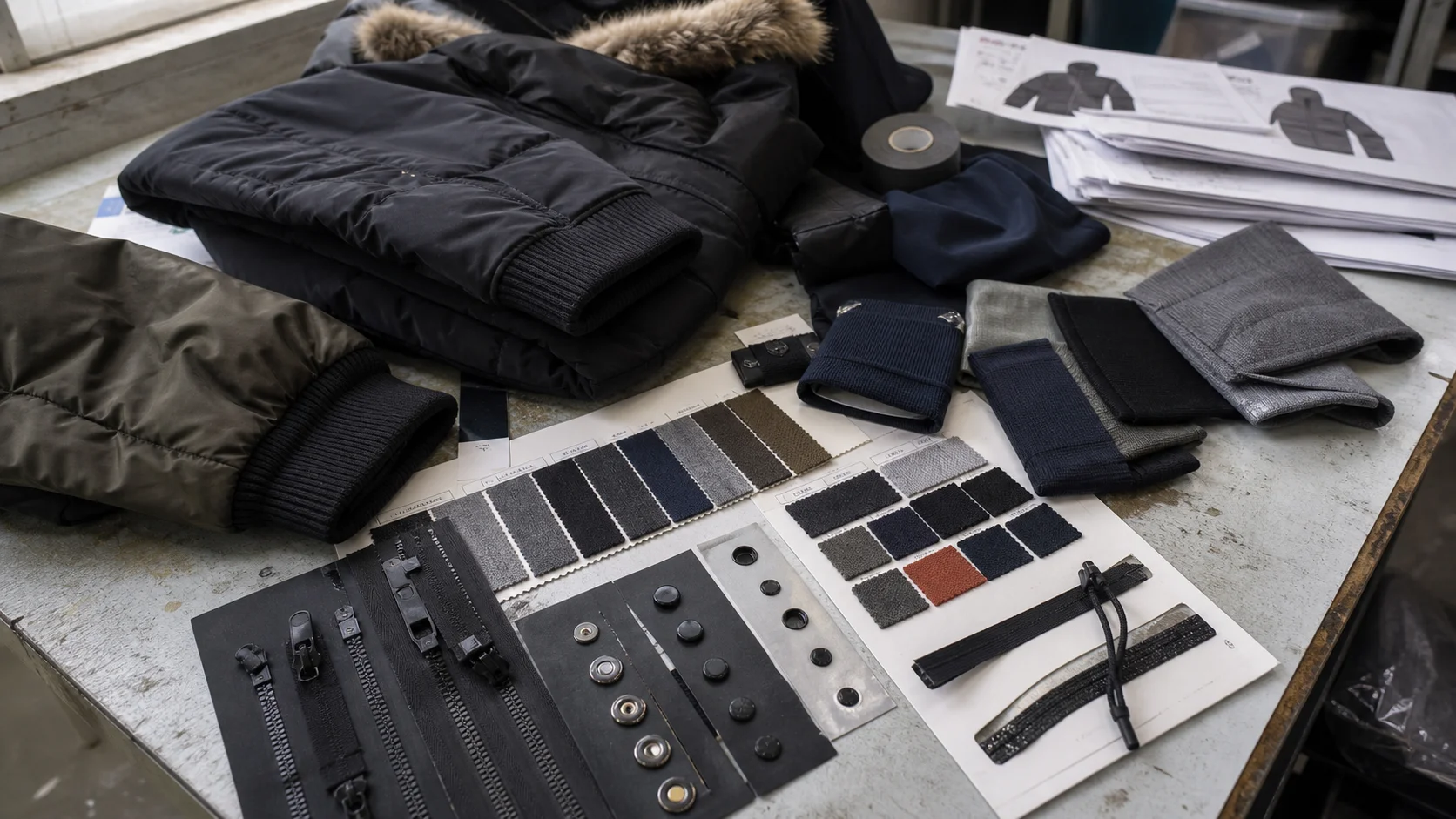
A product-specific inspection outline for gym program buyers sourcing bulk thermal parka trim, covering trim specs, durability checks, compliance risks,...
Thermal Parka Trim Review for Gym Program Buyers - Quality & Inspection manufacturing guide
Bulk thermal parka trim sourcing is often treated as a secondary buying task, behind shell fabric, insulation, and decoration. That is a mistake for gym program buyers. Trims affect warmth retention, durability, member comfort, size consistency, laundering performance, and the perceived value of the finished parka. A good shell can still fail in the field if the zipper pulls off, the snap rusts, the drawcord frays, or the rib cuff loses recovery after a few cold-weather practices.
For gym programs, thermal parkas usually serve more than one purpose. They may be issued to athletes, coaches, staff, travel teams, outdoor training groups, or branded retail supporters. The buyer is not only purchasing outerwear; they are protecting a program identity. Trim choices should support that purpose without pushing cost, lead time, or inspection risk beyond what the order can tolerate.
Thermal parkas are exposed to repeated stress. Athletes zip and unzip them quickly between warm-ups, bus rides, sideline waiting, and post-training recovery. Coaches may wear them daily across a full season. Gym programs often expect these garments to last beyond one event, which makes trim performance more important than it may appear on a spreadsheet.
Trim problems also create visible dissatisfaction. A missing snap, broken zipper, loose cord stopper, or peeling badge is easy for the end user to notice. These issues usually cannot be hidden by good fabric or strong decoration. In a bulk program, one weak trim component can become a repeat complaint across many units.
Buying judgment: if the parka will be issued as official team or staff gear, prioritize zipper, cuff, and closure durability before adding decorative trim upgrades. Functional failures are more damaging than a slightly plainer appearance.
Gym program buyers should review trims as a system. A heavy-duty zipper is useful only if the zipper tape is compatible with the shell fabric and the sewing operation is controlled. A premium drawcord does not solve a weak eyelet. Reflective piping may look strong in a sample but can crack after washing if the wrong material is selected. The best sourcing review checks material, construction, application, and inspection together.
A thermal parka trim package usually includes both visible and hidden components. Buyers should ask for a trim card or trim sheet before bulk approval. This document should identify every trim by material, size, color, supplier code where available, placement, and application method.
The front zipper is the highest-risk trim on most parkas. It carries daily mechanical stress and is usually the first component users blame when a garment feels cheap. For thermal parkas, common options include molded plastic zippers, coil zippers, and metal zippers. Molded plastic is often preferred for sports and gym programs because it is lighter than metal, less cold to touch, and visually substantial. Coil zippers can work well for lighter parkas but may not provide the same rugged appearance.
Useful specification points include zipper type, gauge, puller style, tape color, slider finish, and whether the zipper is one-way or two-way. A two-way zipper can improve sitting comfort on long parkas, but it adds cost and a higher chance of user error if the slider alignment is poor. For youth or entry-level team programs, a simple one-way molded zipper may be the more reliable choice.
Storm flaps improve warmth by covering the zipper line. They may close with snaps, hook-and-loop tape, buttons, or magnetic closures. Snaps are common because they look clean and are easy to use with gloves. The risk is poor attachment strength or corrosion, especially if low-grade metal is used.
For bulk orders, buyers should confirm snap cap diameter, base material, finish, pull strength target, and rust-resistance expectation. Painted snaps can chip. Antique finishes may vary between lots. Hidden plastic snaps can reduce corrosion concerns, though they may not deliver the same premium look.
Drawcords at the hood, hem, or waist help control warmth and fit. Gym programs should consider user age and safety rules. For youth garments, exposed neck-area cords may be restricted in some markets or by buyer policy. Elastic shock cords are functional, but they must be paired with reliable cord stoppers and reinforced exits.
Trim specs should include cord diameter, material, elasticity, color, end finish, stopper type, and whether the cord exits through eyelets, buttonholes, bartacked channels, or cord locks. A cheap stopper can slip under tension, making the drawcord look functional but perform poorly.
Cuffs are critical for thermal performance. Internal storm cuffs, rib-knit cuffs, adjustable hook-and-loop tabs, or elasticated cuffs each have tradeoffs. Rib cuffs offer comfort and warmth, but poor yarn quality or weak recovery creates a stretched-out look. Hook-and-loop tabs allow adjustment but can catch on knitwear, collect lint, and feel rough if placed poorly.
For rib cuffs, specify fiber content, width, stretch recovery, color, and hand feel. Polyester-spandex blends may dry quickly and hold shape. Cotton-rich ribs can feel softer but may absorb moisture and lose recovery faster. For gym program parkas that may be worn after training, moisture management matters.
Hood trims may include drawcords, toggles, elastic binding, detachable snaps, faux fur, hook-and-loop adjusters, and structured brims. A detachable hood adds flexibility but creates more parts to inspect. Faux fur can look premium but may be impractical for school, club, or gym team programs because it complicates washing and consistency.
Bulk buyers should ask whether the hood is fixed, detachable, or packable. If detachable, review the attachment method carefully. Snaps must be aligned, zipper attachments must not twist, and hook-and-loop strips should not irritate the neck.
Pocket trims affect both comfort and utility. Zippered pockets are useful for travel teams and coaches carrying phones, keys, cards, or whistles. Fleece pocket bags add warmth but may pill if low-quality fabric is used. Snap pockets are cheaper but less secure.
Inspection should verify pocket opening size, zipper function, pocket bag attachment, bartacks at stress points, and lining compatibility. A pocket that tears internally may not be noticed during a quick visual check, so buyers should include pocket function in inspection instructions.
Gym program buyers often care about branding, and rightly so. Woven labels, rubber patches, silicone badges, heat-transfer labels, embroidery patches, and zipper pull logos can make a parka feel program-specific. These elements also introduce color matching, adhesion, placement, and durability risks.
Branding trims should be reviewed against approved artwork. Pantone references, logo dimensions, stitch density, backing material, and placement tolerances should be written down. Heat transfers should be tested on the actual shell or lining fabric, not only on a generic swatch.
A strong trim specification does not need to be overly complicated. It needs to be clear enough that a factory, trim supplier, merchandiser, and inspector are all checking the same standard. Vague descriptions such as “good zipper,” “matching cord,” or “premium snaps” do not protect the buyer.
Trim Component Specification Details to Confirm Common Risk Main zipper Type, gauge, length, tape color, puller style, slider finish, one-way or two-way Slider jam, shade mismatch, weak top stop, poor stitching alignment Snaps Diameter, material, finish, cap style, pull strength, rust-resistance requirement Loose attachment, chipping finish, misaligned flap closure Drawcord Diameter, fiber, elasticity, color, end tip, stopper compatibility Slippage, fraying, uneven length, safety non-compliance Rib cuff Fiber content, width, stretch recovery, color, softness, seam construction Loose recovery, twisting, color bleeding, uncomfortable seam bulk Badge or patch Material, logo size, color reference, backing, attachment method, placement tolerance Peeling, crooked placement, color variation, edge liftingFor programs sourcing through an apparel manufacturing partner, it is useful to align trim expectations before development begins. Fabrikn’s manufacturing services page gives buyers a starting point for understanding how product development, sourcing, and production support can connect across a custom apparel order.
Written specs are necessary, but physical references reduce misunderstanding. A buyer may describe a zipper as “heavy-duty,” while the supplier interprets that differently based on local availability and cost target. A reference sample, approved trim card, or previous garment can clarify the intended standard.
Reference samples should not replace written specifications. They should support them. If a sample zipper is accepted, the spec still needs gauge, tape color, length, puller type, and finish. If a badge is accepted, the spec still needs artwork file, dimensions, material, placement, and attachment method.
Trim placement variation is common in bulk production. A small shift may be acceptable on internal labels but unacceptable on a chest badge or storm flap snap. Buyers should define tolerances by trim importance. For example, a logo patch may need tighter placement control than an internal care label.
Color tolerance also matters. Zipper tape, drawcord, rib cuff, lining, and shell fabric may all be “black,” but different materials reflect light differently. A tonal mismatch may be acceptable for budget programs but not for premium team outerwear. Buyers should decide this before bulk production, not after receiving cartons.
Minimum order quantities vary by supplier, market, season, and trim complexity. Buyers should treat any MOQ estimate as a planning range, not a guaranteed rule. Stock trims usually allow lower quantities, while custom-colored or custom-branded trims require more commitment.
Trim Type Typical MOQ Range Buyer Note Stock molded zipper 100–500 pieces per color/length Good for smaller gym programs if color options are flexible Custom zipper tape or puller 500–2,000 pieces Useful for branded programs, but adds lead time and approval steps Stock snaps or toggles 500–1,000 sets Usually manageable, but finish availability may vary Custom rubber or silicone badge 300–1,000 pieces Mold charges may apply; color approval is important Custom rib cuff color 300–1,000 pairs Yarn dyeing can increase lead time and shade risk Printed or woven labels 500–5,000 pieces Low unit cost but often sold in higher quantitiesSmall gym programs often benefit from stock trim choices. Stock black, navy, white, charcoal, and silver trims can keep the order practical. Custom pullers, special cord colors, and molded badges may be worth it for a flagship program or retail drop, but they should not be added casually to a low-quantity order.
Buying judgment: if the total order is under 300 parkas, avoid too many custom trims unless brand presentation is more important than cost control. Put the budget into fit, insulation, zipper reliability, and decoration accuracy first.
Trim approval should happen in stages. Rushing from a digital mockup to bulk production creates avoidable risk. Gym program buyers do not need a complicated corporate approval system, but they do need clear checkpoints.
The development sample tests the overall concept. At this stage, trims may be approximate if exact materials are not yet sourced. Buyers should not approve bulk production from a development sample unless every trim is already confirmed as production quality.
Review fit, function, general trim direction, and branding placement. Note which trims are placeholders. If the sample uses a temporary zipper or substitute badge, document that clearly.
The trim card should include the actual zipper tape, puller, snap, cord, rib, label, badge, hook-and-loop tape, and any other trim proposed for bulk production. For color-sensitive programs, lab dips or strike-offs may be required for rib, cords, badges, and woven labels.
Buyers should compare trims under neutral light where possible. Gym colors can be difficult to match, especially reds, royal blues, maroons, golds, and neons. A color that looks acceptable on screen may be wrong in production material.
A fit sample confirms the garment pattern. Trim affects fit more than buyers sometimes expect. Rib cuffs, hem cords, storm flap construction, and hood adjusters can change comfort and movement. A size set is useful for programs ordering across youth, adult, and extended sizes.
For team orders, buyers should consider the layering use case. Parkas are often worn over hoodies, uniforms, or training tops. If the garment is too fitted, the program may receive size complaints even if measurements match a standard chart.
The pre-production sample should use actual bulk fabric, insulation, lining, trims, decoration, and packaging method whenever possible. This is the most important sample before production starts. Approval should be written, not informal.
Buyers should inspect zipper operation, snap alignment, drawcord function, cuff recovery, badge placement, embroidery or print registration, pocket strength, and care label accuracy. If the pre-production sample is approved with comments, those comments should be precise and traceable.
A top of production sample comes from the early production line. It checks whether factory execution matches the approved pre-production sample. This step is especially useful when the parka has several trims, custom badges, or detailed decoration.
Top of production review can catch problems early, such as wrong zipper pullers, slightly off badge placement, loose snap setting, or lining labels installed incorrectly. Fixing these issues after full production is much harder.
Thermal parka lead time depends on more than cutting and sewing. Trim sourcing can become a bottleneck, particularly during peak outerwear season. Buyers should build a realistic calendar around trim development, sample approval, material booking, production, inspection, and shipping.
Process Step Typical Time Range What Can Delay It Trim sourcing and quotation 3–10 business days Unclear specs, custom branding, unavailable colors Custom trim development 1–4 weeks Mold setup, artwork changes, color matching, supplier backlog Sample making 1–3 weeks Trim substitutions, fabric delays, decoration approval Bulk trim production 1–5 weeks MOQ consolidation, dyeing, custom pullers, holiday schedules Garment production 3–8 weeks Order size, complexity, factory capacity, inspection reworkLead times are shorter when buyers use stock trims, standard colors, and simple decoration. They lengthen when buyers request custom zipper pullers, silicone badges, special rib colors, reflective details, or unusual hardware finishes. Seasonal timing also matters. Outerwear orders placed late in the year often compete with other cold-weather production.
Gym program buyers should work backward from the in-hand date, not the event date. If parkas are needed for a tournament, travel season, or winter launch, allow time for distribution, size sorting, possible replacements, and decoration checks. Buyers who need timeline support can use the contact page to discuss development and production planning before locking a specification.
Inspection should be built around the way the parka will actually be used. A visual pass is not enough. Functional trims need functional checks. Inspectors should open and close zippers, pull snaps, test cord stoppers, stretch cuffs, check pocket bags, and verify branding placement.
Zipper failures can be caused by poor component quality or poor sewing. If the zipper is stitched into a bulky insulated front panel without enough control, it may twist or jam even when the zipper itself is acceptable. Inspect both the trim and the construction.
Hardware problems are often discovered late because they look fine when the garment is hanging. A snap may appear centered but fail under pull. A grommet may look clean but cut into the cord. For sports outerwear, hardware should be reviewed under normal user force, not only visual appearance.
Drawcords are a practical feature, but they can create compliance concerns for youth apparel. Buyers should review the destination market and user age group before approving hood or neck cords. Internal elastic adjusters may be a safer option in some programs.
Cuff failure is not always immediate. A cuff may pass visual inspection but lose shape after laundering. If the program expects multi-season use, buyers should consider wash testing or at least request supplier guidance on cuff recovery and care performance.
Branding mistakes are expensive because they are often not repairable. A crooked silicone badge or wrong-color woven label may make the whole parka unacceptable for a program order. Tight artwork approval and placement checks are worth the time.
Trim selection should match the order’s purpose. A staff-issued parka, premium athlete travel parka, and budget sideline parka should not necessarily use the same trim package. The best buying decision balances durability, brand appearance, MOQ, lead time, and replacement risk.
Buyer Priority Recommended Trim Direction Tradeoff Lowest practical cost Stock zipper, standard snaps, simple labels, limited custom hardware Less brand distinction and fewer color options Strong team identity Custom zipper pull, woven label, logo patch, matched cords Higher MOQ and more approval steps Cold-weather performance Reliable storm flap, rib cuffs, hood adjusters, secure pockets More construction complexity and inspection points Retail or fundraising resale Premium badge, clean hardware finish, branded pulls, polished packaging Higher unit cost and tighter cosmetic standardsA common mistake is spending heavily on visible branding while under-specifying the functional trims. For gym programs, the user experience starts with warmth, fit, and reliability. A branded zipper pull is a nice upgrade; a zipper that does not jam is non-negotiable.
Another mistake is treating all sizes the same. Extended sizes may require longer zippers, adjusted pocket placement, different cord lengths, and proportionally balanced patches. Youth sizes may require safer cord solutions and lighter hardware. A trim review should account for the size range, not only the sample size.
Before confirming a bulk thermal parka program, buyers should ask direct questions. The answers will reveal whether the supplier has control over trims or is simply assembling whatever is available at the last minute.
Buyers should also ask who owns the final trim decision. In some sourcing setups, the factory chooses trims based on target price. In more controlled programs, the buyer approves each trim component. The second approach takes more effort but provides better protection for quality and brand consistency.
Trim quality cannot be reviewed separately from fabric and construction. A heavy zipper on a lightweight shell may cause pulling or puckering. A stiff badge on a thin insulated panel may create distortion. Hook-and-loop tape can damage delicate lining or knit cuffs. Reflective piping may crack if sewn into tight curves or exposed to aggressive laundering.
Thermal parkas commonly use polyester shell fabrics, nylon shell fabrics, soft-touch coated fabrics, fleece linings, quilted linings, synthetic insulation, or down-like padding. Each material interacts with trims differently. Coated shells may show needle marks. Thick insulation can make snap setting less consistent. Fleece-lined pockets may need stronger seam reinforcement.
Buyers should request that trims be tested on the actual production fabric. This is especially important for heat transfers, badges, embroidered patches, snap reinforcement, and hook-and-loop tape. A trim that works on a flat fabric swatch may not perform the same way on an insulated garment panel.
Gym program orders often involve multiple sizes, names, teams, departments, or delivery groups. Trim and labeling accuracy become part of distribution quality. A parka can be well-made but still create problems if the wrong size label is sewn in or cartons are mixed.
Packaging specs should include polybag type, size sticker format, carton label details, folding method, hangtag placement, and whether individual names or team groups are required. If the program includes multiple gym locations or team divisions, carton-level accuracy should be part of inspection.
Rubber badges, zipper pulls, and hardware can also create pressure marks during packing. Bulk parkas are bulky, and over-compressed cartons may crush trims or leave impressions on coated shells. Buyers should confirm carton dimensions and packing quantity per carton before shipment.
Custom trims can be a good investment when the parka is meant to represent a serious program. Branded zipper pulls, silicone sleeve badges, woven neck labels, and team-color cords can create a stronger product than decoration alone. For premium staff gear or resale merchandise, these details may help justify a higher price.
Custom trims are less attractive when quantities are low, delivery is urgent, or the buyer has not finalized branding. A late logo change can delay trim molds, label weaving, packaging, and sample approval. For fast-turn gym programs, standard trims with strong decoration may be the safer path.
Buying judgment: custom trims should support the garment’s purpose, not rescue an unclear design. If the base parka fit, warmth, and zipper quality are not settled, pause custom trim spending until the core product is approved.
Buyers wanting to understand a sourcing partner’s background, operating model, or product development approach can review Fabrikn’s about page before starting a custom parka discussion.
Bulk thermal parka trim sourcing rewards disciplined buyers. The strongest programs do not approve trims by appearance alone. They check function, compatibility, MOQ, timing, and inspection risk before production starts. That approach reduces complaints, protects the brand, and gives athletes and staff outerwear that feels reliable in real use.
Get a free quote from Fabrikn — your trusted B2B clothing manufacturer with 10+ years of experience. MOQ as low as 200 pieces.
Get a Free Quote →The most important trims are the main zipper, storm flap closures, cuffs, hood adjusters, pocket closures, and branding labels or patches. These components affect warmth, durability, comfort, and program appearance.
Typical MOQs vary widely. Custom zipper pulls, badges, and rib colors often start around 300–1,000 pieces, while custom labels may require 500–5,000 pieces. Stock trims usually allow lower quantities and faster production.
Custom zipper pulls are useful for premium team, staff, or resale parkas. For smaller or urgent orders, stock zipper pulls are usually safer because they reduce MOQ pressure, sampling steps, and lead-time risk.
Inspection should include both visual and functional checks. Zippers should be opened and closed, snaps should be pulled, cuffs should be stretched, drawcord stoppers should be tested, and branding placement should be measured against the approved sample.
Yes. Custom trims can delay production through artwork approval, color matching, mold setup, dyeing, and supplier availability. Buyers working toward a fixed season or event date should approve trims early.
Drawcord safety depends on the user age group, garment area, and destination market requirements. Youth parkas may need restricted or alternative cord designs, especially around the hood and neck area.
The pre-production sample is the key approval sample. It should use actual bulk fabric, insulation, trims, decoration, labels, and packaging details whenever possible.
Buyers can reduce risk by using clear written specs, approving a physical trim card, choosing stock trims where practical, testing trims on actual fabrics, setting inspection criteria, and confirming lead-time dependencies before placing the order.