
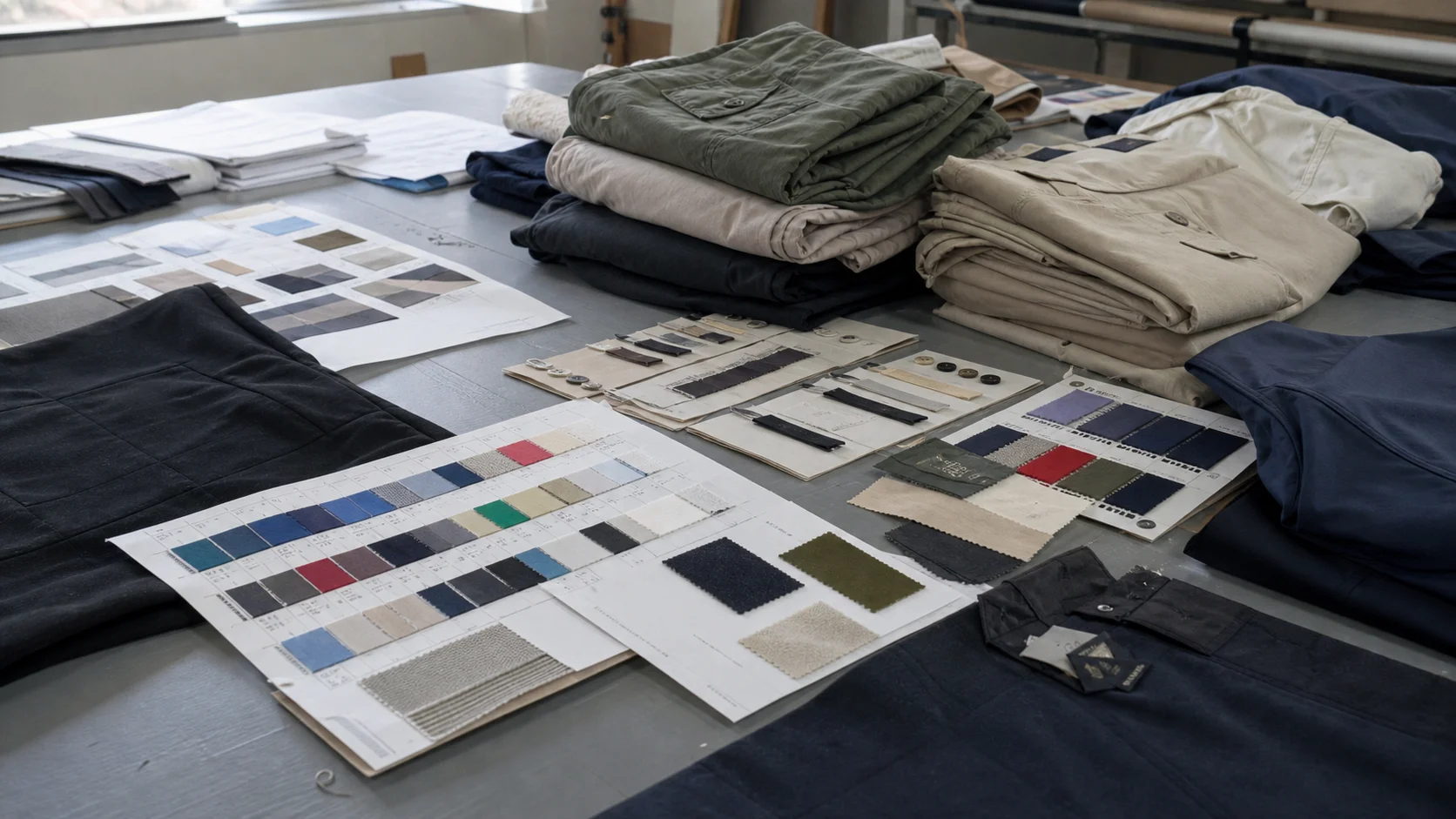
Outline an SEO-focused 2500-word article on how fabric testing costs affect bulk tracksuit sourcing for league merchandise, including test types, budget drivers, and cost-saving quality controls.
Bulk Tracksuits Fabric Testing Cost for League Merch - Fabrikn production reference
Bulk tracksuits for league merchandise sit in a practical middle ground: they need to look commercial, hold up to repeated wear, and stay cost-controlled across a wide size run. Fabric testing is one of the first places sourcing teams should budget carefully, because the testing bill is rarely just one line item. In practice, buyers commonly budget about $150-300 for a basic composition and GSM check, $300-700 for a standard physical-performance package on one fabric, and $800-1,800 for a broader compliance package that also covers colorfastness, pilling, dimensional stability, and restricted-substance screening. It usually includes lab tests, sample yardage, pre-production approvals, and sometimes retesting after a fabric change. For league merch, that spend is easier to justify than for a one-off promotional item, since returns, complaints, and brand damage can cost more than testing ever will.
The real question is not whether to test. It is how much testing is enough for the merchandise risk you are taking on. A basic performance and composition check on a simple 100% polyester interlock or tricot track set may stay in the lower range, while a program that includes colorfastness, pilling, shrinkage, flammability, azo dye or formaldehyde screening, and print adhesion can move quickly into a $1,000+ approval budget per colorway if multiple fabrics and trims are involved. Buyers sourcing for league stores, fan drops, or team programs should treat testing as part of landed cost, not an optional extra, and many also ask whether the factory or mill can support common certification requests such as OEKO-TEX Standard 100, BSCI, WRAP, or GOTS where applicable to the fiber content.
For broader sourcing support, see Fabrikn services, or review the company background on about us before comparing supplier options. If you already have a spec sheet and need a quote path, use the contact page to request a production discussion.
League merchandise has a different commercial profile from standard apparel. It often carries branding, team colors, sponsor placements, and retail expectations that make consistency more important than low unit cost alone. A tracksuit that passes visual review but fails after 5-10 home laundry cycles can hurt sell-through, trigger refunds, and create uneven inventory across sizes and colorways. Typical league programs also use repeat colors across jackets, pants, and sometimes matching tees, so even a 1-2 point shade shift on the gray scale can become visible on the sales floor.
Testing protects against four common sourcing problems. First, it confirms that the fabric matches the intended construction and content, such as 220-260 GSM polyester tricot, 280-320 GSM brushed-back polyester fleece, or a 92/8 polyester-spandex double knit. Second, it checks whether color and finish hold up under use and laundering, with common minimums of grade 4 for wash colorfastness and grade 3-4 for crocking depending on the buyer standard. Third, it highlights whether the garment can be produced consistently at scale, especially when mills change yarn lot, brushing intensity, or heat-setting conditions. Fourth, it reduces the chance that the shipment fails a retailer or league compliance review, where buyers may ask for WRAP or BSCI audit evidence from the factory and OEKO-TEX or GOTS support documents from material suppliers when those claims are part of the program.
For league merch, fabric testing is not just quality control. It is a cost-control tool that reduces the chance of expensive rework, returns, and rushed replacements.
Testing cost depends on the number of tests, the fabric type, the lab selected, and how many revisions the buyer asks for. A single polyester knit for tracksuits is simpler to evaluate than a blended fleece with brushed back, contrast panels, and decorative trims. The more components involved, the more likely you need separate checks for base fabric, rib, zipper tape, print adhesion, and color matching. As a typical sourcing rule, every additional material family adds both direct lab cost and 1-3 business days of coordination time for swatch collection, submission, and report review.
Supplier maturity also matters. A factory that can provide recent certified lab reports, bulk fabric test history, and mill data sheets may reduce the buyer’s testing burden. A new supplier or a fabric mill with no documented history usually requires more verification, especially if the order uses sublimation panels, silicone heat transfers, or brushed fleece that can change after finishing. That is a tradeoff worth paying for when the order is large, the timeline is tight, or the merchandise has strong brand visibility. It is common for buyers to request current audit records such as WRAP or BSCI for cut-and-sew facilities and fiber or chemical compliance documents such as OEKO-TEX Standard 100 or GOTS where the product claim supports them.
Typical cost ranges vary widely by market and test scope, but sourcing teams often see the following pattern:
Testing Scope Typical Cost Range Notes Basic composition or GSM check $150-300 per fabric Useful for confirming fiber blend claims, fabric weight within about +/-5%, and whether a quoted 250 GSM tricot is actually delivered Colorfastness, shrinkage, pilling $300-700 per fabric Common for retail-facing tracksuits; often includes wash fastness, dry/wet rubbing, pilling, and dimensional stability after 3 wash cycles Full performance and compliance package $800-1,800 per style Often needed for branded league programs; may cover base fabric, rib, zipper tape, print adhesion, seam strength, and restricted-substance screening Retesting after revisions $100-500 extra per failed item Triggered by fabric swaps, finish changes, revised heat-setting, or failed results on shade, pilling, or shrinkageBuyers should also budget for sample shipping, customs handling where relevant, and the opportunity cost of delay. Couriering lab swatches and PPS samples commonly adds $40-120 per shipment, and a low testing fee can become expensive if it slows approval and pushes production into a later factory slot.
Not every tracksuit program needs the same test package. A sensible approach is to align tests with use case and sales channel. A fan store item may require less regulatory depth than a premium league retail line, yet it still needs consistent color and dependable wash performance. For most polyester league tracksuits, buyers commonly start with one bulk fabric test set before cutting and then add garment-level checks on the pre-production sample or top sample.
Fabric testing is only half the picture. Trims deserve attention too. Zippers should run cleanly, elastics need recovery, and printed logos or heat transfers should survive wash cycles without cracking or peeling. If the supplier treats trim sourcing as separate from fabric sourcing, the buyer should ask for evidence that both sides are being controlled, typically including zipper cycle checks, drawcord colorfastness, heat-transfer adhesion after wash, and incoming trim inspection against approved cards.
MOQ affects testing cost because smaller orders spread fixed lab and development costs across fewer units. A higher MOQ can reduce the per-piece impact of testing, while a lower MOQ makes each test feel more expensive. For league merchandise, many suppliers set MOQ ranges around 300-500 pieces per colorway for stock-supported tracksuits, 600-1,000 pieces per colorway for semi-custom programs, and 1,000+ pieces when the buyer wants custom-knit fabric, special dye lots, or multiple branded trims. A typical FOB target for a standard adult polyester tracksuit set is often around $12-22 per set at 500-1,000 sets, while premium brushed or spandex-rich constructions can go higher depending on trim count and decoration method.
A clean approval path usually follows five steps:
Skipping steps to save time often costs more later. A buyer who approves fabric from a swatch alone may still face shade variation, shrinkage surprises, or trim incompatibility once production begins. For league merch, where color accuracy and brand presentation matter, the safer path is usually the cheaper one over the full order cycle. As a practical sourcing detail, most buyers ask the factory to hold bulk cutting until the PPS, test report, and print-placement approval are all signed off together.
Best practice: test the fabric, then test the sewn garment. A material can pass on paper and still fail once it is cut, stitched, and washed.
Testing lead times are tied to both lab capacity and the supplier’s responsiveness. A straightforward fabric test may return in 3-5 business days, while a fuller package involving multiple materials, repeat wash cycles, or compliance checks commonly takes 7-12 business days. If restricted-substance screening or retesting is needed, many buyers plan on 12-18 business days total from swatch dispatch to final report. Buyers should plan for the possibility that a failed result adds another round of sampling and retesting, which can stretch timelines materially.
Lead-time risk increases when a league release date is fixed. If the merch launch is tied to a season start, playoff campaign, or sponsor activation, the production calendar has less flexibility. In that case, testing early is cheaper than expediting later. A rushed freight booking or last-minute re-cut usually wipes out any savings from reducing the test scope too aggressively. Typical production lead times for a repeat-order polyester tracksuit are often 35-50 days after PPS approval, but custom fabric knitting, new dye lots, or special trims can push that to 55-75 days.
Good sourcing practice is to separate the budget into three buckets: development, testing, and production. That makes it easier to see whether a quote is truly competitive or merely underpriced because the supplier expects fewer checks. A well-priced program should include enough testing to prevent surprises without overtesting low-risk details. Common dependencies that move timelines are greige yarn availability, lab dip approval speed, print artwork release, zipper or puller customization, and whether the fabric still needs brushing, heat setting, or anti-pilling finishing before it can be cut.
Tracksuits can be made from a range of constructions, and each one carries different testing priorities. Polyester tricot, polyester-spandex knits, brushed fleece, and bonded fabrics all behave differently in wash and wear. A common league shell fabric is 100% polyester tricot at 230-260 GSM with a smooth face for embroidery or heat transfer, while more premium programs may use 92/8 polyester-spandex interlock at 250-300 GSM for better stretch recovery or a 300-340 GSM brushed-back fleece for a warmer hand feel. Each of these constructions responds differently to dyeing, heat setting, and pilling tests, so buyers should specify the exact target rather than approving “poly knit” as a broad category.
Trim detail also changes risk. A reverse coil zipper may look cleaner than a standard nylon zipper, but the tape shade, slider quality, and top-stop security all need checking. Rib cuffs in 1x1 polyester-spandex knit usually recover better than cheaper loose ribs, and drawcords with silicone or metal tips may trigger added appearance or compliance checks depending on the market. Heat-transfer logos generally require adhesion and wash testing, while embroidery needs stitch density review to avoid puckering on lighter interlock fabrics. Common inspection checkpoints here include fabric GSM, panel-to-panel shade continuity, zipper function, rib recovery after stretch, logo position tolerance, and seam appearance after pressing.
Inspection risk on tracksuits usually shows up in repeatable places rather than random defects. Common failures include side-panel shade mismatch, needle lines on tricot, uneven brushing on fleece, puckering at zipper insertion, twisted legs after wash, and print cracking on stretch panels. For league programs, it is typical to run an inline inspection during sewing and a final random inspection based on AQL 2.5, with extra attention on chest logos, sponsor placement, and stripe symmetry.
Useful checkpoints start before sewing. Buyers commonly ask for bulk fabric inspection on shade, GSM, usable width, bowing or skew, and surface defects. During cutting, marker placement and panel direction matter because brushing direction or fabric nap can create visible tone variation. During sewing, operators often use overlock, flatlock, and coverstitch machines, and quality teams should check stitch-per-inch consistency, seam slippage at stress points, bartacks at pocket openings, and zipper run quality. Before packing, a wash-tested garment should be reviewed for shrinkage, color change, print adhesion, elastic recovery, and measurement tolerance, with many buyers using a common tolerance band of +/-1 cm on key points for adult sizes.
Smarter sourcing starts with matching the supplier to the program type. For a basic fan merch drop, a factory with proven stock tricot, standard coil zippers, and existing size blocks can usually move faster and cheaper than a fully bespoke vendor. For a premium league retail line, buyers typically gain more from suppliers that can document mill relationships, provide recent test reports, and support audit or certification requests such as BSCI, WRAP, OEKO-TEX Standard 100, or GOTS where the fiber content and claim justify it.
It is also common to ask early whether the quote includes lab dips, PPS, top sample, bulk fabric testing, trim cards, and final inspection. Many price gaps come from missing process steps rather than true efficiency. As a practical benchmark, a supplier quoting a standard adult polyester tracksuit at around $12-22 FOB per set at 500-1,000 sets with 35-50 day production is often in the normal commercial range, while unusually cheap quotes may rely on lighter GSM, lower-grade zippers, or reduced testing. Buyers generally get better outcomes when they lock the fabric construction, approved color standard, zipper specification, print method, and inspection plan before placing deposit.
Get a free quote from Fabrikn — your trusted B2B clothing manufacturer with 10+ years of experience. MOQ as low as 200 pieces.
Get a Free Quote →How much should we budget for fabric testing on bulk league tracksuits?For a simple polyester program, buyers commonly budget $300-700 per fabric for core performance testing and closer to $800-1,800 per style when compliance, trims, and garment-level checks are included.
What is a typical MOQ for custom league tracksuits?Common MOQs are around 300-500 pieces per colorway for stock-supported styles, 600-1,000 for semi-custom programs, and higher if the mill has to knit and dye a custom fabric lot.
How long do testing and approvals usually take?Basic lab work often takes 3-5 business days, fuller packages 7-12 business days, and an approval cycle with lab dips, PPS, and retesting can easily reach 18-22 business days.
Which certifications are most relevant?Common requests include OEKO-TEX Standard 100 for material safety support, WRAP or BSCI for factory social compliance, and GOTS when the product uses qualifying organic cotton components.
Which construction details matter most?Buyers usually focus on exact fabric type and GSM, brushing or heat-setting finish, zipper type, rib recovery, logo application method, and wash durability of both fabric and trims.