
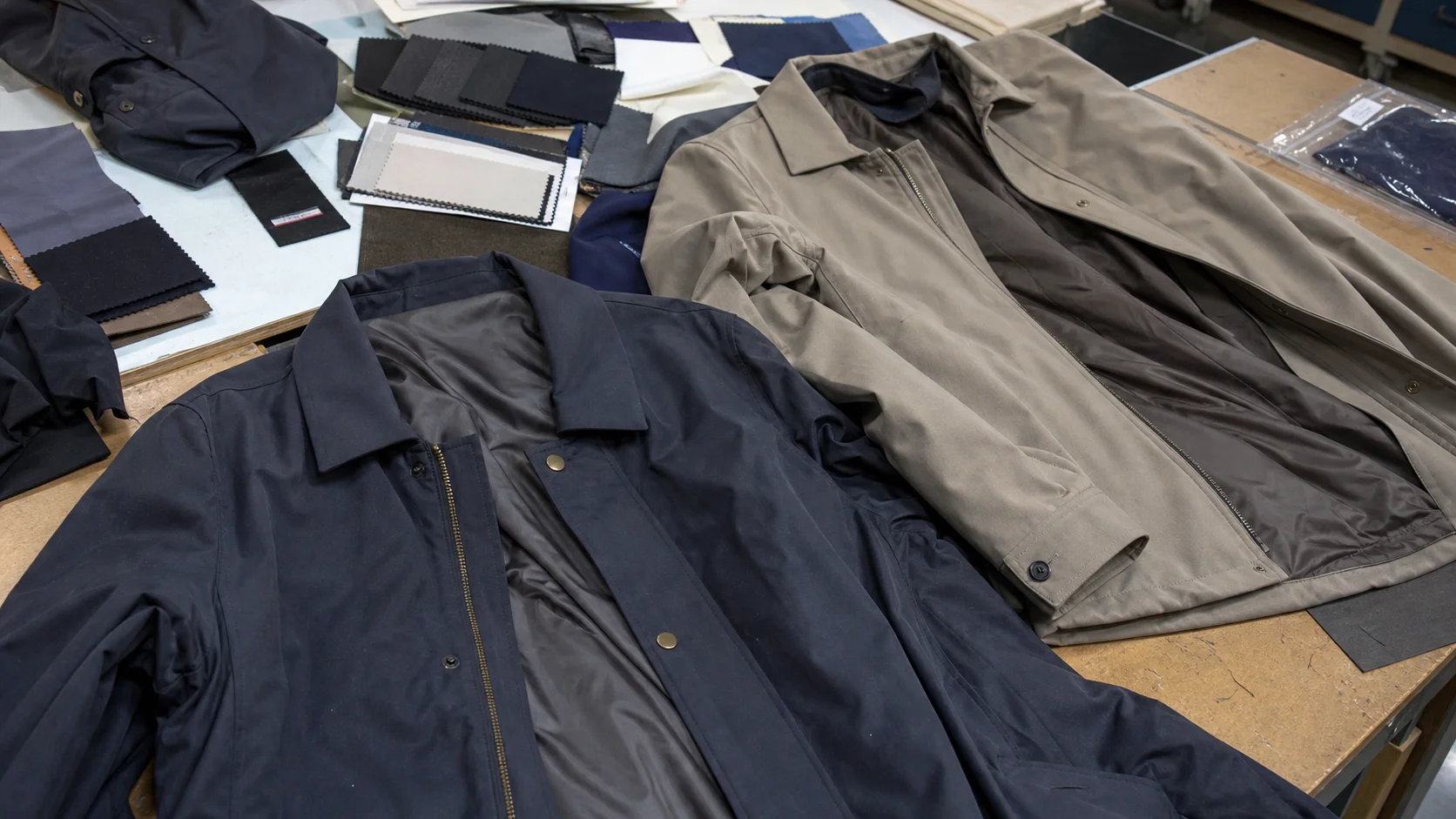
A distributor-focused outline for controlling shrinkage in bulk travel coat programs, covering fabric specs, lab testing, wash protocols, tolerances,...
Travel Coat Shrinkage Plan for Bulk Buyers - Outerwear & Jackets manufacturing guide
For distributor buyers, travel coat shrinkage is not a minor technical issue. It affects size consistency, return rates, customer complaints, warehouse grading, and repeat orders. A coat that looks acceptable at shipment can become commercially risky if the shell fabric, lining, interlining, rib, binding, or seam construction changes after steam finishing, consumer washing, rain exposure, or dry-cleaning.
A practical bulk travel coat shrinkage control plan should begin before fabric booking and continue through sample approval, pre-production testing, inline inspection, final audit, and post-shipment feedback. The goal is not to eliminate all dimensional change. That is unrealistic for most woven and knitted materials. The real goal is to define acceptable shrinkage, control high-risk variables, and make sure the approved sample, bulk fabric, trims, labels, care instructions, and packing method all support the same commercial standard.
This guide is written for distributor buyers sourcing travel coats in bulk, especially buyers managing private label outerwear, wholesale jacket programs, uniform outerwear, promotional travel coats, or seasonal retail replenishment. It focuses on practical purchasing decisions: what to specify, what to test, what to reject, and where cost tradeoffs usually appear.
Travel coats are usually purchased for convenience, comfort, packability, weather protection, and easy care. That makes shrinkage control especially important. A wool overcoat may be labeled dry-clean only and treated as a structured garment. A travel coat, by contrast, is often expected to survive packing, steaming, light rain, and sometimes machine washing. Distributor buyers should assume that end users will test the limits of the care label.
Shrinkage can appear in several ways. The shell fabric may shorten in length. The lining may twist or pull. The sleeve may become tight because the lining and shell shrink at different rates. The hem may curl. The front zipper may ripple because the fabric relaxes around a stable zipper tape. Seam puckering may appear after washing or steaming. In quilted travel coats, channel distortion can become visible when shell, lining, and padding respond differently to heat and moisture.
The commercial impact is straightforward. Size claims become unreliable. A medium that fits before laundering may feel like a small after one wash. A coat that looks clean on a hanger may look distorted after warehouse steaming. In wholesale distribution, even a small defect rate can become expensive because returns move through multiple layers: retailer, distributor, warehouse, and supplier.
Good shrinkage control is not just a lab-test issue. It is a sourcing discipline that connects fabric selection, pattern allowance, care labeling, finishing, packing, and inspection.
For buyers comparing manufacturers, shrinkage control should be treated as part of the factory’s technical capability. A low unit price is less attractive if the supplier cannot show consistent fabric test results, proper sample wash records, and clear tolerance control. Buyers evaluating new outerwear suppliers can review production support options through Fabrikn’s services page before confirming a bulk travel coat program.
Travel coats can be made from polyester, nylon, cotton blends, spandex blends, recycled synthetics, bonded fabrics, coated fabrics, softshell materials, lightweight twills, ripstop fabrics, or compact woven blends. Each material carries a different shrinkage risk. The buyer’s job is to understand where movement can occur and where it cannot be corrected later.
Many woven shell fabrics relax after washing, steaming, or tumble drying. Polyester and nylon are generally more stable than cotton-rich fabrics, but they are not risk-free. Heat setting, dyeing temperature, coating, mechanical finishing, and fabric tension during rolling all affect final dimensional stability.
Cotton-rich travel coats may offer a softer hand feel and better casual styling, but they normally need more aggressive shrinkage control. If a buyer wants a washable cotton-blend travel coat, the fabric should be pre-shrunk or tested carefully after garment wash. Cost usually rises because stable cotton blends require better fabric preparation and tighter quality control.
A common bulk issue is not total garment shrinkage, but component mismatch. The shell may shrink 1.5% while the lining shrinks 3.5%. That difference can pull sleeves, distort hems, or create tension around armholes. This is especially risky when the lining is acetate, polyester taffeta, mesh, brushed tricot, fleece, or stretch knit.
Distributor buyers should not approve lining only by color and hand feel. The lining must be tested against the shell fabric under the intended care method. A stable shell paired with an unstable lining is still an unstable coat.
Travel coats often use fusible interlining at plackets, collars, cuffs, pocket openings, storm flaps, or hood edges. If the fusing temperature is too high, the shell can shrink locally before the rest of the garment. If the adhesive bond is weak, delamination can appear after washing or dry cleaning.
Bonded softshell fabrics need particular caution. The face fabric, membrane, and backing fabric may react differently to heat and moisture. Once a bonded fabric bubbles or separates, it is rarely recoverable at inspection stage.
Elastic trims can recover, shrink, twist, or lose stretch. Rib cuffs and hem ribs can shrink more than the shell, making sleeves feel shorter or tighter. Binding tape can pull along edges if its shrinkage rate differs from the panel fabric. Drawcord channels may pucker if cord, tape, eyelet reinforcement, and fabric do not behave consistently.
These areas are small, but they create visible defects. Buyers should require trim shrinkage testing for any component that is stitched directly into high-tension areas.
A coat can pass sewing inspection and fail after finishing. Steam can relax fabric tension. Pressing can create local shrinkage, shine, seam impression, or shape distortion. High heat used to smooth wrinkles before packing may affect coated fabrics, water-repellent finishes, or fusible parts.
The safest approach is to approve the finishing method during pre-production. If the factory changes steam time, press temperature, tunnel finishing settings, or packing method during bulk production, dimensional results can change.
A shrinkage control plan starts with written specifications. Verbal agreement is not enough for bulk outerwear. Distributor buyers should lock the technical details before fabric purchase order approval, because later corrections are usually expensive.
Specification Area What Buyers Should Define Purchasing Judgment Shell fabric Fiber content, construction, GSM, yarn count or denier, finish, coating, water-repellent treatment, stretch direction Do not approve only by swatch appearance. Ask for lab shrinkage and colorfastness results. Lining Fiber content, weight, weave or knit type, color, anti-static treatment, shrinkage tolerance Match lining stability to shell stability, especially for washable coats. Interlining Fusible type, fusing temperature, pressure, time, placement, peel strength requirement Test after wash or dry-clean method before bulk cutting. Trims Zipper tape, snap tape, elastic, rib, binding, drawcord, stopper, labels, hook-and-loop Stable trims can expose unstable fabric. Test complete garment behavior, not trims alone. Care method Machine wash, hand wash, dry clean, tumble dry, line dry, steam only Care label should match actual test performance, not marketing preference. Shrinkage tolerance Length, width, sleeve, chest, lining, hem, collar, key seam areas Set measurable tolerances before salesman sample approval.Typical acceptable shrinkage depends on product type and market expectations. For many synthetic woven travel coats, buyers often target within 1% to 2% dimensional change after the approved care method. For cotton blends, 2% to 3% may be more realistic if the garment remains visually balanced and within size tolerance. Stretch fabrics require separate recovery and torque evaluation. These are typical working ranges, not universal standards. The final tolerance should be agreed in the tech pack and confirmed by lab testing.
Water-repellent treatments add another layer. Durable water repellent finishes can change hand feel and sometimes affect fabric relaxation. Coated fabrics may resist water but react poorly to high heat or aggressive tumble drying. If the travel coat is marketed as packable, wrinkle-resistant, water-repellent, or washable, buyers should check that these claims do not conflict with shrinkage performance.
Minimum order quantity affects shrinkage control because it determines fabric sourcing options, dye lot stability, testing budget, and production line discipline. Very small orders may rely on available fabric, while larger programs can justify custom fabric finishing and stricter lab validation.
Order Type Typical MOQ Range Shrinkage Control Implication Stock fabric travel coat 300 to 800 pieces per style/color Faster development, but fabric history may be limited. Test each available lot. Custom color synthetic shell 800 to 1,500 pieces per color Better control over dye lot and finishing, but longer fabric lead time. Cotton-blend or stretch shell 1,000 to 2,000 pieces per color Needs stronger pre-shrinkage testing and pattern tolerance planning. Bonded softshell or coated fabric 1,200 to 3,000 pieces per color Higher testing burden. Delamination and heat response must be checked early. Private label multi-size program 1,500 to 5,000 pieces per style More room for lab tests, size-set review, and pre-production correction.These MOQ ranges vary by factory, fabric mill, trim supplier, season, and customization level. Buyers should treat them as planning references rather than fixed rules. A supplier quoting unusually low MOQ for a complex travel coat may be using leftover fabric, mixed lots, or simplified testing. That can work for a promotional order, but it is not ideal for a distributor building repeatable size consistency.
The main tradeoff is speed versus control. Stock fabric can shorten development time, but it may not have reliable shrinkage history. Custom fabric improves repeatability, but fabric testing, dyeing, finishing, and approvals extend the calendar. Buyers should decide which risk matters more: missing a seasonal delivery window or shipping coats with unstable dimensions.
For distributor buyers planning a new outerwear supplier relationship, it is sensible to discuss MOQ, sampling scope, and inspection requirements before placing a bulk deposit. General sourcing background and company context can be reviewed at Fabrikn’s about page.
Sample approval should not be limited to fit, styling, and fabric color. Shrinkage control needs its own approval path. The safest sequence is to move from material testing to proto review, then salesman sample, size set, pre-production sample, and bulk trial evaluation.
Before cutting a proto sample, buyers should request shell fabric and lining test data. At minimum, this should include dimensional change after the intended care method. For washable coats, test after one wash and, where relevant, after three washes. For dry-clean-only coats, test under the recommended dry-cleaning method. For coated and bonded fabrics, include appearance after care.
If the supplier cannot provide test results before sampling, the buyer should avoid approving the sample as production-ready. A good-looking proto made from unstable material is not a reliable reference.
The proto sample checks pattern balance, fit, construction feasibility, seam allowance, pocket placement, lining ease, and trim placement. At this stage, buyers should identify areas that may shrink or distort: sleeve length, front edge, hem, hood opening, zipper area, cuff, collar, and lining attachment points.
Pattern makers may need to add controlled ease to lining or adjust seam construction to reduce pulling after care. This is cheaper during proto development than during bulk production.
Salesman samples often receive commercial approval because they look polished. That creates risk. Buyers should mark the approval status clearly: visual approval only, not shrinkage approval, unless the sample has already passed care testing.
For distributor buyers selling to retailers, salesman samples should not overpromise. If the final bulk coat will use different fabric, different lining, different zipper tape, or different finishing, the sample is not a reliable shrinkage standard.
The size set checks grading and fit across the size range. Shrinkage risk changes by size because larger panels and longer seams can show distortion differently. Buyers should test at least one middle size and one larger size when possible. For plus sizes, long coats, or extended-length travel coats, sleeve and body length shrinkage should be checked carefully.
The pre-production sample should use bulk fabric, bulk lining, bulk trims, bulk labels, final seam construction, final fusing settings, and final finishing. This is the key approval sample for shrinkage control. If the pre-production sample fails dimensional testing, bulk cutting should not begin.
Strong buyers make this point explicit in the purchase order. Bulk cutting approval should depend on passing pre-production measurements and care testing. If the factory cuts before approval, the buyer loses leverage.
The test report should show original measurements, post-care measurements, percentage change, visual appearance, seam behavior, lining behavior, and comments on twisting, puckering, bubbling, color change, or trim damage. Photos are useful, but measurements are essential.
A pass result should be linked to the approved sample ID, fabric lot, and care method. Without that link, test reports become hard to enforce.
A bulk travel coat shrinkage control plan should be written into the production file. It does not need to be complicated, but it must be specific. The factory, buyer, and inspection team should all use the same reference points.
General statements such as “fabric must not shrink” are not useful. Buyers should define tolerance by measurement point. Body length, chest width, sleeve length, shoulder width, hem width, hood opening, lining length, and cuff circumference may all need different controls.
Measurement Point Typical Control Target Risk if Uncontrolled Body length Within 1% to 2% for stable synthetics; up to 3% may be considered for cotton blends Garment looks short after wash or steam Sleeve length Usually tighter than body tolerance because fit complaints are common Sleeves feel short or lining pulls at cuff Chest width Must stay within garment size tolerance after care Customer perceives wrong size Lining length Should remain balanced with shell shrinkage Lining hangs below hem or pulls inside Zipper area No obvious rippling after care Front opening looks twisted or defectiveBuyers should not accept a single average shrinkage figure if the garment shows visible distortion. A coat can technically average within tolerance and still fail commercially because one area pulls badly.
Fabric testing should be performed on bulk fabric, not only development yardage. Dyeing and finishing conditions can change between sample yardage and bulk yardage. Each major fabric lot should be checked for dimensional stability before cutting.
If multiple fabric lots are used in one order, the factory should record which rolls go into which cutting batches. Mixed lots create inspection confusion and can cause size inconsistency within the same shipment.
Fabric may be stretched during rolling, transport, and storage. Spreading and cutting immediately after unrolling can lead to panel shrinkage later. Relaxation time depends on fabric type. Lightweight woven synthetics may need shorter relaxation. Stretch woven, knit-backed softshell, rib, or heavily tensioned fabric may need longer relaxation.
Buyers should ask suppliers to define their relaxation method: unrolling, laying time, spreading tension, roll identification, and cutting room conditions. This is especially important for coats with stretch panels or bonded fabrics.
Fusing should be tested before bulk production. The factory should record temperature, pressure, time, machine type, and placement. Buyers should request peel strength and appearance checks after care testing for fused areas.
If the factory changes interlining supplier, fusing machine, or settings during production, the buyer should require re-approval. Small changes in fusing can create visible shrinkage, bubbling, or front placket distortion.
Sewing tension can create puckering before or after wash. Lightweight travel coat fabrics are vulnerable because needle damage, thread tension, seam type, and feed pressure can distort panels. Coated and water-repellent fabrics may also show permanent needle holes.
The sewing line should test seam appearance after steam or care treatment during early production. Buyers should check sleeve seams, side seams, zipper attachment, pocket openings, hood seams, and hem stitching.
Finishing can trigger shrinkage or mask it temporarily. A coat may be heavily steamed before final inspection, then packed tightly. After unpacking, seam distortion or hem twisting may appear again. Packable travel coats are especially sensitive because compression can set wrinkles or distort padded areas.
Buyers should approve folding method, packing size, polybag type, carton quantity, and compression level. If the product is sold as packable, the factory should test packed recovery. A coat that passes shrinkage testing but fails pack recovery still creates customer complaints.
Final inspection is not enough to control shrinkage, but it can catch obvious problems before shipment. The inspection plan should include measurement, appearance, workmanship, care label review, and limited care testing where timing allows.
Inspectors should measure garments from different sizes, colors, and production batches. If the order uses multiple fabric lots, samples should be pulled from each lot. Measurements should be compared against the approved size specification and, where available, post-care tolerance.
A common mistake is measuring only fresh garments before any care simulation. That confirms sewing dimensions but not shrinkage performance. For high-risk fabrics, buyers should arrange earlier inline care testing rather than relying on final inspection.
Shrinkage-related visual defects include puckered seams, twisted front plackets, uneven hems, lining exposure, sleeve lining pulling, hood edge curling, zipper rippling, pocket distortion, delamination, bubbling, and rib tightening. These defects may not appear evenly across all sizes.
Buyers should treat visible distortion as a functional concern, not just a cosmetic one. A distorted zipper or pulling lining often indicates mismatch between components.
The care label must reflect tested performance. If the coat only passes line drying, the label should not imply tumble drying. If the fabric reacts poorly to steam, warehouse teams and retailers should not be encouraged to steam aggressively.
Care labels should also align with end-user expectations. A travel coat advertised as easy-care but labeled dry-clean only may sell poorly or generate complaints. A washable claim without testing is risky.
Standard AQL inspection can miss shrinkage issues because shrinkage is a performance characteristic, not always a visible workmanship defect. Buyers should add special checks to the inspection protocol. These may include garment measurement after steam, review of fabric test reports, comparison to approved pre-production sample, and random check of lining balance.
For distributor orders, a practical approach is to combine standard workmanship inspection with a shrinkage control checklist. The checklist should be simple enough for the inspector to follow but detailed enough to catch high-risk areas.
Shrinkage control takes time. Buyers who compress the development calendar often remove the exact steps needed to prevent bulk defects. The largest lead-time dependencies are fabric sourcing, lab testing, sample revisions, trim approval, pre-production testing, and inspection scheduling.
Stage Typical Timing Lead-Time Dependency Fabric sourcing 1 to 3 weeks for available fabric; 3 to 8 weeks for custom fabric Depends on mill availability, dyeing, finishing, and minimum yardage Material testing 3 to 10 working days Depends on test method, lab queue, and number of care cycles Proto sample 7 to 14 days Depends on pattern complexity and trim readiness Size set 7 to 15 days after comments Depends on grading, fit corrections, and available materials Pre-production sample 7 to 14 days after bulk materials arrive Depends on final fabric, lining, trims, fusing, and finishing setup Bulk production 30 to 60 days for many travel coat programs Depends on order size, quilting, bonding, seam sealing, washing, and packingThese timelines are typical planning ranges, not fixed guarantees. Peak season, fabric delays, trim shortages, customs issues, lab retesting, or sample failures can extend them. Buyers should build time for at least one round of correction if the fabric is new, the style is complex, or the care claim is ambitious.
A rushed order may still be possible, but the buyer should reduce risk by choosing stable synthetic fabric, avoiding complicated bonded constructions, using proven trims, simplifying care claims, and limiting color variation. Fast sourcing and experimental fabric rarely work well together.
Distributor buyers need clear pass-fail rules. The exact standard should depend on market, product price, fabric type, and care claim, but the following buying judgments are useful when reviewing supplier proposals.
The cheapest quote is not always the best buy. A supplier that includes fabric testing, controlled cutting, trim validation, and pre-production approval may quote higher, but the extra cost is often lower than the cost of returns, markdowns, and damaged retailer relationships.
Care instructions should be decided early because they influence fabric selection, construction, testing, and marketing. Buyers often want machine-washable travel coats because they are easier to sell. That claim is attractive, but it raises the standard for shrinkage control.
Machine washable travel coats need stable shell fabric, compatible lining, secure trims, washable interlining, and tested water-repellent performance if applicable. Tumble drying should only be allowed if the garment passes heat exposure without unacceptable shrinkage or distortion.
Hand wash labeling can reduce risk, but it may not match consumer behavior. Many customers will still machine wash. If the garment is sold through mass retail or online marketplaces, buyers should consider testing machine wash performance even if the label says hand wash.
Dry clean only may suit structured or delicate coats, but it weakens the travel positioning. Buyers should use this label only when the fabric, interlining, or trims genuinely cannot tolerate washing. A dry-clean-only travel coat may be acceptable for premium city outerwear, but less suitable for casual travel programs.
Some travel coats are marketed as wrinkle-resistant and suitable for steaming. Steam testing should be included if retailers or consumers are expected to steam the garment. Steam can cause local shrinkage, seam puckering, or coating damage if the fabric is sensitive.
The supplier needs clear written requirements, not broad expectations. A shrinkage control plan should be included in the tech pack, purchase order notes, sample comments, and inspection checklist. Consistency matters because different teams handle merchandising, sampling, production, quality control, and shipping.
Buyers should also define responsibility for failed tests. If bulk fabric fails before cutting, who pays for replacement or re-finishing? If the factory changes trims without approval, who covers rework? If the buyer changes the care claim late, who absorbs retesting time? These commercial points should be resolved before production starts.
For buyers preparing a bulk outerwear project and needing direct discussion on specifications, MOQ, sampling, or production planning, the next practical step is to contact the sourcing team through Fabrikn’s contact page.
The following checklist can be used before confirming a distributor travel coat order. It is intentionally practical. If a supplier cannot answer these points clearly, the buyer should slow down approval.
Many shrinkage failures come from preventable purchasing mistakes. The most common is approving a garment based on a beautiful sample made from non-bulk materials. Another is assuming polyester or nylon will automatically be stable. Synthetic fabric is generally safer than cotton-rich fabric, but dyeing, coating, bonding, and finishing can still create dimensional problems.
A second mistake is ignoring the lining. Buyers often focus on shell fabric because it is visible and expensive. The lining can create the actual complaint if it shrinks, twists, hangs, or pulls against the shell.
A third mistake is setting size tolerance without post-care tolerance. A garment may measure correctly before washing and fall outside acceptable size after washing. For washable travel coats, pre-care and post-care measurements should both be considered.
A fourth mistake is rushing bulk cutting. Once the fabric is cut, shrinkage problems become expensive. If the test report is late, buyers may feel pressure to approve cutting to protect delivery. That is a risky decision unless the fabric has proven history and the supplier accepts responsibility for failure.
A fifth mistake is using vague inspection instructions. “Check quality” does not tell an inspector to examine lining balance after steam, zipper rippling, hem twisting, or fabric lot differences. Shrinkage control needs named checkpoints.
A strong travel coat shrinkage plan is not about adding paperwork. It is about protecting margin. Distributor buyers need goods that fit consistently, survive normal care, and meet retailer expectations. The best suppliers will welcome clear tolerances because they reduce disputes. Weak suppliers may resist testing, avoid written responsibility, or push for bulk cutting before pre-production approval.
Buyers should pay close attention to that behavior. A factory that cannot control fabric lots, fusing settings, sample records, and final measurements is a poor fit for repeat distributor programs, even if the first quote looks competitive. For small promotional orders, some compromise may be acceptable. For private label outerwear programs, shrinkage control should be treated as a core requirement.
The practical rule is simple: approve the coat only when the bulk materials, final construction, care method, and test results all point in the same direction. If one part is uncertain, the order carries avoidable risk.
Get a free quote from Fabrikn — your trusted B2B clothing manufacturer with 10+ years of experience. MOQ as low as 200 pieces.
Get a Free Quote →For many synthetic woven travel coats, buyers commonly target around 1% to 2% dimensional change after the approved care method. Cotton blends may require a wider tolerance, often around 2% to 3%, if the garment remains balanced and within size specification. The final standard should be written into the tech pack and confirmed by testing.
Testing should happen before bulk cutting. Development fabric tests are useful, but bulk fabric lot testing is more important. Once fabric is cut, failed shrinkage results can lead to rework, replacement panels, shipment delays, or rejected goods.
Polyester is usually more dimensionally stable than cotton-rich fabric, but it can still change after heat, steam, dyeing, coating, bonding, or finishing. Buyers should not skip testing just because the shell is polyester.
The lining can shrink or move differently from the shell. This mismatch can cause pulling at sleeves, uneven hems, lining exposure, or discomfort. Shell and lining compatibility should be tested together under the intended care method.
Typical MOQs range from about 300 to 800 pieces for stock fabric styles and 800 to 3,000 pieces or more for custom fabric, bonded materials, or private label programs. MOQ depends on fabric mill requirements, trim customization, color count, and factory capacity.
Some minor appearance issues can be improved through controlled steaming or pressing, but true fabric shrinkage or component mismatch is difficult to fix after production. Prevention during fabric selection, testing, cutting, and finishing is much more reliable.
The checklist should include measurement by size and color, comparison with the approved sample, review of fabric test reports, lining balance, zipper rippling, hem twisting, seam puckering, fused area appearance, and care label accuracy.
Dry-clean-only labeling can reduce washing risk, but it may not suit the travel coat market. Many buyers prefer washable claims because they are easier to sell. The care label should be based on actual test results, not only risk avoidance.