
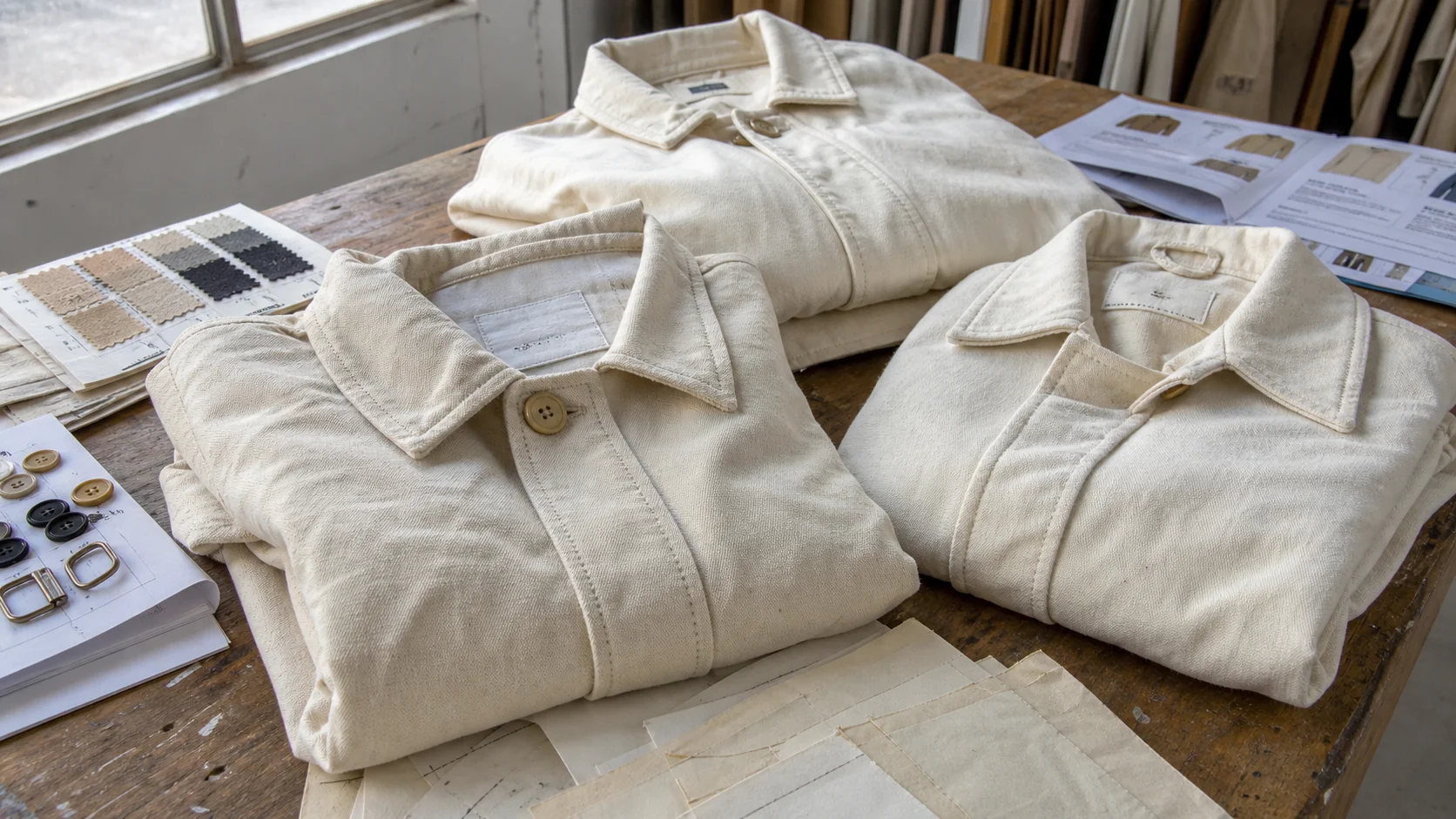
A pricing-focused breakdown of bulk undyed twill coat MOQ thresholds, cost drivers, and distributor buying considerations for sustainable fashion programs.
Bulk undyed twill coat pricing sits in a narrow space between basic outerwear and sustainable sourcing. Distributor buyers usually care about three things at the same time: landed cost, repeatability, and whether the mill or garment factory can hold the same standard when order size increases. Undyed twill can help on all three, but only when the buyer understands what is actually being priced.
Undyed does not mean low-effort. The fabric still needs stable yarn quality, controlled weaving, proper shrinkage behavior, and a coat pattern that works without hiding issues behind heavy finishing. Buyers looking at bulk orders should review pricing as a combination of fabric yield, coat construction, trim package, labor time, and compliance overhead. When those pieces are clear, the quote is easier to compare, and the risks become visible before production starts.
Bulk Undyed Twill Coat Pricing for Distributor Buyers - Sustainable Fashion manufacturing guide
Undyed twill is a fabric that keeps its natural fiber color or the base shade of the yarn, with no added dyeing stage after weaving. That sounds simple, but the practical effect is important for distributor buyers. Removing dye and some wet processing can reduce cost and shorten the production chain, yet the fabric still needs the right weight, hand feel, and consistency for outerwear.
For coats, twill is usually chosen for its diagonal structure, clean drape, and dependable wear resistance. It can be woven from cotton, cotton blends, recycled blends, or other natural fiber combinations. The buyer should not assume that undyed automatically means lower quality or lower price. Pricing depends on how much preparation the mill has already done, whether the cloth is garment-dyed or loom-state, and how much finishing is needed to make the coat wearable and stable.
In distributor terms, undyed twill coat programs often sit in one of three buckets:
The quote changes a lot across those buckets. A buyer comparing two suppliers should not treat them as interchangeable unless the fabric construction, seam count, and trim package are equally defined.
Most bulk undyed twill coat quotes break down into a few cost centers. The problem is that suppliers often present a single unit price without showing where the value sits. That makes comparison difficult. A better review starts with the inputs that move the price up or down.
Heavier twill usually costs more per garment because it requires more yarn and can increase cutting waste. A coat in a 280 gsm fabric is not the same program as a coat in a 380 gsm fabric, even if the style looks similar on paper. Yield also matters. A relaxed silhouette may use more cloth than a tailored silhouette, and oversized sleeves or long hem allowances can increase fabric consumption quickly.
Undyed fabric can still require scouring, pre-shrinking, singeing, or calendering depending on the target finish. If the mill delivers loom-state fabric with limited preparation, the garment factory may need extra steps to stabilize it. That can shift cost from fabric into processing, but the total price may rise if the factory has to manage more shrinkage risk.
Simple unlined coats are cheaper than structured coats with facing, partial lining, sleeve tabs, plackets, internal pockets, and reinforced stress points. Every added panel increases cutting and sewing time. Distributor buyers should ask for a construction breakdown, especially when the quote appears close across two suppliers but the workmanship spec is not identical.
Buttons, zippers, snap fasteners, woven labels, hang tags, seam tape, and thread quality all matter. Natural or recycled trims may raise cost, but cheap trims create failure points in inspection and after sale returns. A good price review separates optional branding elements from structural components, because those decisions affect both appearance and durability.
Testing for colorfastness is less intense than with dyed products, but buyers still need verification of fiber content, shrinkage, seam slippage, pilling, and dimensional stability. If the order requires environmental claims, recycled content, or restricted substance documentation, certification and testing costs should be included in the unit price.
MOQ and unit price are tied together. A larger order usually lowers cut-and-sew cost per unit because pattern making, setup, and grading are spread across more garments. That savings has limits. If the supplier has to source a special undyed twill base in a small mill run, fabric cost may stay high even at a larger garment quantity.
MOQ for bulk undyed twill coats varies by supplier type, fabric source, and the amount of customization. Distributors should treat the MOQ as a signal of production structure, not just a number to negotiate down.
Program Type Typical MOQ Range What It Usually Means Simple stock-style coat 100 to 300 pieces per color/style Limited customization, existing pattern base, easier line planning Private label coat 300 to 800 pieces per style More trim customization, custom labeling, moderate setup cost Certified sustainable program 500 to 1,500 pieces per style Fabric certification, documentation, tighter raw-material sourcing rules Fully custom outerwear 800 to 3,000 pieces per style New pattern, bespoke trims, longer approval and production cycleThese are practical ranges, not fixed rules. Some suppliers will quote lower MOQs if they already hold undyed twill greige goods in stock. Others will insist on a higher MOQ because the base fabric must be woven or reserved specifically for the order. Buyers should ask whether the MOQ applies to fabric purchase, garment assembly, or both. That distinction matters because a low garment MOQ can still sit on top of a high fabric minimum.
A low MOQ may look attractive, but it can raise the per-unit price sharply. A distributor should decide whether the objective is testing a market, filling a small channel order, or building a repeat program. The right MOQ is the one that fits the sales plan and the inventory risk, not the lowest number on the quote sheet.
Sample approval is where many cost mistakes become visible. A well-run supplier will not jump directly from tech pack to bulk. The usual sequence is straightforward: fabric swatch confirmation, proto sample or salesman sample, fit sample, pre-production sample, then bulk approval. Each stage catches a different type of problem.
Distributor buyers should treat sample comments as commercial controls, not just aesthetic feedback. A change in collar shape, pocket size, sleeve length, or seam allowance can affect fabric consumption and labor time. If the supplier revises the pattern after sample approval, the unit price may need to be revisited.
Useful checks at sample stage include:
Buyers should also insist on measurement tolerance rules before bulk starts. A coat with a loose fit can hide small measurement drift, but a structured coat cannot. If the supplier lacks a formal tolerance chart, that is a warning sign. It usually means the factory will judge quality case by case, which is not a good basis for bulk pricing.
Lead time is often presented as a calendar number, but the real schedule depends on raw material readiness. Undyed twill programs can move faster than dyed programs because the fabric avoids a color approval cycle. That advantage disappears if the supplier has to source a special weave, wait for a loom run, or line up certification documents.
The most common lead-time dependencies are:
For distributor buyers, a delayed approval cycle can increase cost in less obvious ways. If the factory holds capacity while waiting, the supplier may add urgency charges, reschedule other orders, or re-quote material if market prices move. A clean approval process often saves more money than pushing the unit price down by a small amount.
Typical planning ranges for an undyed twill coat order are often 45 to 90 days from confirmed sample to shipment for simpler styles, and longer for custom or certified programs. That range can stretch if the fabric must be woven to order or if the order lands near a holiday shutdown. Buyers should not accept lead time without confirming what is already in hand and what still needs to be purchased.
For broader sourcing support, distributors can review the supplier's production approach on services, and use the contact path at contact us when they need a direct quote review or spec check.
Pricing becomes far more stable when the buyer locks key specifications before quotation. A vague style description leads to assumption-based pricing, and assumption-based pricing is where disputes usually begin.
Buyers sometimes assume trims are minor line items. That is not always true. A coat with natural horn-style buttons, heavy-duty snaps, and custom woven labels can move several percentage points in cost versus a basic utility version. If the supplier quotes with generic trims and later upgrades to branded components, the final price can rise without changing the garment silhouette at all.
The smartest purchasing approach is to separate mandatory spec from optional spec. The mandatory list should include the minimum acceptable construction and performance target. Optional upgrades should be priced separately so the buyer can compare a base quote against an enhanced commercial version.
Undyed coats reduce one set of risks, but they introduce another. Because the fabric has not been hidden behind dyeing, weave defects and shade variation in natural fiber lots can be easier to see. Buyers should expect visible checks to be stricter, not looser.
Common inspection risks include:
Inspection plans should be written into the purchase order or quality agreement. A distributor should specify AQL level, critical defect definitions, and whether 100 percent carton review is needed for branded retail channels. When the style is simple and the shipment is large, a statistically valid inspection can work. When the coat is going into a premium channel or a launch window, a stricter final check is usually the safer choice.
Internal factory controls matter too. A supplier with no in-line QC on seam balance, measurements, and trim attachment is likely to leak problems into the final batch. That is not a theoretical concern. Outerwear defects often show up late because they are buried under linings or hidden inside seam layers. By the time they appear in final inspection, rework is already expensive.
For distributors comparing long-term supplier fit, the background approach and company standards can be reviewed through about us.
A pricing review works best when it follows a simple sequence. The goal is not to squeeze every supplier into the same answer. The goal is to identify what is included, what is missing, and where the quote becomes fragile.
Ask whether the quote is ex-works, FOB, CIF, or another term. A unit price without shipping assumptions is not directly comparable across suppliers. Distributor buyers need clarity on who pays local transport, export handling, inspection fees, and carton labeling.
Two quotes are only comparable if the fabric weight, construction, trim package, size range, and packaging spec are the same. If one quote uses a simpler internal finish, it is not a like-for-like comparison. If needed, ask the supplier to re-quote to a common standard.
A useful supplier will tell the buyer which inputs move the price most. That might be fabric width, trim selection, order quantity, or packing method. This helps distributors decide where to make tradeoffs. A small trim upgrade may not matter much, while a heavier fabric weight might change the program economics entirely.
Distributors should compare landed cost against expected channel price, not just against an internal target. A lower unit cost on a coat that returns frequently or misses quality standards is not a better deal. The right question is whether the program supports the sell-through plan.
If the supplier is still revising samples, the price is not final. Every revision can affect consumption, labor, and compliance work. A quote should include a validity window and a rule for re-pricing if the buyer changes the spec after approval.
Review Item What to Check Buyer Risk If Missed Fabric basis GSM, width, finish, fiber content Incorrect cost and unstable garment quality Construction Panels, lining, reinforcements, seam count Hidden labor increase and lower durability MOQ Fabric minimum, garment minimum, color minimum Unexpected inventory pressure Approval path Sample stages and sign-off dates Delayed bulk and possible rush fees Inspection plan AQL, defect list, packaging standard Claims, returns, and reworkUndyed twill has a clear sustainability appeal because it can avoid some dye chemistry, water use, and processing complexity. That claim should still be handled carefully. Sustainability in sourcing is not just about the absence of dye. It also depends on fiber origin, fabric yield, waste control, trim selection, and how many units end up unsold.
For distributor buyers in the sustainable fashion category, the best commercial choice is often the one that keeps the product simple without making it disposable. A well-made undyed twill coat can support a longer lifecycle if the fabric is durable, the construction is repairable, and the trims are chosen for replacement and longevity. A cheap undyed coat that distorts or pills quickly creates waste despite the initial material logic.
Useful sustainability checks include:
Buyers should also be careful with sustainability language in marketing. If the garment is described as eco-conscious, natural, or low-impact, the supporting documentation needs to match the claim. Suppliers can help with evidence, but the distributor remains responsible for how the product is positioned in market materials.
Where a buyer wants a stable external sourcing partner, the next step is usually a direct service conversation through services or a project inquiry at contact us. That keeps the discussion focused on spec, MOQ, and timeline before any commercial commitment is made.
Bulk undyed twill coat pricing is easier to manage when distributors stop treating it like a single-number negotiation. The real pricing picture comes from fabric weight, construction complexity, trim selection, MOQ structure, and the approval process that sits between sample and shipment. Undyed fabric can improve the commercial case for sustainable outerwear, but only when the supplier has tight control over yield, shrinkage, and finish consistency.
For distributor buyers, the practical move is to request a quote that clearly separates fabric, labor, trims, testing, and logistics. That structure makes it easier to compare vendors, protect margin, and avoid last-minute scope changes. A careful review at the beginning usually costs less than a correction after bulk production has already started.
Get a free quote from Fabrikn — your trusted B2B clothing manufacturer with 10+ years of experience. MOQ as low as 200 pieces.
Get a Free Quote →Realistic MOQ often starts around 100 to 300 pieces for simple stock-style programs and moves to 300 to 800 pieces for private label coats. Fully custom or certified sustainable programs often need higher runs. The exact MOQ depends on whether the fabric is already available or must be woven to order.
Undyed twill can avoid the cost of dyeing and some wet processing. The savings are not automatic. If the fabric needs extra stabilization, special finishing, or small-batch weaving, the final price can still be close to or higher than a dyed alternative.
The buyer should confirm fiber content, fabric weight, width, finish, trim package, size range, packaging, inspection standard, and MOQ basis. A quote is only meaningful when those details are aligned across suppliers.
Simple undyed twill coat programs often run 45 to 90 days from sample approval to shipment. Custom construction, special trims, or certified material sourcing can extend that timeline. Fabric availability is usually the biggest schedule driver.
Common risks include shade variation in natural fiber lots, uneven shrinkage, puckering on heavy seams, trim failure, and weak pocket reinforcement. These issues are easier to control when sample approvals and inline checks are written into the order.
Yes, if the fabric is durable, the trims are appropriate, and the production run is sized to demand. Sustainability claims should be supported by traceability and quality records. A low-impact material choice does not offset poor construction or excess inventory.