
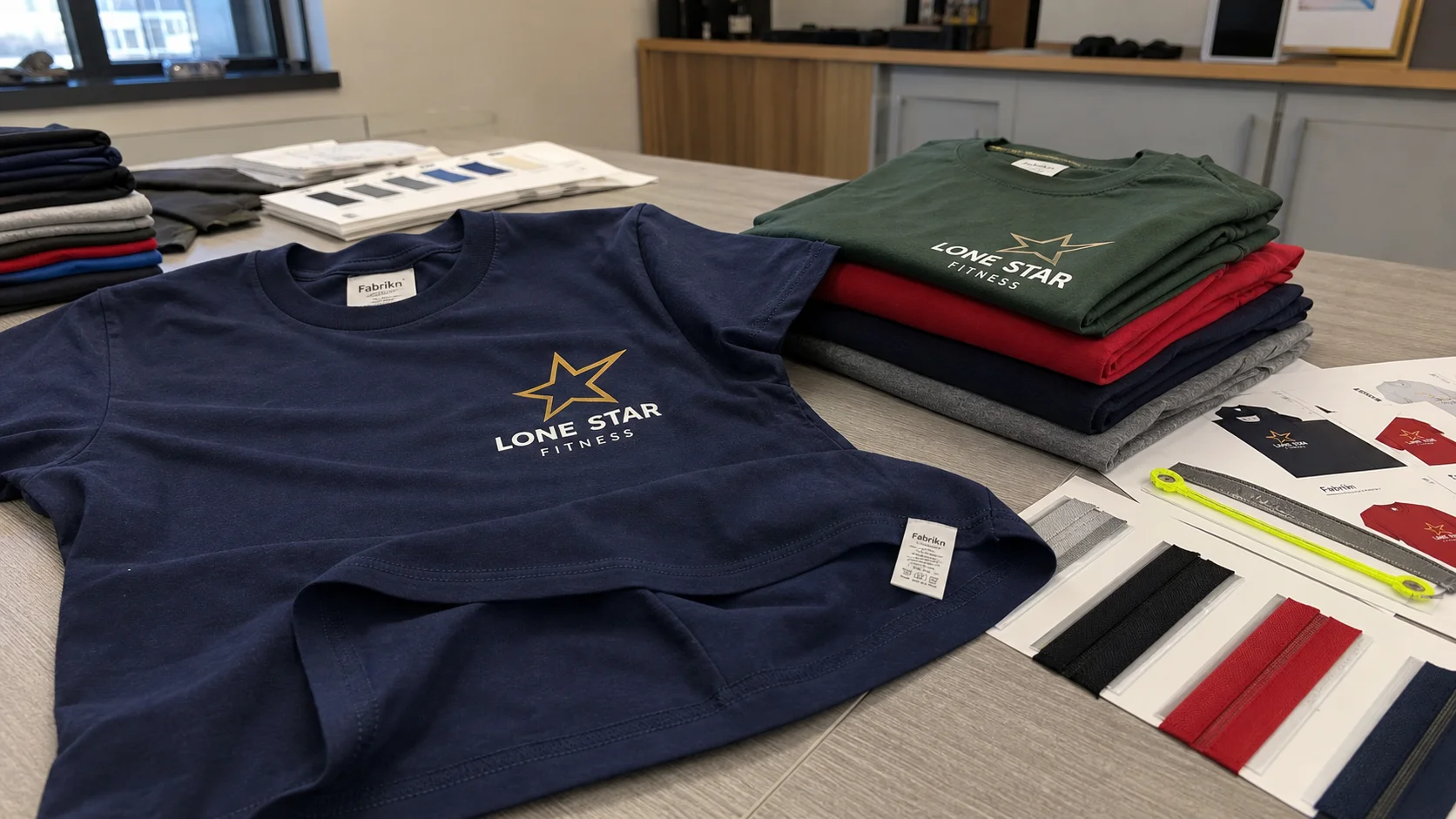
A focused outline for cleaning service distributors evaluating bulk uniform heat transfer, covering transfer types, garment compatibility, artwork setup, production workflow, durability, compliance, and ordering factors specific to decorated uniform programs.
Bulk Uniform Heat Transfer for Distributor Orders - Fabrikn production reference
Bulk uniform heat transfer is a practical decoration method for cleaning service distributors that need repeatable branding, scalable order handling, and controlled unit costs across multiple garment types. For distributors supplying janitorial contractors, facility maintenance teams, housekeeping services, and commercial cleaning crews, the decoration method matters as much as the garment itself. A uniform program that looks clean on day one but fails after repeated industrial washing quickly becomes a claims problem.
That is why heat transfer remains a strong option in distributor uniform programs. It supports logos, employee names, branch identifiers, reflective markings, and role-based labeling without requiring the setup profile of large embroidery runs or the color limitations that come with some lower-cost print methods. When the order mix includes polo shirts, work tees, lightweight jackets, softshells, aprons, and high-visibility items, heat transfer gives purchasing teams more flexibility.
For cleaning service distributors, the real question is not whether heat transfer works. The better question is where it works best, what specifications should be locked before bulk production, and how to structure orders so decoration quality stays consistent from one replenishment cycle to the next. That is the difference between a decoration method that supports long-term account growth and one that creates rework.
If you are reviewing scalable decoration options for commercial uniform supply, it helps to compare garment sourcing, logo application methods, and production controls together. FabrikN’s services page is a useful starting point for evaluating broader apparel production support, and the about-us page can help buyers understand supplier positioning before moving into quotations and development.
Heat transfer decoration applies a pre-printed or cut design onto a garment using controlled temperature, pressure, and dwell time. In bulk uniform production, the process is usually standardized through approved artwork, fixed logo sizing, press settings matched to the fabric, and placement guides for each garment style.
For cleaning service distributors, heat transfer is commonly used for:
The main commercial advantage is flexibility. Distributors rarely sell one garment in one logo version only. They often manage repeating orders for many end users, with small artwork variations spread across larger combined production lots. Heat transfer accommodates that mixed-order environment better than some decoration methods that require more rigid batch structures.
It also gives a cleaner surface finish than embroidery on lightweight or stretch fabrics. That matters in cleaning uniforms because many garments need ease of movement, a neat appearance, and low irritation during long shifts. A stitched logo can add bulk and distortion on lighter knits. A properly specified transfer usually avoids that issue.
Cleaning service distributors face a sourcing pattern that differs from fashion apparel and even from some industrial workwear categories. Orders often combine practical wear requirements with branding consistency, fast replenishment, and price sensitivity. Heat transfer fits that profile for several reasons.
A distributor may supply the same cleaning company with short-sleeve polos, long-sleeve tees, fleece jackets, and smocks. Keeping the logo color, placement, and scale aligned across these items is easier when decoration is managed from one approved transfer package rather than interpreted separately by different decoration methods.
Uniform distributors frequently handle branch-level customization, employee names, or client-specific logo changes. Heat transfer is usually easier to adapt for that type of variation than embroidery, especially when each SKU needs multiple logo versions in the same production cycle.
Many cleaning crews wear polyester polos, poly-cotton blends, moisture-management knits, or stretch work tops. These fabrics can perform well with heat transfers if the transfer type and press settings are matched correctly. Embroidery can pucker lighter fabrics, while some direct print options may struggle on textured or treated surfaces.
Bulk programs often start with a larger rollout and continue through repeat replenishment. Heat transfer supports this model when the supplier keeps artwork files, placement templates, approved samples, and transfer specifications on record. Reorders become easier to control because the reference standard already exists.
Purchasing judgment: heat transfer is usually the better choice when a distributor needs logo consistency across several garment categories, moderate customization, and controlled visual presentation on lightweight uniforms. Embroidery still has a place for premium polos and corporate front-office uniforms, but it is not automatically the best answer for active cleaning crews.
Not every uniform behaves the same under a heat press. The safest buying decision is to review decoration compatibility at the garment-development stage rather than after stock is booked.
These are common in front-facing cleaning teams, supervisors, and branded service crews. Smooth polyester or poly-cotton polos generally take transfers well, though dye migration testing is important on dark polyester garments. Low-bleed transfer materials may be necessary where navy, red, black, or royal garments are involved.
Cotton and blended tees are among the easiest substrates for standard logo transfers. They are cost-efficient for volume orders and work well for large back prints plus small chest logos. Distributors serving price-sensitive contractors often use this route for entry-level programs.
Outerwear can be a good use case for transfers, but fabric texture and heat sensitivity need closer review. Some softshell laminations, water-resistant coatings, and brushed fleece surfaces require specific temperature limits or alternative transfer constructions. A supplier should confirm compatibility by pre-production testing, not by assumption.
These items are common in hospitality cleaning and institutional housekeeping programs. Flat fabric panels make logo placement straightforward. The main concern is wash durability, especially where garments are laundered frequently with stronger detergents.
For crews working in parking lots, transport hubs, industrial sites, or overnight facility cleaning, reflective transfers may be part of the decoration package. Buyers should confirm the reflective specification, placement rules, and wash retention standard before release.
“Heat transfer” covers several material categories. A distributor should not buy on the label alone. The transfer construction needs to match the garment use case.
These are often used for names, numbers, simple logos, and single-color applications. They provide sharp edges and consistent placement. They can be effective for small runs or variable-data programs, though they are not always the best fit for complex multi-color brand marks at high volume.
These are commonly used in bulk uniform orders because they combine relatively efficient scaling with strong logo detail. They suit left-chest logos, back graphics, and repeated distributor programs well. Once artwork is approved, repeatability is usually stronger than ad hoc small-batch decoration.
These are used for safety visibility, premium branding effects, or functional labeling. Cleaning service distributors should be selective here. Specialty effects look good in presentations, but they are only worth specifying if they survive the real wash environment and daily abrasion.
These matter for polyester-rich garments. High heat can scorch some fabrics or activate dye migration, where garment dye bleeds into the transfer and changes logo color over time. Low-bleed adhesives and tested press conditions reduce that risk, but they should be validated through wash tests.
At minimum, purchasing specifications should cover:
A weak sourcing process often treats decoration as the final step only. A stronger process treats decoration as part of the garment spec package from the beginning.
Distributors handling cleaning service accounts benefit from a disciplined approval workflow. This reduces logo errors, placement inconsistencies, and reorder disputes.
Start with vector artwork, approved brand colors, and a defined logo usage file for each customer account. If the logo is being resized for small chest placement, confirm that fine lines and text remain legible.
Before sampling, verify fabric content, coating details, stretch level, and colorfastness risk. This is especially important when the same logo is applied across cotton tees, polyester polos, and softshell jackets in one program.
A transfer sample or strike-off is the first checkpoint for color and edge quality. Buyers should approve this before bulk transfer production starts, not after garments are decorated.
The pressed sample shows how the logo performs on the actual garment. This step is critical because a transfer that looks fine off-garment can behave differently once applied to textured or stretch fabric.
For cleaning uniforms, at least a basic wash trial is worth the time. If the garments will face frequent commercial laundering, the trial should reflect that environment as closely as possible.
Only after artwork, placement, and sample results are approved should the order move into full production. Approved reference samples should be retained for comparison during inspection and repeat orders.
This workflow may feel cautious, but it protects the distributor. Replacing branded uniforms after a logo failure costs more than a controlled sampling stage.
Bulk buying decisions in this category usually come down to balancing MOQ, speed, logo complexity, and reorder stability.
MOQ depends on whether the supplier is sourcing blank garments, manufacturing uniforms, producing custom transfers, or decorating customer-nominated stock. In practical terms, buyers often see patterns like these:
Order Type Typical MOQ Range Notes Bulk decoration on stocked blanks 50–150 pieces per logo or style Often suitable for distributor replenishment orders Custom uniform production with heat transfer 200–500 pieces per style/color Varies by fabric sourcing and trim customization Mixed-size distributor rollout programs 300–1000+ total pieces Better cost efficiency when logos are standardized Variable-name or branch-custom orders Can run lower per variant if grouped Per-unit decoration cost usually rises with variationThese are not fixed rules. They are practical market ranges. Buyers should ask which MOQ applies to garment production, which applies to transfer production, and which applies to decoration by logo version. Those are often different numbers.
Lead time is usually shaped by more than pressing logos onto garments. The main variables include:
For decorated stocked garments, a practical lead time may fall around 2 to 5 weeks after final approval, depending on capacity and order complexity. For custom-manufactured uniforms with heat transfer, 45 to 90 days is a common planning window, with longer timelines possible if fabric development or multiple sample rounds are involved.
The lowest unit price is not always the best distributor outcome. A cheaper transfer with weak wash durability can trigger claims, credits, and account damage. A more stable transfer construction may cost slightly more but lower replacement rates.
There are also tradeoffs between consolidation and flexibility. Larger combined orders generally improve costing. Too much logo variation inside one program can reduce that efficiency. Distributors should standardize where the end customer will accept it: same logo size, same placement, same garment colors where possible.
Purchasing judgment: if a cleaning service account reorders regularly, it is usually worth paying for proper sampling, wash validation, and documented decoration specs. That upfront discipline tends to reduce total program cost over time.
Heat transfer failures are rarely random. Most can be traced to specification gaps, rushed approvals, or inconsistent pressing controls.
A reliable inspection protocol should include garment count, color, size assortment, logo placement measurement, adhesion check, visual appearance, packaging accuracy, and random wash or stretch review where appropriate. If the order is packed by wearer or branch, carton accuracy becomes part of the quality check as well.
For cleaning service distributors, packaging errors can be almost as costly as decoration defects. If a rollout is organized by site, team, or employee name, mislabeled packs create operational delays for the customer.
Keep one sealed approved sample per style and logo version where possible. This becomes the reference point for future reorders and dispute handling. Without a retained control sample, every reorder becomes more subjective.
The best supplier is not simply the one with the lowest quote or the widest decoration menu. For distributor orders, the priority should be process control.
When qualifying a supplier, ask practical questions:
A supplier that answers these questions clearly is usually easier to work with than one that only emphasizes price and capacity. For distributor programs, repeatability is the real value driver.
If you are comparing decoration partners or developing a cleaning uniform program with custom branding, the quickest route is usually to review production capabilities first, then move into artwork and order structure. FabrikN’s services page outlines broader apparel support areas, and the contact-us page is the right place to request quotations, MOQ guidance, or sample planning details tied to your order profile.
In practical sourcing terms, bulk uniforms heat transfer for cleaning service distributors works best when four pieces align: the correct garment base, the correct transfer construction, a disciplined sample approval path, and inspection controls that match the wash reality of the end use. Miss one of those, and the decoration program becomes fragile. Get them right, and heat transfer is one of the more flexible and commercially efficient options in the uniform supply chain.
That is why many distributors continue to use it across housekeeping, janitorial, building services, and contract cleaning accounts. The method is not universal, and it is not always the premium answer. It is often the most balanced answer when branding consistency, moderate customization, and scalable repeat ordering matter more than decoration prestige alone.
Get a free quote from Fabrikn — your trusted B2B clothing manufacturer with 10+ years of experience. MOQ as low as 200 pieces.
Get a Free Quote →The main advantage is flexible branding across multiple garment types with relatively consistent logo appearance. It works well for distributor programs that need repeat orders, employee names, branch customization, and scalable logo application.
It can be, provided the transfer type is matched to the garment fabric and wash environment. Durability depends on material choice, press settings, and whether the uniforms face standard home laundering or heavier commercial wash conditions.
For decoration on stocked garments, a common practical range is about 50 to 150 pieces per style or logo version. For custom uniform manufacturing with decoration, MOQ often starts around 200 to 500 pieces per style/color, though exact numbers vary by supplier and fabric setup.
Lead time depends on stock availability, artwork approvals, sample rounds, and packing complexity. Decorated stock programs may move in roughly 2 to 5 weeks after final approval, while custom-manufactured uniform programs often require 45 to 90 days.
Dye migration is one of the biggest risks, especially on dark polyester garments. If the transfer and press settings are not designed to block dye bleed, the logo color can shift after application or washing.
Yes. The safest path includes artwork approval, a transfer sample or strike-off, a pressed garment sample, and ideally a basic wash review. This reduces costly errors in logo size, placement, and adhesion before the full run starts.