
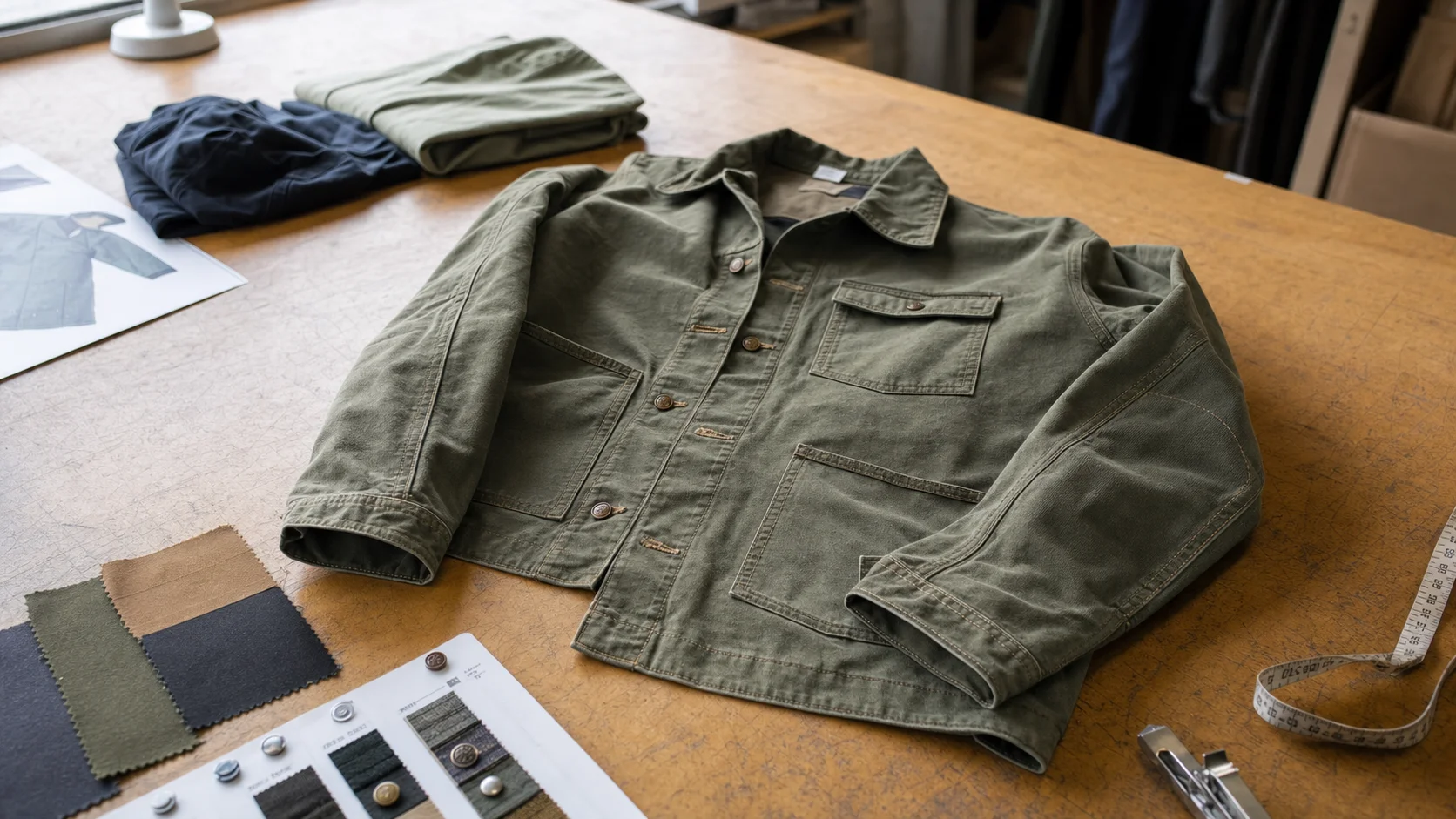
A product-specific SEO outline for distributor buyers managing bulk utility coat factory releases, covering fit, shell fabric, trims, labeling, inspection,...
Utility Coat Release Checklist for Bulk Buyers - Fabrikn production reference
For distributor buyers, a utility coat is not just another outerwear SKU. It usually carries a higher landed cost than basic fleece or shirts, has more technical construction points, and is often expected to perform across workwear, casualwear, uniform, promotional, and retail channels. A weak factory release process can turn a profitable bulk order into a slow-moving liability: uneven sizing, unstable fabric, zipper failures, shade variation, missing trims, late cartons, or inconsistent labeling.
This utility coat factory release checklist is written for bulk buyers who need practical control before mass production, during sewing, and before shipment. It focuses on the decisions that affect distributors most: MOQ planning, sample approval, fabric and trim specifications, workmanship standards, packaging, inspection risks, and release documentation. The goal is simple: do not let a factory release bulk utility coats until the order is technically approved, commercially aligned, and inspectable against clear standards.
A bulk utility coat factory release checklist protects the buyer before the order reaches the expensive stage. Once shell fabric is cut, most problems become costly. Once lining is attached, pocket positions are harder to correct. Once branded hardware is fixed, rework slows production and may damage the garment. Once cartons are sealed, the buyer may be forced to choose between accepting risk or delaying delivery.
Utility coats often include multiple fabric layers, patch pockets, flap pockets, snaps, zippers, drawcords, storm flaps, sleeve tabs, inner pockets, quilting, linings, or water-resistant finishes. Each added feature creates a possible failure point. A basic T-shirt inspection can focus heavily on size, sewing, color, and packing. A utility coat inspection needs a broader release standard because performance, fit, and hardware function matter more.
For distributor buyers, the release stage is also where commercial assumptions need to be checked. Are the size ratios realistic for the sales channel? Are the colors stable enough to replenish later? Are the carton markings aligned with warehouse intake requirements? Are care labels suitable for the target market? Is the garment strong enough for the way customers will use it?
The best release checklist is not a paperwork exercise. It is a buying control tool that forces the factory, merchandiser, QA team, and distributor buyer to agree on what “approved for bulk” actually means.
The factory should not begin sourcing or sampling until the buyer brief is specific enough to price, engineer, and inspect. A vague request such as “men’s utility coat in cotton canvas with pockets” leaves too much room for interpretation. The release checklist should begin with a written brief that defines the customer, channel, price target, usage, design direction, and compliance expectations.
A distributor selling to corporate programs may need stable repeat production, conservative fit, simple color options, and durable trims. A distributor selling to lifestyle retailers may accept higher fabric cost for better handfeel, garment wash effect, or more refined hardware. A promotional distributor may prioritize lower MOQ, fast delivery, and easy branding access over complex construction.
Before release, confirm that the factory understands the order purpose. Outerwear built for warehouse staff, field service teams, or outdoor retail has different stress points. Sleeve movement, pocket durability, zipper strength, and fabric abrasion resistance can matter more than a small saving in FOB cost.
If the buying team needs support converting a concept into a production-ready outerwear brief, a structured supplier process is useful. Fabrikn outlines broader production support on its apparel manufacturing services page, which can help buyers frame the required development and production steps before a coat order is released.
MOQ is one of the first commercial issues to settle. For utility coats, typical MOQ ranges vary widely depending on fabric availability, custom dyeing, trim development, quilting, lining, and private label requirements. A simple stock-fabric utility coat may be feasible from roughly 300 to 600 pieces per color in some sourcing setups. Custom fabric, custom dye, bonded fabric, heavy washing, or branded hardware often pushes MOQ toward 800 to 1,500 pieces per color or higher.
Total order quantity also matters. A factory may accept a lower per-color MOQ if the total order is healthy and colors share the same fabric base and trims. A three-color order of 500 pieces each can be easier to place than a single 500-piece custom color if the mill and dye house need efficient batch volume. Distributor buyers should ask for MOQ by style, color, size, fabric, lining, and trim, not just one headline number.
Small MOQs are attractive, but they can carry tradeoffs. Unit price rises because cutting, sewing line setup, pattern grading, sample development, testing, and inspection costs are spread across fewer garments. Fabric wastage may be higher. Color consistency can be harder if the mill runs very small lots. Trim suppliers may substitute available options unless the buyer locks specifications early.
Order Scenario Typical MOQ Range Buyer Tradeoff Stock fabric, standard trims, simple lining 300 to 600 pieces per color Faster setup, but fewer exclusive design details Custom color fabric with standard hardware 600 to 1,200 pieces per color Better brand control, but longer fabric lead time Custom fabric construction or special finish 1,000 to 2,000 pieces per color Stronger product differentiation, but higher inventory risk Branded snaps, zipper pulls, or custom labels Often 1,000+ pieces per trim or style Premium presentation, but rework risk if trim arrives lateDistributor buyers should also challenge the size ratio before release. A factory may accept the ratio given, but it is the buyer’s responsibility to avoid a warehouse full of unpopular sizes. For workwear-style utility coats, larger sizes may move faster than fashion ratios suggest. For women’s or unisex programs, fit testing and sales channel data should guide the ratio.
The technical pack is the center of the release process. It should describe the coat so clearly that the factory, inspection team, and buyer can all judge the same garment against the same requirements. If the tech pack is incomplete, the factory will fill gaps with its own assumptions. Some assumptions may be reasonable; others may create quality complaints later.
A release-ready utility coat tech pack should include front, back, and internal views; fabric details; lining details; trim callouts; seam construction; pocket dimensions; measurement chart; tolerance table; artwork; label placement; packing instructions; and testing requirements. For a distributor buyer, it should also state whether the product is a one-time promotion, a seasonal line, or a replenishment item. Replenishment styles need tighter color, fabric, and trim continuity than one-off programs.
Do not release a bulk utility coat based only on a photo and a price. That may work for a low-risk stock item, but it is not enough for custom outerwear. If the factory offers an existing style, the buyer should still request a written specification and approved sample. “Same as sample” is useful only when the sample is fully tagged, dated, measured, and retained as a reference.
Fabric selection drives cost, performance, appearance, and lead time. Utility coats are commonly produced in cotton canvas, cotton twill, poly-cotton twill, nylon taslan, polyester oxford, ripstop, brushed cotton, wax-look fabric, or coated water-resistant fabric. The correct choice depends on the use case. Cotton canvas has a strong workwear feel but may shrink and fade more. Polyester blends can improve stability and drying time but may feel less premium if poorly specified. Nylon can reduce weight but may look too technical for some lifestyle channels.
The factory release checklist should record fabric composition, construction, weight, finish, color, shrinkage target, colorfastness standard, and handfeel reference. Fabric weight should be stated in gsm or oz/yd², not described only as “heavy” or “medium.” A 240 gsm twill and a 330 gsm canvas will produce very different coats. The buyer should also clarify whether the garment will be garment washed, enzyme washed, pigment dyed, coated, laminated, quilted, or brushed.
Water resistance needs careful wording. “Waterproof” is a technical claim and usually requires fabric construction, seam sealing, and test data. Many utility coats are only water-resistant because the fabric has a DWR or coating but the seams are not sealed. Selling a water-resistant coat as waterproof can create returns and compliance risk. If the coat is intended for light rain, say so. If waterproof performance is required, specify hydrostatic head targets, seam sealing requirements, and breathable membrane expectations.
Fabric Point Release Requirement Inspection Risk Composition Confirm fiber content and care label alignment Mislabeling, compliance issue, wrong handfeel Weight State gsm or oz/yd² with acceptable tolerance Coat feels cheaper or heavier than approved sample Shrinkage Set washing and dimensional change limits Post-wash size complaints and sleeve length issues Colorfastness Test washing, rubbing, perspiration, and light where relevant Crocking onto light garments or fading in store Finish Define DWR, coating, peach, wax-look, wash, or brush finish Uneven surface, odor, poor durability, inconsistent shadeUtility coats rely heavily on trims. Zippers, snaps, buttons, eyelets, drawcords, toggles, hook-and-loop tape, patches, labels, thread, and elastic parts must be checked before bulk sewing. A strong fabric cannot compensate for a weak zipper. A good-looking coat can still fail if snaps pull out or pocket bartacks are missing.
The release checklist should include trim supplier references or approved samples for every visible and functional part. Zipper type should be specified by material, size, tape color, teeth color, slider type, puller design, and length. Snaps should be specified by diameter, finish, cap style, post length, and attachment strength. Buttons should include size, material, color, hole count, and spare button requirement if used.
Branded trims require earlier decisions. Custom zipper pulls, engraved snaps, embossed leather patches, woven patches, and private label packaging usually have their own MOQ and lead time. Late trim approval is a common reason outerwear production stalls. If a distributor is working toward a fixed delivery date, standard trims may be the safer decision.
Direct purchasing judgment: do not approve a lower-grade zipper to save a small amount on a utility coat unless the coat is clearly positioned as short-use promotional outerwear. The cost saving is usually not worth the return risk. For distributor programs where the buyer’s customer may reorder, reliable hardware is part of the margin protection.
Sample approval should move in stages. Factories may use different names, but the logic is generally similar: development sample, fit sample, pre-production sample, size set, and sometimes shipment sample. The buyer should not treat all samples as equal. A nice first sample may prove the concept, but it does not prove the factory can run bulk production correctly.
The development sample is used to review style direction, fabric feel, rough construction, and costing assumptions. It may use substitute fabric or trims, so it should not be approved for production unless all substitutions are documented. The fit sample checks pattern shape and measurements. It should be reviewed on the intended body type or fit form, especially for sleeve pitch, arm movement, chest ease, shoulder width, and body length.
The pre-production sample is the key release sample. It should use bulk fabric, bulk lining, bulk trims, correct labels, approved artwork, final wash or finish, and production construction. This sample becomes the reference for the sewing line and inspection team. A size set then confirms grading across the size range. Utility coats can look correct in medium but fail in larger sizes if sleeve width, armhole depth, or body length grading is weak.
Sample Stage Purpose Release Decision Development sample Confirm concept, silhouette, and initial construction Approve direction, not bulk production Fit sample Check body fit, sleeve movement, and base measurements Approve pattern corrections before bulk materials are cut Pre-production sample Confirm final fabric, trims, labels, construction, and finishing Approve production only if all comments are closed Size set Check grading and measurements across size range Approve cutting only after critical sizes pass Shipment sample Confirm packed production output before dispatch Use as a reference, not a substitute for inspectionEvery sample comment should be closed in writing. “Improve pocket shape” is not enough. State the correct pocket dimension, position, stitch width, and reinforcement method. If a comment affects cost or lead time, it should be reflected in the final quotation and production schedule before release.
Fit problems are expensive in outerwear because customers expect layering comfort. A utility coat that fits like a shirt will feel restrictive over a hoodie or work uniform. A coat that is too oversized may look sloppy and increase fabric consumption. The release checklist should define intended fit: regular, relaxed, oversized, women’s shaped, straight unisex, or workwear layering fit.
Measurement tolerance should be realistic. Outerwear tolerances are often wider than lightweight apparel because of fabric thickness, quilting, padding, and construction complexity. Still, critical points need control. Chest, body length, sleeve length, shoulder width, hem, and armhole are usually high-risk points. For lined coats, lining measurements must also be checked to avoid pulling, twisting, or restricting movement.
Size grading should be reviewed carefully for extended sizes. A simple grade rule may not work if the coat includes many pockets, panels, or shaped seams. Larger sizes may require adjusted pocket placement, longer zipper lengths, wider sleeve openings, and stronger reinforcement. If the buyer sells into uniform or workwear channels, extended-size accuracy is not optional.
For private label programs, buyers can review supplier background and production approach before locking a size system. Fabrikn provides company context on its about us page, which can help sourcing teams understand whether a supplier’s service model fits their development needs.
Utility coats should be judged by both appearance and durability. Buyers should check seam strength, stitch density, reinforcement points, pocket symmetry, zipper setting, lining attachment, topstitch consistency, collar shape, hem balance, and pressing quality. A coat can pass a quick visual review while still having weak bartacks or poor lining control.
Pockets deserve special attention. Utility coats often feature large patch pockets, chest pockets, hidden pockets, side-entry pockets, or cargo-style compartments. These pockets create value for the wearer, but they are also common defect zones. Pocket flaps may be uneven, pocket openings may stretch, bartacks may be misplaced, and pocket bags may twist after washing. If pockets are functional, they should be reinforced for actual use.
Seam type should match the fabric and positioning. Heavy cotton canvas may require stronger needles, suitable thread, and adjusted machine tension. Lightweight coated fabric may show needle holes if reworked. Quilted or padded sections need even channel spacing. Lined coats need clean attachment without pulling at the armhole, hem, or sleeve opening.
Area Release Check Common Defect Front zipper Straight setting, smooth operation, aligned placket Wavy zipper, uneven front length, catching lining Pockets Symmetry, reinforcement, opening size, flap coverage Crooked pockets, weak bartacks, uneven flap points Collar and hood Shape, balance, seam turning, drawcord function Twisting, puckering, poor edge shape Lining Correct ease, clean attachment, no twisting Pulling at sleeve, exposed seam, trapped fabric Topstitching Consistent width, tension, thread color Skipped stitches, waviness, broken threadDirect purchasing judgment: if the factory struggles to produce clean pocket symmetry and zipper alignment on the pre-production sample, do not assume bulk production will improve. Sampling is usually slower and more controlled than mass sewing. Bulk output tends to expose weaknesses, not hide them.
Color approval should be handled before fabric booking. For dyed fabric, buyers usually review lab dips. For yarn-dyed, printed, coated, or washed fabrics, the approval process may include strike-offs, handlooms, wash panels, or bulk fabric swatches. The checklist should state the approved color reference, light source, tolerance, and approval authority.
Shade control is a major risk in bulk utility coat production. Different fabric lots can produce visible variation between panels, sleeves, collars, and pockets. Garment washing can increase variation. Coated or wax-look fabrics may show streaking or uneven finish. If a distributor is splitting inventory across customers, visible shade differences can create complaints during replenishment or mixed shipments.
The factory should confirm whether all shell fabric is from one dye lot. If multiple lots are unavoidable, the cutting plan should prevent shade mixing within a garment and ideally within the same carton. Shade bands can be used when needed. Buyers should approve bulk fabric before cutting, not after the factory has already consumed it.
Neutral colors such as black, navy, khaki, olive, and charcoal are common for utility coats, but they still carry risk. Black can show poor crocking results. Navy can vary strongly under different light. Khaki and olive can shift between yellow, green, and brown undertones. Charcoal may look inconsistent if different fiber blends are used across shell, rib, and trims.
Testing requirements should be agreed before production, not after shipment. The exact tests depend on market, fiber content, claims, and buyer policy. Common utility coat tests include fiber composition, dimensional stability, colorfastness to washing, colorfastness to rubbing, seam strength, tear strength, pilling, zipper strength, snap attachment, nickel release for metal trims where applicable, and water resistance if claimed.
Testing is not free, and distributor buyers should decide which risks justify cost. A low-price promotional coat may not need a full premium retail test package, but basic safety, labeling, and colorfastness should not be ignored. A workwear-style coat sold for repeated use should have stronger durability requirements.
Test Area Why It Matters Release Timing Shrinkage Protects fit after washing Before size set approval where possible Colorfastness to rubbing Reduces risk of color transfer Before bulk fabric cutting Seam strength Checks durability at stress points Before or during early production Snap and button pull strength Confirms hardware attachment safety Before final inspection Water resistance Supports performance claims Before marketing claim approvalBe cautious with performance language. If a coat is described as water-resistant, wind-resistant, stain-resistant, flame-resistant, or heavy-duty, the buyer should have test evidence or should soften the claim. Marketing language that outruns test results is a preventable commercial risk.
Before bulk release, the factory should show that the production line is ready. This includes approved patterns, graded markers, fabric inspection reports, trim inventory, machine setup, operator instructions, quality checkpoints, and an approved pre-production sample at the line. Outerwear production may require specialized machines for heavy seams, snap setting, buttonholing, quilting, binding, or bartacking.
Fabric inspection should happen before cutting. Buyers can request a 4-point fabric inspection summary, roll inventory, shade grouping, and shrinkage report. If defects are found after cutting, replacement fabric may delay the schedule. For coated, brushed, or washed fabrics, roll direction and nap direction should be controlled during marker planning.
Production lead time depends on fabric booking, trim availability, sample approvals, testing, factory capacity, finishing, inspection, and logistics. A simple stock-fabric coat may move faster, while custom fabric and trim programs can require significantly longer timelines. As a broad planning guide, many bulk outerwear orders may need 60 to 120 days after full approval, with custom fabrics, special washes, or peak season capacity pushing longer. Buyers should confirm the timeline by milestone rather than accepting a single shipment date.
Direct purchasing judgment: late sample approval usually costs more than buyers expect. It can push the factory into a rushed sewing window, reduce inspection time, and increase the chance of air freight pressure. If the delivery date is fixed, simplify the coat before production rather than hoping a complex style will catch up later.
Inspection planning should be part of the release checklist. For bulk utility coats, many buyers use AQL-based inspections, often with separate attention to critical, major, and minor defects. The exact AQL level depends on buyer policy, order value, and risk tolerance. A common approach is to treat safety issues, wrong labeling, severe measurement failures, and non-functioning closures as critical or major defects.
Inline inspection is valuable for utility coats because many defects can be corrected before the entire order is finished. If pocket placement is wrong on the first 200 pieces, it is much easier to correct than after 5,000 pieces are sewn. Final inspection is still necessary, but it should not be the first quality checkpoint.
Inspection should include visual review, measurement checks, function tests, packaging checks, and carton audits. Inspectors should open and close zippers, snap and unsnap closures, test drawcord function, check pocket openings, review lining attachment, and inspect high-stress points. Measurement checks should include multiple sizes and colors, not only one middle size.
Defect Type Examples Buyer Action Critical Sharp metal, unsafe drawcord, wrong legal label, severe contamination Hold shipment until corrected and re-inspected Major Broken zipper, missing snap, wrong measurement, wrong color, open seam Require repair, sorting, or replacement Minor Loose thread, slight pressing mark, small stitch irregularity Accept within agreed AQL if not excessiveCarton inspection is often underestimated. Distributor buyers need cartons that move through warehouses cleanly. Wrong size breakdowns, missing barcodes, poor carton strength, mixed colors without clear markings, or inaccurate packing lists can create chargebacks and fulfillment delays. For multi-customer distribution, carton-level accuracy is as important as garment-level appearance.
Packing instructions should be confirmed before final production. Utility coats are bulkier than shirts, so carton dimensions, folding method, polybag size, and carton weight need planning. Overpacked cartons can crush garments, damage snaps, bend collars, or create handling problems. Underpacked cartons raise freight cost. The checklist should state units per carton, size-color assortment, folding method, polybag warning text, silica gel use if needed, carton marks, and barcode placement.
Labeling must match the destination market and buyer requirements. Care labels usually include fiber content, care instructions, country of origin, size, and importer or brand information where required. Hangtags should not make unsupported claims. If recycled content, organic cotton, waterproofing, or special performance claims are used, documentation should support them.
Distributors should confirm whether goods are packed by solid size, solid color, pre-pack ratio, or customer allocation. The right answer depends on the warehouse and sales model. Retail pre-packs may speed allocation, while solid cartons may be better for wholesale replenishment. Mixed cartons save space in some cases but increase sorting risk.
If a buyer needs clarification before placing or releasing a bulk order, it is better to resolve it before production starts. Fabrikn’s contact page gives sourcing teams a route to discuss project details, timelines, and production requirements before committing to a release schedule.
A final factory release should be documented. The buyer should not rely only on chat messages or informal approvals. A proper release file helps resolve disputes and gives the factory a clear production standard. It also helps future replenishment because the buyer can compare new production against the original approved documents.
The release package should include the signed purchase order, final quotation, approved tech pack, approved pre-production sample record, size set approval, bulk fabric approval, trim approval, color approval, test reports, production schedule, inspection plan, packing instructions, and shipping requirements. If any point is approved with a concession, the concession should be written clearly with limits. For example, accepting slight shade variation in lining does not mean accepting shell fabric shade variation across panels.
Release Document Why It Is Needed Buyer Check Purchase order Confirms commercial quantity, price, delivery, and terms Match style, color, size ratio, and shipment date Final tech pack Controls product specification Use latest version only Approved PP sample record Defines the production reference Record date, comments, and approval status Material approvals Locks shell, lining, trims, labels, and packaging Confirm no substitutions without written approval Inspection plan Sets quality control method Define AQL, defect classes, and inspection timing Shipping documents Supports customs and receiving Check packing list, invoice, carton count, and origin detailsFinal release should be blocked if critical items remain open. Open items include unapproved bulk fabric, missing trim confirmation, failed test results, unresolved fit comments, unclear labeling, or incomplete packing instructions. A factory may be eager to start cutting to protect its schedule, but cutting before approval shifts risk to the buyer.
The following checklist can be used as a working release control before the factory cuts bulk fabric. Distributor buyers should adapt it to their product type, compliance market, and customer requirements.
A distributor buyer should release production only when the factory can prove readiness. If the coat is straightforward, materials are approved, samples are correct, and delivery pressure is manageable, release is reasonable. If the style has unresolved fit issues, untested performance claims, or late custom trims, holding release is usually safer than accepting weak bulk output.
There are also times when simplifying the style is the best commercial decision. Removing a custom snap, reducing pocket complexity, using a reliable stock lining, or avoiding a special wash can protect delivery and reduce quality risk. Product teams sometimes resist simplification because it feels like reducing value. In bulk utility coat sourcing, a clean, durable, on-time coat often has more commercial value than a complicated coat that arrives late or inconsistent.
Cost negotiation should not focus only on FOB. A lower FOB price can be erased by re-inspection fees, air freight, customer chargebacks, returns, or markdowns. The best release decision balances cost, quality, delivery, and customer expectation. Distributor buyers should push for value, but not at the expense of the functional parts that make the coat saleable.
Get a free quote from Fabrikn — your trusted B2B clothing manufacturer with 10+ years of experience. MOQ as low as 200 pieces.
Get a Free Quote →A utility coat factory release checklist is a control document used before bulk production starts. It confirms that the purchase order, tech pack, fabric, trims, samples, testing, inspection plan, labeling, and packing instructions are approved. For distributor buyers, it helps prevent quality failures, shipment delays, and warehouse receiving problems.
Typical MOQ can range from about 300 to 600 pieces per color for stock fabric and standard trims. Custom fabric, custom dyeing, branded hardware, special coating, quilting, or garment washing may increase MOQ to around 800 to 2,000 pieces per color or more. Exact MOQ depends on the fabric mill, trim suppliers, factory capacity, and total order volume.
The pre-production sample is usually the most important release sample because it should use bulk fabric, bulk trims, final construction, final labels, and approved finishing. A size set is also important because it checks whether the grading works across the full size range, not only the base size.
Common inspection risks include zipper failure, weak snap attachment, crooked pockets, uneven front placket, incorrect measurements, lining twisting, shade variation, skipped stitches, missing bartacks, wrong labels, poor pressing, and inaccurate carton packing. Functional checks are especially important because utility coats often have more hardware and pockets than basic jackets.
Yes, at least for key risks. Shrinkage, colorfastness, fabric weight, fiber content, seam strength, and trim attachment are common checks. If the coat carries a water-resistant, waterproof, wind-resistant, or durability claim, testing should support that claim before the buyer approves production or marketing language.
Lead time depends on sample approval, fabric sourcing, trim availability, testing, production capacity, finishing, inspection, and shipping. Many bulk outerwear orders may require about 60 to 120 days after final approval. Custom materials, peak season capacity, late sample comments, or failed tests can extend the timeline.
It is possible, but risky. A factory may start cutting or sewing while waiting for final trims, but production can stall if zippers, snaps, labels, or patches arrive late or fail quality checks. For utility coats, trim readiness should be treated as a release condition because hardware affects both appearance and function.
The final release file should include the purchase order, final tech pack, approved pre-production sample record, size set approval, fabric and trim approvals, test reports, production schedule, inspection plan, packing instructions, and shipping requirements. Written records reduce disputes and support future replenishment orders.