
A practical SEO outline for pricing bulk workwear coats for maintenance teams, covering material choices, decoration costs, durability, order size effects,...
Bulk Workwear Coat Costs for Maintenance Teams - Fabrikn production reference
Bulk workwear coat costs for maintenance teams depend less on the word “coat” and more on the actual build spec. A lightweight shop coat for indoor maintenance, a lined coat for cold storage work, and a rain-resistant coat for outdoor service are not priced the same way, even if they look similar in a catalog. Buyers who source at scale usually get better results by treating this as a specification exercise first and a price exercise second.
For maintenance teams, the right coat has to handle dirt, repeated laundering, tool abrasion, and frequent wear around machinery and sharp surfaces. Cost matters, but a cheap garment that shrinks, pills, or loses shape quickly often costs more across a season than a better-built coat bought at a slightly higher unit price. That is the central tradeoff in outerwear sourcing: lowest sticker price rarely equals lowest total cost.
If you are building a program for facilities, plant maintenance, utilities, or service contractors, it helps to define the intended use before you request quotes. A standard workwear coat for interior maintenance may only need a durable poly-cotton shell, reinforced seams, and practical pockets. A winter coat may need insulation, storm closures, and a heavier lining. Once those details are fixed, pricing becomes much more comparable across suppliers. For broader production support, see fabrikn.com/services/.
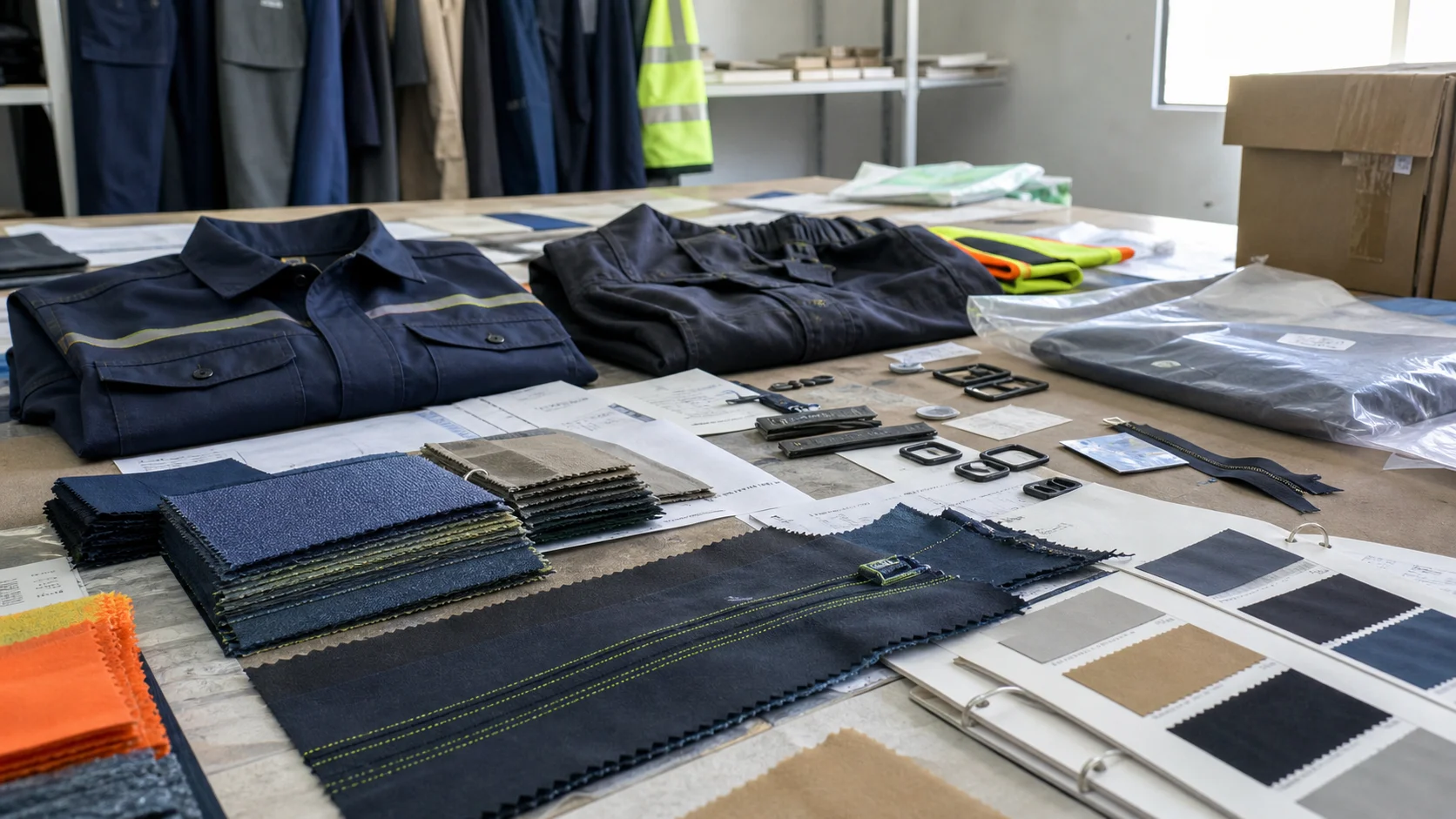
The biggest cost driver is fabric choice. A basic poly-cotton twill typically costs less than heavy canvas, bonded softshell, or technical waterproof fabric. Fabric weight also matters. A coat made from a 180 gsm shell will usually price below one built from 260 gsm or 300 gsm material, assuming all other details are similar. Heavier cloth usually improves abrasion resistance, but it raises both material cost and sewing time.
Trim package is the second major factor. Zippers, snaps, hook-and-loop closures, reflective tape, adjustable cuffs, storm flaps, and internal pocketing add cost in ways buyers sometimes underestimate. A simple button-front coat with basic patch pockets can be economical in bulk. A coat with branded zip pulls, contrast panels, mic loops, and segmented reflective tape is a different class of garment altogether.
Construction detail affects labor cost. Double-needle stitching, bar tacks at stress points, bound seams, gusseted underarms, and reinforced elbows take more time and better quality control. That extra labor is usually worth paying for when coats will be used daily by maintenance teams. A weak seam at the armhole or pocket opening is not a small defect in this category; it becomes a repeat replacement issue.
Decoration can change cost as well. Embroidery, screen print, heat transfer, and woven labels each carry different setup charges and production impacts. Small logos on the chest usually remain manageable, while large back decoration can slow production and require more approval steps. Buyers should also check whether decoration is included in the quoted garment price or listed separately.
There is no universal price sheet, but typical bulk ranges can help set expectations. A basic unlined maintenance coat in standard fabric may land in a lower-cost bracket when ordered in volume. A midweight lined coat with reinforced details usually sits in the middle. Technical outerwear with water resistance, insulation, and high-visibility features can move well above that.
Coat Type Typical Bulk Positioning Cost Drivers Basic shop coat Lowest cost tier Simple pattern, poly-cotton fabric, limited trim Durable service coat Mid-range tier Heavier fabric, reinforced seams, more pockets Lined cold-weather coat Higher mid-range to premium Insulation, lining, storm features, zippers Water-resistant or hi-vis coat Premium tier Technical fabric, reflective tape, compliance-related constructionMost suppliers will quote different price breaks at 100, 300, 500, and 1,000 pieces, sometimes with stronger savings above 3,000 pieces. As a general sourcing rule, the unit price often improves sharply once the pattern, grading, and sample development costs are spread across a larger order. Smaller quantities carry a premium because cutting, setup, and coordination costs do not shrink proportionally.
MOQ ranges vary by factory and by construction complexity. A straightforward coat may be available at 100 to 300 pieces per color or style. More technical outerwear can start at 300 to 500 pieces or higher. Some suppliers will accept lower MOQs, but the buyer usually pays for that flexibility through higher unit pricing or reduced trim customization. For supplier background and operating approach, review fabrikn.com/about-us/.
Buyers often ask for a quote before locking the spec, then wonder why the numbers vary so widely. That usually means the supplier is pricing risk as much as the garment. Clear technical details reduce that spread. At minimum, the brief should define fabric composition, fabric weight, color standards, closure type, pocket layout, seam construction, labeling, and decoration method.
Fabric composition should be stated precisely. A common workwear shell might be 65/35 poly-cotton twill or 100% cotton canvas. If the garment must survive industrial laundering, the fabric finish matters too. Pre-shrunk, enzyme-washed, and wrinkle-resistant finishes can affect both appearance and durability. If the coat will be worn in wet or cold environments, the buyer should specify whether the outer shell needs water resistance, a laminated membrane, or only a durable water-repellent treatment.
Lining and insulation are major price variables. An unlined coat is cheaper to make and easier to fit across body types, while a quilted or fleece-lined version adds material and assembly time. Thermal liners, quilt mapping, and detachable liners increase complexity again. Maintenance teams working indoors usually do not need heavyweight insulation unless part of the job requires exposure to cold docks, loading areas, or exterior plant equipment.
Pockets are small on paper and expensive in aggregate. Chest pockets, internal document pockets, tool pockets, sleeve pen pockets, and reinforced lower pockets all add labor. If the team needs to carry small tools, a stronger pocket bag fabric is worth specifying. Weak pocket bags fail early, and that defect is often blamed on “wear and tear” when it is actually a spec problem.
Branding affects the quote in practical ways. Woven labels, care labels, size labels, and country-of-origin labels are standard requirements. Custom neck prints, contrast hang loops, or embroidered identifiers may be useful for corporate programs, but they also add setup and approval steps. The more color-matching or logo control you require, the more time you should allow for approvals and strike-offs.
A clean sample process is the fastest way to control bulk workwear coat costs. First, the buyer submits the tech pack or written spec. Next comes a proto sample or development sample to confirm silhouette, measurements, and general construction. After that, the supplier may produce a size set or pre-production sample for final review. Some programs also require lab dips, trim cards, or wash tests before bulk release.
The approval stage should not be rushed. Maintenance coats are functional garments, and a fit issue that looks minor in a sample can become a serious problem when a team of fifty receives the wrong proportions. Sleeve length, body length, armhole mobility, collar height, and pocket placement all affect wearability. Buyers should test samples while wearing the uniforms and tools that the coat is meant to work with.
Practical sourcing judgment: a lower quote is not useful if the sample stage is vague. The cheapest program often becomes the most expensive one when fit corrections, trim substitutions, or rework hit the bulk order.
Sample timing also affects cost. Rush sampling can raise fees, especially when the supplier must source specialty trims or recreate custom fabric finishes. If the coat needs color matching, expect lab dip approvals to add calendar time. If reflective tape or waterproof tape must be tested for wash durability, the approval loop may extend further. Those delays are normal, but they should be planned before the purchase order is issued.
Bulk lead time is usually shaped by three variables: fabric availability, sample approval speed, and production queue. Stock fabric can shorten the schedule. Custom-dyed or custom-finished fabric can extend it by several weeks. If the order includes imported trims or specialized labels, those items can become the bottleneck even when the garment body is straightforward.
A realistic bulk program for maintenance coats often needs several weeks for sampling and approval, followed by additional production time once the order is confirmed. More technical styles take longer. Buyers should be cautious about promises that sound too fast for the complexity involved. A factory can sometimes move quickly on a simple coat, but a rush order tends to expose quality risks in stitching, measurements, and packing accuracy.
Inspection risk is real in this category. Common defects include uneven stitching, skipped seams, broken needles marks, shade variation, label errors, zipper failures, uneven fill in insulated styles, and size spec drift across production lots. Buyers should ask how the supplier handles inline inspection, final inspection, and corrective action. A coat that passes a first-piece sample is not automatically safe in bulk if the operator workload rises or fabric lots change.
Packaging should also be discussed early. Bulk cartons, size assortments, polybagging, barcode labels, and individual folding standards can affect both logistics cost and delivery accuracy. For maintenance programs, mixed-size carton packing is often less efficient than size-sorted packing, yet mixed assortments may be preferred at distribution stage. That tradeoff should be resolved before production starts.
Cost comparison only works when the quotation basis is consistent. One supplier may quote a coat with fabric, labeling, and basic packaging included. Another may exclude decoration, freight, or testing. The lowest number is not necessarily the best value if it omits materials or shifts risk to the buyer later.
Strong comparison points include MOQ, sample cost, color options, fabric source, stitching standard, wash durability, trim brand, inspection method, and lead time. Buyers should ask whether the supplier can hold the same fabric and trim package across repeat orders. Program consistency matters in maintenance uniforms because replacement coats should match the first run closely.
Responsiveness is part of supplier quality. A team that answers technical questions clearly and returns corrected specs quickly is usually easier to manage through sampling and bulk. That does not guarantee perfect production, but it lowers coordination cost. For sourcing support or commercial discussion, use fabrikn.com/contact-us/.
A practical buyer should also consider what happens after the first delivery. Reorder pricing, shade continuity, and shrinkage control matter more than a one-off discount. Maintenance uniforms are rarely a single purchase. They are usually an ongoing program with replacements, seasonal additions, and size rebalancing.
Budget planning should start with garment life, not unit price. A coat that survives more wash cycles, resists abrasion, and holds its shape can justify a higher initial cost. The real budget question is how many replacements you will need over the full service period. Teams working in abrasive environments may cycle through garments faster than office-facing service staff, so the cost model should reflect actual wear.
For mixed teams, it is often smarter to specify two or three coat tiers instead of forcing one style to do everything. Indoor maintenance staff may only need a lighter service coat. Outdoor or cold-area teams may need a lined version. That approach can control spending better than overbuilding every coat to the highest spec.
Reserve part of the budget for sampling, size set approvals, freight, and inspection. Buyers sometimes focus only on garment unit cost and discover later that development, labeling, and logistics altered the landed cost materially. If the supplier quotes in FOB terms, confirm what the buyer must pay locally. If the quote is ex-works, the landed cost will be materially higher once shipping and handling are added.
Get a free quote from Fabrikn — your trusted B2B clothing manufacturer with 10+ years of experience. MOQ as low as 200 pieces.
Get a Free Quote →Many suppliers start around 100 to 300 pieces for a simple coat, with higher MOQs for technical outerwear. MOQ depends on fabric, trim, and whether the style is stock-based or fully custom.
Price shifts with fabric weight, lining, stitching detail, branding, and compliance features. A basic coat and a lined, water-resistant coat are not comparable products even if they serve the same team.
A common sequence is proto sample, fit or revised sample, and pre-production sample. More complex coats may also require lab dips, trim approval, or wash testing before bulk release.
Watch for seam defects, zipper failure, wrong measurements, label errors, shade variation, and poor pocket reinforcement. In outerwear, small construction issues often become wear failures faster than expected.
Keep the spec disciplined. Use the lightest fabric and simplest trim package that still meets the job requirement, and avoid unnecessary decorative details. Clear approvals also reduce expensive rework.
Start with the garment specification, then compare sample quality, MOQ, and landed cost. For supplier discussion and program support, review fabrikn.com/services/ and reach the team through fabrikn.com/contact-us/.