
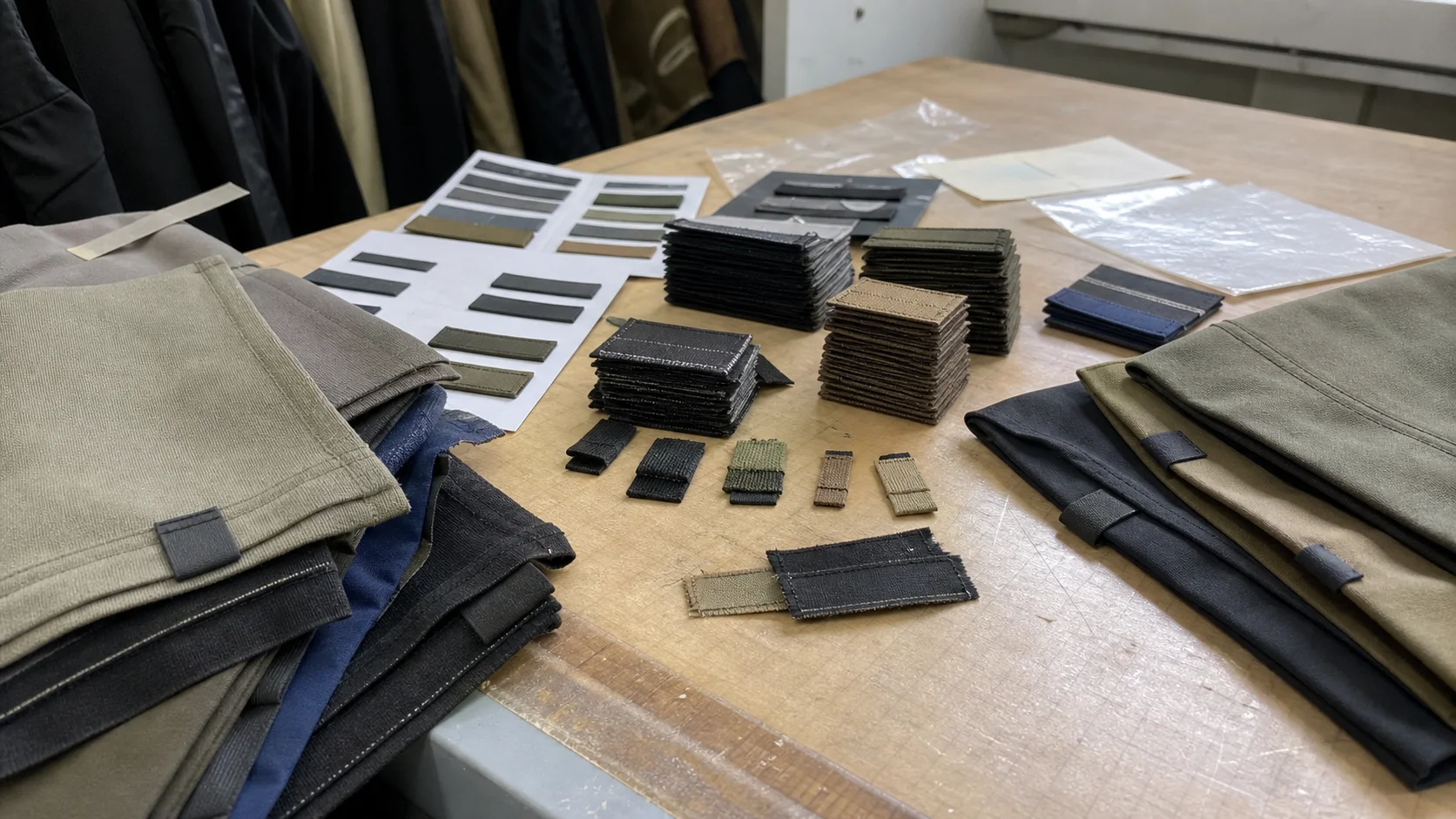
A factory release checklist for bulk woven origin tabs used by security contractors, covering artwork lockup, compliance markings, attachment specs,...
Bulk woven origin tabs are a small item with an outsized procurement impact. For security contractors, they sit at the intersection of compliance labeling, brand control, and production discipline. A tab that looks simple on paper can still create release delays, rework, packing mistakes, or documentation problems when the factory is not given a precise checklist before bulk production starts.
This guide is built for buyers who need a practical factory release checklist for woven origin tabs used on uniforms, tactical apparel, outerwear, and related contractor programs. The focus is on what to confirm before approving bulk production, what to lock down in samples, and where the hidden risks usually appear. For sourcing support, it helps to keep the factory conversation organized through a clear service scope, a contact channel, and a company background page such as /services/, /contact-us/, and /about-us/.
Woven Origin Tab Checklist for Security Contractor Buyers - Decoration & Printing manufacturing guide
A woven origin tab is a small woven label or tab attached to a garment seam, hem, pocket, or placket to indicate country of origin, brand identity, or program marking. In contractor apparel, the tab may be a purely compliance-oriented label, or it may carry a brand mark, size reference, or procurement code. The construction is usually damask woven, satin woven, or a tight taffeta-style weave depending on the visual and durability target.
The key buying point is that a woven origin tab is not just decoration. It is a controlled component that must match the approved artwork, legal marking rules, physical dimensions, and sewing placement. A small deviation can turn into a lot-level issue if the product ships in bulk with the wrong origin marking or the wrong placement on a regulated uniform.
Security contractor programs tend to have tighter expectations than casual retail garments. Uniform consistency matters. So does traceability. If an origin tab is incorrectly placed, too large, too visible, or inconsistent across sizes and lots, the issue is not cosmetic. It can affect uniform approval, end-user acceptance, and warehouse receipt.
Buyers should also assume that the label area is one of the first places where a factory will try to simplify work. That can mean switching tab material, changing sew-in position, substituting a standard fold, or packing labels loosely instead of attached as specified. A proper release checklist prevents those shortcuts from becoming the default.
For bulk woven origin tabs, the safest approach is to treat artwork, construction, and placement as frozen inputs before the factory starts production. A late label change often costs more than the label itself.
Before bulk release, the buyer should have a complete, signed-off package. If any of the items below remain vague, the factory will improvise. That is where most errors begin.
For contractor buyers, the most useful rule is simple: if the factory can interpret it in more than one way, it should be redrafted. A woven origin tab is too small to carry ambiguity.
Use the release checklist below when giving a factory permission to start mass production. The goal is to stop any unresolved variance before the loom run or sewing line begins.
Checklist item What to confirm Buyer risk if missed Artwork approval Final logo, origin text, border, and glyph readability Misread origin text or incorrect brand appearance Size tolerance Finished width and length, plus acceptable tolerance Tabs too large, too small, or inconsistent across bulk Weave density Woven quality target and minimum legibility on small text Blurry letters, weak edges, poor brand presentation Color standard Approved yarn color, backing color, and contrast level Shade drift and rejected lots Fold and cut type Center fold, end fold, mitre fold, or heat cut specification Wrong sew-in method or exposed edges Attachment method Sewn in seam, bar-tacked, topstitched, or loop inserted Label damage, replacement labor, or placement mismatch MOQ and overrun Minimum order quantity and acceptable overrun percentage Unexpected cost or unusable surplus inventory Sample sign-off Approved physical sample or signed photo proof No clear reference for bulk inspection Inspection plan Inline, final, or third-party inspection point Defects found too late to correct efficiently Packaging method Bulk packed, carton labeled, or sewn into garments before packing Mix-ups across size runs or PO linesThis kind of checklist is not paperwork for its own sake. It is the release gate that protects the rest of the production run. If the factory asks for clarification after bulk has started, the program is already behind.
Most woven origin tabs are made from polyester yarn because it holds detail well and stands up to wear. Some programs use a softer hand feel or a denser weave for clearer text. Buyers should specify whether the tab needs a smooth face, matte finish, or a higher contrast weave. If the label will sit on tactical outerwear or uniforms exposed to friction, edge stability matters as much as appearance.
Woven tabs do not always match printed artwork exactly. The buyer should check the yarn color against a standard under neutral light. A factory may claim close match acceptance, but a gray origin tab on a black uniform can still show a noticeable difference if the backing, edge, or border color shifts. Color approval should be written against a reference, not just described verbally.
Security contractor tabs often contain compact text. Once the text becomes too small, the weave can obscure the letters and make the origin statement difficult to read. The buyer should ask for a sample at actual size, not a scaled mockup, because readability at production size is the real test. Fine lines, small capitals, and narrow symbols need special attention.
Finished edges can be heat-cut, laser-cut, merrowed, or folded depending on the design. The wrong edge choice creates fraying, stiffness, or a bulky seam. If the tab is exposed on a visible area, the edge finish becomes part of the quality standard. If it is hidden inside a seam, the focus shifts to durability and sewability.
Placement needs a drawing, a point of measurement, and a sew method. A tab inserted into a seam behaves differently from a topstitched tab. If one style is attached on the cuff and another on the hem, the buyer should confirm that the factory has a garment-by-garment instruction. A single batch with inconsistent placement can fail audit review or warehouse QC.
Woven origin tabs often have a lower MOQ than the garments they are attached to, but the actual minimum depends on weave complexity, color count, size, and whether the label is custom or standard. In the market, small custom woven label orders may start around a few hundred pieces per design, while larger programs can require 1,000 pieces or more to stay cost efficient. For contractor buyers, the right MOQ is not just the lowest number. It is the quantity that can be controlled without creating unused stock.
Sample approval should follow a strict sequence. First comes artwork confirmation. Next comes a strike-off or digital proof. Then comes a physical sample if the label is highly visible or the text is small. A buyer should not approve bulk from a photo alone when the tab must meet a compliance or brand presentation standard.
Lead time is usually driven by three variables: yarn sourcing, loom scheduling, and sewing capacity if the tabs are attached to garments before shipment. A simple woven tab may be fast to produce, but a crowded production line, delayed approval, or trim shortage can stretch the schedule. It is common to see label-only production complete in a shorter window than the garment line, yet that does not help if the labels are waiting for final sign-off.
Release timing should also account for inspection and correction. If a tab batch fails color approval or text clarity, the factory may need to rerun the loom program. That rerun can add days or weeks, depending on machine availability. Buyers should not compress this step if the order is tied to a fixed delivery date.
Bulk woven origin tabs fail for predictable reasons. The buyer can reduce risk by watching for these points during pre-production and in-line inspection.
The most expensive defects are often not the most visible ones. A slight wording error on an origin tab can stop a shipment longer than a cosmetic shade issue. A placement error on a contracted uniform can force relabeling across a whole PO. That is why release documents should be checked line by line, not only by appearance.
For lower-risk programs, a buyer may rely on internal QC and a photo approval. For tighter contractor programs, a physical pre-production sample and a final carton audit are better. If the order is large, a third-party inspection can be justified because the cost of a failed shipment is usually higher than the inspection fee.
When inspection is required, the sample should be compared against the approved artwork, the packaging instruction, and the purchase order. The inspector should not be left to infer whether the origin tab is acceptable. The acceptance criteria need to be explicit enough to defend the decision.
A clean PO file is one of the easiest ways to reduce disputes. The file should include the artwork approval, production specification, sample sign-off, and any email or written confirmation related to tolerance, overrun, or packaging. If the factory later ships a slightly different version, the buyer needs a documented baseline.
At minimum, keep the following in the file:
Program managers often underestimate how much time is lost when a supplier cannot prove which version was approved. A few extra minutes spent on documentation can prevent a disputed lot from sitting in limbo.
For woven origin tabs, supplier selection should focus on control, not just price. A low quote is not useful if the supplier cannot hold the same color across runs, cannot explain how the woven edge is finished, or cannot state the lead time for a repeat order. Buyers should ask direct questions about loom setup, proofing, and re-run policy before placing the order.
Useful supplier questions include:
A supplier with a disciplined process can usually explain these points clearly. If the answers stay vague, the buyer should expect friction later. For broader support on sourcing structure and project coordination, the service overview at /services/ and company information at /about-us/ can help frame the level of support available.
Once a woven origin tab has been approved for a contractor program, the fastest path is to lock the spec and avoid unnecessary changes. Repeat orders should reference the prior approved version by date, artwork ID, and PO number. If a change is needed, it should go through the same sample approval path as the original.
For recurring programs, it is also worth standardizing the following items:
That level of standardization reduces waste. It also makes supplier replacement easier if the original source becomes unavailable. When a second-source factory receives a complete spec instead of a loose description, the chance of a failed first run drops significantly.
A simple release framework works well for bulk woven origin tab orders.
Confirm the exact origin wording, logo if any, and final size. Do not approve bulk at this stage unless the artwork is complete.
Review the physical sample or proof at actual size. Check readability, color, fold, and placement logic. Ask for correction if the edge or backing creates a different hand feel than expected.
Issue written approval only after the sample matches the required standard and the factory confirms the lot schedule, MOQ, and pack method.
Verify the finished tabs against the approved sample, not against memory. Randomly check cartons for mixed lots and incorrect colorways. Any defect trend should be documented immediately.
This sequence sounds basic, but it is the difference between a controlled component and a recurring source of exceptions. In a security contractor workflow, simple mistakes are expensive because they can affect uniform issue, contract compliance, and delivery confidence all at once.
Buyers often face a tradeoff between fast release and precise control. Faster production is possible when the factory uses standard label structures, standard yarn colors, and a repeat artwork setup. That speed is useful when the program is stable. It becomes less attractive if the label is highly visible, the contract requires strict origin marking, or the buyer expects audits and reorders.
In practical terms, the right decision is usually to spend a little more time on the sample and spec sheet than to chase the lowest unit cost. A narrow savings on woven origin tabs can disappear quickly if the bulk lot requires relabeling, reinspection, or delayed shipment. The more sensitive the contractor program, the more valuable precision becomes.
If the program is still being defined, the buyer should lean toward a supplier that can handle both sample discipline and production discipline. That does not mean the most expensive source. It means the source that can read the spec, confirm the risks, and produce the same result again without improvisation. For a procurement team comparing options, a direct contact path at /contact-us/ is useful when the release checklist needs clarification before bulk starts.
Get a free quote from Fabrikn — your trusted B2B clothing manufacturer with 10+ years of experience. MOQ as low as 200 pieces.
Get a Free Quote →The MOQ depends on design complexity, color count, and construction. Small custom woven tab orders often start in the low hundreds per design, while some suppliers prefer 1,000 pieces or more for better efficiency. The buyer should confirm MOQ before sample approval, because a low sample quote can change at bulk stage.
A physical sample is safer when the text is small, the color contrast is tight, or the tab is customer-facing on a uniform. A photo can work for low-risk repeat items, but it does not always show weave clarity, edge finish, or true color.
Lead time is usually affected by artwork approval, loom scheduling, yarn availability, sewing capacity, and inspection timing. A fast label run can still be delayed if the sample is not approved on time or if the factory has to rerun the weave for a correction.
The most common mistakes are vague wording, missing placement instructions, unapproved artwork, and no written tolerance for size or color. Another frequent problem is assuming the factory will attach the tab in the expected way without a clear sew method.
Overrun should be stated in the purchase order or pre-production agreement. A small overrun is common in trim production, but it should not be left undefined. If the program is tight on storage or budget, the buyer should cap the acceptable overrun in writing.
Incorrect wording or inconsistent placement usually matters most because those issues can affect compliance, uniform issuance, and lot acceptance. Color and finish matter too, but text accuracy and placement are the first things to lock down.
For buyers building a repeatable sourcing process, the practical priority is simple: lock the specification, approve a real sample, confirm the release conditions, and keep the documentation clean. That approach protects the bulk order and makes the next run easier to manage.