
A product-specific sourcing review for restaurant groups buying bulk zip puller charm trim for uniforms, outerwear, staff bags, and branded merchandise.
Zip Puller Charm Trim Sourcing for Restaurant Buyers - Decoration & Printing manufacturing guide
Bulk zip puller charm trim sourcing sounds like a small decoration decision until a restaurant group has to roll out uniforms across multiple locations. Then the zipper pull becomes part of the guest-facing brand system, the staff dressing experience, the wash performance of the garment, and the replenishment plan for future hiring.
For restaurant buyers, zip puller charms are usually sourced for fleece jackets, softshells, vests, chef coats, staff hoodies, delivery outerwear, merchandise capsules, and manager uniforms. They can be functional, decorative, or both. The best versions make the garment easier to open with gloves or wet hands while also carrying a subtle brand detail. The worst versions look good in a digital mockup but chip, detach, snag aprons, slow production, or fail after commercial laundering.
This sourcing review is written for restaurant groups, franchise operators, hospitality purchasing teams, apparel distributors, and brand managers evaluating bulk zip puller charm trim for uniform programs. It focuses on practical purchasing judgment: materials, MOQ ranges, sample approval, production risks, lead times, compliance concerns, and the tradeoffs between custom branding and operational reliability.
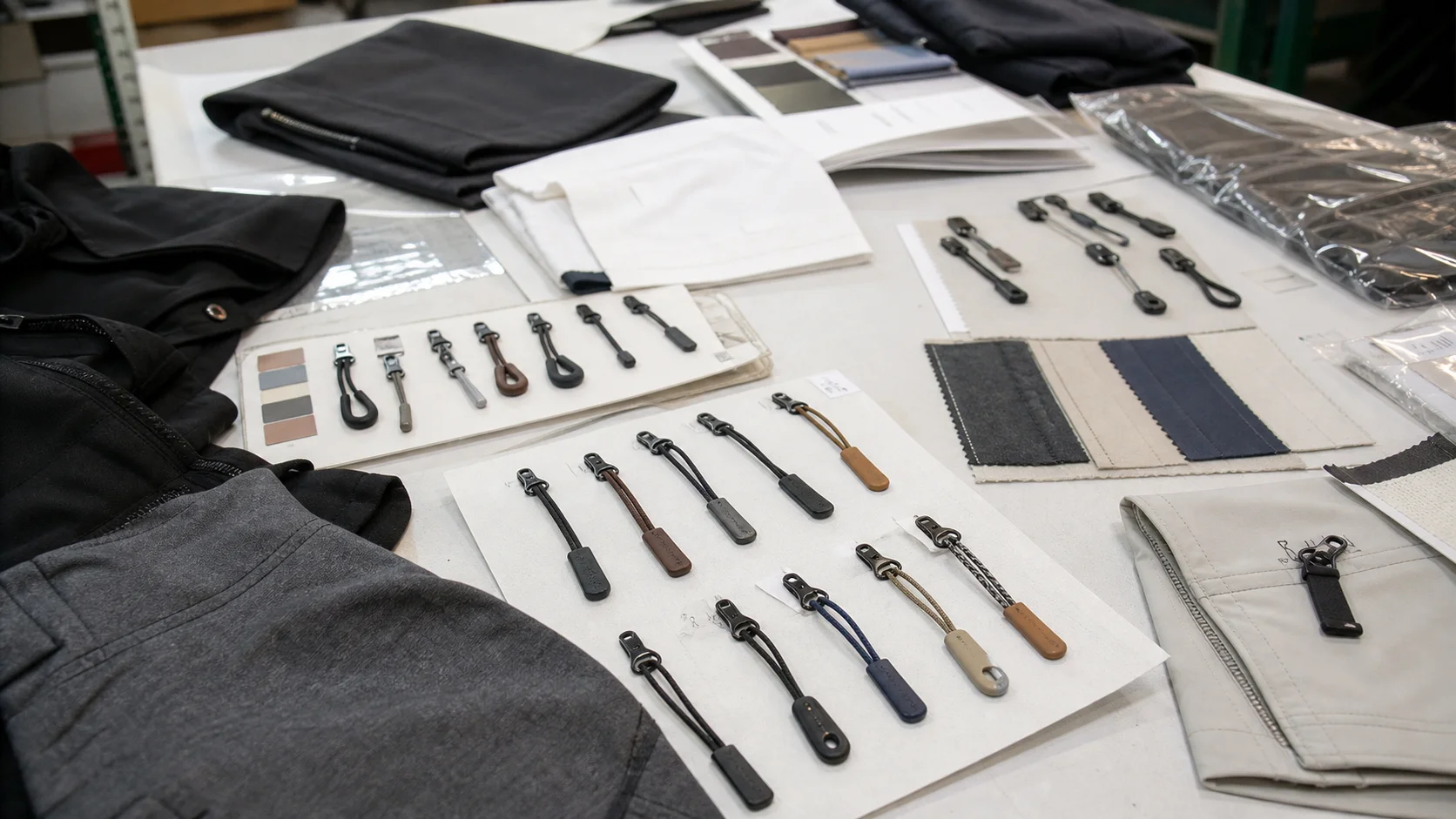
A zip puller charm trim is an added pull component attached to a zipper slider. It may be a molded rubber tab, woven loop, metal charm, leather-look patch, silicone tag, cord puller, TPU element, or branded pendant. In restaurant apparel, it is typically used to improve zipper handling and add a small brand detail to outerwear or staff layers.
The trim can be attached directly to the zipper slider through a hole, ring, cord loop, split ring, snap hook, or custom slider connection. Some zip puller charms are ordered together with the zipper from the zipper supplier. Others are produced separately as decorative trims and attached during garment manufacturing or finishing.
For large restaurant groups, the sourcing question is not only whether the charm looks attractive. Buyers should ask whether it survives repeated washing, whether it interferes with daily service movement, whether it can be replenished, and whether it creates a choking, snagging, or detachment risk. A zip puller charm is small, but it sits at a high-contact point on the garment.
Restaurant groups usually choose zip puller charm trim for one of three reasons: brand visibility, garment function, or uniform differentiation.
Brand visibility is the most obvious. A small logo puller on a black softshell jacket can make a basic uniform feel custom without adding a large embroidery or printed logo. This is useful for restaurant groups that prefer subtle branding, especially for management layers, host uniforms, catering staff, and delivery outerwear.
Function matters more than many buyers expect. Staff may open and close outerwear quickly when moving between kitchen, storage, patio, delivery area, freezer, or front-of-house. A longer rubber or cord puller can be easier to grip than a standard metal slider tab, particularly in cold or wet environments.
Uniform differentiation is also common. A brand may use one puller color for managers, another for event staff, and a third for retail merchandise. The trim allows a small variation without changing the entire garment pattern or inventory structure.
Purchasing judgment: zip puller charms are most valuable when they solve a handling or branding need at low cost. They are less effective when used as a decorative afterthought on garments that will face heavy industrial laundering or high snag exposure.
Zip puller charm trim is usually not appropriate for every garment in a restaurant uniform program. It works best where the zipper is visible, frequently used, and not exposed to direct food contact during preparation.
Softshell jackets are one of the strongest applications. The main front zipper and pocket zippers offer visible locations for branded pullers. Softshell fabrics also tend to support a more premium trim package, making custom zipper pulls feel appropriate rather than excessive.
Fleece is widely used in restaurants, catering, delivery, and hospitality because it is warm, affordable, and easy to layer. Rubber or cord pullers usually perform better than heavy metal charms on fleece, since metal can swing, catch, or feel noisy during service.
For restaurant merchandise, zip puller charms can help distinguish a retail hoodie from a generic blank. This is a good use case when the buyer wants a slightly elevated product without redesigning the full garment.
Zip puller charms should be used cautiously on kitchen garments. In back-of-house settings, loose trims can create contamination, snagging, or heat exposure concerns. If used, the puller should be low-profile, securely attached, washable, and approved against the garment’s intended kitchen use.
Delivery teams often benefit from oversized pullers that can be gripped quickly. Reflective or high-contrast puller options may also be considered, though buyers should not treat them as a substitute for certified high-visibility apparel where safety standards apply.
The material choice drives the look, hand feel, wash durability, attachment strength, and cost. Restaurant buyers should compare materials based on the actual working environment rather than appearance alone.
Material Best Use Advantages Risks Silicone Softshells, fleece, branded outerwear Flexible, washable, good color options, comfortable grip Can attract lint; fine logos may lose definition PVC Promotional uniforms, merchandise Strong 3D logo effect, economical at volume Compliance and odor checks are important; may stiffen in cold TPU Modern technical trims Clean finish, flexible, often more refined than basic PVC Higher cost; color matching can require careful approval Metal Premium retail merchandise, manager jackets Premium feel, crisp logo engraving or embossing Noise, weight, corrosion risk, snagging, plating wear Woven or Jacquard Loop Sporty uniforms, casual jackets Lightweight, soft, good for repeated use Fraying, color bleed, logo readability limits Cord Puller Outdoor, freezer, delivery apparel Easy grip, practical, low cost Can look less branded unless paired with a molded end Leather or Faux Leather Premium hospitality, boutique restaurant merchandise Warm look, upscale casual feel Wash durability, cracking, staining, animal-origin concernsSilicone and TPU are often the safest choices for restaurant uniform programs because they balance grip, branding, and wash performance. Metal may look premium, but the practical downside is real. It can clink against zipper teeth, scratch surfaces, and feel out of place on active service garments. Woven loops are comfortable and lightweight, though small logos can become difficult to read.
PVC needs a more careful compliance review. It is common in promotional trim, but buyers should request material declarations and confirm restricted substance requirements. If the restaurant group has sustainability targets or children’s merchandise programs, PVC may not be the best fit.
The branding method should match the logo style. A simple wordmark, icon, or monogram works better than a detailed restaurant crest or multi-line slogan. Zip puller charms are small, and over-designing them causes production problems.
Debossing presses the logo into the surface. It gives a subtle, durable effect on silicone, TPU, PVC, leather, and faux leather. It is a good option for restaurants that want understated branding.
Embossing raises the logo above the surface. It improves visibility but can wear on high-contact edges if the design is too fine. Raised logos also collect more soil than smooth surfaces.
Color fill can make a logo stand out, but restaurant buyers should test rubbing and washing. Poor color fill can crack or peel. It also adds cost and approval complexity because both base color and fill color must be controlled.
Printing is useful for flat surfaces and lower-cost trims. It is less durable than molded or debossed branding unless the ink system is appropriate for the material. Print adhesion testing is important for zip pullers because they are touched often.
Laser engraving is common on metal and some synthetic trims. It creates a clean result but may have limited contrast depending on the base material.
Woven text works on zipper tape-style pullers and jacquard loops. It is comfortable and durable, but small restaurant logos may simplify poorly. Buyers should approve an actual woven sample rather than relying only on an artwork proof.
Bulk zip puller charm trim sourcing for restaurant groups should begin with the garment program, not the trim catalog. A charm that works on a retail hoodie may fail on a daily uniform jacket. Start with the garment type, wash method, staff role, brand standards, and replacement plan.
Restaurant buyers should check these points before committing to bulk production:
For broader production planning, restaurant buyers can review apparel development and sourcing capabilities through Fabrikn services. Trim decisions are easier to control when they are treated as part of the full garment specification rather than a late-stage decoration add-on.
MOQ varies by material, mold requirement, logo complexity, and supplier setup. Buyers should treat the following as typical planning ranges, not fixed guarantees.
Trim Type Typical MOQ Range Notes for Restaurant Buyers Stock cord puller 500 to 1,000 pieces Lowest setup burden; limited branding Stock silicone or rubber puller 1,000 to 3,000 pieces Good for quick uniform programs if colors are acceptable Custom molded silicone or PVC charm 2,000 to 5,000 pieces Mold cost applies; better unit pricing at higher volume Custom TPU puller 2,000 to 5,000 pieces Cleaner finish; color and mold approval matter Metal logo charm 1,000 to 3,000 pieces Plating, corrosion, and weight must be checked Woven loop puller 1,000 to 5,000 pieces Logo detail depends on weave density and widthPricing is shaped by several factors: mold fee, material, number of colors, logo detail, attachment hardware, plating, packaging, inspection requirements, and whether the puller is supplied loose or attached to zippers. Unit price may look minor, but it multiplies quickly. A jacket with five zipper pulls uses five pieces, so a 5,000-garment program may require 25,000 pullers before considering extras or replacements.
Buyers should also budget overage. A practical allowance is often 2% to 5% extra trim, depending on garment quantity, attachment method, and inspection strictness. For custom trims with long replacement lead times, holding extra inventory can prevent delayed repairs or incomplete shipments.
Sample approval should be more structured than choosing the best-looking prototype. A restaurant group may have dozens or hundreds of locations, and a small trim issue can become a widespread complaint after rollout.
Start by simplifying the logo if needed. Very fine lettering, thin outlines, tiny taglines, and complex restaurant icons often do not reproduce cleanly on a small puller. Confirm actual dimensions in millimeters, not just visual scale on a PDF.
Approve physical color chips or strike-offs. Brand colors can shift across silicone, TPU, PVC, metal plating, and woven yarn. A Pantone reference helps, but physical approval is more reliable.
For custom molded pullers, review the prototype for logo depth, edge smoothness, flexibility, attachment hole size, surface finish, and smell. Strong odor can be a sign of poor material handling or curing issues.
The puller should be tested on the actual zipper slider or a confirmed equivalent. Check whether it threads easily, sits correctly, and does not twist or block zipper movement. A puller that is too thick for the slider opening can slow factory assembly.
At minimum, run home-laundry simulation for the intended garment care label. For commercial laundering, request testing that reflects higher heat, stronger chemistry, and mechanical agitation. Check color transfer, peeling, cracking, deformation, and detachment.
A short wear trial with the final garment sample is useful. Staff movement, apron straps, seat belts, counters, and service carts can reveal snag issues that do not appear on a sample table.
The approved pre-production sample should be sealed as the reference for bulk inspection. It should include the final puller, zipper, garment fabric, stitching, packaging method, and care label.
If the project requires guidance on development files, production handoff, or quotation structure, buyers can use the Fabrikn contact page to discuss trim specifications within a broader apparel sourcing brief.
Lead time depends on whether the buyer chooses stock trim or custom trim. Stock pullers may be available quickly if the supplier has inventory, while custom molded charms require artwork setup, tooling, sampling, approval, production, and shipping.
Stage Typical Time Range Key Dependency Artwork adjustment 2 to 5 working days Logo complexity and buyer approval speed Tooling or mold development 7 to 15 working days Material type and supplier capacity Sample production 5 to 12 working days Color matching, mold corrections, attachment type Testing and buyer review 5 to 20 working days Wash testing level and internal stakeholder approval Bulk trim production 10 to 25 working days Quantity, material, custom colors, plating, packaging Garment production impact Variable Trim arrival must align with cut-and-sew scheduleA common sourcing mistake is approving the garment fabric while leaving the custom zip puller undecided. The factory may be ready to sew, but production cannot finish if the trims are missing. Trim delays can be especially costly when uniforms are needed for a new restaurant opening, seasonal rollout, franchise refresh, or catering contract.
For restaurant groups with tight launch dates, a stock puller or semi-custom option may be the better purchasing decision. Full custom molded charms are more brand-specific, but they reduce flexibility and add development risk.
Zip puller charms do not exist alone. They interact with zipper tape, zipper teeth, slider finish, garment fabric, pocket construction, lining, and the staff member’s daily movement.
Softshell fabrics often have a smooth face and water-resistant finish. TPU, silicone, and cord pullers work well. Buyers should check whether the puller rubs against coated fabric and leaves marks after abrasion.
Fleece can shed fibers, and silicone may attract lint. Dark silicone on black fleece usually hides this better than light colors. Metal charms can pull on fleece pile or feel heavier than the garment requires.
Lightweight shell jackets need lightweight pullers. Heavy charms can distort pocket zippers or make thin fabric bounce. Cord pullers with molded ends are often practical.
Cotton-rich chef coats and poly-cotton kitchen jackets require caution. Any loose element should be evaluated against food safety expectations, heat exposure, and laundering. Low-profile zipper tabs may be safer than dangling charms.
Restaurant uniforms are often worn with aprons. A zipper charm positioned at the lower front zipper can catch on apron ties, bib straps, or waist loops. Buyers should test the complete uniform set, not just the jacket.
Zip puller charm trim has several inspection risks that buyers should include in the quality checklist. Small components are easy to overlook during garment inspection, especially when the main focus is sizing, stitching, and fabric defects.
Inspection should include a light pull test, visual comparison to the approved sample, zipper function check, and count verification. For higher-risk programs, buyers may define a specific pull strength requirement. The exact test method should be agreed before production, since informal tugging is not a reliable standard.
Restaurant groups should also consider the risk of detached trims reaching dining or food preparation areas. This does not automatically mean zip puller charms should be avoided, but it does mean attachment security deserves attention. For back-of-house garments, a simple low-profile pull may be a better choice than a loose charm.
Sustainability claims around small trims should be treated carefully. A recycled or lower-impact garment can still be undermined by difficult-to-remove mixed-material trims. If the restaurant group has ESG targets, ask whether the puller can be removed for repair or recycling and whether the material is consistent with the garment’s sustainability story.
Compliance priorities may include restricted substances, heavy metals in plating, phthalates in certain plastics, nickel release for metal components, lead content, colorfastness, and odor. Requirements depend on the selling market, garment use, buyer policy, and whether the item is sold as merchandise to consumers.
For restaurant merchandise, especially if sold online or through multiple regions, buyers should avoid vague claims such as “eco-friendly rubber” unless the supplier can document the material. If PVC is used, ask for relevant restricted substance documentation. If metal is used, plating quality and nickel-related concerns should be reviewed.
A clear trim specification prevents confusion between the restaurant group, garment factory, trim supplier, and quality inspector. The spec sheet should be simple but complete.
Specification Field What to Include Trim name Custom branded silicone zip puller charm, cord puller, metal charm, or other type Material Silicone, TPU, PVC, metal alloy, woven polyester, cord, faux leather Dimensions Length, width, thickness, attachment hole size, cord length if applicable Color Pantone reference plus approved physical sample Logo method Debossed, embossed, printed, color-filled, engraved, woven Attachment Direct slider loop, split ring, cord loop, snap hook, molded connector Zipper compatibility Slider model, slider hole size, zipper gauge, metal or plastic zipper teeth Garment placement Main front zipper only, pockets, chest pocket, sleeve pocket, all zipper points Care requirements Home wash, commercial wash, tumble dry, dry clean restriction, heat limits Testing Wash, rub, colorfastness, pull strength, corrosion, nickel, restricted substances as applicable Packing Attached to garment, supplied loose, spare pullers packed separately, protection method Approved sample Reference sample date, version, signed approval, photo recordThis level of detail may seem excessive for a small trim, but it prevents the most common bulk problems: wrong color, wrong size, poor attachment, and mismatched zipper compatibility.
Zip puller charm trim is a good choice when the garment is customer-facing, the zipper is used often, and the trim can improve both branding and grip. It is especially suitable for manager jackets, host outerwear, delivery softshells, retail merchandise, and seasonal uniform capsules.
It may be a poor choice for garments used in high-heat kitchen roles, high-snag environments, strict food safety zones, or extremely cost-sensitive programs. A restaurant group ordering basic staff fleece at the lowest possible price may get more value from better fabric, stronger zipper quality, or improved fit than from a custom charm.
The best purchasing decision is often a balanced one. Use custom pullers on visible front zippers and standard pullers on hidden pocket zippers. Choose silicone instead of metal for active service roles. Use stock colors for fast rollouts and reserve custom molds for long-running programs. Keep the logo simple enough to manufacture cleanly.
Restaurant buyers comparing decoration and trim options can learn more about sourcing support and company background through Fabrikn’s about page. For uniform programs, the strongest results usually come from aligning decoration, fabric, trims, fit, and care requirements early in development.
For most restaurant group uniform programs, a flexible silicone or TPU zip puller is the safest starting point. It offers a good grip, solid wash performance, and enough branding space for a simple logo. Cord pullers with molded ends are a practical alternative for delivery, freezer, and outdoor use. Metal charms should be reserved for premium merchandise or low-activity roles where noise and snagging are less of a concern.
Custom trim is worth the investment when the restaurant group expects repeat orders, wants consistent brand presentation, and has enough volume to absorb mold and development costs. For a single small rollout, stock or semi-custom options are usually more sensible. The charm should not delay the entire uniform launch.
Buyers should not approve bulk production from a photo alone. Physical samples, zipper compatibility checks, wash testing, and attachment review are basic requirements. If the trim supplier cannot provide consistent samples or material information, that is a warning sign.
The final decision should be based on the complete uniform system: garment use, laundry method, staff comfort, guest-facing appearance, safety expectations, and replenishment plan. A zip puller charm is a small component, but in bulk restaurant apparel sourcing, small components often determine whether the finished garment feels considered or careless.
Get a free quote from Fabrikn — your trusted B2B clothing manufacturer with 10+ years of experience. MOQ as low as 200 pieces.
Get a Free Quote →Silicone and TPU are usually the most practical choices for restaurant uniforms. They are flexible, comfortable to grip, and suitable for many fleece and softshell applications. Metal looks premium but can be noisy, heavy, and more prone to snagging.
Custom molded zip puller charms often start around 2,000 to 5,000 pieces, depending on the material, mold, colors, and supplier. Stock pullers may start around 500 to 1,000 pieces. The required quantity rises quickly when each garment uses multiple zipper pulls.
A typical custom timeline may require 4 to 8 weeks when artwork, tooling, sampling, approval, bulk production, and shipping are included. Fast projects should consider stock or semi-custom pullers to reduce delay risk.
They can be used on some chef or kitchen jackets, but caution is needed. Loose or dangling trims may create snagging, heat exposure, or food safety concerns. Low-profile, secure, washable pullers are safer for back-of-house use.
Both options can work. Zipper supplier attachment can improve consistency if the puller is designed for the slider. Garment factory attachment may offer flexibility but requires clear instructions and inspection. The best choice depends on the zipper type, production flow, and quality control plan.
Restaurant buyers should request wash testing, rub testing, color review, zipper function checks, attachment strength review, and visual comparison against the approved sample. Metal trims may also need plating, corrosion, and nickel-related checks depending on the market and use.
The unit cost can be modest, but the total cost depends on quantity and the number of zipper points per garment. A jacket with five pullers uses five trim pieces. Custom molds, special colors, logo fill, metal plating, and testing can increase the final cost.
Reorders are possible if the mold, material, color standard, and supplier records are maintained. Buyers should confirm mold ownership, storage period, reorder MOQ, and color tolerance before the first production order.
The main risk is approving a trim that looks good but fails in use. Common failures include weak attachment, poor wash durability, wrong color, logo distortion, odor, plating wear, and snagging with aprons or kitchen equipment.
They are both. In apparel sourcing, they function as a trim component because they attach to the zipper, but they also serve as decoration when branded with a logo, color, or custom shape. For restaurant groups, they should be managed in the garment bill of materials like any other critical trim.