
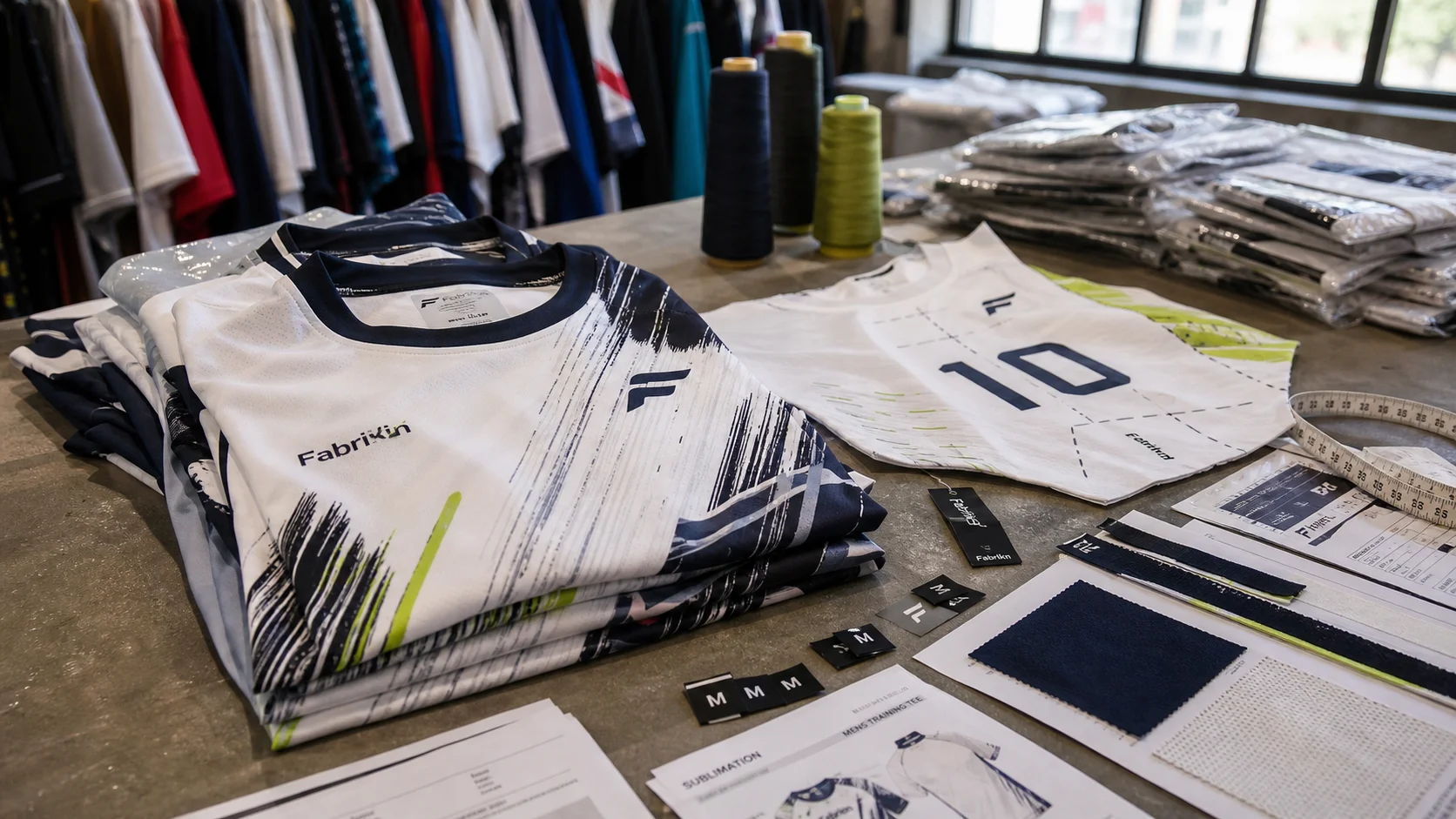
A focused outline for sportswear retailers evaluating custom activewear sets with compliance testing, covering fabric performance, labeling, chemical restrictions, fit approvals, and production-ready documentation.
Buy Custom Activewear Sets With Compliance Testing - Fabrikn production reference
Custom activewear sets sit in a demanding category. Retailers are not only buying a coordinated top-and-bottom look. They are buying fit consistency, performance fabric behavior, labeling accuracy, and product safety in one package. For sportswear retailers, compliance testing is not a marketing extra. It is part of basic purchasing discipline.
Activewear moves through hard use conditions: stretch, sweat, laundering, abrasion, and repeated wear. A leggings and bra set may look correct at the sample stage and still fail in production if dye migration, seam slippage, poor elastic recovery, or restricted substance issues are not controlled. That is why compliance testing matters before bulk shipment, not after customer complaints start.
Retail buyers also face market-specific obligations. Requirements differ depending on destination country, fiber claims, care labeling rules, chemical restrictions, and packaging standards. A supplier that understands custom activewear sets with compliance testing for sportswear retailers should be able to explain what is standard, what is optional, and what needs third-party laboratory confirmation.
The practical issue is simple: if the set fails performance or regulatory checks, the retailer absorbs the commercial damage. Returns rise. Marketplace ratings drop. Reorders stall. Margin disappears quickly when a supposedly premium set shows pilling after light wear or fails colorfastness on dark shades.
For private label activewear, the cheapest development path is rarely the lowest-risk buying path. Testing adds cost upfront, but product failure costs more once inventory is landed.
Retailers that buy carefully usually specify testing at three levels: material approval, pre-production confirmation, and final shipment verification. That structure is especially useful in activewear because small changes in knit composition, GSM, brushing finish, dye process, or elastane percentage can materially change performance.
The phrase “activewear set” covers several commercial formats. Some retailers focus on gym co-ords such as sports bra and leggings sets. Others buy jogger and hoodie sets, cycling sets, tennis sets, training shorts with fitted tops, or lounge-to-fitness hybrids. The right sourcing approach depends on which of these categories the retailer is building.
In most private label programs, the bestselling custom activewear sets share a few traits:
Retailers are also buying according to price architecture. Entry-level sets usually target simpler silhouettes, standard nylon-spandex or polyester-spandex knits, and fewer custom trim developments. Mid-market programs often request heavier interlock knits, better opacity, brushed surfaces, removable bra cups, branded waistbands, and upgraded packaging. Premium programs push harder on fabric hand feel, sculpting fit, recycled fibers, bonded finishing, and a stricter test protocol.
This is where purchasing judgment matters. A set that looks premium online may still be built on a fabric that is too light for squat-proof use, too shiny for the brand position, or too unstable for repeat production. Retailers should buy against a written specification pack, not against appearance alone.
If you are building a private label program, it helps to map product concept to manufacturing capability early. Fabrikn outlines broader production support on its services page, which is a useful starting point when comparing development and sourcing options.
Compliance testing for activewear usually combines regulatory, chemical, physical, and performance checks. Not every program needs the same test matrix, but sportswear retailers should expect a supplier to discuss these categories in detail.
This area is non-negotiable for many markets. Fabrics, prints, coatings, elastics, heat transfers, and accessories can all introduce risk. Retailers commonly request testing against restricted substance lists relevant to their market or platform requirements.
Factories do not always produce these issues directly. Sometimes the risk comes from dye houses, print suppliers, elastic vendors, or packaging sources. That is why material traceability matters as much as sewing quality.
If a set is sold as 75% nylon and 25% spandex, or as recycled polyester with elastane, that claim needs to be supportable. Misdeclared fiber content creates customs, labeling, and customer trust problems. Blended knits used in activewear should be checked against the approved standard, especially when suppliers substitute available greige fabric during peak periods.
Dark activewear shades often sell best, and they also create risk. Color bleeding, shade transfer, or crocking can trigger returns quickly. Sweat exposure testing matters because activewear is worn under heat and motion, not only casual conditions. Testing often covers wash fastness, rubbing fastness, perspiration fastness, and sometimes water fastness depending on use case.
Retailers should check shrinkage after wash and drying conditions stated on care labels. Circular knit fabrics used in leggings, tops, and fitted layers can also show torque or spirality if processing is weak. A matching set that twists after wash does not remain a matching set in the customer’s eyes.
Brushed activewear fabrics can feel excellent in the hand yet pill too quickly. That does not always appear in fit samples. Abrasion and pilling tests help retailers judge whether the set can survive expected use. There is a tradeoff here: ultra-soft finishes can reduce long-term surface durability if the fabric construction is not balanced properly.
Seam performance is central in activewear. Coverstitch, overlock, flatlock, bartack reinforcement, needle type, and thread quality all affect durability. In fitted garments, seam slippage or broken stitching usually appears first at the crotch, side seams, underband, armhole, or pocket attachment points.
Retailers should ask whether the factory tests stretch recovery and checks seam extension against the end-use requirement. A yoga set and a high-impact training set should not be judged by identical movement expectations.
Depending on product type and destination, flammability standards and care/fiber/origin labeling reviews may be required. Retailers often underestimate labeling risk. A good garment can still become non-compliant if the sewn-in label, care instructions, size declaration, or country-of-origin marking is incorrect.
Retailers sourcing custom activewear sets with compliance testing should expect a more structured development process than for basic promotional apparel. Activewear depends on precise fit, fabric behavior, and finishing control.
The approval gates matter. Too many buyers approve a flattering fit sample made in a substitute development fabric, then assume the bulk fabric will behave the same way. That is a common mistake. Compression, opacity, recovery, and panel tension can shift significantly between sample yardage and bulk-dyed fabric.
A cautious buyer usually asks for at least one pre-production sample made in actual bulk fabric, with final artwork, labels, and trim placements confirmed. If the activewear set includes screen prints, silicone logos, foil details, bonded hems, or zipper pockets, those details should appear in the sample submitted for approval and testing.
Retailers new to the category often benefit from early communication on feasibility and risk. Fabrikn’s about-us page provides a general sense of the company’s positioning in apparel manufacturing support, which can help brands frame the right conversation before development begins.
Fabric selection drives most of the commercial result in activewear. Styling matters, but the fabric does the real work. Buyers should request clear specifications rather than generic terms like “premium stretch fabric” or “buttery soft quality.” Those descriptions are too loose for production control.
Trim selection also needs discipline. Reflective transfers, branded zipper pulls, silicone logos, adjustable straps, and packaging inserts can elevate a set. They can also create avoidable delays if artwork approvals, mold lead times, or adhesion testing are not managed early.
A good sourcing brief should define:
Sportswear retailers should approach MOQ and lead time claims with caution. Custom activewear sets are not usually as flexible as blank basics. Fabric knitting, dyeing, testing, logo applications, and coordinated sizing all affect the minimum order.
Small-batch programs are possible in some cases, but buyers should expect tradeoffs. These usually include higher prices, reduced fabric choices, fewer custom trim options, or reliance on stock-supported materials. For startup retailers, that can still be the right decision if the goal is market testing rather than margin optimization.
A common timeline for custom activewear sets might include 2 to 4 weeks for development sampling, 1 to 2 weeks for revisions, 1 to 2 weeks for compliance testing depending on scope, and 4 to 8 weeks for bulk production after approvals. That is not a fixed rule. It is a planning reference. Complex trim packages, recycled material programs, or repeated fit corrections can push the schedule longer.
Retailers should also be realistic about the cost impact of testing. Third-party lab work, especially on multiple colorways or trim combinations, increases landed cost. Still, skipping tests to protect a few percentage points on initial margin is often short-sighted. The wiser question is which tests are essential for this product and market, and which can be staged by risk level.
Activewear quality failures often appear in areas buyers do not fully inspect during showroom-style sample reviews. Bulk inspection has to go deeper than visual presentation.
Inspection should cover inline checks and final random inspection, not just end-of-line review. Inline control is important because many activewear issues are expensive to rework once panels are assembled. If the problem is fabric skew, tension setting, or unstable transfer adhesion, late discovery usually means delay or write-off.
Retailers should ask whether the supplier checks matching-set pairing during packing. This sounds basic, but size or shade mismatch between bra and legging components can still happen when coordination controls are weak.
For activewear, the risk is not only “defect or no defect.” It is also whether the garment performs the same after wear, wash, and stretch as it did on the packing table.
Not every apparel manufacturer is a good fit for private label activewear. Retailers should screen suppliers on technical capability, communication discipline, and testing transparency rather than only price.
A reliable supplier should give grounded answers. Watch out for overpromising. If a manufacturer claims very low MOQ, very fast lead time, full customization, and full compliance testing at the lowest price, the offer deserves scrutiny. In activewear production, those benefits rarely all come together without compromise somewhere.
The strongest buying position comes from balanced requirements. Retailers should identify what cannot move, such as restricted substance compliance, fit consistency, or squat-proof opacity, and where flexibility exists, such as packaging detail or launch quantity.
For sportswear retailers exploring custom activewear sets with compliance testing, the value of a manufacturing partner is not limited to cutting and sewing. The better value sits in development coordination, sourcing clarity, and commercial risk control.
Fabrikn is positioned to support private label apparel buyers who need a structured approach to product development and manufacturing. That matters when activewear programs involve technical fabrics, trim coordination, sample approvals, and testing milestones that can affect launch dates and sell-through.
Retailers evaluating next steps can review Fabrikn’s broader capabilities through the services page and use the contact-us page to discuss product specs, order volumes, and compliance expectations in more detail.
The commercial advantage of careful sourcing is straightforward. Better preparation tends to reduce failed samples, avoidable rework, testing surprises, and inconsistent bulk output. In a category where fit and fabric performance drive repeat purchase, that discipline is worth protecting.
Buying custom activewear sets with compliance testing for sportswear retailers requires more than a good design concept. It requires technical alignment from fabric sourcing to final inspection. Retailers that treat testing as part of product development, not as a late-stage formality, usually make better decisions on quality, cost, and launch timing.
The strongest private label activewear programs are built on clear specifications, realistic MOQ planning, disciplined sample approvals, and supplier transparency around test requirements and production risks. That approach does not remove every issue, but it sharply reduces the chance of expensive mistakes.
In practical terms, sportswear retailers should buy activewear sets the same way they sell them: on performance. If the fabric, seams, trims, and labels can hold up under compliance review and actual use, the product has a far better chance of holding up in the market as well.
Get a free quote from Fabrikn — your trusted B2B clothing manufacturer with 10+ years of experience. MOQ as low as 200 pieces.
Get a Free Quote →It often includes chemical restricted substance testing, fiber content verification, colorfastness, dimensional stability, pilling, seam performance, and labeling checks. The exact scope depends on the destination market, retailer standards, and the product’s materials and trims.
Many suppliers work within a range of about 200 to 600 sets per style per color, though fabric mill minimums can push requirements higher for custom-dyed materials. Lower MOQs are possible in some programs, but they usually come with higher unit cost or reduced customization.
A typical program may take several weeks for sampling and approvals, then another 4 to 8 weeks for bulk production after final confirmation. Timing depends on fabric availability, sample revisions, trim sourcing, and laboratory testing turnaround.
Pre-production samples confirm how the actual bulk fabric, trims, labels, and construction perform together before full production begins. This step helps catch problems with fit, opacity, stretch recovery, logo application, and labeling before they become expensive.
Nylon-spandex is often chosen for a softer hand feel and a more premium look, while polyester-spandex can be more cost-efficient and easier for certain print programs. The right choice depends on brand positioning, price target, and performance needs.
Not always, but dark, bright, heavily treated, or trim-heavy colorways often carry more risk and may justify separate testing. A risk-based approach is common, especially when the construction is consistent but colors or applications differ.
They should lock fabric and trim specs early, approve pre-production samples in bulk materials, request testing before production release, and confirm that the supplier controls shade matching and set pairing during packing. Clear tolerances and inspection checkpoints also help.