
A product-specific SEO outline for outdoor school buyers inspecting chef coat orders with AQL standards, focusing on fabric durability, safety,...
Chef Coat AQL Checklist for Outdoor School Buyers - Quality & Inspection manufacturing guide
A chef coat order for an outdoor school is not the same as a fashion uniform order for a controlled indoor kitchen. The garment has to look presentable, withstand repeated laundering, tolerate active movement, and remain comfortable in changing weather. Students may wear the coats during cooking lessons, camp programs, outdoor catering exercises, food safety training, or vocational hospitality modules. That makes quality inspection more practical than decorative.
AQL inspection gives buyers a structured way to decide whether a shipment is acceptable before it leaves the factory or warehouse. AQL stands for Acceptable Quality Limit. It does not mean every garment is perfect. It means the checked sample quantity falls within an agreed defect tolerance. For outdoor school buyers, that structure is useful because uniform budgets are often tight, replacement timelines are awkward, and late discoveries can disrupt an entire term or training season.
The key is to use AQL as a buying control, not as a paperwork exercise. A checklist should reflect the way chef coats will actually be worn: bending over prep tables, carrying trays, working near heat, washing frequently, and possibly layering over base garments in outdoor teaching environments.
Purchasing judgment: do not approve a chef coat shipment only because the fabric weight and color look correct. Fit consistency, seam strength, button attachment, shrinkage, and wash durability are usually the costlier problems once garments reach students.
This guide gives outdoor school buyers a practical chef coat order AQL inspection checklist, including specifications to confirm, sample approval steps, typical MOQ ranges, lead-time dependencies, defect categories, and the inspection risks that deserve extra attention.
A strong inspection starts before production. If the buyer brief is vague, the factory and inspector will interpret quality differently. For chef coats, small details matter: sleeve length, cuff finish, placket construction, buttons, collar shape, pocket placement, embroidery position, and tolerance after washing.
The buyer brief should be short enough to use, but detailed enough to prevent debate. It should include the garment purpose, wearer profile, usage conditions, required fabric, trim standard, color, size range, branding, packaging, and inspection level.
Buyers sourcing multiple uniform items can also align inspection rules across aprons, trousers, hats, and chef coats. That helps avoid mixed quality standards in the same delivery. For broader sourcing support, buyers can review apparel production service options at fabrikn.com/services/.
The AQL checklist should be built from the approved product specification. If the specification is not complete, inspection becomes subjective. A practical chef coat tech pack or order sheet should cover the items below.
Outdoor school chef coats are commonly made from cotton, polyester-cotton blends, or performance blends. The right choice depends on climate, budget, wash process, and comfort expectations.
Fabric Option Typical Use Buyer Tradeoff 100% cotton twill Traditional chef coats, breathable classroom use Comfortable but may shrink more and crease easily if not controlled. 65/35 polyester-cotton twill School uniforms, repeated washing, budget-sensitive orders More durable and stable, but less breathable than cotton in hot weather. Performance polyester blend Lightweight programs, warm climates, quick-dry needs Easy care, but heat exposure and hand feel must be checked carefully. Canvas or heavier twill Outdoor camps, rugged use, staff coats Hard-wearing, but may feel stiff for younger students.Fabric weight should be specified in GSM or oz/yd². Many school chef coats sit roughly in the 160–240 GSM range, depending on the fabric construction and climate. Heavier fabric can improve durability and opacity, but it can also reduce comfort during outdoor summer lessons. Lighter fabric may improve movement, but buyers should check seam slippage, transparency, and tear resistance.
Trims often cause inspection failures because they are easy to overlook during costing. Chef coat trims should be selected for wash resistance, safety, and consistent replacement availability.
For outdoor school programs, button security deserves special focus. Loose or poorly attached buttons create a practical nuisance and may create food safety concerns during cooking lessons. If snap buttons are used, inspection should include opening and closing tests, alignment checks, and rust or sharp-edge checks.
Construction should match the use environment. A coat that looks neat on a hanger can fail quickly if the armhole, side seam, or pocket stitch is weak.
Outdoor school buyers should be cautious with decorative details that add failure points. Contrast piping, unusual cuffs, and multiple pockets can improve appearance, but they also increase inspection risk and production variation. For student uniforms, simple construction often gives better value.
AQL inspection uses a sampling plan. Instead of checking every chef coat, the inspector checks a defined sample size from the shipment and classifies defects as critical, major, or minor. The order passes or fails based on the accepted number of defects for the selected AQL level.
Common apparel inspection settings often use AQL 2.5 for major defects and AQL 4.0 for minor defects. Some buyers use stricter levels for premium uniforms, safety-related products, or first-time suppliers. Critical defects are usually not tolerated.
Defect Type Typical AQL Approach Chef Coat Example Critical Usually zero tolerance Sharp metal contamination, hazardous broken snap, unsafe loose component for children. Major Often AQL 2.5 Wrong size measurement, broken seam, visible stain, missing button, wrong logo. Minor Often AQL 4.0 Small thread end, slight press mark, minor shade variation within approved tolerance.The buyer should confirm the inspection standard in the purchase order. Do not leave AQL settings to the final week of production. The supplier needs to know the acceptable defect limit before cutting fabric and ordering trims.
General Inspection Level II is often used for final random inspection in apparel. Level I may reduce inspection cost but gives less visibility. Level III checks more pieces and may be suitable for first orders, high-risk suppliers, or programs where delivery failure would be expensive.
Special inspection levels can be used for specific tests, such as carton checks, measurement checks, metal detection checks, or packaging review. The right choice depends on order size, risk level, and budget.
Purchasing judgment: for a repeat supplier with stable history, General Level II with clear measurement and packaging checks may be enough. For a first chef coat order for a school program, a stricter approach is usually worth the modest inspection cost.
Outdoor school buyers often focus on final inspection only. That is risky when fabric, sizing, and trims are not already proven. A staged approval process reduces surprises.
The pre-production sample should be made in correct or near-correct fabric, trims, color, and construction. It is the reference garment for bulk production. Buyers should approve the sample in writing, preferably with comments, photos, and sealed sample retention.
Sample approval should not be rushed. A chef coat can look acceptable before washing and become too short in sleeve length or body length after laundering. That is a major issue for schools because size exchanges are time-consuming and stock buffers are limited.
A size set includes one garment in each ordered size, or at least a representative run across the size range. This step is important for children’s and teen sizing because grading errors can create inconsistent fit.
Outdoor school buyers should avoid approving only a medium sample when the order includes youth sizes, adult sizes, or plus sizes. Fit risk often appears at the size extremes.
Inline inspection is useful when 20–50% of production is complete. It catches problems while the factory can still correct them. This is especially useful for new suppliers, new fabrics, or new construction methods.
Final random inspection should happen when production is complete and at least 80% packed, with all goods available for sampling. The inspector should randomly select cartons, open units, check garments, measure selected pieces, and review packaging.
If the supplier presents only selected cartons, the inspection loses value. Buyers should require access to the full packed quantity and any remaining unpacked goods from the same lot.
Pre-shipment review confirms that passed goods are correctly packed, labeled, documented, and ready for dispatch. For school buyers, this step matters because deliveries often need to be sorted by size, class, campus, or program group.
The checklist below can be adapted into a final random inspection report or supplier quality control form. It is written for chef coat order AQL inspection checklist use by outdoor school buyers.
Short shipments are not always visible during garment inspection. Carton counting and size reconciliation should be done before detailed quality checks. A school may tolerate a small overage in common sizes, but shortages in small or large sizes can create immediate distribution problems.
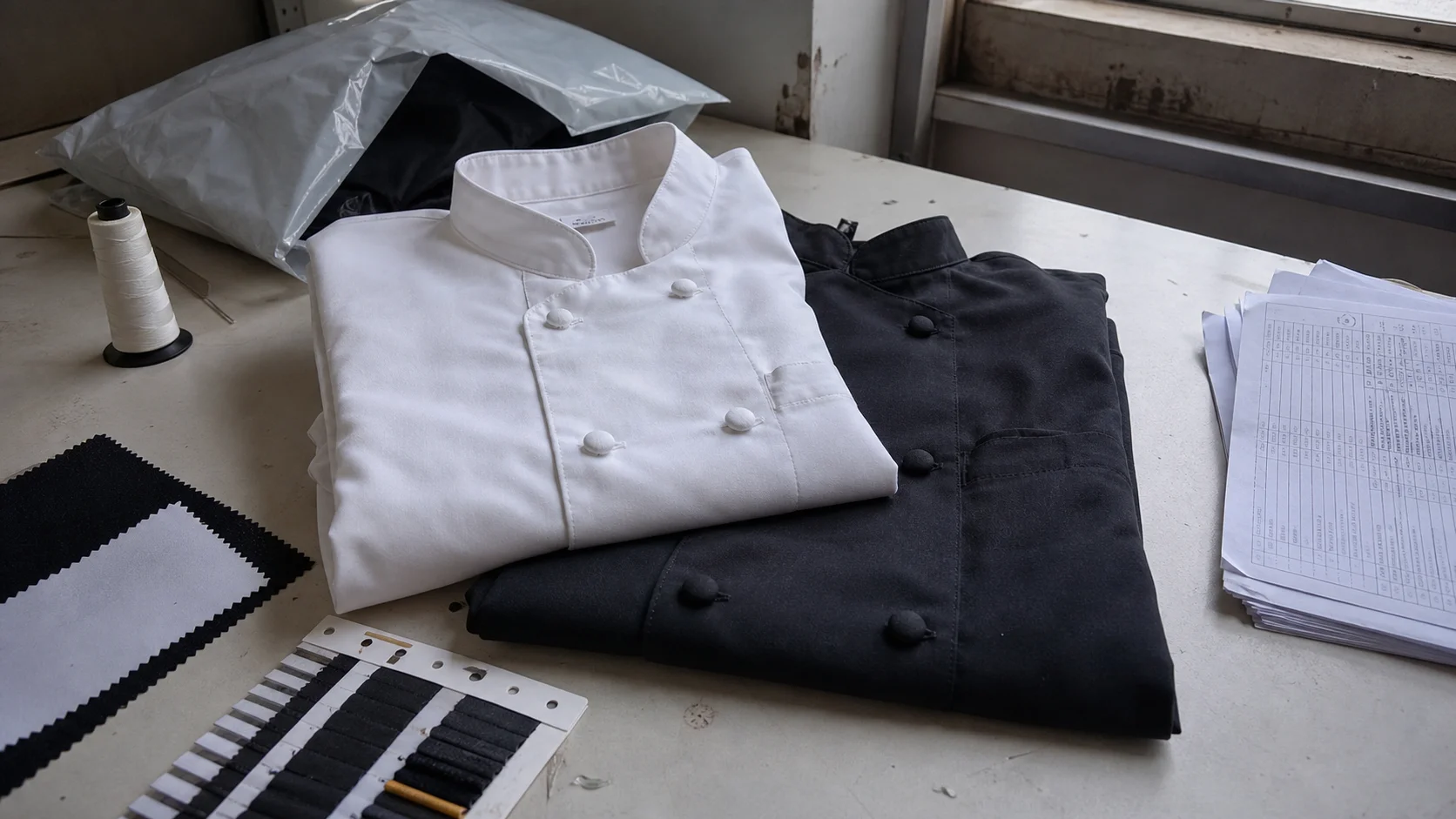
White chef coats need close inspection under suitable lighting because stains, yellowing, and shade differences are easy to miss in dim packing areas. Black or dark coats need lint, crease, and shade banding checks.
Typical apparel measurement tolerances may range from about plus or minus 0.5 cm for small points to plus or minus 1.0–2.0 cm for larger body measurements, depending on the product, size, and buyer standard. The purchase order should define tolerance instead of relying on general practice.
The strongest inspection attention should go to stress areas. Chef coats are opened and closed repeatedly, sleeves are pulled, and pockets are loaded with thermometers, pens, or small tools. Weak pocket corners and loose button areas often fail early.
For younger students, closure safety is more important than styling. Detachable chef buttons can be convenient for washing and replacement, but they must be secure during use. Press studs may be faster for students, but poor-quality snaps can break or become sharp.
Logo errors are usually major defects because they affect the entire uniform program. A school crest placed too low, stitched in the wrong color, or applied to the wrong side may make the goods unusable even if sewing quality is otherwise acceptable.
Finishing defects may look minor at factory level, but they become expensive when school staff must sort and clean garments before issuing them. A low-price order loses value if the buyer inherits factory housekeeping work.
Wash performance is one of the most important checks for outdoor school chef coats. Students may wash garments at home using inconsistent methods. School laundries may use hotter washing, heavier agitation, or stronger detergents. The care label should be realistic, not optimistic.
Packaging is not just cosmetic. Outdoor schools often distribute uniforms quickly before a course starts. Wrong size stickers or mixed cartons can cause more operational trouble than a few minor loose threads.
Defect classification should be agreed before inspection. The examples below are practical classifications, but buyers should adjust them based on age group, safety expectations, and program requirements.
Inspection Area Critical Defect Major Defect Minor Defect Safety Sharp broken snap, metal fragment, hazardous loose component. Loose button on student garment. Slightly rough thread end not contacting skin. Measurement Not usually classified as critical unless safety-related. Out of tolerance affecting fit or wearability. Slight deviation within agreed secondary tolerance. Fabric Contamination that creates safety concern. Visible hole, stain, wrong fabric, unacceptable shade panel. Small slub in hidden area within buyer tolerance. Sewing Construction fault creating wearer hazard. Open seam, broken stitch at stress point, twisted collar. Minor thread end, slight uneven topstitching. Branding Not usually critical unless compliance-related. Wrong logo, wrong position, wrong color, missing label. Slight embroidery thread end that can be trimmed. Packaging Unsafe packaging for children where warning requirements apply. Wrong size sticker, incorrect carton ratio, wet carton. Slight carton scuffing with no product impact.Critical defects should usually trigger immediate hold or rejection because they may create a safety or compliance risk. For outdoor school buyers, critical concerns include broken sharp snaps, metal contamination, mold, chemical odor, or unsafe packaging for children.
Major defects affect appearance, function, durability, fit, or brand acceptability. Examples include missing buttons, wrong measurements, open seams, visible stains, wrong logo placement, and incorrect fabric. Too many major defects mean the shipment should not be accepted without sorting or repair.
Minor defects do not seriously affect use but still indicate workmanship quality. Examples include small thread ends, slight uneven stitching, minor press marks, or small packaging scuffs. A few minor defects are normal in bulk apparel, but a high number can point to weak finishing control.
Outdoor school buyers have extra quality risks compared with indoor kitchen uniform buyers. These risks should be reflected in the AQL checklist.
Outdoor learning programs may move between classrooms, covered kitchens, open-air cooking areas, gardens, and campsites. A chef coat that is too heavy may discourage students from wearing it correctly. A coat that is too light may lack durability or opacity. The buyer should balance comfort and lifespan rather than chase the lowest fabric cost.
Students may wear base layers, T-shirts, or thermal tops underneath chef coats. The fit should allow arm movement and bending without pulling at the chest, shoulder, or armhole. Size set review should include movement checks, not just flat measurements.
Outdoor cooking programs can create soil, smoke odor, grass stains, food stains, and grease marks. The garment must tolerate frequent washing. Buyers should treat wash testing as a practical requirement for repeat programs.
White is traditional for chef coats, but it may not be the best choice for outdoor school use. White shows stains quickly, especially in camp or garden-based programs. Black, navy, charcoal, or checked fabric may hide marks better, though darker colors can feel hotter in direct sun.
Purchasing judgment: if the program is outdoors, student-led, and high-contact, a mid-tone color may reduce replacement complaints. If the program teaches formal culinary standards, white may still be preferred, but fabric stain release and wash performance become more important.
Children and teenagers vary widely in height, shoulder width, and arm length. A generic adult unisex block may not fit younger students well. Buyers should review size curves carefully and consider size buffers for the most common sizes.
Chef coats used in teaching environments still need to support food hygiene behavior. Loose threads, shedding trims, missing buttons, and dirty packaging are not acceptable. AQL inspection should check cleanliness and secure construction as part of the food safety presentation.
MOQ and lead time depend on fabric availability, customization, size range, trim sourcing, and production capacity. Buyers should be cautious with any supplier promising very low MOQ, custom fabric, embroidery, size range, and fast delivery at the same time. One of those variables usually carries a tradeoff.
These are typical sourcing ranges, not fixed rules. Some suppliers may accept lower quantities with surcharges. Others may require higher MOQs for special fabric, unusual colors, or broad size ranges. A higher MOQ can reduce unit cost but increases inventory risk for schools with changing enrollment.
Buyers should keep one approved sample and require the factory to keep one matching sample. This reduces disputes during final inspection. If a sealed sample is not practical, dated photos and signed measurement records are still better than verbal approval.
Lead time can range widely. Stock garment decoration may take around 2–4 weeks after artwork approval. Custom chef coats may take around 6–10 weeks after sample approval. Orders requiring fabric dyeing, lab testing, complex trims, or peak-season capacity may need longer.
Lead-Time Driver Impact on Schedule Buyer Control Point Fabric availability Available fabric shortens lead time; custom dyeing extends it. Approve fabric early and reserve yardage where possible. Logo approval Embroidery sampling can delay production if artwork changes. Finalize logo file, size, thread color, and placement before sampling. Size range Broad size ranges require more cutting and packing control. Confirm size ratio and label system before production. Testing Fabric composition, colorfastness, and wash tests add time. Book testing early and define pass standards. Inspection and rework Failed inspection can delay shipment by days or weeks. Use inline inspection for first orders and high-risk styles.Seasonal school calendars make late delivery painful. Build in time for inspection, possible rework, and re-inspection. If the coats must be issued before a camp or term date, the purchase order should show a latest acceptable delivery date, not just an estimated ship date.
An AQL result should support a commercial decision. Buyers should not treat inspection as a simple pass-or-fail stamp without reading the defect details. The type and location of defects matter.
Passing is reasonable when defect counts are within the agreed AQL limits, no critical defects are found, measurements are stable, and packaging is correct. Minor defects should be documented, but they may not justify shipment delay if the garments are fit for use.
Holding the shipment is sensible when defects are repairable and the supplier can sort goods quickly. Examples include untrimmed threads, minor pressing issues, replaceable buttons, or packaging errors. The buyer should request a corrective action plan, sorting record, and photos before release.
Rejection is appropriate when critical defects are found, major defects exceed the AQL limit, measurements are broadly out of tolerance, fabric is wrong, logo placement is unacceptable, or wash performance fails. Rejection may also be necessary when cartons are wet, contaminated, or mixed so badly that distribution cannot be trusted.
Purchasing judgment: do not accept a failed lot because the school deadline is close unless the defects are clearly non-functional and the buyer has a documented concession. Late delivery is difficult; issuing poor uniforms creates a longer problem.
Sometimes a buyer may accept goods with a known deviation, such as a slight packaging change or a minor measurement issue in a slow-moving size. This should be written as a concession, not treated as normal approval. The concession should state the affected quantity, defect type, commercial adjustment if any, and whether future orders must return to the original standard.
For buyers building a long-term uniform program, supplier transparency matters as much as price. A supplier that reports issues early is usually easier to manage than one that hides defects until final inspection. Buyers who want to discuss production planning or supplier coordination can reach out through fabrikn.com/contact-us/. Company background and sourcing approach can also be reviewed at fabrikn.com/about-us/.
The following template can be added to a chef coat purchase order or inspection booking. It should be adjusted for the buyer’s own quality manual, local requirements, and age group.
Checklist Area Requirement Inspection Method AQL Standard Critical: 0; Major: AQL 2.5; Minor: AQL 4.0, unless otherwise agreed. Final random inspection using agreed sampling plan. Reference Sample Bulk must match approved pre-production sample. Compare garment, fabric, trims, labels, and workmanship. Measurements Must meet approved size chart and tolerance. Measure selected units across sizes and cartons. Fabric Correct composition, color, weight, hand feel, and shade control. Visual check, swatch comparison, and lab test review if required. Trims Correct buttons, snaps, labels, thread, and embroidery backing. Visual check and functional check. Workmanship No open seams, skipped stitches, stains, holes, or major puckering. Garment-by-garment inspection of sampled units. Wash Performance Shrinkage, colorfastness, and appearance after wash within standard. Review test report or conduct wash test on sample units. Packaging Correct folding, polybag, labels, carton marks, and size ratio. Carton inspection and packing list reconciliation.The best chef coat order is not necessarily the cheapest order. For outdoor school buyers, the better target is predictable quality at a cost the program can repeat. A slightly higher unit price may be justified if the fabric is stable, the sizing works, buttons stay attached, and the supplier can meet inspection standards without repeated sorting.
A chef coat AQL inspection checklist should protect the buyer from the most likely field failures: poor fit, weak seams, unstable fabric, insecure closures, incorrect branding, and bad packing. Outdoor school buyers need to think beyond showroom appearance. These garments are used by active learners, washed often, and distributed under fixed school timelines.
Start with a clear specification, approve samples carefully, define AQL levels in the purchase order, inspect at the right stages, and make pass-or-reject decisions based on defect risk rather than pressure alone. That approach gives schools a better chance of receiving chef coats that are practical, durable, and ready for real teaching use.
Get a free quote from Fabrikn — your trusted B2B clothing manufacturer with 10+ years of experience. MOQ as low as 200 pieces.
Get a Free Quote →Many apparel buyers use AQL 2.5 for major defects and AQL 4.0 for minor defects, with zero tolerance for critical defects. First orders, children’s garments, safety-sensitive trims, or high-visibility school programs may justify stricter inspection.
Yes, especially for first orders, new fabrics, white garments, and school laundry use. Wash testing helps confirm shrinkage, color change, seam puckering, button security, and label durability before bulk goods are issued to students.
Common failures include wrong measurements, loose buttons, open seams, visible stains, shade variation, poor embroidery placement, incorrect labels, and mixed size packing. Outdoor school orders also face higher risk from fabric durability and wash performance issues.
Typical MOQs may range from 50–200 pieces for blank stock coats, 100–300 pieces for logo decoration on stock garments, 300–800 pieces for custom styles using available fabric, and 800–1,500+ pieces for custom fabric or special trims. Actual MOQ depends on the supplier and material availability.
Final random inspection should happen when production is complete and at least 80% packed, with all goods available for random carton selection. Inspecting too early can miss packing errors, size shortages, and late-stage finishing defects.
White chef coats support a traditional culinary look, but they show stains quickly in outdoor programs. Mid-tone colors may reduce visible wear. The right choice depends on teaching goals, climate, laundry process, and replacement budget.
The buyer should review defect types, request sorting or rework if defects are repairable, and consider re-inspection before shipment. Critical defects, major measurement problems, wrong fabric, or unacceptable branding errors usually justify rejection or formal concession terms.
Schools can reduce risk by approving fabric and trims early, reviewing a washed pre-production sample, checking a full size set, defining AQL levels in the purchase order, and scheduling inline inspection for first-time or high-risk orders.