
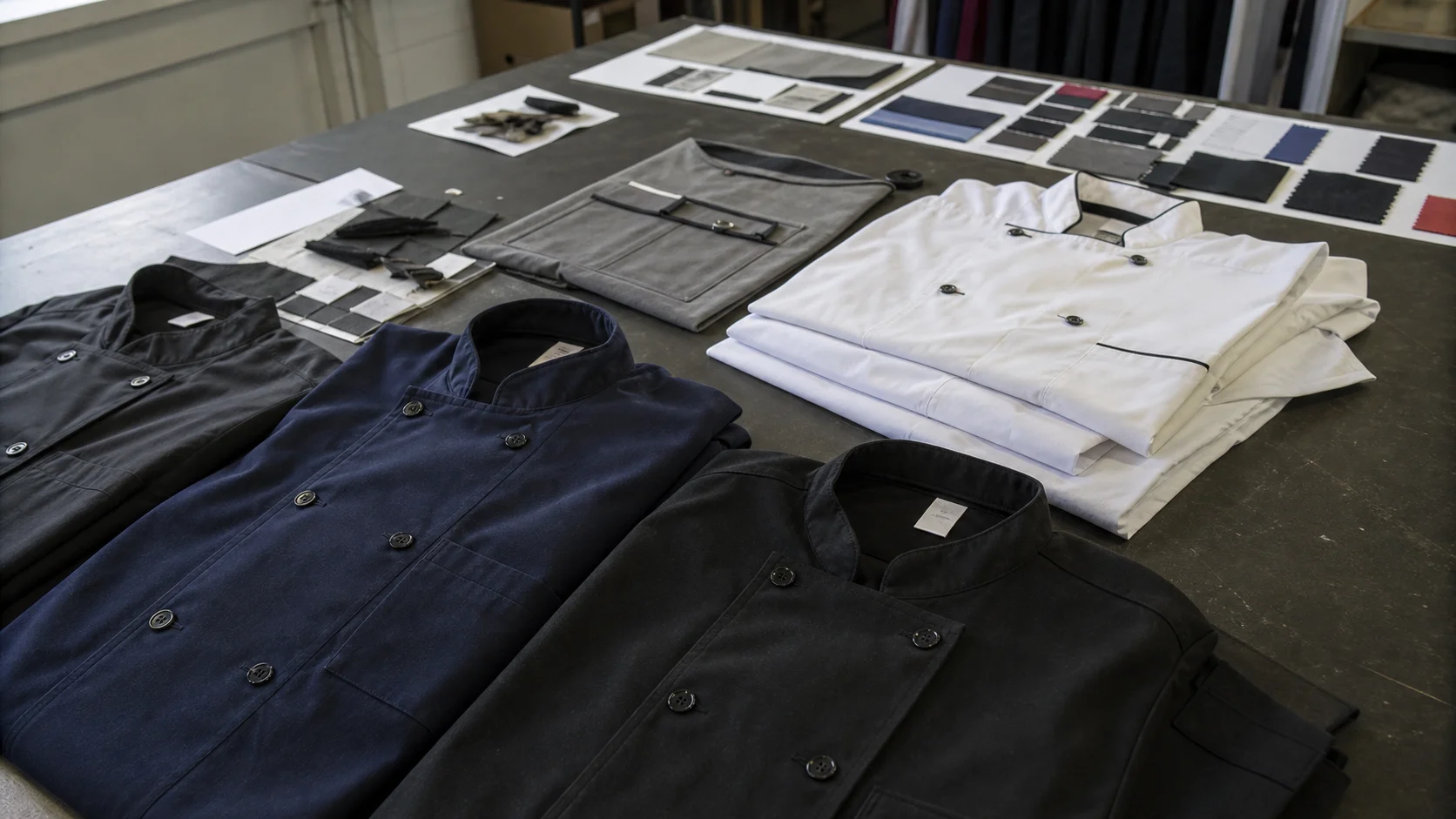
A quality-and-inspection outline for reviewing chef coat fit blocks with the needs of security contractors in mind, covering measurements, mobility,...
Chef Coat Fit Block Review for Buyers - Fabrikn production reference
A chef coat fit block review is not just a pattern check. For buyers sourcing for security contractors, it is the point where garment shape, movement, appearance, and repeatability either hold together or start creating avoidable risk. The fit block is the approved base pattern that production will copy across sizes and future replenishment. If that block is off, the same problem repeats in every order.
For security contractors, the chef coat is usually less about kitchen branding and more about professional presentation, durability, and controlled comfort during long shifts. The garment may be worn in front-of-house, in hospitality support zones, at secured event sites, or in mixed operations where appearance matters as much as function. That makes fit approval more demanding than a basic size chart review.
Buyers should treat the fit block as a production control tool. It should confirm shoulder balance, sleeve mobility, chest ease, waist sweep, collar behavior, cuff finish, and how the coat hangs when worn over a shirt or lightweight base layer. A coat that looks neat on a flat form may still pull across the back, ride up at the front hem, or twist at the sleeves once the wearer starts moving.
A solid fit block review also checks whether the buyer’s use case matches the silhouette. Security contractors often need a slightly cleaner, less oversized profile than traditional kitchen coats. A garment that is too boxy can look untidy under a blazer or outer layer. A garment that is too trim can pinch at the back and forearm, especially when worn with radios, badges, or layered shirts.
Chef coats for security contractors sit in an unusual category. They are not always used in a kitchen, and they are not always used purely as ceremonial uniforms either. Depending on the contract, the garment may need to support frontline hospitality service, access control, temporary command posts, or high-visibility service work where a polished appearance signals order and trust.
That mixed-use environment changes the fit brief. Buyers should not rely on fashion fitting habits. Security staff need room to move, but they also need discipline in appearance. The coat should be structured enough to hold a professional line after hours of wear, yet practical enough to avoid hot spots, cuff drag, and strain at the armhole.
This is where many purchasing teams under-specify the job. They ask for “regular fit” or “classic fit” without clarifying posture, underlayers, or usage duration. A better brief includes wearer height bands, chest ranges, expected movement, and whether the coat will be laundered industrially or by standard commercial laundry. These details affect shrinkage allowance, seam durability, and eventual fit stability.
Buyers should also decide whether the coat is being sourced as a stock garment or a program-specific uniform item. Stock garments offer faster replenishment, but fit may be generic. Program-specific garments require tighter approval but deliver better consistency. For security contractors, consistency is usually worth the extra sample rounds because uniform appearance is part of operational credibility.
Fit cannot be separated from construction. A coat may pass the block review in a sample room and still fail in production if fabric recovery, seam balance, or trim quality changes. Buyers should confirm the garment specification in writing before approving bulk.
Common chef coat fabrics include cotton, polyester-cotton blends, and performance blends with moisture management finishes. For security contractor use, the tradeoff is usually between comfort, ease of care, and image retention. Cotton-rich fabrics feel better and may breathe more naturally, but they can wrinkle more and may shrink if pre-shrink control is weak. Poly-cotton blends generally hold shape better and are easier to manage in commercial laundering.
Typical weight ranges often fall around 180–260 gsm for woven coat fabrics, though the right target depends on climate and use intensity. Lighter fabrics improve breathability, while heavier fabrics can hold a more structured look. Buyers should not chase the heaviest fabric as a default. A heavy coat that traps heat is a poor fit for security teams working long shifts indoors or in warm venues.
Trim quality deserves more attention than it usually gets. Buttons should resist heat and laundering. Interlining, if used, should not cause stiffness at the neck or front panel. Labels should not scratch the wearer. Piping, contrast panels, or embroidery can improve presentation, but they also add failure points if the factory does not control placement and tension.
If the uniform includes branding, buyers should specify the decoration method. Embroidery may be durable, but dense stitching can pull fabric and alter the fit block near the chest or sleeve. Heat transfer can be faster and cleaner for small runs, though it may not wear as well under repeated washing. Screen print is less common on chef coats but can work on certain program garments if the design is simple.
Sample approval should follow a sequence, not a single yes-or-no review. A disciplined process reduces the chance of costly rework in bulk. For a chef coat fit block review, the minimum path should include a proto sample, a fit sample, a size set or graded sample if the order is large enough, and a pre-production sample before bulk release.
The proto sample confirms the concept and basic silhouette. The fit sample tests pattern balance on the intended wear profile. The size set checks grading across the size range, which matters if the security contractor workforce spans a wide spread of body types. The pre-production sample confirms that final fabric, trims, labels, and decoration match the approved specification.
Buyers should ask for written measurement tables with tolerance bands. A tolerance of around +/- 0.5 cm to 1.0 cm at key points is common in many garment programs, though the exact band should be set by the product type and factory capability. Chest, shoulder, sleeve length, and body length deserve the closest control. Once those drift, fit inconsistency becomes visible even to non-technical wearers.
A common mistake is approving a sample because the garment “looks right” while ignoring measurable fit problems. Buyers should not rely only on visual approval. A coat may appear elegant on a hanger and still show excessive front drag or back strain on a wearer. The factory needs precise comments, not general praise.
For larger programs, buyers should keep one sealed reference sample as the master approved block. This helps when production questions arise later. If the factory changes a pattern, a pocket location, or a sleeve angle, the approved master sample becomes the reference point for dispute resolution.
MOQ for chef coats varies widely by factory, fabric availability, and decoration complexity. For custom programs, a common starting range may be 300 to 1,000 pieces per style or color, while smaller cut-and-sew suppliers may accept lower volumes at a higher unit cost. Buyers should expect tighter pricing only when size breakdowns, fabric minimums, and trim sourcing align cleanly.
Lead time usually depends on sample approvals, fabric booking, print or embroidery setup, and production capacity. A simple repeat order may move in 30 to 45 days after approval if materials are in hand. A fully custom program can take 45 to 75 days or longer, especially when the fabric must be milled to order or the garment includes special trims, lining, or logo work.
Do not ignore the lead-time impact of sample iteration. One extra fit round may be the difference between a clean launch and a delayed uniform rollout. If the contractor has a fixed opening date or security deployment schedule, the buyer should protect calendar time for approvals rather than assume everything will pass on first submission.
Decision Area Lower Risk Option Tradeoff Fabric Poly-cotton blend Better shape retention, less natural hand feel Fit Moderate ease with graded size set More sample work, better wearer acceptance Decoration Small embroidery or woven label Cleaner production, less visual flexibility MOQ Higher volume per style Better pricing, less SKU flexibilityBuyers should weigh cost against replacement risk. A cheaper coat with poor fit control may lead to returns, replacement shipments, and inconsistent appearance across teams. A slightly higher unit price can be justified if it reduces field complaints and keeps the contractor’s staff presentable across the contract term.
Inspection for this category should cover more than sewing defects. The most common risk is variation across size lots. One lot may fit well, while another lot shifts in chest width, sleeve pitch, or body length because the factory changed a pattern marker, a fabric roll, or a trim supplier.
Another recurring issue is seam distortion after washing. If the fabric shrinks more than expected, the coat may pull at the shoulders or shorten at the hem. If the collar construction is too rigid, it can twist after laundering and make the garment look cheap even when construction is otherwise acceptable.
Buyers should request an inspection plan that includes visual, measurement, and workmanship checks. Inline inspection is useful if the order is large enough to justify it. Final inspection should verify size distribution, label accuracy, packing count, and carton markings. If the garments are exported, packaging also needs to hold shape during transit.
Inspection risk rises when the buyer approves too many variables at once. Fabric shade, logo method, contrast details, and fit changes should not all be changing in the same development round unless there is enough time for controlled testing. The cleanest programs isolate the fit block first, then lock decoration, then move to bulk approval.
If you are working with a new supplier, ask how they manage pattern control and re-order consistency. A factory that can produce one strong sample is not automatically strong at repeat production. What matters is whether they can reproduce the same block across multiple lots without losing balance or shrinking the approved ease.
The practical buying decision is simple: prioritize repeatable fit, wash stability, and presentable structure over cosmetic detail. Security contractors need uniforms that support authority and reliability. If the coat is comfortable, durable, and consistent, it will perform better than a more elaborate garment that is hard to maintain.
Buyers should also be realistic about expected wear life. A coat used in a security contract may be worn frequently and laundered often. That means fabric recovery, seam durability, and trim integrity matter more than novelty. A stylish block that weakens after a few washes is a poor procurement choice.
For program managers, the best review questions are operational ones. Does the coat maintain a clean line on different body types? Does it allow staff to move without looking sloppy? Can the factory repeat the same measurements on the next order? These questions protect both image and budget.
When a chef coat is being sourced for security contractors, the fit block is not an academic detail. It is the control point that determines whether the uniform looks disciplined in the field or turns into a constant replacement problem.
Supplier selection should be based on pattern control, sample discipline, and production transparency. A capable factory should be able to explain how its base block is developed, how approvals are recorded, and how future orders are matched back to the approved reference. If the answers are vague, the buyer should expect inconsistent results.
For sourcing support, buyers often start by reviewing the supplier’s services, capability notes, and contact process. Fabrikn’s service overview is a useful place to begin if you are mapping a custom uniform program: /services/. When a program needs design clarification, sampling coordination, or a pricing discussion, the direct route is usually faster than waiting for assumptions to resolve themselves. Use the contact page here: /contact-us/.
It also helps to understand the supplier’s company position and manufacturing approach before you issue a full brief. Background on the team and capabilities is available at /about-us/. That kind of review does not replace a sample audit, but it does help buyers decide whether the supplier is likely to handle a structured fit-block program without unnecessary churn.
Buyers should issue a clear tech pack, request a measurement sheet, define acceptable tolerances, and insist on pre-production confirmation. That keeps the factory accountable and gives the buyer a stronger basis for final inspection. A supplier that welcomes precision is usually easier to work with than one that treats every clarification as a change order.
Get a free quote from Fabrikn — your trusted B2B clothing manufacturer with 10+ years of experience. MOQ as low as 200 pieces.
Get a Free Quote →It is a structured review of the base pattern, measurements, and wear behavior of a chef coat before bulk production. The goal is to confirm that the garment fits correctly, moves well, and can be repeated across sizes.
Security contractors often need a uniform that looks sharp, stays comfortable during long shifts, and works over layered clothing. A poor fit can make staff look untidy and can reduce wearer acceptance.
Many factories start custom orders around 300 to 1,000 pieces per style or color, though this depends on fabric, decoration, and factory capacity. Smaller runs are possible, but unit cost is usually higher.
A practical program often uses a proto sample, a fit sample, a size set if needed, and a pre-production sample. Larger or more complex orders may need extra rounds if the pattern or fabric changes.
Poly-cotton blends are often the safest choice because they balance comfort, durability, and shape retention. Cotton-rich options can feel softer, but they may require tighter control for shrinkage and wrinkling.
Check measurements, seam quality, button strength, label placement, color consistency, and wash stability. The approved sample should match the tech pack and the production garment should match the approved sample closely.
Use a detailed tech pack, define tolerances, approve samples in stages, and keep a sealed master sample. A clear inspection plan and written approval trail also reduce disputes later.