
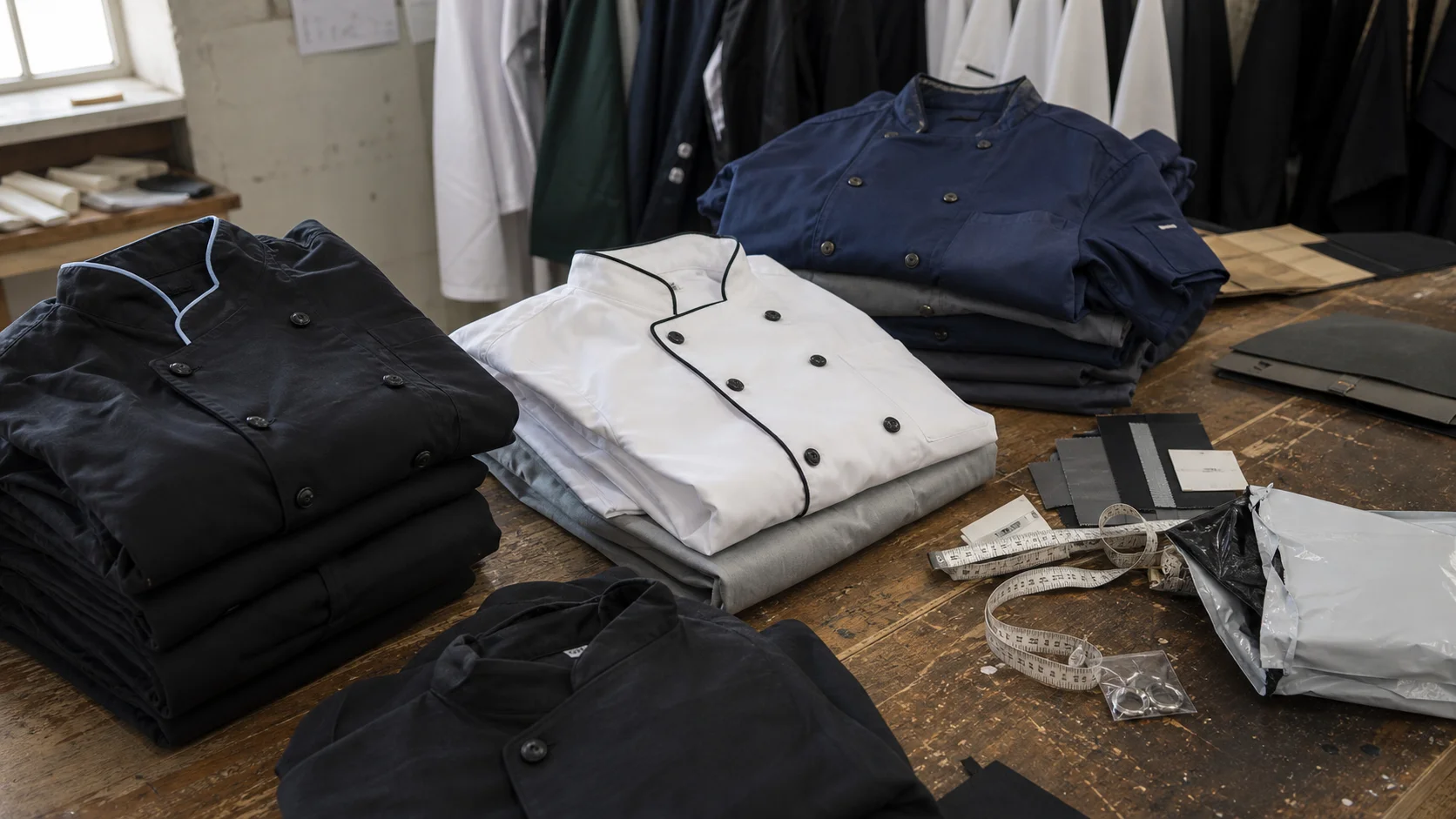
A quality and inspection-focused outline for outdoor school buyers evaluating chef coat MOQ pricing, construction standards, sample reviews, and production...
Chef Coat MOQ Pricing Review for School Buyers - Quality & Inspection manufacturing guide
Chef coats for outdoor school programs are not the same purchase as standard restaurant uniforms. A school buyer is usually balancing student sizing, safety rules, budget cycles, repeated washing, seasonal outdoor use, and a hard deadline tied to class start dates. The lowest unit price can look attractive on a quotation, but it may hide weak fabric, unstable sizing, poor seam strength, long sampling delays, or a minimum order quantity that creates excess inventory.
This chef coat MOQ pricing review is written for school procurement teams, outdoor education coordinators, culinary program buyers, and distributors serving school accounts. The focus is practical: what quantity levels usually affect pricing, which fabric and trim specifications matter, how to review samples, and what inspection risks should be checked before shipment.
For B2B apparel sourcing support, buyers can also review Fabrikn’s manufacturing service scope at fabrikn.com/services/, learn more about the company background at fabrikn.com/about-us/, or discuss a chef coat project through fabrikn.com/contact-us/.
The correct MOQ is not always the lowest MOQ. For school chef coats, the better target is the quantity that secures stable fabric, consistent sizing, acceptable decoration quality, and a delivery date that fits the academic calendar.
Outdoor school buyers often purchase chef coats for cooking classes, food service training, field kitchens, hospitality clubs, camps, outdoor learning programs, or student culinary events. These garments may be used indoors and outdoors, sometimes in humid weather, cold mornings, dusty environments, or near grills and portable cooking stations. That use case changes the buying standard.
A basic chef coat can be acceptable for a controlled kitchen demonstration. It may fail quickly when students kneel, carry equipment, work around wood smoke, or wash garments frequently in school laundry cycles. Student users also create a wider size curve than adult staff uniforms. A single purchase order may need youth, unisex, and adult sizes. That has a direct effect on MOQ and pricing.
School programs also have approval layers. A sourcing buyer may need input from instructors, finance teams, health and safety officers, and sometimes parent or district stakeholders. This slows down decisions. If the supplier’s sample approval process is not planned early, bulk production may start late, leaving no time to fix defects.
The main purchasing question is simple: can the chef coat survive school use at a price that fits the program budget? The answer depends less on marketing descriptions and more on the actual specification sheet, sample quality, and inspection plan.
MOQ, or minimum order quantity, is the lowest quantity a supplier is willing to produce under a certain specification. For chef coats, MOQ can be set by the garment factory, fabric mill, dyeing facility, button or snap supplier, embroidery unit, packaging supplier, or printing vendor. The quoted MOQ may not reflect only cutting and sewing capacity.
Typical MOQ ranges vary by supplier setup and customization level. School buyers should treat these as working ranges, not fixed rules:
A low MOQ does not automatically mean a better deal. It can mean the supplier is using available fabric, mixed trim lots, or less controlled production scheduling. That may be acceptable for a short event, but it is risky for a repeat school program that needs consistent reorders.
Buyers should ask whether the MOQ applies to the total order, per color, per size, per fabric, or per logo design. A quote for 300 pieces may sound manageable until it becomes 300 pieces per color or 300 pieces per size group. For school chef coats, the size curve can make or break the order economics.
Chef coat pricing is shaped by more than order quantity. A proper review separates garment cost into fabric, trims, labor, decoration, packaging, testing, inspection, logistics, and supplier margin. A school buyer does not need to audit every cost line in detail, but the quotation should be transparent enough to explain major price differences.
Fabric is usually the biggest material cost. A lightweight polyester-cotton blend may be cheaper and easier to dry, while a heavier cotton-rich twill can feel more premium but may shrink more and take longer to dry. For outdoor school buyers, the decision should consider comfort, wash durability, opacity, and weather conditions.
Common chef coat fabrics include:
Traditional cloth knot buttons give a classic culinary look but can be slower for students to fasten. Plastic buttons are economical but can crack under heat or rough handling. Metal snaps are practical for quick removal, though they add cost and must be checked for secure attachment and corrosion resistance.
For school use, snap strength and button pull strength are not minor details. Missing fasteners create safety and appearance problems. If the coat is used near outdoor cooking stations, easy removal may be valuable.
Embroidery is durable and common for school logos, culinary departments, or outdoor education branding. Small chest embroidery usually has a manageable cost, but larger logos, multiple thread colors, metallic thread, or sleeve embroidery increase price and sampling time. Heat transfer can be cheaper for larger graphics, but wash durability and heat resistance need careful checking.
Buyers should ask for decoration charges separately. A quotation that hides logo cost inside the unit price can make comparison difficult. Set-up fees, digitizing fees, thread color matching, and repeat-order costs should be confirmed before approval.
School orders often need a complicated size breakdown. A supplier may quote one price for adult XS to XL, then add surcharges for 2XL, 3XL, tall sizes, or youth sizes requiring separate patterns. Outdoor school buyers should not assume one pattern covers every student safely.
A poor size curve causes two expensive problems: unused inventory in slow sizes and shortages in high-demand sizes. Before confirming MOQ, review enrollment data, past uniform demand, and whether the chef coat is worn over base layers in colder outdoor settings.
Outdoor use changes the fabric discussion. In a warm climate, breathability matters. In a cool or wet setting, drying speed and layering comfort may be more important. The chef coat should also remain professional after repeated laundering.
For most school buyers, a midweight polyester-cotton twill is the safest starting point. A common working range is around 160 to 220 gsm, depending on the exact weave and composition. Lighter fabrics reduce cost and improve comfort in heat, but can appear transparent in white and may wear faster at stress points. Heavier fabrics look structured and durable, yet they can feel hot during active outdoor cooking sessions.
Color also affects purchasing. White is traditional and widely available, which usually helps MOQ and price. Black hides stains but may feel warmer outdoors. Navy, grey, or custom school colors can be useful for identity, though fabric availability and dye-lot control become more important. Custom-dyed colors may require higher fabric MOQ and longer lead time.
Water-repellent finishes can sound appealing for outdoor programs, but they add cost and may reduce breathability. Some finishes also weaken after laundering. If the coat is mainly for cooking instruction rather than rain exposure, a durable easy-care finish may provide better value than a water-repellent finish.
Chef coats for school use are handled roughly. Students pull sleeves, stuff coats into bags, wash them inconsistently, and may wear them over hoodies or thermal layers. Construction quality should be reviewed before the purchase order is approved.
Important construction points include seam type, stitch density, reinforcement, pocket placement, cuff shape, collar structure, and closure strength. A cheaper coat may reduce cost by lowering stitch density, using narrow seam allowance, skipping reinforcement, or selecting thinner interlining. Those choices may not show clearly in a photo, but they appear after several wash cycles.
For student chef coats, relaxed fit is usually safer than a narrow fashion fit. Tight garments restrict movement and increase returns. Oversized garments can create snagging risks near equipment. The specification should define fit clearly rather than relying on generic size labels.
Sampling is where school buyers prevent most production problems. A chef coat sample should not be treated as a formality. It is the buyer’s chance to confirm fabric hand feel, fit, construction, logo placement, wash behavior, and packaging presentation.
A practical sample process often includes these stages:
For a simple stock-style chef coat, buyers may compress the process. For a custom outdoor school coat with logo embroidery, special fabric, broad sizing, or district-level distribution, skipping the pre-production sample is a poor tradeoff.
School chef coats should be washed before final approval. A single wash is not enough for a durability claim, but it can reveal obvious shrinkage, puckering, twisting, color bleeding, logo distortion, and snap issues. A practical review may include three to five wash cycles using the intended school laundry method.
Measure the garment before and after washing. Check body length, chest width, sleeve length, collar shape, and embroidery appearance. If the supplier states a shrinkage tolerance, it should be written into the specification and inspection checklist.
Lead time is one of the biggest risks for school buyers. Academic calendars are fixed, and a late uniform order can disrupt classes or events. Suppliers may quote a standard lead time, but the real timeline depends on fabric availability, sample approval speed, decoration complexity, production queue, inspection booking, and shipping method.
Typical timing ranges for chef coat orders may look like this:
Buyers should avoid confirming a delivery date before the supplier confirms which milestone starts the clock. Some quotes define lead time from deposit payment. Others define it from final sample approval, fabric arrival, or logo artwork approval. This difference can create a serious planning gap.
For programs starting in late summer or early fall, sourcing should begin well before the academic year. Sampling, logo approval, budget sign-off, and size collection can take longer than production. A rushed order often forces buyers into higher freight costs, weaker sample review, or reduced inspection time.
If the program has uncertain enrollment, consider splitting the order. A first bulk order can cover known demand, while a smaller replenishment order can fill late sizes. The tradeoff is higher unit cost on the replenishment order. It may still be cheaper than overbuying unpopular sizes.
Chef coat quality problems are often preventable if the buyer defines inspection criteria early. A school buyer does not need a complicated technical manual, but the supplier and inspector should know what is acceptable and what is not.
Common inspection risks include incorrect measurements, uneven logo placement, shade variation, loose threads, weak buttons or snaps, skipped stitches, open seams, stains, fabric defects, packaging mistakes, and wrong size ratios. These issues matter more for school distribution because uniforms may be handed out in bulk before anyone has time to check every garment.
Measurement tolerance should be written clearly. A common tolerance may be around 1 cm to 2 cm for key points, depending on garment size and buyer standard. Critical points include chest width, body length, shoulder width, sleeve length, cuff opening, and collar size. Larger tolerance may be acceptable for low-cost event garments, but school chef coats need enough consistency that students can select sizes predictably.
Logo placement should be measured from fixed points, such as center front, shoulder seam, or pocket edge. “Left chest logo” is not precise enough. Embroidery defects can include thread loops, poor density, backing show-through, puckering, wrong color, crooked placement, or inconsistent size. Heat transfers can crack, peel, scorch the fabric, or shift during application.
White chef coats should be checked for yellowing, stains, and transparency. Dark colors should be checked for rubbing and shade variation. If production uses multiple fabric rolls, shade bands may appear across sizes or production lots. Buyers should ask the supplier how shade lots are controlled and whether all sizes will be cut from the same approved fabric batch when possible.
Schools often need easy distribution. Individual polybags with size stickers can save time, but they add cost and packaging waste. Bulk packing reduces cost but increases sorting labor. Carton marks should be clear, especially for multi-size orders shipped to schools, campuses, or district warehouses.
AQL inspection is common in apparel, but the chosen level should match the risk. For school chef coats, an inspection plan should include workmanship, measurements, labeling, logo placement, packaging, quantity, and carton condition. If safety or compliance testing is required by the buyer’s market, that must be handled before shipment rather than after goods arrive.
School buyers should spend money where it reduces repeat problems: fabric durability, size consistency, secure closures, logo quality, and inspection. These areas affect daily use and student satisfaction. Saving a small amount on weak fabric or poor stitching can create replacement costs that exceed the original discount.
Cost can be reduced more safely in areas that do not affect performance. For example, a simple label may be enough instead of a complex woven private label. Standard white or black fabric may be more practical than a custom school color if the order quantity is low. Bulk packing may work if the school has staff time to sort sizes. A standard unisex fit may be acceptable if the program does not need a tailored appearance.
Outdoor school buyers should be careful with over-specification. A chef coat does not need every premium feature to perform well. Heavy fabric, custom color, reinforced panels, multiple logos, specialty trims, and individual packaging can push the order into a higher MOQ and longer lead time. Each added feature should have a clear reason.
A strong purchasing decision is not always the cheapest quote. It is the quote that matches the school’s actual use, protects the delivery date, and gives the buyer enough control over quality before goods ship.
Before requesting final quotations, school buyers should prepare a clear specification. This keeps suppliers from quoting different assumptions and makes price comparison more reliable.
Suppliers should quote against the same checklist. If one supplier offers a much lower price, check whether fabric weight, trim quality, logo method, packaging, or inspection support has been reduced. A vague quote is difficult to enforce later.
A quotation should show more than a unit price. At minimum, school buyers should ask for MOQ, size ratio assumptions, sample cost, sample lead time, bulk lead time, logo setup cost, packaging details, payment terms, shipping terms, and validity period. If the order may repeat, ask about reorder MOQ and whether the same fabric can be maintained.
Price breaks are useful, especially for uncertain school demand. Ask for pricing at several quantity levels, such as 100, 300, 500, and 1,000 pieces. This shows where the cost curve changes. Sometimes the difference between 280 pieces and 300 pieces is meaningful because it allows more efficient fabric purchasing or production planning. In other cases, the price break is small and does not justify buying extra inventory.
For school budgets, landed cost matters more than garment cost alone. Freight, duties, local delivery, inspection, testing, and replacement allowance should be included in the purchasing review. A low ex-factory price can become expensive if the order ships late by air or requires rework after arrival.
Inspection should be planned before production starts. The buyer, supplier, and inspector should all work from the same approved sample and specification sheet. Inspection after goods are packed is helpful, but inline checks during production can catch issues earlier for larger orders.
Final inspection should not be the first time the buyer discovers a measurement issue. Once the entire order is cut and sewn, correction options are limited. For customized school chef coats, earlier control is usually worth the added coordination.
Budget planning should start with expected usage. A chef coat used once per semester does not need the same specification as a coat used weekly in an outdoor culinary course. The buyer should estimate how many wash cycles the garment must survive and whether students keep the coat, borrow it, or return it to the school.
If coats are loaned and reused, durability becomes more important. The school may need stronger fabric, better labels, and easier size identification. If students purchase their own coats, price sensitivity may be higher, and the buyer may need a more basic specification. If coats are used for public events or competitions, appearance and logo consistency matter more.
A practical budget should include extra units for late enrollments, damaged garments, sample retention, and size exchange. Many school programs benefit from a small overage in common sizes. Overbuying every size is wasteful, especially in extremes such as very small or very large sizes unless past data supports demand.
Chef coat MOQ pricing for outdoor school buyers should be reviewed through a quality and inspection lens, not only a purchasing lens. The best order quantity is the one that supports the required fabric, size range, logo quality, delivery schedule, and inspection standard without creating excessive inventory.
For small programs, stock chef coats with controlled embroidery may offer the best balance. For recurring programs, custom specifications at 300 to 500 pieces can improve fit, durability, and brand consistency. For district-level or distributor programs, larger MOQs may justify custom fabric, private labeling, and stronger price negotiation.
The most important buyer discipline is to define the garment before comparing prices. Fabric weight, size grading, trims, decoration, packaging, sample approval, and inspection criteria should be clear. Once those details are fixed, MOQ pricing becomes easier to judge and easier to negotiate.
School buyers preparing a chef coat order can compare manufacturing options through Fabrikn’s services page or send project details through the contact page for a more specific review.
Get a free quote from Fabrikn — your trusted B2B clothing manufacturer with 10+ years of experience. MOQ as low as 200 pieces.
Get a Free Quote →A typical MOQ may start around 50 to 100 pieces for stock chef coats and around 300 to 500 pieces for customized chef coats. Custom fabric, custom color, broad size ranges, and private labeling can push MOQ higher.
Logo decoration adds setup work, sampling, machine time, thread or transfer materials, and placement control. Some suppliers can decorate low quantities, but the unit cost is usually higher. Embroidery digitizing and approval samples should be included in the timeline.
A midweight polyester-cotton twill is often the most practical option because it balances durability, cost, wash care, and comfort. Hot climates may need lighter fabric, while rough outdoor programs may need stronger woven fabric or reinforced construction.
Snaps are practical for quick opening and may suit student use, but they must be tested for attachment strength. Traditional buttons or knot buttons give a classic chef look, though they can be slower to use and may require more replacement checks.
A custom chef coat order using available fabric may take about 5 to 8 weeks after pre-production sample approval. Custom fabric color, special finishes, testing, or large size curves can extend the timeline to 8 to 12 weeks or more.
Inspection should check measurements, workmanship, seam strength, fabric defects, shade consistency, logo placement, decoration quality, labels, packaging, quantity, and carton marks. The approved sample and specification sheet should be used as the inspection benchmark.
Not usually. A very low quote may use lighter fabric, weaker trims, loose tolerances, basic packaging, or limited inspection support. School buyers should compare total landed cost and expected durability, not only the quoted garment price.
Schools can reduce cost by using standard fabric colors, limiting logo complexity, choosing practical packaging, planning size ratios carefully, and ordering at a quantity level that gives a real price break. Cutting fabric quality or skipping sample approval is usually a poor saving.